

You've adjusted the foam gun, added more shampoo, and opened the spigot fully, yet the spray still looks like diluted milk. The foam runs off the panel instead of clinging to it, and the first instinct is usually to blame the soap or the cannon. In many cases, the missing measurement is water flow rate, the amount of water reaching the tool over time.
Flow rate affects how a foam gun draws concentrate, mixes it with water, and delivers the finished solution. Too little flow can produce weak or inconsistent pickup. Too much can create a thin mixture, shorten dwell time, and waste water. A simple bucket test can tell you more than a guess based on how forceful the hose feels.
Why Your Foam Gun Feels Watery and What Flow Rate Has to Do With It
You squeeze the trigger, expect a thick blanket, and get a runny spray that slides off the paint. Turning the adjustment knob may change the texture slightly, but it won't correct a supply problem if the gun isn't receiving a stable volume of water.
A foam gun uses incoming water to create the movement that pulls shampoo through its dilution circuit. If the supply is too weak, the siphon may draw concentrate unevenly. The spray can pulse, lose suction, or look thin because the water and shampoo aren't mixing consistently. A restricted inlet screen, kinked hose, or undersized fitting can create the same symptom.
High flow isn't automatically better. A large volume of water can move through the mixing chamber faster than the tool can meter concentrate, producing a wet, loose layer. It can also rinse the product away quickly, reducing the time the shampoo remains on the panel. The practical target is stable, appropriate flow, not the maximum output your spigot can provide.
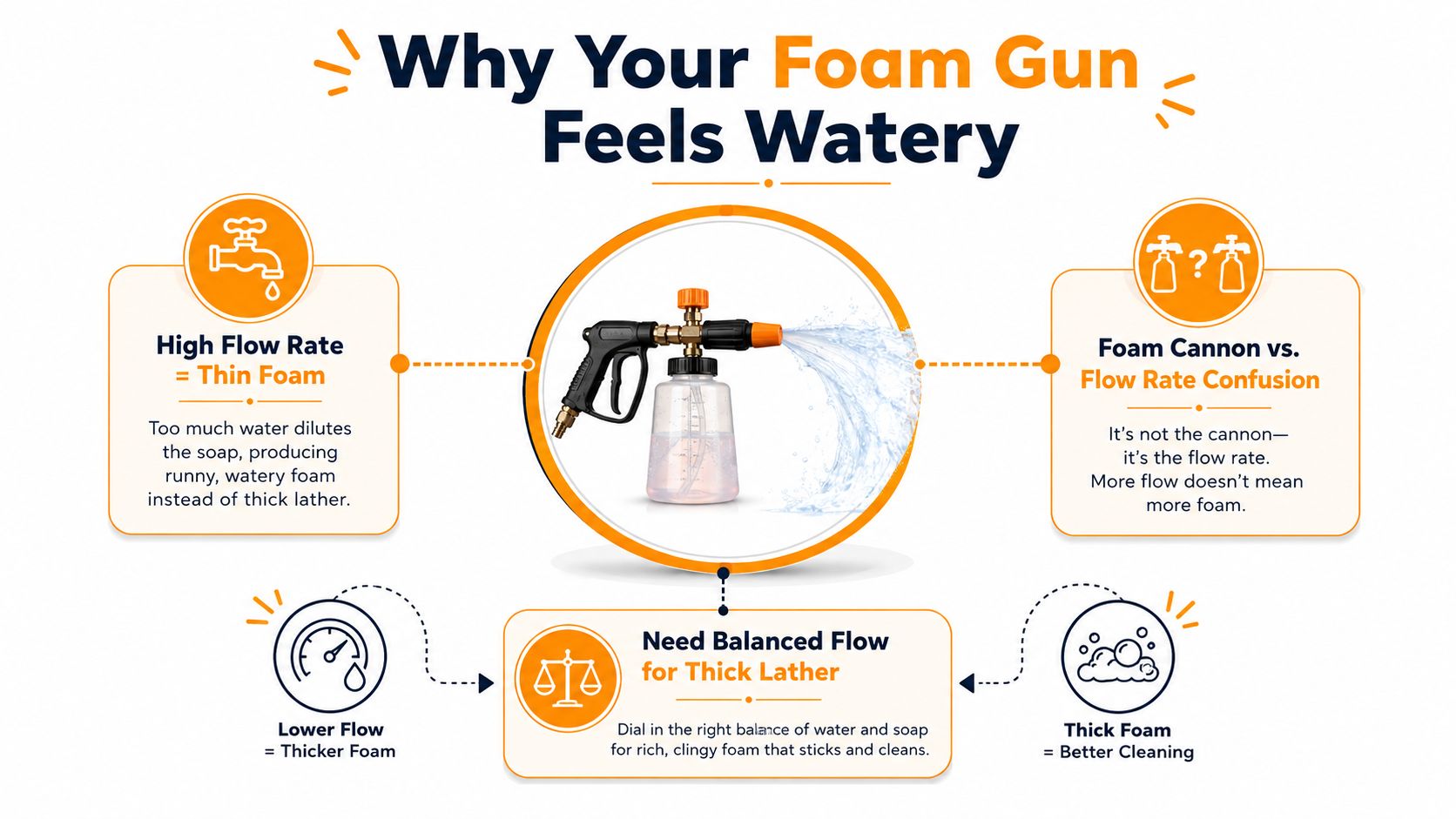
Start with a measurement
Before replacing the foam gun, test the hose at the point where you'll wash. Use a bucket and stopwatch, then repeat the test with the same hose, fittings, and trigger setup you normally use. The result gives you a working baseline instead of a generic hose specification.
Workshop rule: Match the foam gun to a repeatable flow rate, then adjust dilution and technique. Chasing maximum output often makes foam wetter, not richer.
Hose diameter, hose length, household pressure, quick-connects, inlet screens, and nozzle restrictions can all change the volume arriving at the tool. Once you know that volume, you can diagnose whether the problem comes from supply, mixing, or the foam gun itself.
What Water Flow Rate Actually Means
Water flow rate is the volume of water passing a point during a set period. It isn't the same as pressure. Pressure is the force pushing water through the plumbing, while flow rate tells you how much water reaches the outlet.
A bucket makes the distinction easy. Two hoses can feel similarly forceful at the end, yet one may deliver a wider stream and fill the bucket sooner. A narrow jet can look powerful because the water leaves through a smaller opening, but appearance alone doesn't tell you the total volume delivered.
The common unit is gallons per minute, or GPM. You may also see liters per minute, abbreviated L/min. One US gallon equals 3.785 liters, so a GPM reading can be converted by multiplying by 3.785. The basic calculation is simple:
Flow rate = collected volume ÷ collection time
If you collect a known volume and measure the time in minutes, the result is GPM. For a more technical setup, an inline meter measures the water moving through the hose while you work, but a bucket test is usually enough to establish a useful household baseline.
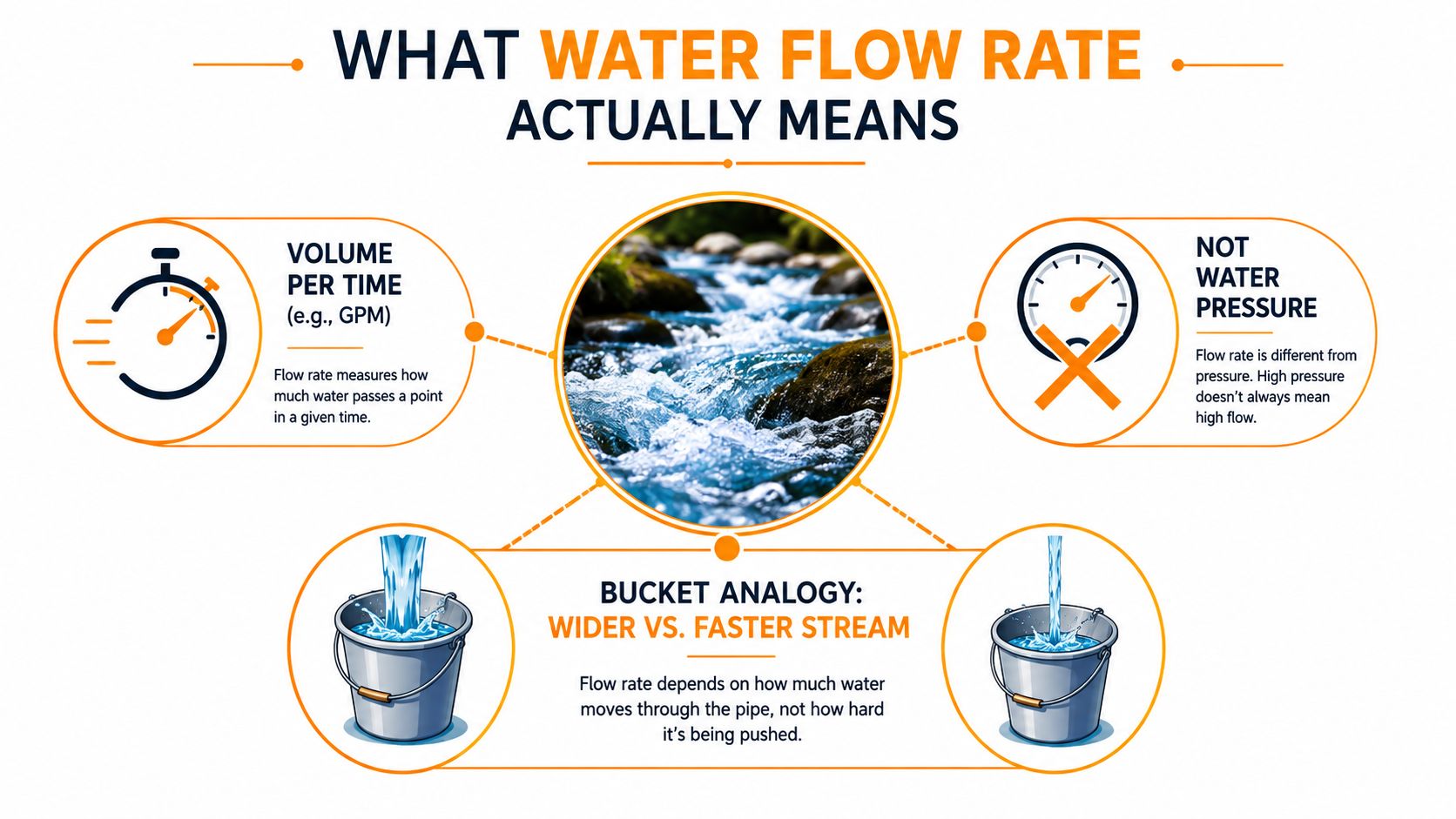
Pressure is only part of the picture
Pressure can increase flow when the supply has enough capacity, but restrictions consume available pressure before water reaches the foam gun. A partially closed valve, clogged filter, bent hose, or restrictive adapter can make the system feel pressurized while the actual output remains low.
Household fixtures also draw from the same plumbing. If another tap, shower, washing machine, or irrigation line is running, the outdoor spigot may deliver a different result than it does by itself. That's why measuring at the working hose is more useful than relying on a pump label or a subjective impression of spray strength.
The Four Variables That Change Your Hose Output
A hose doesn't have one universal output rating. Its result depends on the complete path from the water supply to the foam gun. Independent hose-flow guidance notes that a standard 5/8-inch hose can range from roughly 9 to 17 GPM at household pressures, depending on the conditions and configuration described in the garden hose flow-rate guide.
| Variable | What changes | Typical effect |
|---|---|---|
| Internal diameter | The open area inside the hose | A larger diameter generally reduces friction and supports greater flow |
| Hose length | The distance water must travel | Longer runs create more resistance and can reduce output |
| Available pressure | The force available at the inlet | More usable pressure can increase flow, provided the supply and fittings aren't restrictive |
| Restrictions and fittings | Kinks, valves, screens, adapters, and connectors | Each restriction can reduce the volume reaching the tool |
Internal diameter matters because water loses energy as it rubs against the hose wall and moves through the system. A wider internal path usually lets the same supply move more water with less friction. That doesn't mean every larger hose will solve a weak-flow problem, because the household supply may be the limiting factor.
Length adds resistance. A long run from the spigot to the driveway gives friction more hose surface to act against. Lay the hose straight before testing it, and don't coil it tightly beside the vehicle.
Pressure supports flow, but the two terms shouldn't be swapped. A pressure reading at the supply doesn't prove that the foam gun receives sufficient volume. Quick-connects, adapters, shutoff valves, and the gun's inlet port can introduce sudden changes in geometry and pressure loss.
If your setup uses reinforced tubing, review the construction and connection considerations in this guide to reinforced hose selection.
Diagnose the complete path
Start at the spigot and work toward the gun. Open the valve fully, remove unnecessary adapters, straighten the hose, inspect screens, and confirm that every connector matches the intended hose size. Then measure flow at the working end, not only at the faucet.
How to Measure Your Household Water Flow Rate
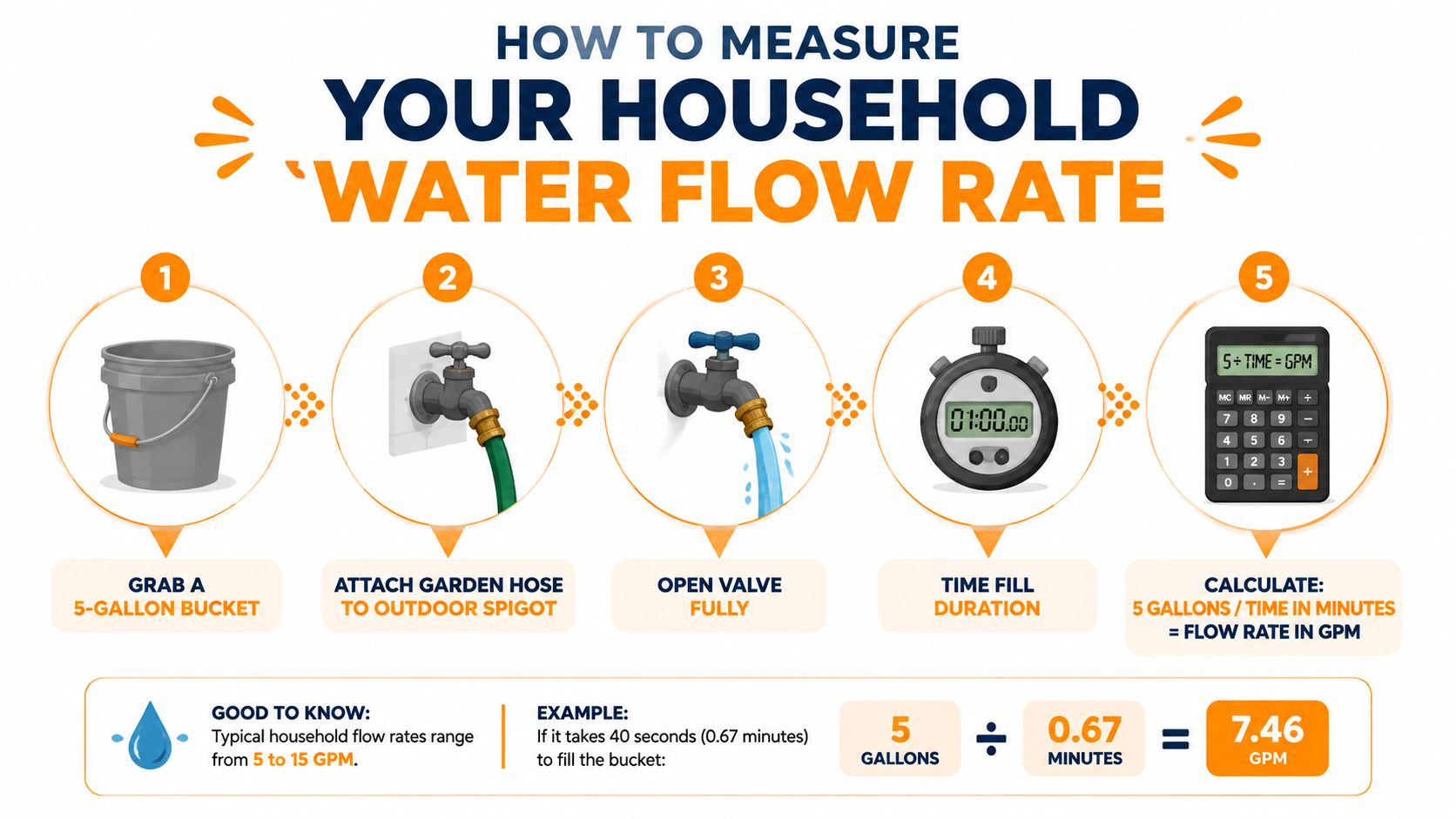
A bucket test turns a vague foam complaint into a number you can compare. You'll need a 5-gallon bucket, a garden hose, an outdoor spigot, and a stopwatch. Keep the test setup identical to the setup you'll use while washing.
Run the bucket test
- Choose the working location. Place the bucket where the hose will normally operate, and make sure the hose isn't kinked or tightly coiled.
- Attach the hose. Connect the standard garden hose to the outdoor spigot. Keep the foam gun off for the first baseline reading unless you want to measure the entire assembly.
- Open the valve fully. Start the timer as the water begins entering the bucket.
- Stop at the fill line. Stop timing when the bucket reaches its marked capacity. Repeat the test if the timing was rushed or the stream changed.
- Calculate GPM. Divide the collected gallons by the fill time in minutes.
For example, if a 5-gallon bucket fills in 45 seconds, convert 45 seconds to 0.75 minutes, then calculate 5 ÷ 0.75, or roughly 6.7 GPM. The result describes that hose and supply under those test conditions. It isn't a permanent property of every outlet on the property.
An indoor faucet can be tested with a smaller container, such as a 1-gallon jug, when a full bucket is inconvenient. For mobile detailers or anyone tracking changes between jobs, an inline flow meter can provide repeatable readings without interrupting the wash.
Run the test at the pressure you normally use. A fully open spigot may show the supply's maximum available output, but your actual wash may include a trigger, filter, adapter, or foam gun that changes the result. If your property relies on a private well, understanding the equipment behind the supply can help, and you can also compare well pump installation costs when evaluating broader water-system work.
This video provides another visual demonstration of the measurement process:
How Flow Rate Affects Foam Quality and Mixing
Foam quality comes from controlled dilution, not just from sending more water through the gun. A siphon or metering opening draws shampoo into the water stream, and the tool has to balance the two streams well enough to create a stable mixture.
At very low flow, the water may not create enough suction to pull concentrate consistently. The gun can produce weak foam, intermittent pickup, or a spray that changes texture as you move around the vehicle. At excessive flow, water can dominate the mixture and carry it across the paint too quickly.
The nozzle orifice also changes the result. A smaller opening can create a more concentrated discharge from the same supply, while a larger opening generally allows more water through. That adjustment changes the operating balance between supply, pressure, suction, and dilution.
| Orifice size | Flow rate | Dilution ratio | Foam thickness | Best use |
|---|---|---|---|---|
| 1.25 mm | Higher relative demand | Follow the manufacturer's setting | Wetter when the supply overwhelms mixing | Broad coverage when the system has adequate control |
| 0.95 mm | Lower relative demand | Follow the manufacturer's setting | Denser when the supply is better matched | Concentrated foam and controlled panel coverage |
Treat those orifice choices as system adjustments, not guaranteed outcomes. The same insert can behave differently on different hoses and supplies because the available water flow rate changes before it reaches the mixing chamber.
Mixing principle: A foam gun should meter water and concentrate together. If one side overwhelms the other, adjustment becomes a compensation exercise instead of a stable setup.
The flow-rate control guide is useful when you're tuning the relationship between supply and application. Begin with the tool manufacturer's recommended dilution, then adjust one variable at a time. Observe whether the foam clings, spreads evenly, and remains consistent across the panel.
Thicker foam generally stays on the surface longer than a watery spray. That added dwell gives the shampoo more contact time to loosen grime before rinsing, although dwell alone won't replace safe washing technique or mechanical agitation where needed.
Why the EPA Recommends 3.0 GPM for Vehicle Washing
Maximum flow isn't the same as maximum cleaning performance. The EPA WaterSense vehicle-wash guidance says self-service wash nozzles should be limited to 3.0 GPM, a practical benchmark that general hose articles often overlook. You can review the EPA vehicle-wash guidance for the source recommendation.
That benchmark reframes the question. Instead of asking how to force more water through a hose, ask how much flow the task and tool can use effectively. A foam gun needs enough water to maintain consistent suction and coverage, but water beyond the useful operating range can leave the vehicle faster without improving the cleaning process.
Driveway washing also differs from a professional wash system. Commercial conveyor facilities may collect, treat, and reuse wash water, while residential washing sends runoff away from the work area. Using a right-sized flow helps reduce waste and makes the wash easier to control.
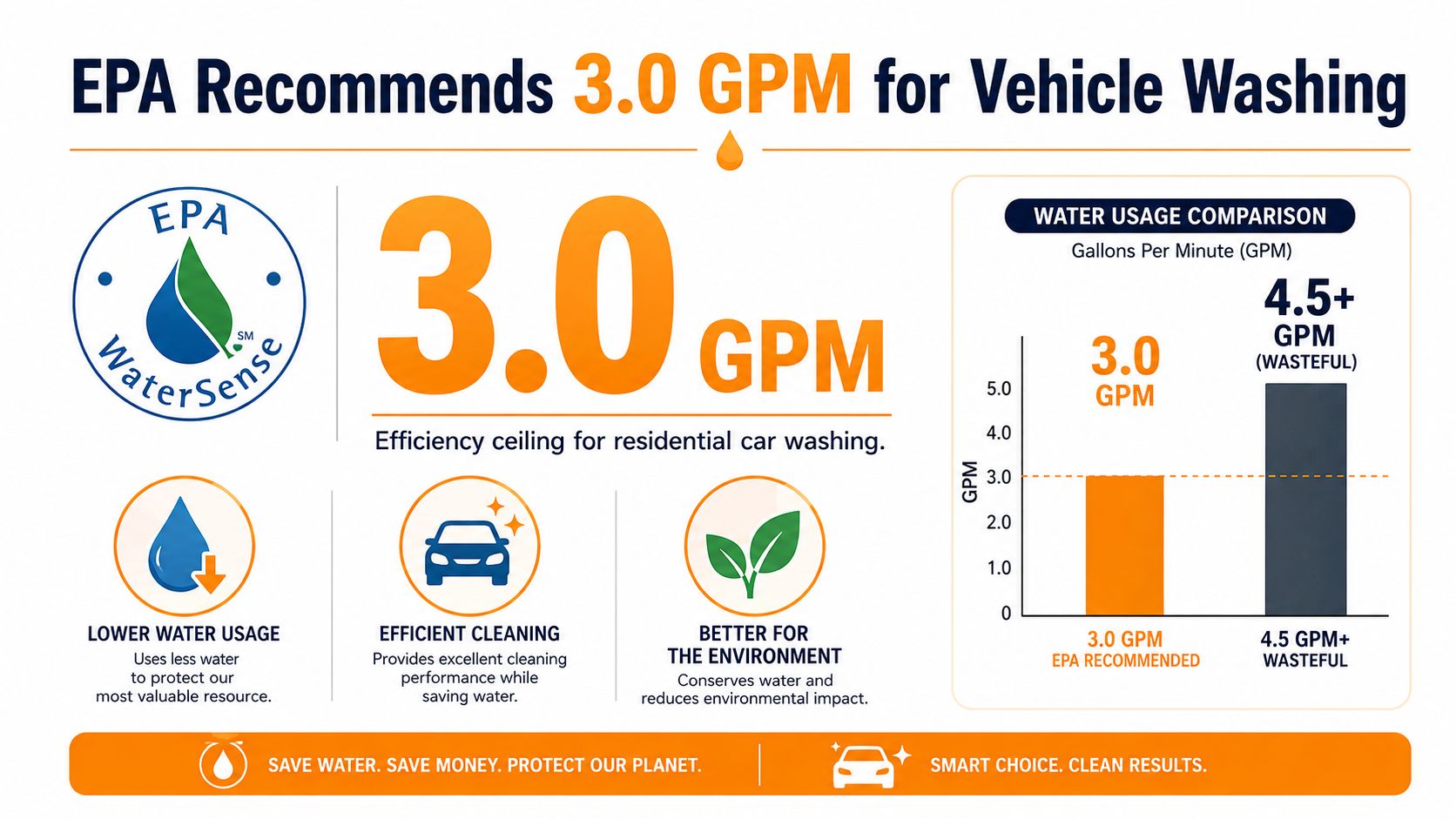
Use the benchmark as a ceiling, not a target for every gun
The EPA figure is a vehicle-wash efficiency benchmark, not a promise that every foam gun should operate at exactly that rate. Your tool may require a different minimum flow for reliable siphoning, and the final rinse may call for a different pattern than the foaming stage.
Measure your setup, then reduce avoidable restrictions and tune the gun for consistent output. A controlled stream can clean effectively while using less water than an unrestricted hose left running throughout the session.
Troubleshooting Common Flow Rate Problems
Foam complaints usually become easier to solve once you separate supply, restriction, and mixing problems. Work from the water source toward the nozzle instead of turning every adjustment at once.
Watery foam
Start with the shampoo mixture. An overly diluted solution can look watery even when the hose delivers suitable volume. Return to the manufacturer's recommended dilution, clean the pickup tube, and adjust the metering control in small quarter-turn changes.
If the spray remains wet, measure the hose output and inspect the orifice. A larger opening or unrestricted supply may be sending more water through the mixing chamber than the gun can balance.
Weak suction
Look for restrictions first. Straighten the hose, check the quick-connect, clean the inlet screen, and confirm that the adapter isn't narrowing the path abruptly. If your current hose is narrow, testing a wider-diameter model can show whether friction is limiting the tool.
For a broader plumbing diagnosis, use this guide to fix low water pressure. A foam gun can't create supply volume that the property doesn't provide.
Pulsing or inconsistent output
Fluctuating household demand can change the available supply. Turn off other water-using fixtures, open the spigot consistently, and check for leaks around every connection. A pressure washer setup also needs to operate within the equipment manufacturer's stated pressure range, because an unsuitable operating condition can affect both delivery and spray behavior.
Troubleshooting order: Source, hose path, screens, fittings, orifice, then metering adjustment. Replace equipment only after those checks produce no answer.
If the flow changes without an obvious hose problem, investigate the plumbing rather than assuming the foam gun failed. Homeowners who suspect hidden losses can learn how professionals detect hidden water leaks before investing in new wash equipment.
Your Flow Rate Optimization Checklist
Treat flow-rate tuning like a small quality-control routine. Record the result once, then repeat the same checks when you change hoses, move to another property, or notice a change in foam texture.
Before the wash
- Run the bucket test: Measure the working hose and record the result in GPM.
- Use the normal setup: Include the hose, connectors, filter, and foam gun if you want an application reading.
- Remove competing demand: Shut off nearby fixtures so the baseline reflects the wash rather than a shared supply.
- Choose the wash area: Keep the hose straight and prevent it from rubbing against sharp edges or forming tight bends.
Inspect the equipment
Check the hose diameter and length, then examine the inlet screen and pickup tube. Look for dripping connections, damaged washers, partially closed valves, and adapters that reduce the internal opening.
If you're comparing water-use practices beyond vehicle care, this overview of water savings from Prestonwood Commercial Landscape Services offers useful conservation context for household and property maintenance.
Calibrate the mix
Begin at the product manufacturer's recommended dilution. Change the metering screw in small increments, wait for the spray to stabilize, and judge the foam on a clean test panel rather than making several adjustments at once.
A garden-hose foam gun such as the SwiftJet Car Wash Foam Gun can connect to a standard garden hose and apply shampoo through a trigger-controlled spray. If you use it or another model, measure its actual operating flow and tune the mixture to that tool instead of relying on a generic hose average.
During the session
Maintain a consistent wand distance and movement speed. Watch whether foam thickness changes between panels, especially when another fixture starts running or the hose shifts under the vehicle. Record the setting that gives stable coverage, useful cling, and controlled water use.
A repeatable baseline turns “watery foam” from a frustrating mystery into a solvable system problem. Measure first, remove restrictions, adjust one variable, and keep the setup that performs consistently.
If you want a garden-hose foam gun designed for controlled vehicle washing, visit SwiftJet to review its trigger-controlled foam application and standard-hose connection. Use your measured water flow rate to choose a setting that delivers consistent coverage without chasing unnecessary output.
