

Saturday wash starts the same way for a lot of people. Bucket ready. Soap mixed. Foam gun clipped to the hose. You squeeze the trigger expecting that thick blanket of suds you see in satisfying wash videos, and instead you get weak, watery spray that runs straight off the paint.
Often, the soap is blamed first. Then the foam gun is blamed. After that, attention shifts to pressure, adapters, and random accessories. The underlying issue is usually simpler. The setup isn't managing water well.
That's what flow rate control comes down to. It's the difference between a foam wash that clings long enough to loosen grime and one that just wets the car. It decides whether rinsing feels quick and clean or slow and frustrating. It also explains why two people can use similar gear and get very different results.
In detailing, this matters more than many beginners realize. A foam wash isn't just about making the car look covered in soap. The water has to move through the hose, trigger, internal passages, and nozzle in a way that supports stable mixing. If that flow gets restricted at the wrong point, foam quality drops fast.
I've found that once someone understands flow instead of guessing at it, their whole wash process improves. They stop treating the tool like a mystery box. They start reading the setup like a system.
The Secret to a Perfect Car Wash
A perfect foam wash doesn't start at the soap bottle. It starts upstream, with how water reaches the gun.
When foam comes out thin, people often react by adding more soap concentrate. Sometimes that helps a little. Often it just wastes product. If the gun isn't getting the right volume of water in a stable way, richer soap mix won't fix the core problem. You'll still get uneven output, weak cling, or a spray pattern that feels inconsistent from one pull of the trigger to the next.
That's why flow rate control matters so much in car washing. It's the quiet part of the setup that decides whether your tool behaves predictably. Good flow gives you consistent draw, steadier spray, and rinsing that carries loosened dirt away. Poor flow turns the whole wash into compensation. More soap. More passes. More time.
What good foam is really telling you
Thick foam is a visible result, not the root cause. When foam lays down evenly, three things are usually happening:
- Water is moving with enough volume to support proper mixing inside the gun.
- Restrictions are limited so the stream isn't being choked before it reaches the nozzle.
- The operator is using the trigger steadily instead of pulsing the flow and disturbing the mix.
If one of those goes wrong, the foam tells on the system immediately.
Good foam is usually a sign of stable flow, not magic soap.
This is why experienced detailers pay attention to hose condition, fittings, nozzle choice, and trigger feel. Those don't sound glamorous, but they're what separate a satisfying wash from a messy one.
The apprentice mistake most people make
New detailers tend to focus on what they can see. Soap color. Foam thickness. Spray pattern. The better approach is to ask what the water is doing before it reaches the paint.
If you learn that habit, you stop chasing symptoms. You start correcting causes. That's when washing a car gets easier, faster, and a lot more repeatable.
Understanding Flow Rate and Pressure
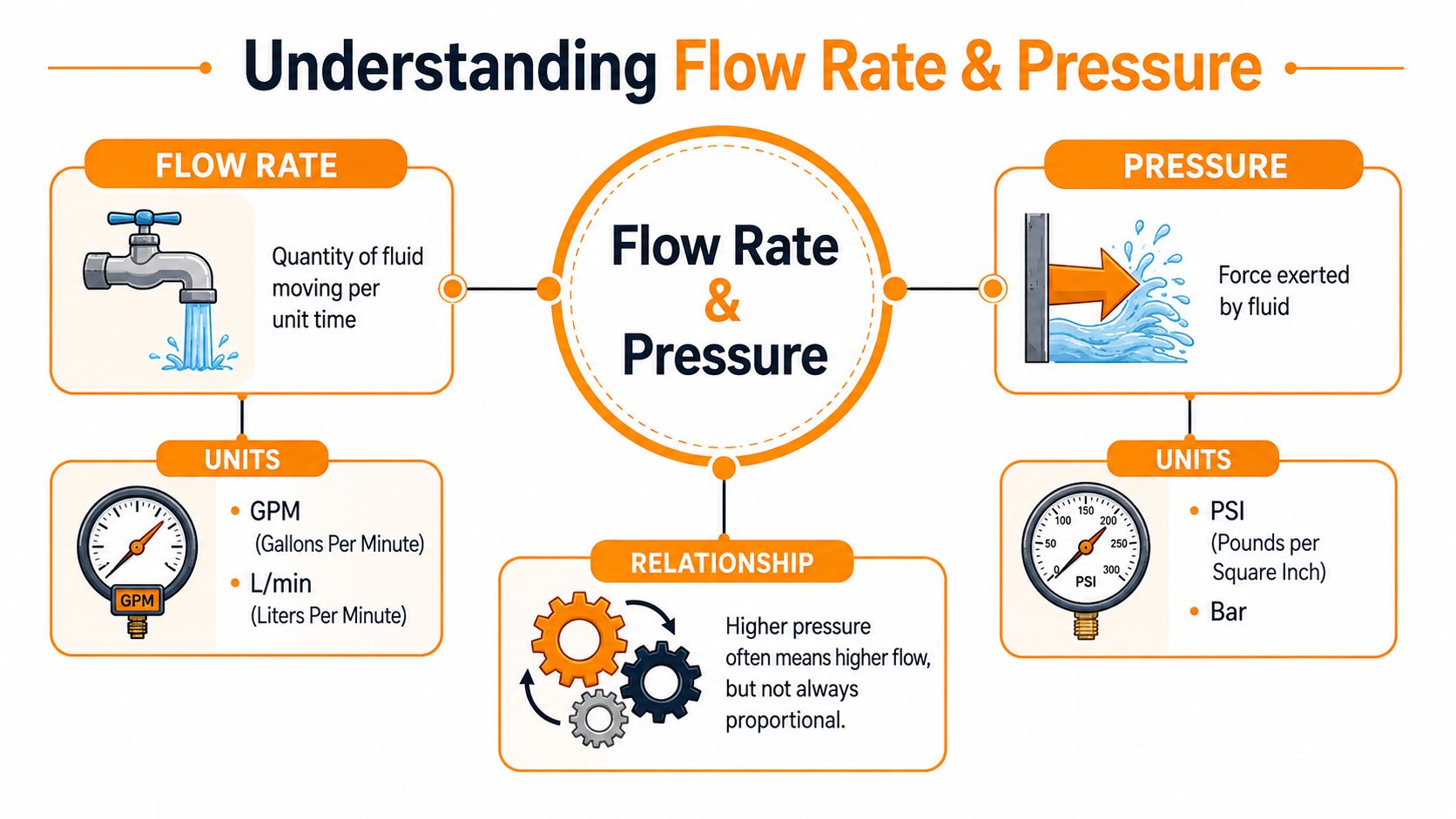
Flow rate is the amount of water moving through your system over time. In car washing, you'll usually see it discussed as GPM, or gallons per minute, and sometimes L/min, liters per minute.
Pressure, usually shown as PSI, tells you how hard that water is pushing. These are related, but they aren't the same thing. A hose can hit hard and still not move much water. It can also move a healthy volume of water without feeling especially aggressive at the outlet.
The bucket test mindset
The easiest way to understand this is with a bucket.
If a hose fills the bucket quickly, that's flow rate. If the stream slaps the back wall of the bucket hard, that's pressure. You need both in cleaning, but they do different jobs. Pressure helps break stubborn grime loose. Flow rate carries loosened dirt, soap, and rinse water away.
That's why cleaning performance often disappoints when people obsess over PSI alone. For general industrial cleaning, the required flow rate follows a surface coverage rule of 0.5–1.0 GPM (1.9–3.8 LPM) per 100 square feet (9.3 m²) of surface area per hour, and that same guidance notes that insufficient flow directly limits cleaning efficiency regardless of pressure because flow determines the water volume available to flush contaminants away (industrial cleaning flow rate guidance).
For car washing, the practical lesson is simple. If your rinse feels slow and your foam doesn't clear dirt well, lack of volume may be the bigger problem than lack of force.
Why home plumbing affects the wash
A foam gun attached to a garden hose only works with the water your house can deliver. If the incoming pressure is unstable, or if a pressure reducing valve is set too conservatively, the tool can feel lazy even when nothing is technically broken. Homeowners trying to understand that side of the setup can get useful background from this guide to residential PRV water pressure.
It also helps to understand the pressure side of a standard hose setup before blaming the foam tool itself. If you want a homeowner-friendly breakdown of that, this explanation of garden hose PSI and what it means in practice is worth reading.
Practical rule: Pressure starts the work. Flow rate finishes it.
What this means at the car
When you pre-rinse a dusty panel, pressure can knock material loose. When you rinse soap from badges, mirrors, panel gaps, and lower doors, flow rate becomes the hero because it brings the water volume needed to carry residue away.
That's why a wash can feel weak even when the stream seems sharp. The water hits, but it doesn't move enough volume to flush efficiently. Once you see that difference, equipment choices make a lot more sense.
Methods for Controlling Flow Rate
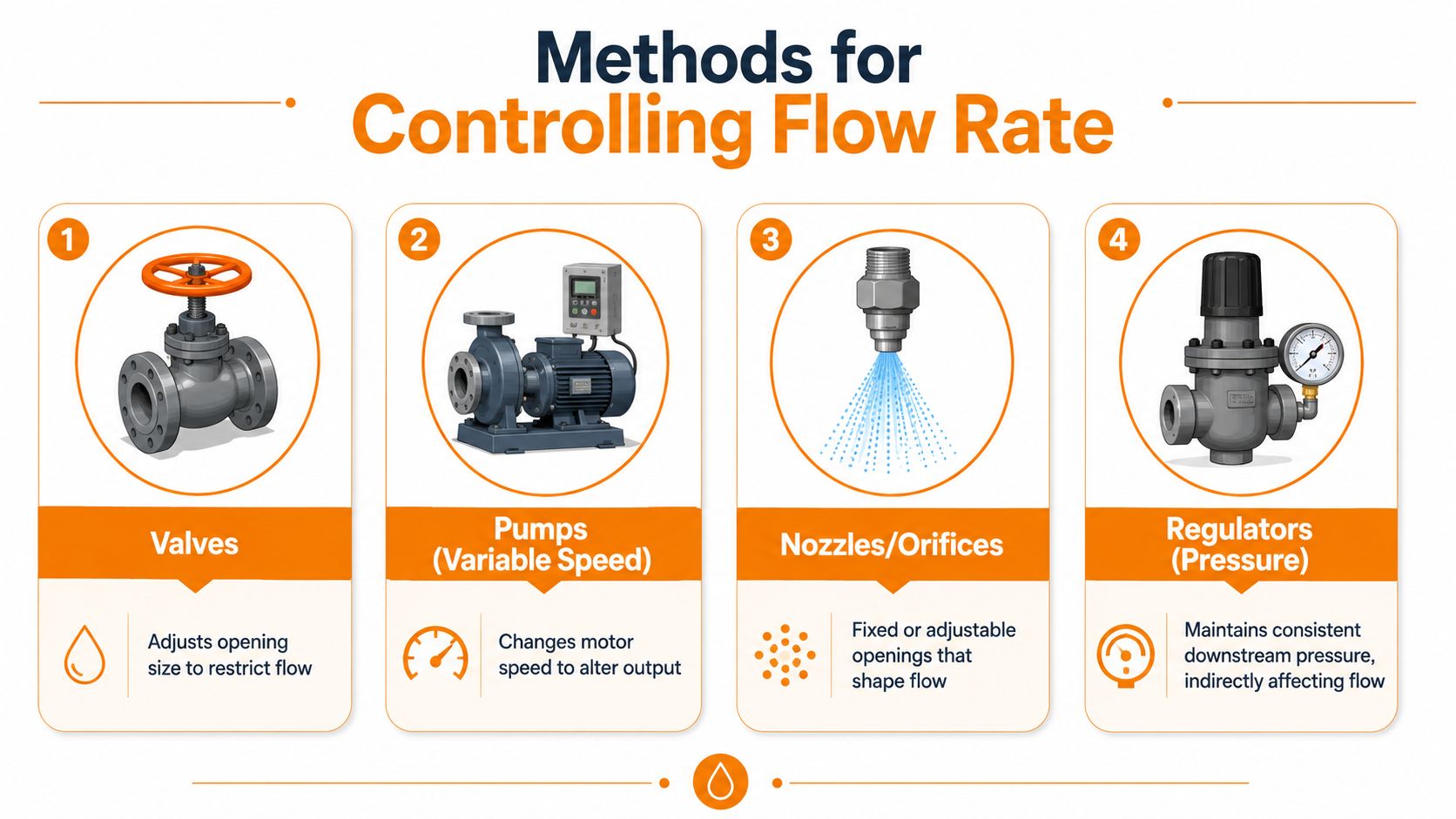
Water doesn't arrive at the nozzle untouched. Every part of the system shapes what gets through. In practical washing terms, the main control points are the valve, the nozzle or orifice, the regulator, and the hose itself.
Valves and triggers
The trigger is the control often thought about first. It's the hand-operated gate that opens or narrows the path. In theory, that gives you control. In practice, many consumer triggers behave more like rough gates than precision instruments.
That's fine for broad on-off use. It's less useful when you want a very steady, repeatable low-to-medium flow for foam application. A sticky trigger or one that changes output too abruptly makes it harder to lay down an even coat.
Nozzles and orifices
The nozzle is where small geometry changes create big behavior changes. Narrower openings restrict flow more aggressively. Wider ones allow more water through, but they also change how the stream forms.
A helpful industrial example comes from flow restrictors. By decreasing the orifice size, they can lower flow output from 5 gallons per minute to 2 gallons per minute while also increasing upstream pipe pressure and flow force. That same mechanism is used to prevent problems like overpressure and water hammer in fluid systems (flow restrictors and regulators explained).
For car washing, the lesson is direct. A tiny restriction somewhere in the path may make the system feel punchier upstream while starving the outlet where you need water.
Regulators and source stability
Regulators don't create flow out of thin air. What they do is manage pressure changes so the downstream side behaves more consistently. In a home setup, that consistency matters because foam quality gets erratic when source conditions bounce around.
If your output changes depending on what else is running in the house, the regulator or supply side may be part of the story. The foam gun often gets blamed for a problem that started at the spigot.
Hose size and layout
Hose diameter and hose condition matter more than many beginners expect. A long hose with tight bends, kinks, or cheap restrictive fittings creates cumulative losses. None of those alone may seem dramatic, but together they change how the tool feels in your hand.
A simple comparison helps:
| Control method | What it changes | Best use in car washing | Common mistake |
|---|---|---|---|
| Trigger valve | Opening size during use | Starting, stopping, feathering output | Treating it like a precision metering tool |
| Nozzle orifice | Restriction and spray behavior | Matching output to wash task | Using too small an opening and starving flow |
| Regulator | Downstream pressure consistency | Stabilizing erratic supply | Expecting it to fix every low-flow issue |
| Hose path | Delivery losses before the gun | Preserving available volume | Ignoring kinks and hard bends |
If you're trying to understand how foam nozzle choices affect output at the end of the line, this breakdown of a pressure washer foam nozzle and how nozzle design changes performance gives useful context, even if you're working from a hose-fed setup rather than a dedicated pressure washer.
The system only performs as well as its tightest restriction.
That's the right way to think about flow rate control. Not as one part, but as a chain.
The GPM vs PSI Debate in Car Washing
Car people argue about GPM and PSI the way mechanics argue about tools. One side wants more force. The other wants more volume. For washing vehicles, volume usually wins more often than beginners expect.
The reason is mechanical, not emotional. Pressure, flow rate, and nozzle size are linked. You don't get to change one in isolation and pretend the others don't move. The nozzle size needed to achieve a specific pressure output from a constant system flow rate is determined by the formula Nozzle Size = 63.23 × (system flow rate / √desired pressure), and a given flow rate and nozzle size combination results in a fixed pressure value (nozzle sizing and cleaning efficiency reference).
Why volume matters more on paint
Cars aren't concrete. You're not trying to strip heavy deposits with brute force. Most of the time you're trying to pre-soak, lift road film safely, and rinse thoroughly without driving grit across the surface.
That shifts the priority toward water volume. The same nozzle reference notes that, for most cleaning jobs, a higher GPM allows the use of less PSI to achieve the same cleaning efficiency. That lines up with what detailers see every day. A fuller rinse clears soap faster, flushes panel gaps better, and feels less harsh on delicate surfaces.
A practical detailer's answer
If someone asks whether they should chase more PSI from a hose-fed foam setup, my answer is usually no. That's not what this kind of tool is best at.
A garden hose foam cannon works by making the most of available household water. It wants stable supply, decent volume, clean internal passages, and a sensible nozzle path. It does not benefit from trying to imitate a high-pressure washer at all costs.
Use pressure carefully where it helps. Value flow where it finishes the wash.
- Pre-rinse dirt: Moderate force helps loosen contamination.
- Foam application: Stable flow matters more than aggression.
- Final rinse: Higher volume usually makes the job feel faster and cleaner.
- Paint safety: Excessive pressure is easier to regret than insufficient volume.
The best wash setups don't chase headline PSI. They deliver controlled water where it matters.
Optimizing Your SwiftJet Foam Gun Performance
Foam quality is often thought to come down to soap ratio and trigger time. Those matter, but they're only part of the story. The neglected factors are usually the mechanical ones close to the gun itself.
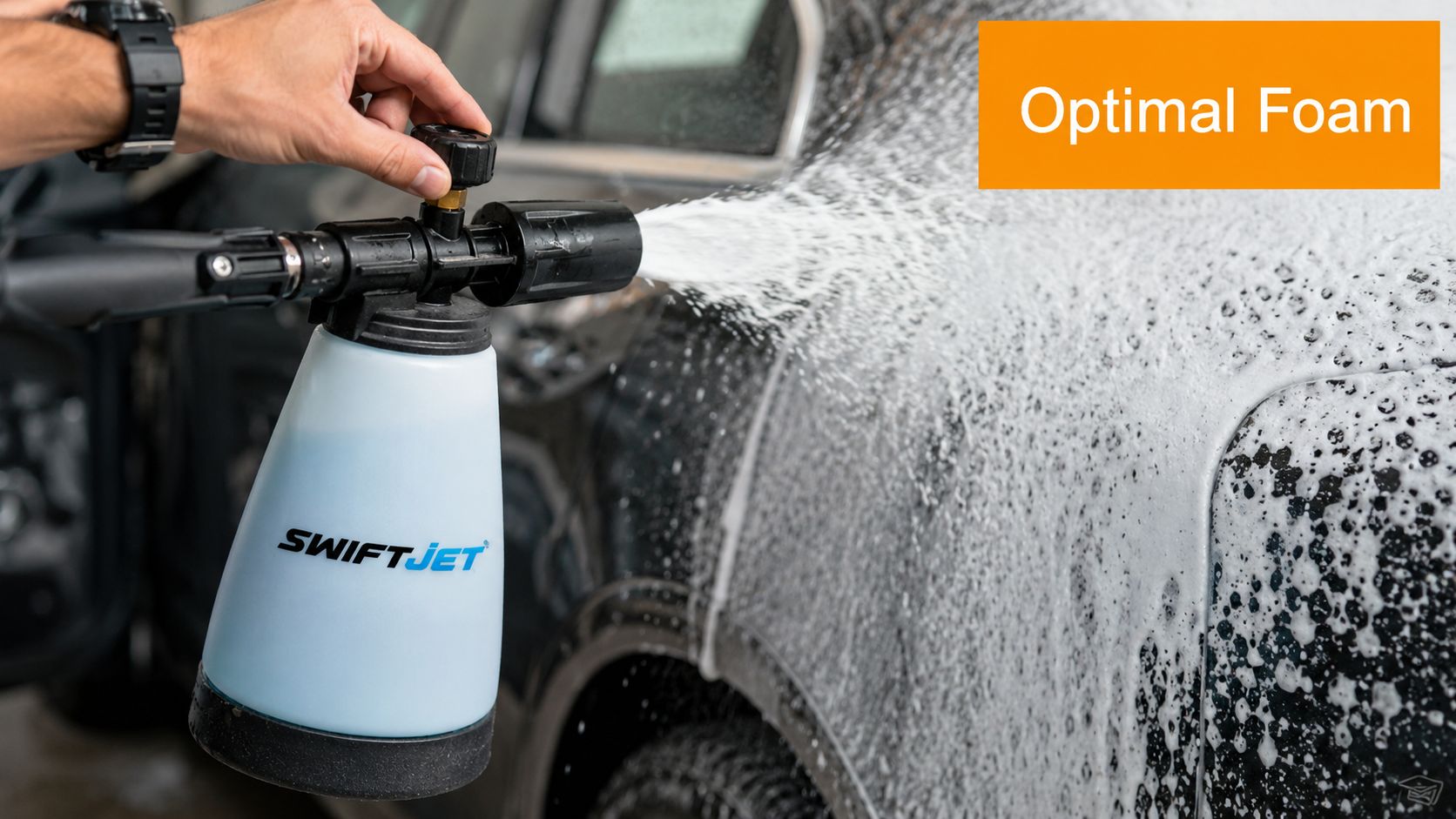
If you want better foam from a garden hose setup, pay attention to how water enters the tool, how sharply the hose bends near the inlet, and how steadily you operate the trigger. Those details change the flow before soap ever reaches the paint.
Fix the hose angle first
This one gets ignored constantly. Industrial research shows that junction angles between 30–45 degrees reduce pressure losses by up to 15% compared to standard 90-degree configurations, which means a badly angled hose connection can meaningfully degrade foam gun performance (junction angle and pressure loss findings).
That sounds industrial, but the garage version is easy to spot. If the hose snaps into a hard bend right at the gun handle, or the adapter forces a sharp turn before water enters the body, you're creating avoidable loss.
A few practical habits help:
- Keep the last section of hose relaxed. Don't let it twist hard at the grip.
- Avoid aggressive right-angle adapters unless you absolutely need them. Convenience can cost flow.
- Support the hose weight with your off hand when laying foam on larger vehicles so the inlet stays straighter.
Trigger finesse matters more than people think
A foam gun trigger isn't always a linear control. Many consumer triggers feel like nothing happens, then too much happens all at once. That abrupt behavior encourages pulsing, and pulsing disrupts consistency.
The better technique is to use a smooth squeeze and maintain it through each pass. Don't stab at the trigger. Don't half-release and re-engage every second unless you're intentionally spotting tight areas like grilles or emblems.
A foam pass should feel like painting a wall. Steady hand, steady overlap, steady output.
If you want a broader walkthrough on getting the most from the setup as a whole, this guide to foam gun performance optimization is a useful companion.
Use your body position to protect flow
A lot of weak-foam complaints come from the operator fighting the hose. When the hose drags behind your feet, catches on a tire, or pulls downward from an awkward angle, the gun inlet sees that stress.
Try this instead:
- Start at the roof and upper glass so the hose hangs more naturally.
- Walk the vehicle in a consistent direction instead of crossing your body repeatedly.
- Reposition the hose before each side if you feel drag building.
That sounds minor, but it keeps the water path cleaner and the application more even.
After you've got the mechanics right, watch a live demonstration and compare it to your own hand movement and hose setup.
What usually doesn't work
People often waste time on fixes that don't address the cause.
- Adding extra soap won't overcome a restricted inlet.
- Snapping the trigger repeatedly won't create better mixing.
- Forcing a tighter bend for convenience usually hurts output instead of helping it.
The best gains usually come from cleaner geometry, steadier operation, and fewer restrictions near the point of use.
Troubleshooting Common Flow Rate Problems
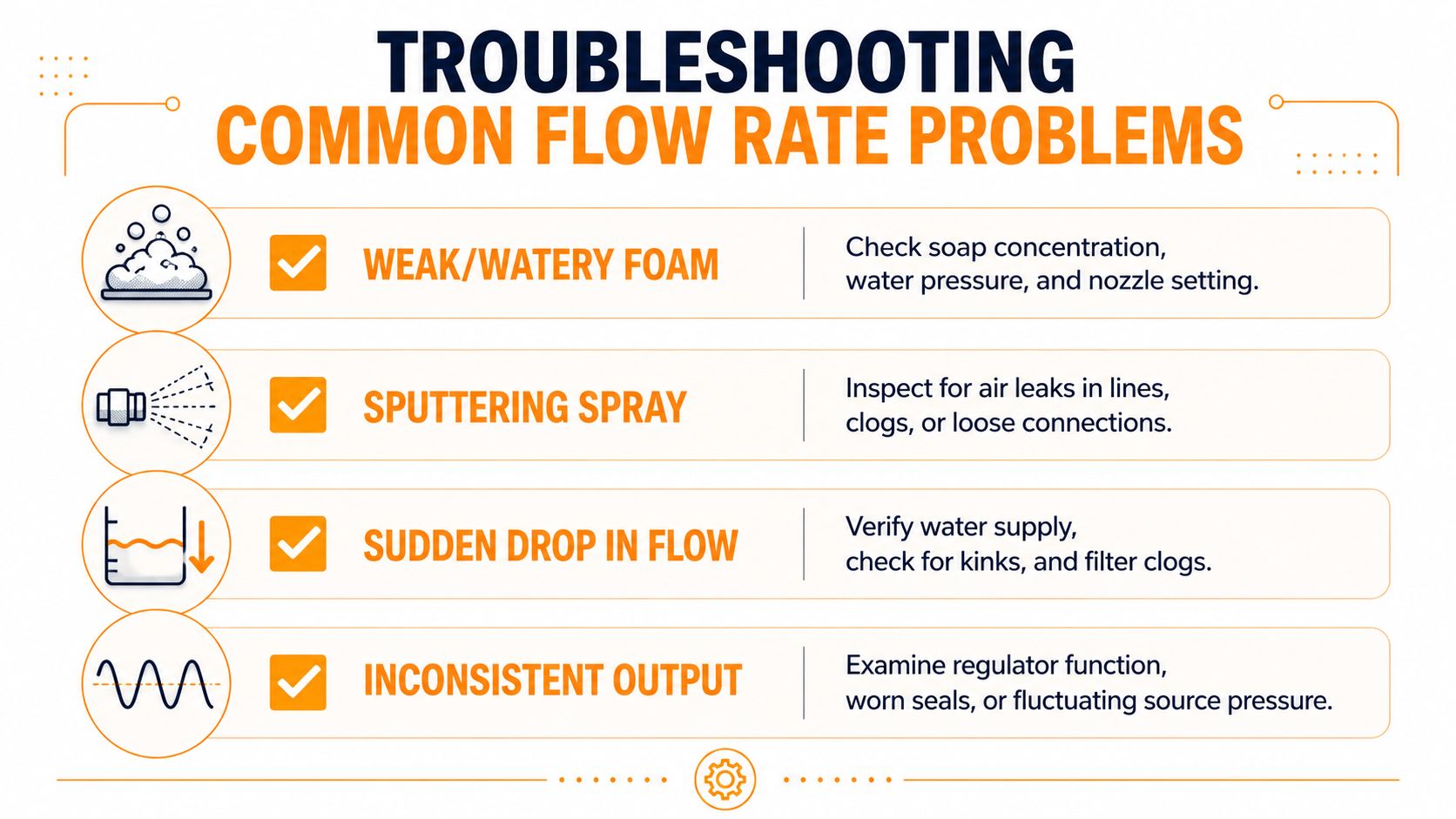
When a foam gun starts acting up, don't troubleshoot by feel alone. Start with the symptom, then trace the water path from source to outlet.
Weak or watery foam
This usually means the system isn't delivering stable mixing conditions.
Check the easy things first. Look for a kinked hose, a partially blocked nozzle, or a loose connection that's disrupting flow. Then inspect your soap concentration and make sure you're not starving the tool with a restrictive fitting upstream.
If the foam gun performed better before and suddenly got weak, dried soap residue inside the mixing path may be reducing flow.
Sputtering spray
Sputtering often points to air entering the system or water delivery becoming inconsistent. Loose fittings are common culprits. So are clogged passages that interrupt the stream.
Run through this checklist:
- Tighten every connection: A small leak can upset the spray pattern.
- Flush the gun with clean water: Internal buildup can create intermittent flow.
- Check the hose washer and inlet screen: Debris at the entrance often causes erratic output.
Sudden drop in performance
If output falls off mid-wash, think supply first. Someone may have opened another water fixture in the house, the hose may have kinked behind you, or the source side may have become restricted.
Then consider heat and handling. A hose dragged around a hot driveway can soften and twist more easily, especially near the gun where the bend radius gets tight.
Trigger feels sticky or non-proportional
There's a mechanical reason this happens. Standard triggers often lack the linear volumetric control found in industrial V-port valves, and a 90-degree internal design does not allow for fine control the way angled 30-degree and 60-degree V-ports do (V-port valve behavior and modulation reference).
That explains why some foam gun triggers feel jumpy at low settings. You're not necessarily doing anything wrong. The mechanism isn't designed for delicate metering.
If the trigger feels like it goes from off to too much in a tiny movement, work with longer, smoother pulls instead of chasing tiny micro-adjustments.
A simple diagnostic table helps:
| Symptom | Likely cause | First action |
|---|---|---|
| Weak foam | Restriction, poor mix, low supply | Check hose, nozzle, soap setting |
| Sputtering | Air leak or clog | Tighten fittings and flush |
| Sudden flow drop | Supply issue or kink | Check spigot, hose path, filters |
| Sticky trigger feel | Non-linear trigger geometry | Use steadier trigger motion |
Think like a technician, not a frustrated owner. Symptoms make more sense when you follow the path of the water.
Final Tips for Maintenance and Safety
Good flow rate control isn't a one-time setup. It's a maintenance habit.
Flush the foam gun with clean water after every wash. That one step prevents soap residue from drying inside the passages and gradually choking performance. Store the tool where the trigger, seals, and fittings won't sit under stress, and don't leave the hose bent sharply at the connection point after you finish.
A short maintenance routine goes a long way:
- Rinse the internals: Clean water through the system clears leftover soap.
- Inspect washers and screens: Small debris causes outsized problems in small passages.
- Straighten the hose before storage: Repeated kinks train restrictions into the line.
- Check fittings by hand before each wash: Loose connections waste water and consistency.
Safety matters too. Never point a pressurized spray at people, pets, or delicate surfaces. Keep your footing secure when moving around wet pavement, and don't force more pressure into a vehicle wash than the surface requires.
The biggest takeaway is simple. Better washing usually comes from better control, not more aggression. If the water reaches the tool cleanly, moves through it smoothly, and exits consistently, the whole wash gets easier.
If you want a hose-fed foam setup built for easier washing at home, SwiftJet is worth a look. It's designed to connect to a standard garden hose and make the foam wash process simpler for cars, trucks, RV gear, and everyday cleanup.
