

Reclaiming your hours usually doesn't start with a grand overhaul. It starts when you notice how much time disappears into little frictions. You search for the right towel. You rinse the same panel twice because your process is sloppy. You sit down to do focused work, then lose momentum because the task feels too big to start.
That pattern shows up everywhere. It shows up in office work, home chores, weekend errands, and vehicle care. A car wash that should feel simple turns into a drawn-out project because the setup is clumsy, the tools are wrong, and the order of operations makes no sense. The same thing happens with email, planning, and routine maintenance. What's often lacking isn't more effort. It's better systems.
Good time saving techniques work because they cut wasted motion, reduce decisions, and make repeat tasks easier to start. The best ones also travel well across domains. The same mindset that improves your calendar can improve how you wash a truck, maintain an RV, or handle a multi-car household.
Some methods are universal, like the Pareto Principle and time-blocking. Others are highly practical, like batching similar work and setting up your tools before you begin. And in vehicle care, the right equipment changes the pace of the entire job. A foam gun such as SwiftJet isn't just a gadget. Used correctly, it simplifies the pre-wash stage, reduces unnecessary scrubbing, and makes regular maintenance easier to keep up with.
1. Foam Cannon Technology for Pre-Wash Cleaning
The fastest way to wash a vehicle isn't to scrub harder. It's to make the dirt easier to remove before you ever touch the paint.
A foam cannon or foam gun earns its place in a routine because it turns pre-wash into a real step instead of a quick splash of soap. Thick foam clings to the surface, gives the soap time to work, and loosens grime so your wash mitt doesn't have to do all the labor. That saves time in the contact wash and usually makes the job feel less tiring.
How to make foam do the heavy lifting
With the SwiftJet foam gun, I'd treat the pre-wash as the setup for everything that follows. Apply foam from the upper sections first so it can travel downward, then give it a short dwell period before rinsing or touching the surface. That simple pause often removes the urge to over-scrub.
A few habits matter more than people think:
- Use a soap made for foam tools: The right car wash soap helps the foam cling instead of sliding off too quickly.
- Work from top to bottom: Gravity helps you instead of forcing you to chase runoff.
- Keep hose pressure consistent: Uneven pressure usually means uneven foam and a messier workflow.
For more on dialing in output and consistency, SwiftJet's guide to foam gun performance optimization is worth a look.
Here's a quick visual on foam application in practice:
Practical rule: If the foam stage doesn't reduce your scrubbing, you're rushing the dwell time or using weak wash chemistry.
For DIY owners, mobile detailers, and RV travelers, that's a significant win. The tool doesn't save time by magic. It saves time because it removes friction from the dirtiest part of the job.
2. Batch Processing for Fleet and Multi-Vehicle Management
If you wash several vehicles one by one from start to finish, you keep paying the setup cost over and over. Hose out. Soap ready. Towels sorted. Then you repeat the whole routine for the next vehicle. That's where batching helps.
Batch processing groups similar actions together. Rinse everything first. Foam everything next. Let one vehicle dwell while you move to another. Then rinse and dry in a controlled order. Families with multiple cars, small fleets, and mobile detailers all benefit from that rhythm.
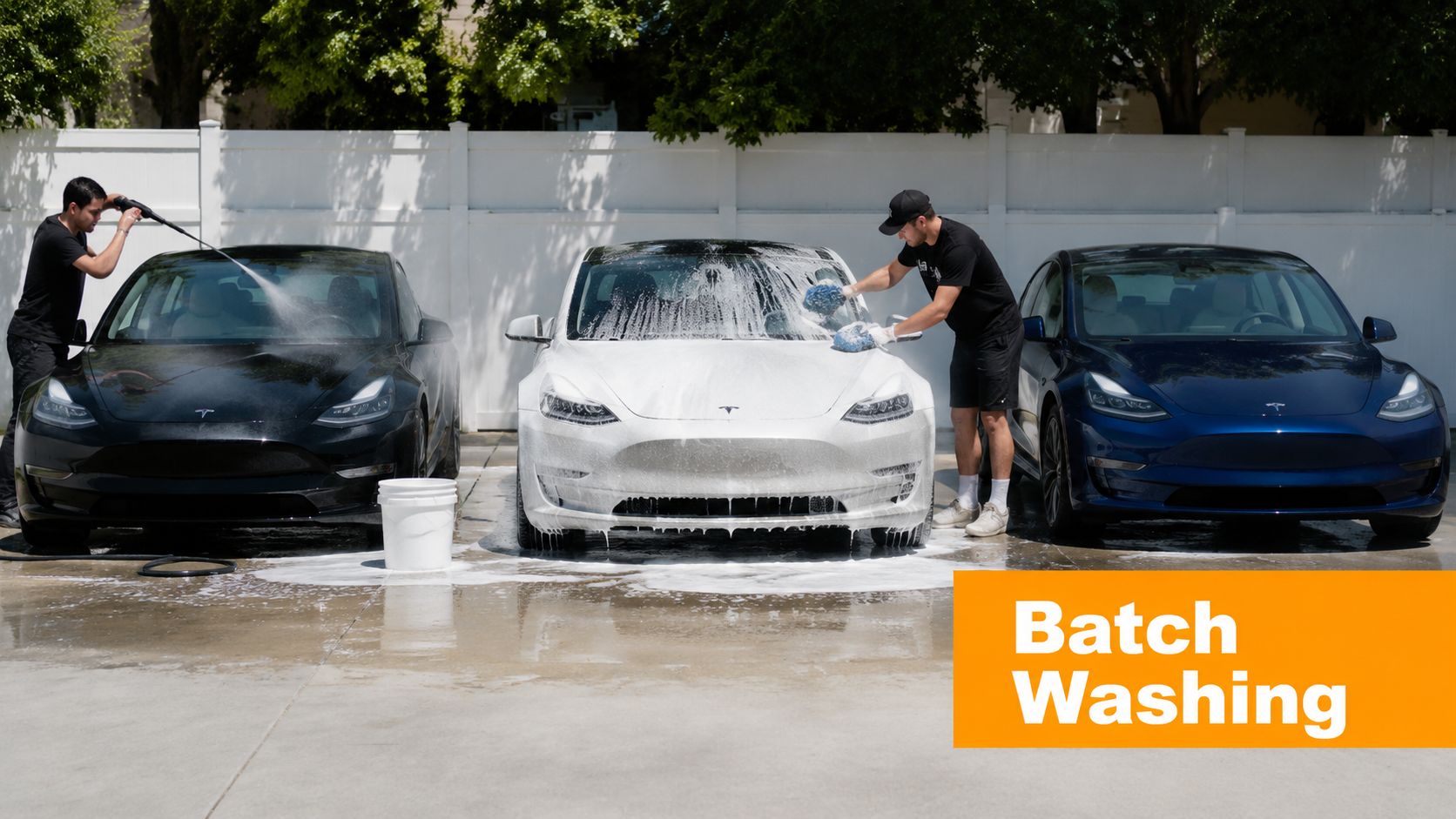
What batching fixes
The big gain is reduced context switching. In regular productivity work, task batching cuts the mental drag of shifting between unrelated jobs. In physical work like washing vehicles, it cuts motion waste and idle time.
I've seen this work best when the operator thinks in phases instead of cars. That means:
- Stage vehicles in order: Put the dirtiest or largest one where your energy is highest.
- Prep all supplies first: Buckets, mitts, soap, drying towels, and wheel tools should already be in position.
- Use dwell time productively: While foam sits on one vehicle, move to the next instead of waiting.
This applies beyond washing. Sales teams do it with outreach. Admin teams do it with approvals. Businesses revisiting stale opportunities often use systems like database reactivation to get more jobs from old leads because batching follow-up work beats handling each lead as a random interruption.
Work in waves, not isolated starts. Repetition gets faster when the process stays the same.
The trade-off is space. Batch processing needs enough room to stage vehicles and enough discipline to avoid chaos. If you have both, it's one of the cleanest time saving techniques available.
3. Strategic Scheduling and Time-Blocking
A lot of wasted time is really delayed decision-making. You don't know when you'll do the task, so you keep renegotiating it with yourself. Then it slips.
Time-blocking solves that by giving routine work a reserved slot. Car washing is a perfect example. If you always decide in the moment, you'll lose time to weather, heat, poor lighting, and procrastination. If you reserve a recurring window, the job becomes simpler to start and easier to finish.
Give recurring work a home on your calendar
The method is straightforward. Pick a block, protect it, and treat it like a commitment. For vehicle care, cooler parts of the day usually make washing easier because soap behaves more predictably and drying is less frantic.
For focused desk work, the same principle holds. Pair it with the Pomodoro Technique when you need help starting. That method uses exactly 25 minutes of work followed by a 5-minute break, and after four Pomodoros you take a longer break of 20 to 30 minutes. It's designed to reduce procrastination and task-switching, and the referenced overview says it can save an estimated 1 to 2 hours of effective work time per day (time management techniques overview).
A few scheduling habits make this stick:
- Choose a repeatable slot: Saturday morning is better than “sometime this weekend.”
- Set reminders in advance: A reminder before the task helps you gather supplies and avoid excuses.
- Match the slot to the task: High-focus work goes where your concentration is best. Physical cleaning goes where conditions are favorable.
If you run a service business, scheduling discipline matters even more. Teams comparing tools for route planning and appointments can learn from SkipCalls' take on top scheduling tools.
The downside is rigidity. If you over-schedule every hour, the system breaks fast. Time-blocking works when it creates structure, not when it leaves no room for real life.
4. Quality Microfiber Tools and Equipment Investment
Cheap tools often look like savings until they touch the paint or force extra passes. Then you pay with time.
Good microfiber changes the pace of washing and drying because it handles more water, picks up contamination more cleanly, and glides better across the surface. That means fewer interruptions and fewer redo spots. For a DIYer, that's practical. For a detailer with multiple stops, it's operational.
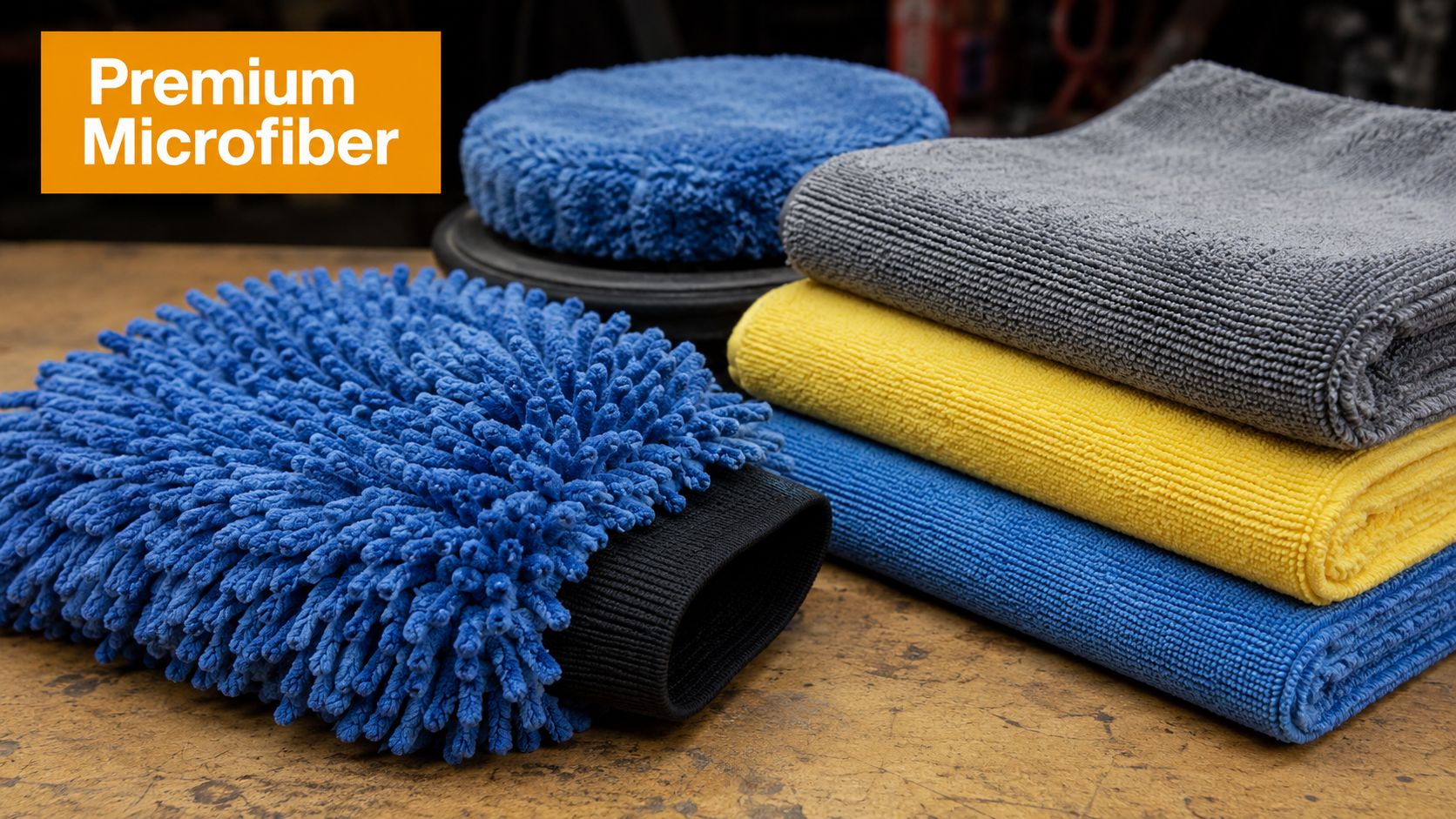
Where better towels actually save time
Microfiber matters most in two phases. First, during contact washing, where a decent mitt moves smoothly and releases dirt more reliably when rinsed. Second, during drying, where an absorbent towel cuts down on repeated wiping.
SwiftJet includes a microfiber wash mitt with the product, which is a smart pairing. If you want a primer on choosing the right towel types for different cleaning jobs, SwiftJet's article on microfiber towels for cleaning is useful.
Focus on basics that improve repeat performance:
- Keep multiple towels in rotation: A soaked or contaminated towel slows you down.
- Wash microfiber separately: Cross-contamination ruins absorbency and softness.
- Skip fabric softener: It leaves residue and makes towels less effective.
This is one of those time saving techniques people resist because the gain doesn't look dramatic on day one. But over repeated washes, good tools remove a lot of hidden friction. You stop fighting your equipment, and that changes everything.
5. Two-Bucket Wash Method Optimization
The two-bucket method sounds like a paint-preservation tip, and it is, but it's also a time-management tool. A clean mitt works faster than a dirty one.
One bucket holds your wash solution. The other is for rinsing the mitt before it goes back into soap. That simple separation keeps grime from circulating back onto the vehicle. In practice, it reduces the number of times you need to rework a panel because the mitt is dragging dirt instead of cleaning.
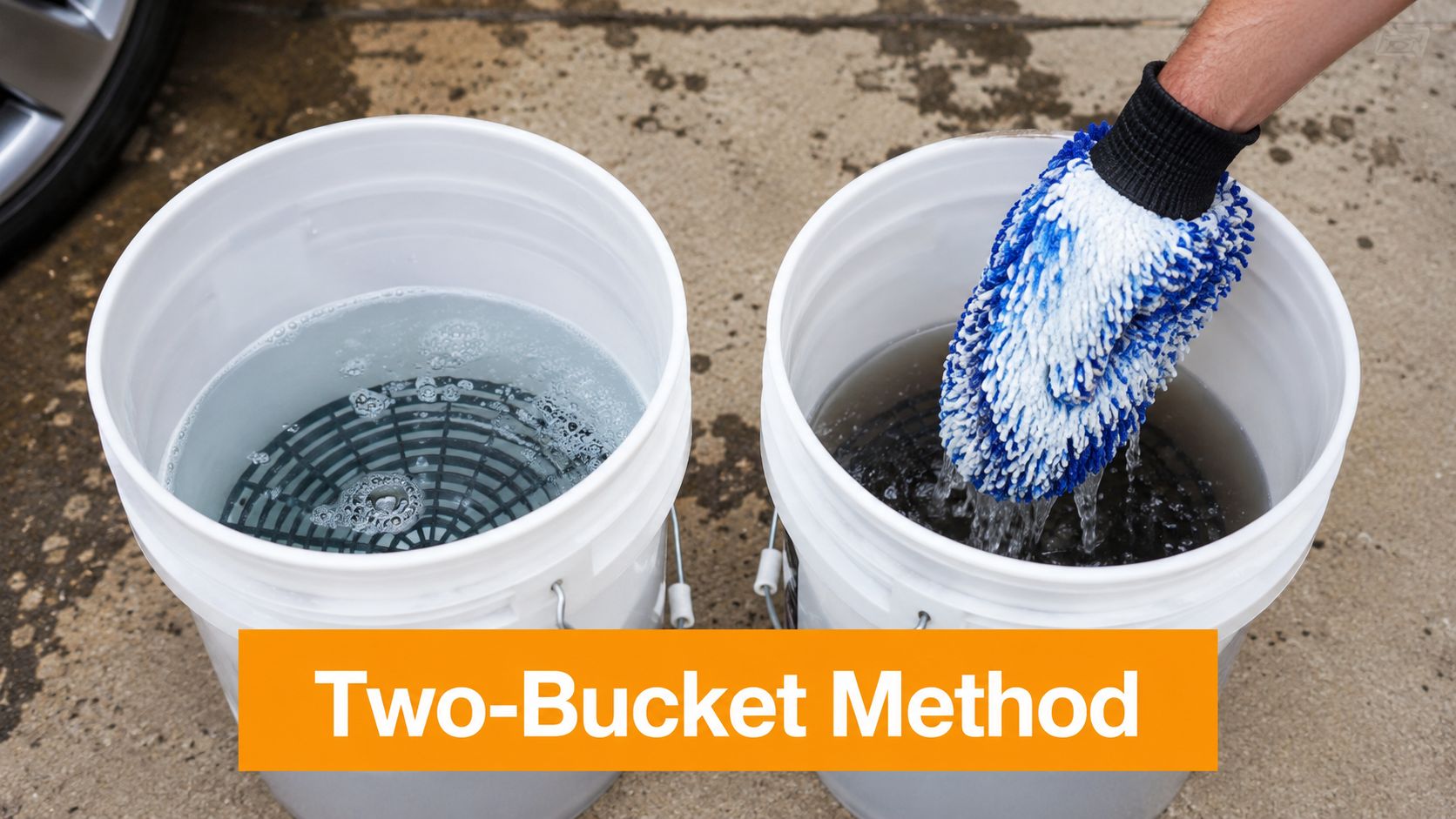
A cleaner wash path is a faster wash path
People sometimes skip this because they think one extra bucket means more hassle. In real use, the opposite is true. Your wash mitt stays usable longer during the session, and you work with more confidence on each section.
I'd combine it with a foam pre-wash and a top-to-bottom pattern. That gives you a clean progression: loosen contamination first, wash with controlled contact second, then rinse and dry without bouncing around the vehicle.
A fast wash isn't frantic. It's controlled enough that each pass counts.
Keep the method simple:
- Use dedicated rinse and soap buckets: Don't combine roles halfway through the wash.
- Rinse the mitt after each panel or section: Don't wait until it feels dirty.
- Keep lower sections for last: They carry more grime and can contaminate your mitt quickly.
This approach doesn't produce flashy before-and-after marketing. It produces something better. Fewer repeated passes, fewer wash-induced issues, and a routine that stays efficient even when the vehicle is heavily dirty.
6. Pressure and Flow Rate Optimization
Individuals often use more pressure than the task needs, then wonder why the process feels messy and inefficient. Pressure should match the phase.
Soap application needs control. Rinsing needs enough force to clear loosened dirt and product without wasting motion. The benefit of a tool like SwiftJet is that the trigger gives you more direct control over how aggressively you apply or rinse. That lets you work with intent instead of blasting every step at the same setting.
Match flow to the job
If you're applying foam, lower and steadier usually beats aggressive. If you're rinsing wheel wells or lower panels, you may need more force. The point is to avoid treating every part of the wash as if it requires maximum output.
The broader automation side of the industry makes the same case at a larger scale. A projection on automatic car wash trends says AI-integrated predictive maintenance reduces downtime by 50% while also optimizing resource usage with 20% less water and 15% fewer detergents (automatic car wash machine trends projection). Even if you're washing at home, the lesson transfers. Controlled inputs create faster, cleaner operations.
For better day-to-day results, SwiftJet's guidance on flow rate control can help you tune your setup.
A few practical adjustments:
- Start lower than you think you need: You can always increase pressure.
- Check hose restrictions: Kinks and weak connectors often cause inconsistent output.
- Clean nozzles regularly: A partially clogged nozzle wastes time because the pattern becomes unreliable.
This is a classic case of precision beating force. The goal isn't maximum spray. It's minimum wasted movement.
7. Pre-Planning and Preparation Protocols
The fastest operators I know don't start by washing. They start by staging.
Preparation is one of the least glamorous time saving techniques, which is why many people skip it. Then they lose momentum halfway through because they forgot towels, mixed the wrong soap ratio, or discovered a bad hose connection after the vehicle was already wet.
Stop solving preventable problems mid-task
Before any wash, gather everything and inspect the setup. That means checking the hose, the foam gun connection, the soap, the mitts, the drying towels, and the weather. It also means looking at the vehicle itself so you know where the heavy contamination is.
There's another reason this works. People are poor judges of how long physical tasks will take when they rely on instinct alone. Research summarized in the provided material notes that using past data on similar tasks improves estimation accuracy by 20 to 30 percent, and breaking the job into smaller steps also supports better planning (time estimation gap research summary).
Use that insight directly:
- Estimate by stages, not by whole job: Setup, pre-rinse, foam, wash, rinse, dry, cleanup.
- Track your last few sessions: A simple note on duration makes future planning sharper.
- Pack supplies in one container: Walking back and forth to collect forgotten items kills pace.
For professionals, prep can include route order and loadout checks the night before. For homeowners, it may be as simple as filling buckets and setting towels out before you connect the hose. Either way, the principle is the same. A few minutes of preparation prevent a lot of broken rhythm.
8. Sectional and Systematic Workflow Approaches
Random movement feels productive because you're always doing something. Systematic movement is what finishes the job faster.
A sectional workflow breaks the vehicle into a consistent order. Roof first. Glass. Hood and upper panels. Mid-sections. Lower panels. Wheels last, or in a separate sequence if they're especially dirty. Once that order becomes habit, you stop wasting time deciding where to go next.
Build a repeatable route around the vehicle
This matters even more when more than one person is involved. Shared systems reduce overlap and missed spots. In larger automotive operations, process discipline has measurable effects. One Lean Kaizen example in an automotive service center reduced average car wash duration from over 13 minutes to under 8 minutes, a 38.5% time reduction, and also identified that 45% of total cycle time had been tied to inefficient washing (A3 car wash Kaizen report).
That's an industrial example, but the same logic works in a driveway. Standardize the path and the work speeds up.
Here's how to keep it tight:
- Use the same route every time: Muscle memory is faster than improvisation.
- Work top to bottom: Dirt and runoff naturally move downward.
- Don't jump between sections: Finish the current area before chasing a missed spot elsewhere.
I'd also keep wheel work mentally separate from paint work. It reduces contamination risk and keeps your workflow cleaner. Time is lost every time your process doubles back on itself. A sectional method prevents that.
9. Maintenance and Prevention Through Regular Care
Heavy buildup is expensive in time. Regular care is usually cheaper than heroic cleanup.
That's why prevention beats intensity. If you let dirt, road film, brake dust, and seasonal grime stack up for too long, every wash turns into a corrective project. If you maintain the vehicle on a steady cadence, the same job stays lighter, quicker, and less frustrating.
Why shorter, regular sessions win
The Pareto Principle is useful. The 80/20 rule says approximately 80% of results come from 20% of efforts, making it a strong framework for prioritizing high-yield work and cutting low-value activity (Pareto Principle overview). In vehicle care, that often means hitting the high-impact maintenance actions consistently instead of waiting for a perfect full-detail day.
Those high-yield actions usually include:
- Foam and rinse on a regular schedule: Light contamination is easier to remove than neglected buildup.
- Target the dirtiest zones first: Lower panels, wheels, and front surfaces usually need the most attention.
- Protect surfaces during maintenance cycles: A maintained finish generally cleans easier than an unprotected one.
This isn't only about cars. RV owners, off-road drivers, and anyone parking outdoors benefit because the environment keeps adding grime whether you're ready or not.
The trade-off is commitment. Prevention saves time only if you do it regularly. Miss the cadence, and the task turns back into a deep-clean problem.
10. Portable and Mobile Setup for Convenience Cleaning
The best routine is the one you will use. Convenience matters more than many people admit.
A portable setup removes excuses. If your foam gun connects to a standard garden hose and doesn't require a bulky machine or power source, you're much more likely to clean the vehicle when the opportunity is there. That's a huge advantage for homeowners, RV travelers, and mobile detailers working in changing environments.
Remove friction from starting
Portable systems shine because they reduce setup resistance. You don't need to build the perfect workstation each time. You need a dependable kit that's easy to grab, connect, and put away.
That's also where strategic rest matters, especially in repetitive physical work. Occupational therapy research summarized in the provided material shows that balancing activity with rest during repetitive labor improves mechanical efficiency and reduces total task duration (rest-integration research summary). For a mobile detailer or someone cleaning a large truck or RV, short deliberate breaks can keep quality high and prevent the slowdowns that come from fatigue.
Use portability well:
- Store your kit together: Foam gun, soap, mitt, towels, and connectors should live in one grab-and-go setup.
- Clean when access is easy: Home, work, campground, or any place with convenient water access.
- Use short maintenance windows: A brief upkeep session is often better than postponing until the vehicle is heavily soiled.
A portable setup doesn't just save physical setup time. It saves decision time. And that's often the difference between regular maintenance and another week of delay.
10-Point Time-Saving Techniques Comparison
| Method / Item | 🔄 Implementation Complexity | ⚡ Resource Requirements | ⭐ Expected Outcomes | 📊 Ideal Use Cases | 💡 Key Advantages / Tips |
|---|---|---|---|---|---|
| Foam Cannon Technology for Pre-Wash Cleaning | 🔄 Moderate, initial equipment purchase and technique learning | ⚡ Foam cannon, quality soap, hose, consistent water pressure | ⭐ High, ~30–50% wash time reduction; safer paint handling | 📊 Home detailers, mobile pros, RV/camping users | 💡 Apply top-to-bottom, 3–5 min dwell, use quality soap and consistent pressure |
| Batch Processing for Fleet and Multi-Vehicle Management | 🔄 Moderate–High, coordination, space and workflow planning | ⚡ Multiple vehicles space, team/help, hoses, organized supplies | ⭐ High, ~35–40% time reduction for 3+ vehicles | 📊 Fleets, rental companies, families with multiple cars, mobile detailers | 💡 Arrange vehicles logically, prep equipment, use timers and helpers |
| Strategic Scheduling and Time-Blocking | 🔄 Low, requires discipline to maintain recurring slots | ⚡ Calendar/booking tools, reminders, weather checks | ⭐ Moderate, ~20–30% reduction by preventing heavy buildup | 📊 Solo owners, fleet managers, professionals with recurring clients | 💡 Schedule cooler times, set reminders, combine with other tasks |
| Quality Microfiber Tools and Equipment Investment | 🔄 Low–Moderate, care routine and initial cost | ⚡ Premium microfiber mitts/towels, storage, laundering supplies | ⭐ High, ~40–50% faster drying; improved finish protection | 📊 Professionals, enthusiasts, those upgrading toolkits | 💡 Buy higher GSM, wash separately, avoid fabric softener, keep spares |
| Two-Bucket Wash Method Optimization | 🔄 Low–Moderate, simple procedure but requires practice | ⚡ Two buckets, grit guards, quality mitts and soap | ⭐ Moderate, ~25–35% faster wash phase; fewer micro-scratches | 📊 Detailers, DIYers focused on paint safety and efficiency | 💡 Use 5-gallon buckets, grit guards, rinse mitt between panels |
| Pressure and Flow Rate Optimization | 🔄 Moderate, requires understanding of pressure dynamics | ⚡ Adjustable trigger/foam cannon, quality hose, optional gauge | ⭐ Moderate, ~20–40% faster rinsing and lower water use | 📊 Foam cannon users, mobile detailers, water-limited settings | 💡 Start low, raise for rinsing, clean nozzles, check hose quality |
| Pre-Planning and Preparation Protocols | 🔄 Low, habit formation and checklist adoption | ⚡ Checklist, supply caddy, equipment inspection tools | ⭐ Moderate, ~20–30% total session time savings by avoiding interruptions | 📊 Professional detailers, mobile operators, organized DIYers | 💡 Use laminated checklists, organize supplies, verify equipment before start |
| Sectional and Systematic Workflow Approaches | 🔄 Low–Moderate, requires routine and minor planning | ⚡ Visual markers, documented workflow, team coordination (if needed) | ⭐ Moderate, ~25–30% improvement via reduced backtracking | 📊 Shops, mobile teams, training programs, repeatable workflows | 💡 Work top-to-bottom, define sections, document for consistency |
| Maintenance and Prevention Through Regular Care | 🔄 Low, consistent commitment over time | ⚡ Regular access to quick-clean tools (foam gun, microfiber), scheduled time | ⭐ Very High, ~40–50% reduction in annual cleaning time; better paint longevity | 📊 Car enthusiasts, fleet managers, RV travelers | 💡 Adopt weekly/bi-weekly quick foams, focus high-contam areas, apply protective coatings |
| Portable and Mobile Setup for Convenience Cleaning | 🔄 Low, simple deployment and breakdown | ⚡ Portable foam gun (hose-powered), compact supplies, access to water | ⭐ High, enables 30–40% more frequent maintenance and ~35–50% annual time savings | 📊 Travelers, commuters, mobile detailers, RV users | 💡 Keep kit in vehicle, map water-access locations, use battery rinse if needed |
Your Blueprint for an Efficient Future
Time saving techniques work best when they become part of a system instead of isolated hacks. That's the thread connecting everything here. The foam gun helps because it improves the pre-wash stage. The two-bucket method helps because it keeps each pass cleaner. Time-blocking helps because it removes the endless decision about when to begin. Preparation helps because it prevents interruptions you could've avoided.
What doesn't work is chasing speed for its own sake. Rushing usually creates rework. In productivity, that means switching tasks so often that nothing gets finished well. In vehicle care, it means missed spots, bad wash habits, and cleanup that takes longer because the process was sloppy. The better approach is controlled efficiency. Use fewer steps, but make them count.
If you're trying to improve quickly, don't adopt all ten techniques at once. Pick one process technique and one equipment or routine upgrade. For example, pair time-blocking with a pre-planned wash kit. Or pair a foam pre-wash with a stricter sectional workflow. That combination usually produces visible improvement fast because it fixes both planning and execution.
For household routines, these same principles carry over cleanly. Batch similar chores. Protect your best focus time. Track how long repeating tasks take. If you run a service business, systemization matters even more because every delay compounds across jobs, travel, setup, and follow-up. Physical work rewards standardization just as much as office work does.
One more point is worth keeping in view. Sometimes the best way to save time isn't to move faster. It's to reduce future work. Regular maintenance does that. Better tools do that. Better storage does that. Better scheduling does that. Prevention rarely feels exciting in the moment, but it consistently beats crisis-mode effort.
That mindset applies whether you're cleaning one daily driver, maintaining a family fleet, running a mobile detailing route, or just trying to make your weeks feel less scattered. Build a process that removes unnecessary motion, protects your attention, and makes starting easy. That's what durable efficiency looks like.
If your work also depends on hauling gear or building a smarter field setup, it's worth thinking through logistics too. Teams outfitting mobile operations often learn a lot from resources on choosing the right contractor trailer, because storage and transport have a direct effect on time lost or saved.
If you want a faster, simpler way to keep your vehicle clean without turning every wash into a full project, SwiftJet is a practical upgrade. It connects to a standard garden hose, lays down thick foam, includes a microfiber wash mitt, and makes regular maintenance easier to stick with. For DIY car care, RV use, and quick at-home washes, it's the kind of tool that reduces friction from the first step.
