

You're probably here because your car is dirty, your driveway hose is already in your hand, and you don't want to buy a bulky machine just to wash mud off paint and brake dust off wheels. That's a reasonable instinct. A pressure washer can be useful, but for a lot of home and auto cleaning, it's also loud, awkward to store, and easy to misuse.
That tension is why the category keeps growing. The global pressure washer market was valued at approximately USD 2.5 billion in 2021 and is projected to reach USD 3.19 billion by 2025, with adoption expanding across residential, commercial, and industrial use, according to MarketsandMarkets. People want a cleaner finish at home. They just don't all want the same tool.
Most articles blur that distinction and pretend every hose attachment is a pressure washer alternative in the same way. It isn't. Some tools are safer but weaker. Some are more convenient but slower. Some are excellent for paint and useless for caked concrete. The right choice comes down to the surface, the grime, and how much risk you're willing to accept.
The Search for a Simpler Deeper Clean
A lot of people don't want more power. They want enough power, with less hassle.
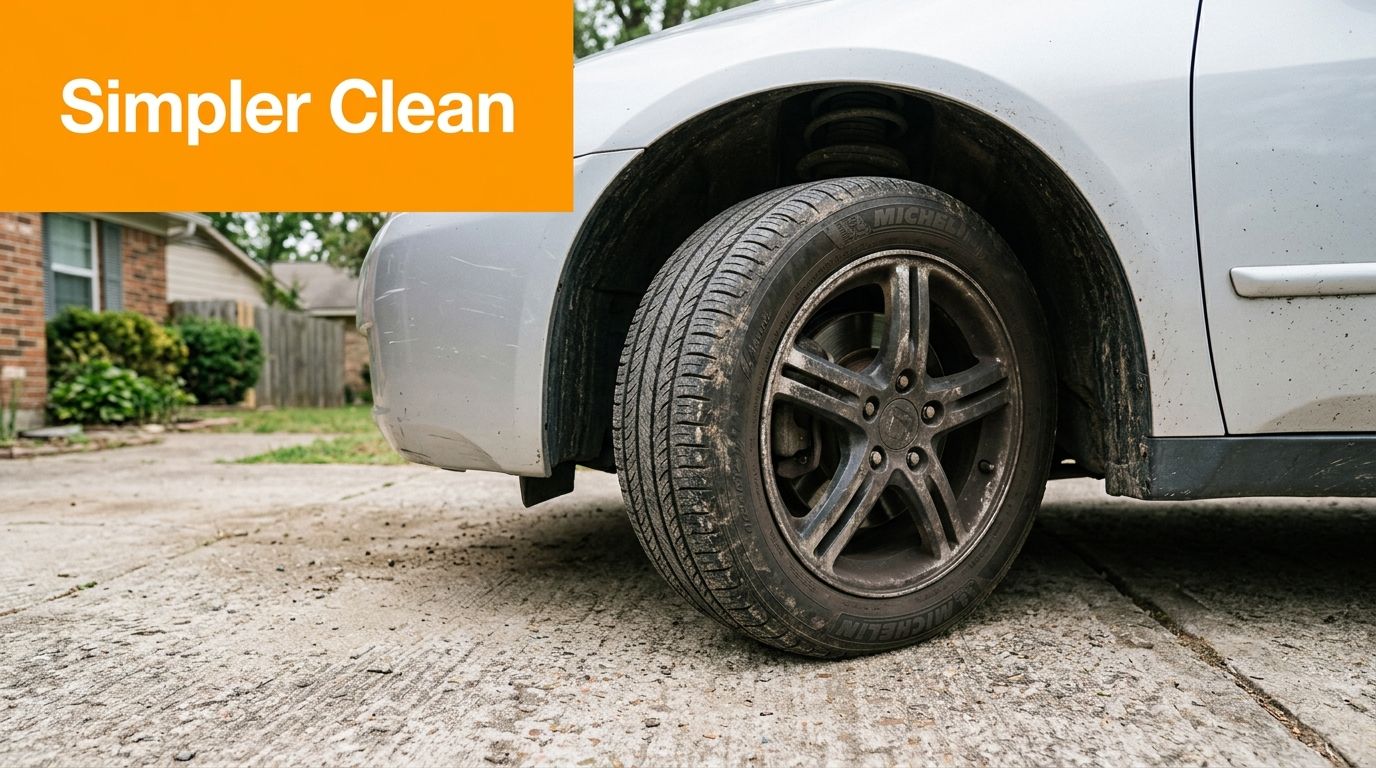
When you're washing a daily driver, an RV, a motorcycle, or even outdoor furniture, the goal usually isn't stripping years of buildup off concrete. It's getting to a clean surface without dragging out a machine, dealing with cords or fuel, and worrying about whether one bad pass will mar the finish.
What people actually want
Most readers looking for a pressure washer alternative are after some mix of these:
- Safer washing for paint: Especially on newer cars, soft trim, decals, and plastic pieces.
- Less setup: Hook up the hose, mix soap, wash, rinse, done.
- Smaller footprint: Something that fits on a shelf instead of taking over a corner of the garage.
- More realistic ownership: A tool you'll use weekly or monthly, instead of once every season.
That demand isn't niche. Cleaning equipment keeps moving into mainstream home use because people want professional-looking results without commercial-level complexity.
Practical rule: If your main job is washing vehicles, not blasting masonry, start by asking how gentle the tool is, not how aggressive it sounds.
Different tools, different wins
A common pitfall in advice: A foam gun, a spray nozzle, a pump sprayer, and a compact washer don't solve the same problem. They overlap, but they don't replace each other cleanly.
A good pressure washer alternative should be judged on the job it's built for. On cars, safe soap delivery and controlled rinsing matter a lot more than brute force. On patios, brute force matters more. Once you split those tasks apart, the choices get easier.
Why You Might Not Need a Pressure Washer
Pressure washers are effective. They're also easy to overbuy for the cleaning most homeowners perform.
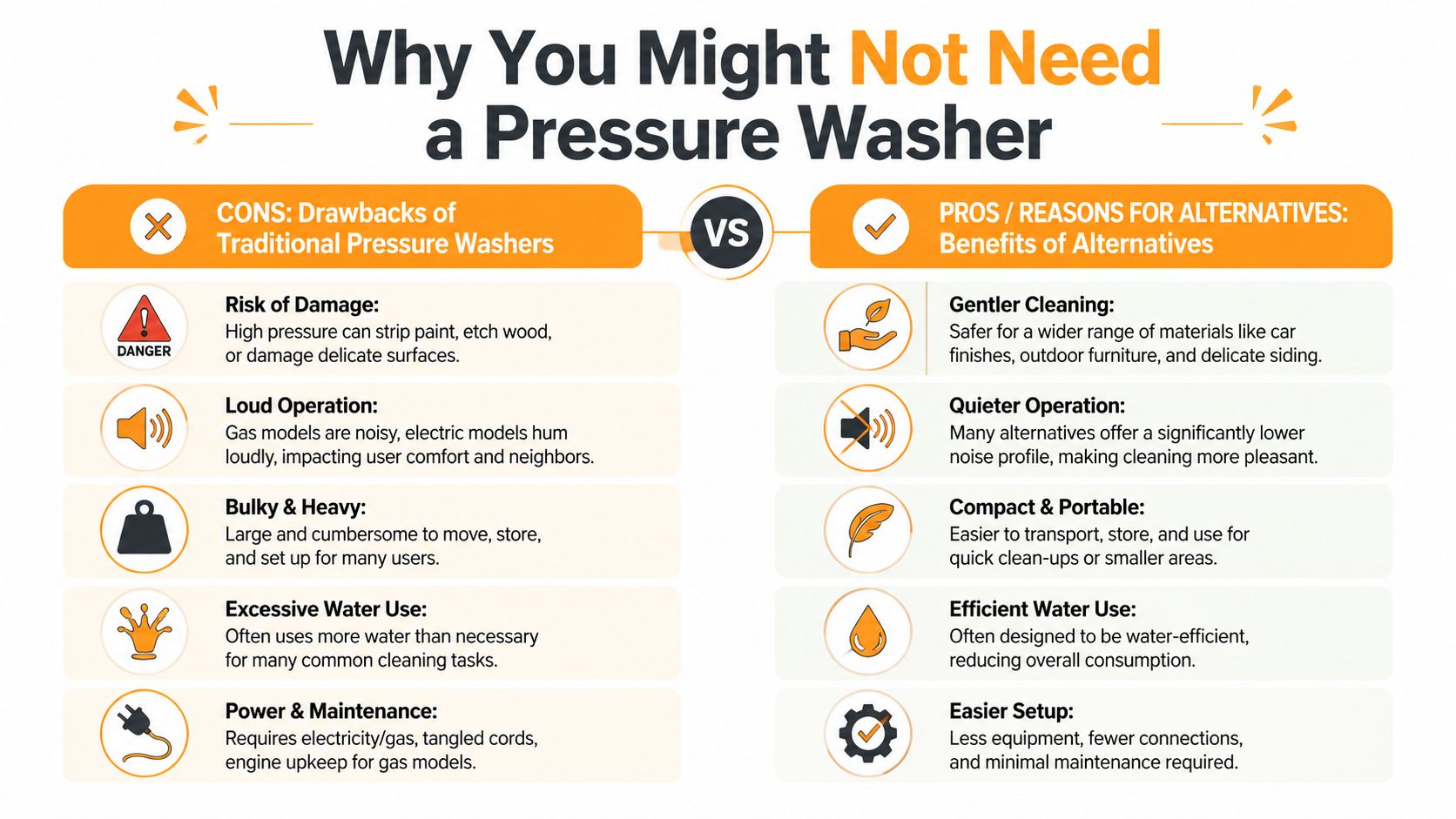
For vehicle care, the biggest issue isn't whether a pressure washer can clean. It's whether that extra force helps more than it hurts. According to Hotsy of Memphis, common tips on standard consumer units can push pressure over 1,000 psi, and that level carries a real risk of surface damage on paint and other delicate materials.
The trade-offs are real
Even if you ignore the purchase price, a pressure washer comes with practical baggage:
- Storage: The machine, hose, wand, tips, and power setup all need room.
- Noise: Gas units are the obvious offenders, but even electric machines aren't subtle.
- Setup time: Pulling out the unit, connecting lines, and cleaning up after use turns a quick wash into a longer job.
- Risk: The wrong tip or distance can do damage fast.
For someone washing a car every week or two, that can be more tool than task.
The safety issue matters most on vehicles
A car isn't a concrete slab. Paint, clear coat, badges, rubber seals, trim, soft plastics, and older finishes all respond differently to water pressure. That's why a lot of detailers and careful DIY owners prefer lower-pressure methods for maintenance washes.
If you're also weighing the bigger cost of home exterior cleanup, it helps to look at broader budgeting for home refresh decisions before buying a machine for one or two specific jobs. Renting or hiring out heavy cleaning can make more sense than owning a tool you'll rarely use.
A pressure washer is great when the surface can take it and the grime demands it. It's a poor fit when the surface is the expensive part.
When skipping one is the smart move
You probably don't need a pressure washer if your main routine looks like this:
- You wash vehicles regularly: A gentler process is usually the smarter long-term play.
- You live in a townhouse, apartment, or smaller home: Storage and noise become a bigger issue.
- You want quick maintenance washes: Hose-based tools are faster to deploy.
- You're not comfortable managing spray distance and nozzle choice: That hesitation is justified, not timid.
For home and auto owners, choosing a pressure washer alternative often isn't settling. It's matching the tool to the actual risk.
Comparing Top Pressure Washer Alternatives
For car care, the useful question isn't “What replaces a pressure washer?” It's “What gets my surface clean enough, safely enough, with the least hassle?”
For context, Forbes notes that for standard vehicle cleaning, 1,800 to 2,800 PSI is considered sufficient yet safe, while higher pressure can risk paint damage. That benchmark matters because most alternatives sit well below that level. That's a limitation, but on paint, it can also be a feature.
Pressure Washer Alternative Comparison
| Alternative | Effective Power | Average Cost | Best For |
|---|---|---|---|
| Foam gun or foam cannon for garden hose | Low pressure, strong soap delivery | Low to moderate | Routine car washing, pre-soak, gentle rinsing |
| High-pressure hose nozzle | Low to moderate flow concentration | Low | Quick rinse-downs, mats, light dirt |
| Cordless or compact electric washer | Moderate, closer to true washing power | Moderate to high | RVs, bikes, light exterior cleaning, mobile use |
| Traditional hand washing | Manual agitation, no pressure boost | Low | Controlled contact washing, delicate finishes |
| Steam cleaner | Targeted heat rather than rinse force | Moderate to high | Interior trim, crevices, spot cleaning |
| Chemical cleaner with pump sprayer | Depends on cleaner and dwell time | Low to moderate | Bug residue, wheels, pre-treatment |
| Rental pressure washer | High, real pressure washer output | Variable | Occasional heavy-duty jobs like concrete or stripping buildup |
Foam guns and hose-fed foam cannons
For vehicle owners, this is the most honest alternative to discuss because it doesn't pretend to be something else. A foam gun doesn't create pressure washer force. It lays down soap, softens grime, and improves lubrication before you touch the paint with a wash mitt.
That's why it works. The foam gives dirt time to loosen, and the contact wash does the actual finish work. For maintenance washes, that combination is often safer than chasing more pressure.
What it won't do is blast packed mud out of deep tread blocks or strip old grime off hardscape. If you expect that, you'll be disappointed.
High-pressure hose nozzles
A quality hose nozzle has a place. It can tighten the spray pattern, improve control, and make rinsing easier than using an open hose end. For floor mats, wheels, and quick cleanup, it's fine.
But the jump in performance is often overstated. These nozzles concentrate what your hose already provides. They don't transform household water into true pressure washer output.
Buyers often confuse spray intensity with actual cleaning muscle. They aren't the same thing.
Cordless and compact electric washers
These sit in the middle. They're more capable than a hose attachment and easier to live with than a full-size machine. For RV owners, apartment detailers, or anyone washing in places where full water hookups are awkward, they can make sense.
The trade-off is consistency. You gain portability and lose some sustained output. For light exterior work and moderate grime, they're useful. For a weekly sedan wash, they can still be more machine than you need.
Traditional hand washing
Done correctly, hand washing remains one of the safest ways to clean paint. It's slow compared with spray-first methods, but it gives you total control over pressure, contact, and problem areas.
It also exposes a common mistake in the pressure washer conversation. Water alone rarely delivers a polished result. Most of the quality comes from lubrication, mitt choice, rinse discipline, and drying technique.
If your car isn't heavily contaminated, careful hand washing will outperform a “powerful” but sloppy setup every time.
Steam cleaners
Steam is useful, but mostly in specialized roles. It excels at badges, vents, jambs, trim edges, cupholders, and greasy spots. It's not a whole-car exterior replacement for rinsing and washing.
For detailers, steam is a support tool. For homeowners, it's easy to overestimate because it feels technical and precise. It solves narrow problems well. It doesn't replace basic wash equipment.
Chemical cleaners and pump sprayers
This category is underrated. A good pre-wash cleaner, bug remover, wheel cleaner, or all-purpose cleaner in a pump sprayer can do a lot of the heavy lifting before water even enters the equation.
The key is chemistry and dwell time, not force. That makes this route especially useful for wheels, lower panels, bugs, and greasy trim. It also pairs well with a foam gun or hand wash setup.
Rental services and occasional heavy-duty use
If you only need serious cleaning power once in a while, renting is often the smarter route. That's especially true for concrete, fencing, deck restoration, or anything where real pressure is the point.
This is the same logic people use in other maintenance categories. If you compare one-time tool use against ownership, borrowing or renting often wins. The same practical mindset shows up in Pool & Landscaping of Vistancia LLC's recommendations for choosing purpose-built equipment instead of forcing one tool to do every outdoor job.
The short version
If your main target is car paint, the strongest pressure washer alternative usually isn't the one with the hardest spray. It's the one that gives you:
- enough rinse ability,
- good soap coverage,
- safe contact washing,
- less chance of damage.
That points most vehicle owners toward a foam gun plus proper hand-wash technique, not a fake pressure-washer wand.
A Reality Check on Garden Hose Attachments
Honesty matters most. A lot of “power washer wand” products sell the idea that a brass tip and a long tube can turn a garden hose into a pressure washer. That's not how it works.
A real pressure washer uses a pump to raise pressure. A hose attachment changes spray pattern and flow concentration. Those are not the same thing.
Why the marketing feels convincing
A narrow stream can look powerful. It can reach farther, hit a tighter spot, and feel sharper on your hand. That visual effect makes people assume the cleaning power has jumped in the same way.
In practice, it usually hasn't.
A YouTube test of the Turbo Jet Power Washer showed it performed no better than a standard hose nozzle. That lines up with what many detailers see in real use. These attachments can be handy, but they don't deliver pressure washer performance.
PSI versus flow
People mix these up all the time:
- Pressure: How forcefully water hits the surface.
- Flow: How much water moves through the tool.
A hose attachment can shape flow. It doesn't create pump-driven pressure out of nowhere. If your home already has weak water delivery, the attachment won't fix the root problem. If that's your situation, basic plumbing checks for fixing low water pressure are more useful than buying another nozzle.
For car washing, that limitation isn't fatal. It just needs to be understood clearly. A hose-fed foam tool can still be very useful because its job is soap application and safe rinsing, not pretending to be a pressure washer. If you want a practical example of that approach, this guide to car washing with a foam cannon shows the method in the right context.
Don't judge a hose attachment by how aggressive it looks. Judge it by what it actually helps you clean.
What these attachments are actually good at
They still have uses:
- Light rinsing: Dust, pollen, and loose dirt.
- Quick cleanup: Floor mats, patio chairs, muddy boots.
- Reach: Getting water into spots that are awkward with an open hose.
- Convenience: Faster than dragging out larger equipment.
The mistake is expecting them to replace a machine built around a pump. They won't.
How to Get a Professional Clean with Top Alternatives
Once you accept the power limits, the process gets easier. Good results come from the wash method, not just the hardware.
For vehicle owners, two approaches consistently make sense without needing a pressure washer: a foam-gun-assisted wash and a proper two-bucket hand wash.
The foam gun method
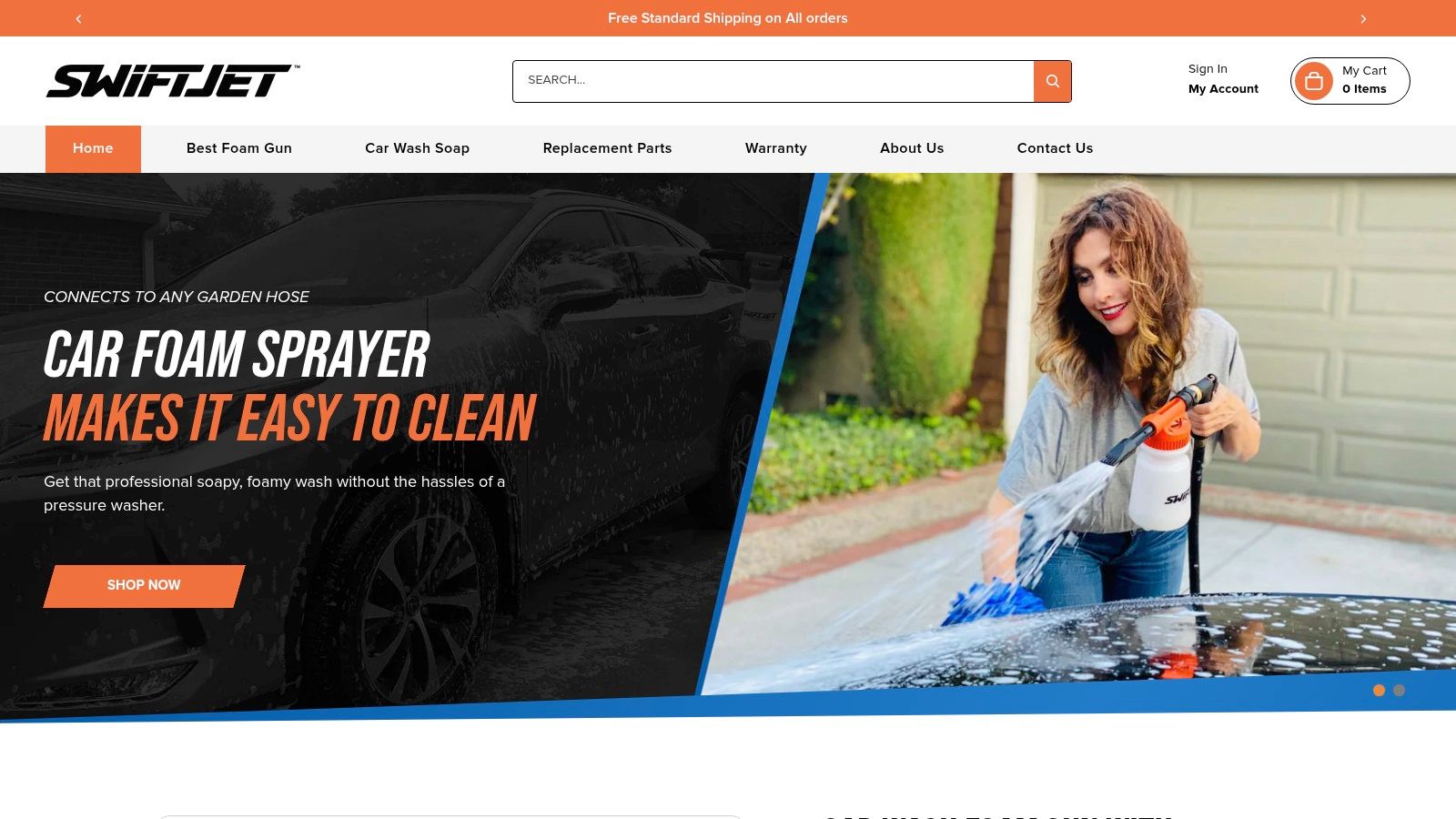
A hose-fed foam gun works best as a pre-soak and lubrication tool. It's there to cover the panel, loosen grime, and reduce friction before your mitt touches the surface. One example is the SwiftJet Car Wash Foam Gun, which connects to a garden hose and applies soap through a trigger-controlled sprayer.
Use it like this:
- Rinse loose dirt first. Focus on the lower doors, rocker panels, wheels, and rear bumper where grit collects.
- Apply foam generously. Start at the top and work downward so the soap has time to dwell on dirtier lower sections.
- Wash with a microfiber mitt. Use straight-line passes, not hard circles. Reload the mitt often.
- Rinse panel by panel if needed. Don't let soap bake on in direct sun.
- Dry with a proper drying towel. Blot or glide lightly. Don't grind leftover water into the paint.
This method shines on maintenance washes. It's quick, gentle, and repeatable.
Shop habit: The cleaner the car is before your mitt makes contact, the better your finish usually looks after drying.
The classic two-bucket wash
If you don't want another attachment, the two-bucket method still works. It's slower, but it gives very consistent results.
You'll want:
- One wash bucket: Filled with car shampoo solution.
- One rinse bucket: For releasing dirt from the mitt.
- Grit guards if you have them: They help keep debris lower in the bucket.
- A dedicated wheel tool set: Don't use your paint mitt on wheels.
The key is discipline. Wash a section, rinse the mitt, reload with soap, then move on. That keeps old grit from coming back onto the paint.
Here's a walk-through of safe wash technique in motion:
Where waterless options fit
Waterless and rinseless-style methods can help when access is limited or the vehicle only has light dust and fingerprints. They are not the right move for thick mud or abrasive grime, but they can be practical in apartments, garages, or travel situations.
If you're considering that route, this overview of a waterless car wash is useful as a companion method, not a universal replacement.
What makes the result look professional
Professional-looking results usually come from a few boring habits:
- Wash in the shade: Soap behaves better and dries slower.
- Start with the dirtiest risk zones in mind: Lower panels and wheels need separate attention.
- Use clean media: Dirty towels ruin finishes faster than weak water pressure ever will.
- Dry properly: Most streaks and marring happen after the rinse, not during it.
The main takeaway is simple. A pressure washer alternative can produce a very clean vehicle if your process is sound.
Matching the Right Alternative to Your Cleaning Task
The right tool depends on what you're cleaning and what “clean enough” means for that job.
A car enthusiast chasing a swirl-free finish usually does best with a foam gun and careful contact wash. An RV owner at a campsite may prefer a compact washer or a low-water method because setup matters more than perfect correction-safe technique. A homeowner trying to revive a stained deck is often better off renting a true pressure washer instead of fighting the job with underpowered tools.
Real-world matches
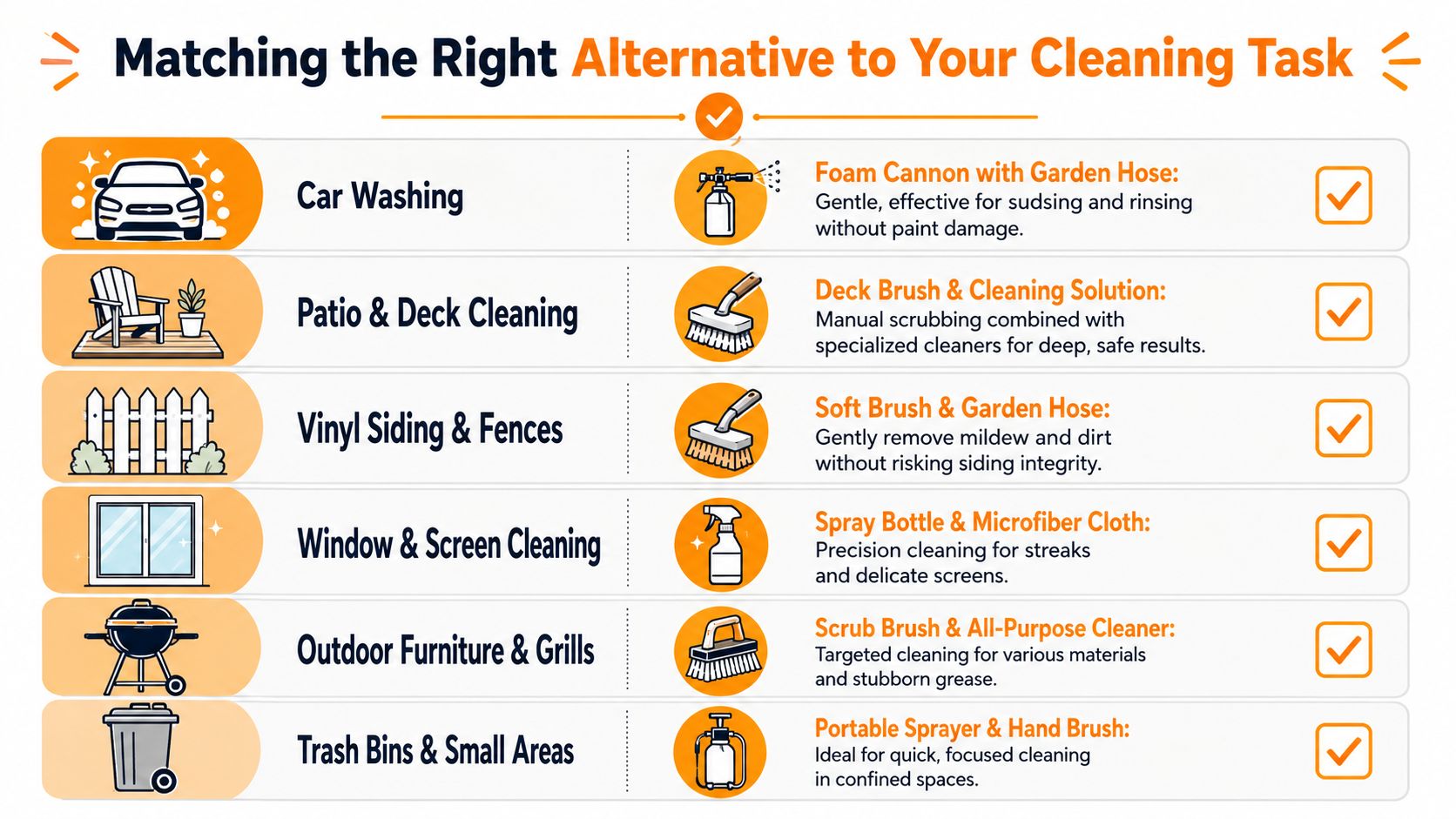
- For a weekly-driven car: Choose a foam gun plus mitt wash. That setup is gentle and easy to repeat.
- For motorcycles and bikes: A hose nozzle, soft brushes, and targeted cleaner often work better than broad high-pressure spray.
- For wheel wells and undercarriages: Access matters as much as power. A specialized angled accessory is often the missing piece for these areas, as shown in this discussion of hard-to-reach cleaning and angled attachments for wheel wells and undercarriages.
- For patio furniture, screens, and siding touch-ups: Soft brush plus hose is usually enough.
- For steam-style spot work: Tools in the same category as the Vapamore MR-100 approach to detailing tasks fit better for crevices and interior cleanup than for full exterior washes.
One mistake to avoid
Don't ask one tool to do every job. That's how people end up disappointed with hose wands and overly aggressive with pressure washers.
If the surface is delicate, choose the gentler method. If the contamination is heavy and structural, rent the stronger machine. Matching the tool to the task is what saves time, money, and finishes.
So Which Pressure Washer Alternative Should You Choose
If your main goal is safe, effective vehicle washing, the most sensible pressure washer alternative is a foam gun paired with a proper hand-wash routine.
That combination gives you what most car owners need. Good soap coverage. Better lubrication on the paint. Enough rinsing ability for maintenance washes. Lower risk than blasting panels with high pressure. It also stores easily, sets up fast, and makes routine washing more likely to happen.
If you need to clean concrete, strip buildup, or tackle heavy exterior restoration, a real pressure washer still has its place. But that's a different job with a different risk profile.
For cars, trucks, and RVs, the honest answer is this: the best alternative isn't the one pretending to be a pressure washer. It's the one built for washing vehicles safely and consistently.
If you want a simple hose-based setup for vehicle washing, SwiftJet is worth a look. It fits the kind of routine most home detailers follow: fast setup, foam-first washing, and safer paint care without dragging out a full pressure washer.
