

Ever wonder why your foam gun gives you that perfect, thick shaving-cream-like foam one day, and a runny, sad mess the next? The secret isn't your soap or even the gun itself—it's your garden hose PSI. This one thing is the make-or-break factor for getting a truly satisfying, sudsy car wash at home.
Why Your Garden Hose PSI Is Key to a Perfect Car Wash
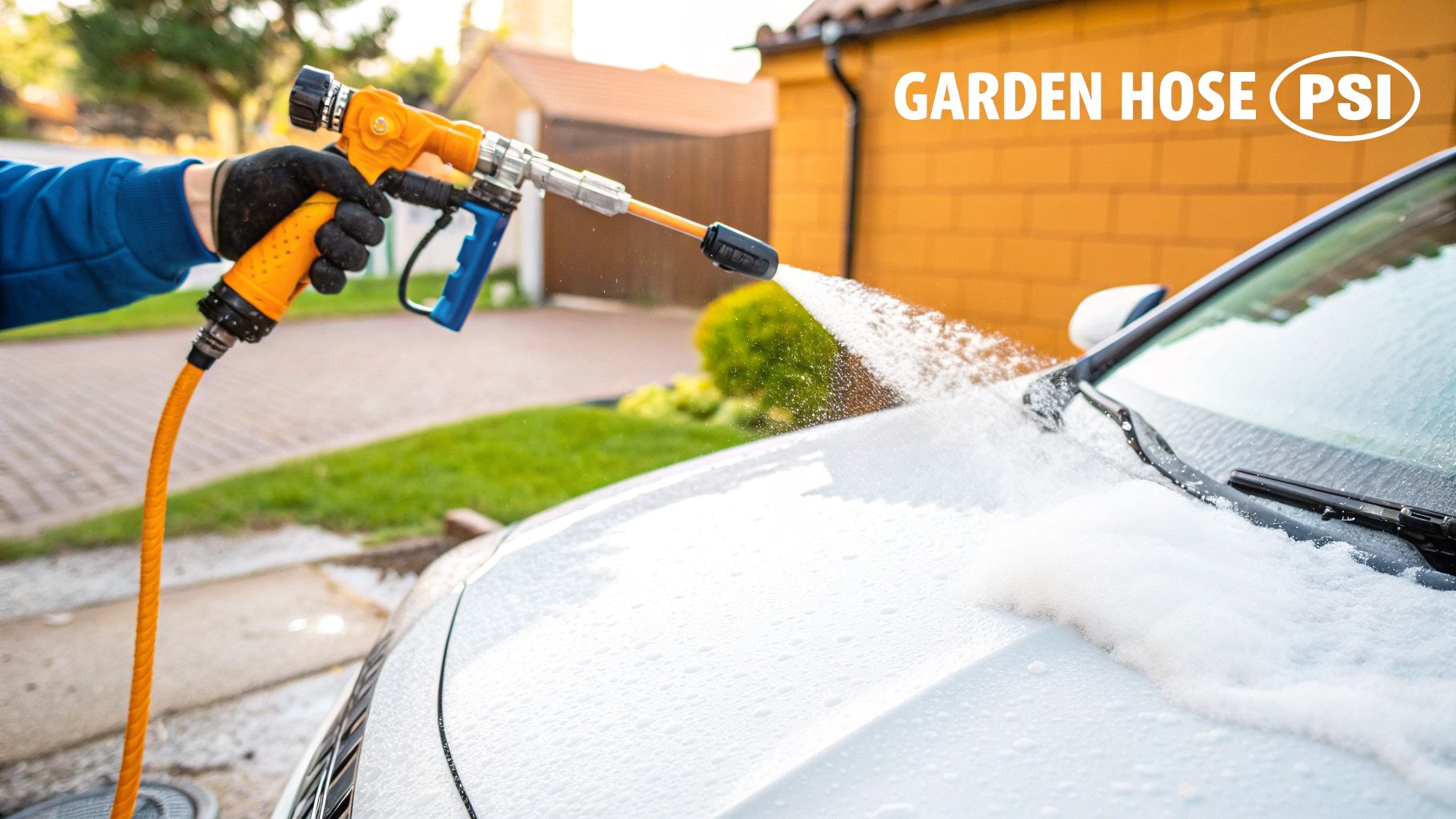
Let's break down what PSI really means. It stands for Pounds per Square Inch, and it’s all about the force behind the water coming out of your hose. It’s not a measure of how much water is flowing, but how hard it's pushing.
Think of it like this: trying to knock over a can with a slow, lazy softball toss won't do much. But a fastball? That’s going to send it flying. That’s the difference pressure makes.
When you hook up a foam gun like the SwiftJet, that water pressure is the engine that drives the whole operation. It’s what violently mixes your soap concentrate with air to create that thick, dirt-lifting foam. If your PSI is too low, the water just can’t agitate the soap properly. You end up with a watery, weak solution that just slides right off your car, taking almost no dirt with it.
The Connection Between Pressure and Performance
Get the pressure right, though, and you create the perfect storm of soap, water, and air. This ideal force is what allows your foam gun to churn out dense, clinging suds that stick to your vehicle’s paint. This "dwell time" is absolutely critical—it gives the cleaning agents in the soap a chance to get to work, breaking down all that stubborn road film and grime.
Ultimately, this means you get a much better clean with less scrubbing and less wasted soap. You can see how this fits into the bigger picture in our complete guide on how to properly wash a car.
The right PSI is the difference between simply wetting your car and truly cleaning it. It transforms a standard hose into a powerful cleaning tool, enabling your foam gun to perform exactly as it was designed.
Basically, getting a handle on your garden hose PSI unlocks the full potential of your entire car washing setup. It’s the first and most important step to getting that professional-level clean in your own driveway. Without enough pressure, even the best foam cannon and premium soap will fall flat, leaving you with a disappointing wash and a car that’s still dirty.
Finding the Ideal Water Pressure for Your Foam Gun
So, what’s the magic number for garden hose PSI to get that perfect, snowy foam on your car? The good news is that most homes already have what it takes.
In most American homes, the water pressure coming out of your spigot falls somewhere between 40 and 80 PSI. More often than not, it hovers right around 50-60 PSI. This isn't just a random number—it's the sweet spot, and it's what makes tools like foam guns work so well without needing a pressure washer.
This typical pressure range means your foam gun is pretty much designed to work perfectly with the water supply you already have. For instance, the SwiftJet Foam Gun is engineered to hit its stride in that 50-60 PSI zone, turning a simple car soap solution into the thick, dirt-lifting foam you're looking for.
Understanding the Pressure Sweet Spot
So why is that specific PSI range so crucial? Think of it like a perfectly balanced recipe.
If the pressure is too low (let's say below 40 PSI), the water and soap just won't mix with enough oomph. You’ll end up with weak, runny suds that slide right off your car. On the flip side, if the pressure is way too high (over 80 PSI), it can blast the mixture apart too forcefully, creating more of a misty spray than a thick foam.
The 50-60 PSI range strikes the perfect balance. It’s got enough force to whip up a rich, clingy foam but is gentle enough that you aren’t wasting soap or risking any damage to your car's finish.
Knowing this helps you understand what to expect. If your foam looks amazing, you’re probably right in that ideal zone. If it’s looking a little sad and watery, low pressure might be the culprit, and you now know where to start looking. You can get more tips on fine-tuning your setup in our guide to choosing the best car foaming gun.
Keep in mind that things like your home's plumbing, how far you are from the water main, and even what time of day it is can make your pressure wiggle around within that 40-80 PSI window. But for a great car wash, aiming for that mid-range sweet spot is always your best bet.
How to Measure Your Water Pressure in Minutes
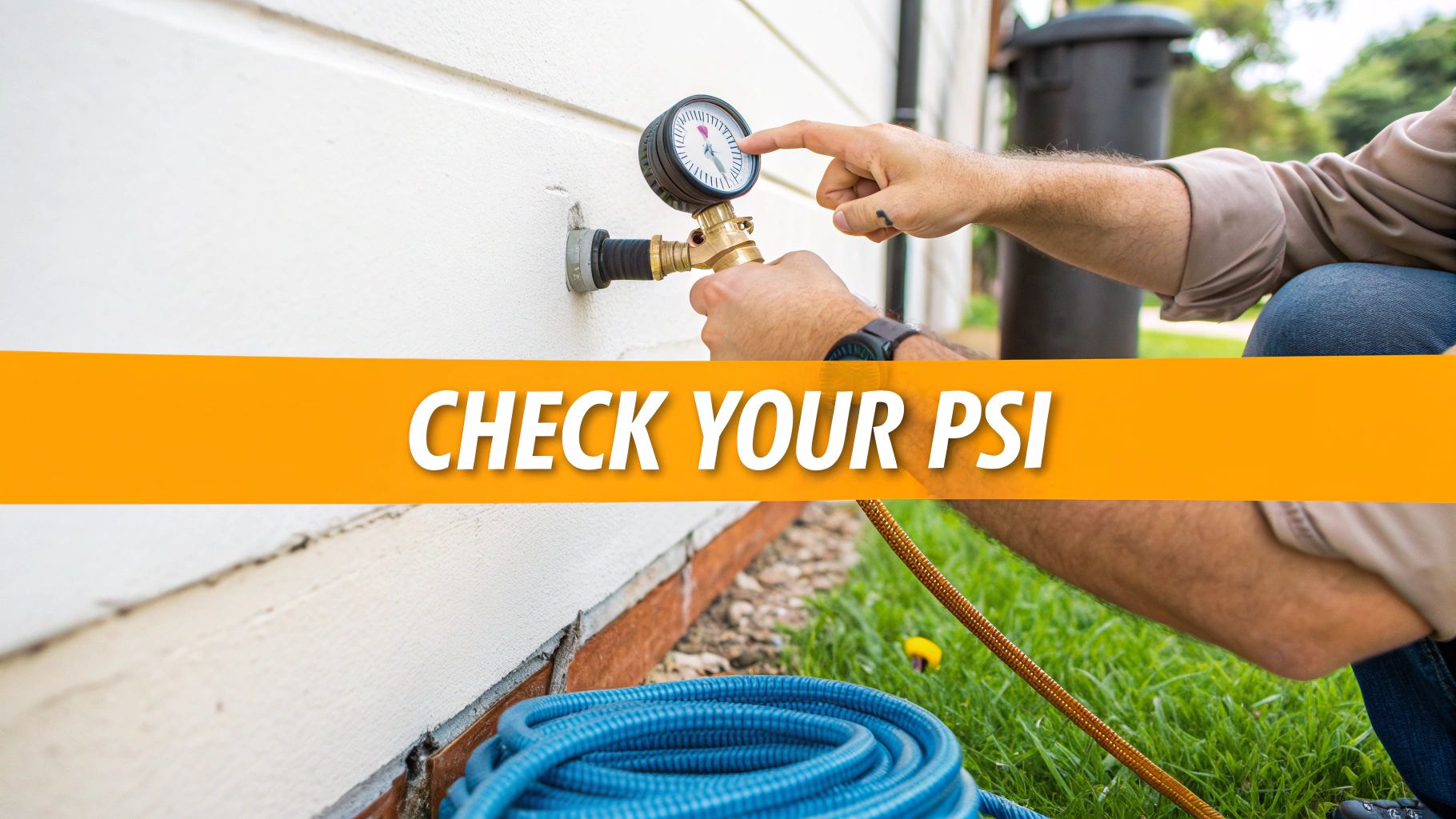
Stop guessing about your water pressure. Finding out the exact number is surprisingly easy, takes just a couple of minutes, and gives you crucial information for getting the most out of your foam gun.
All it takes is a simple water pressure gauge, an inexpensive little tool you can grab at any hardware store. This handy device just screws right onto your outdoor spigot, the same way you’d attach your hose. Knowing your precise garden hose PSI is the key to dialing in your entire car washing setup.
The Step-By-Step Measurement Process
Ready to get a reading? It’s a straightforward process. Just follow these quick steps to measure your home's static water pressure right at the source.
-
Prepare Your Home: First thing's first—make sure no water is running anywhere in your house. That means shutting off all faucets, sprinklers, dishwashers, and washing machines. We need to measure the baseline pressure when the system is just sitting still.
-
Attach the Gauge: Next, screw the water pressure gauge onto the threads of your outdoor spigot. Just hand-tight is perfect. You just want a snug fit so no water drips out and throws off the reading.
-
Get Your Reading: Now, turn the spigot handle all the way on. The needle on the gauge will instantly pop up and settle on a number. That’s it—that’s your PSI! Jot that number down.
Pro Tip: To get the truest reading of your home's maximum pressure, test the spigot closest to where the water main enters your house. This gives you the best picture of your pressure before it has to travel through all the pipes inside.
Thinking in terms of measurement can improve more than just your car wash. For instance, learning how to accurately measure soil moisture can completely change your lawn care game. Now that you have your PSI, you can start fine-tuning your tools for truly professional results.
Getting the Best Foam at Any PSI Level
So, you've tested your water pressure. Whether it came back surprisingly low, impressively high, or right in that sweet spot, you can absolutely get that thick, satisfying foam you're after. The trick isn't fighting your PSI, but learning how to work with it. A few simple tweaks to your setup can completely change your SwiftJet Foam Gun’s game.
If Your Pressure is on the Low Side
Let's say your reading came in below 40-45 PSI. Don't worry, this is a common scenario. Your main goal here is to remove any bottlenecks that are slowing down the water flow. Think of it like this: a long, skinny garden hose is like a one-lane country road, while a short, wide hose is a multi-lane highway. You want the highway.
- Go Shorter: A 50-foot hose has way less friction loss than a 100-foot hose, which means more pressure gets delivered to the foam gun.
- Go Wider: If you're using a standard 1/2-inch hose, swapping it for a 5/8-inch or even 3/4-inch diameter hose will make a huge difference in water volume.
- Seal it Up: Check every single connection, from the spigot to the hose to the foam gun. Even a tiny drip is precious pressure escaping before it can do its job.
Fine-Tuning Your Foam With High Pressure
Now, what if you're on the other end of the spectrum with pressure above 70-75 PSI? You've got plenty of power, but sometimes too much force can blast right through the soap, creating a thin, watery mess. The solution is simple: adjust the soap-to-water ratio on your foam gun. By dialing back the water mix (usually with the top knob), you allow the soap to properly mix and foam up, giving you that thick, shaving-cream consistency.
For a deeper dive into getting the perfect mixture, check out our guide on the best foam soap for cars.
No matter your PSI, a secure, leak-free connection is everything. A tight seal ensures every bit of available water pressure is channeled directly into the foam gun, which is critical for maximum sudsing power.
This brings up a point we often take for granted: how do all these different hoses and nozzles fit together so perfectly? It's all thanks to standardized threads, specifically the ANSI-ASME B1.20.7 standard in the US. This ensures the male hose thread (MHT) on your foam gun screws perfectly onto your garden hose's female hose thread (FHT).
Without this standard, we’d be dealing with leaky, pressure-robbing connections all the time. It's a small detail that makes a massive difference in your car wash setup. If you're curious, you can learn more about the history of garden hose standardization on Wikipedia.
Solving Common Water Pressure Problems
Is your foam cannon producing sad, soupy bubbles instead of thick, shaving-cream-like foam? Or maybe the spray just sort of sputters out? Don't worry. Most water pressure problems are surprisingly easy to fix. Let's walk through some common culprits and get your foam performance back on track.
This little flowchart is a great way to visualize the steps, whether your pressure is too low, too high, or just right.
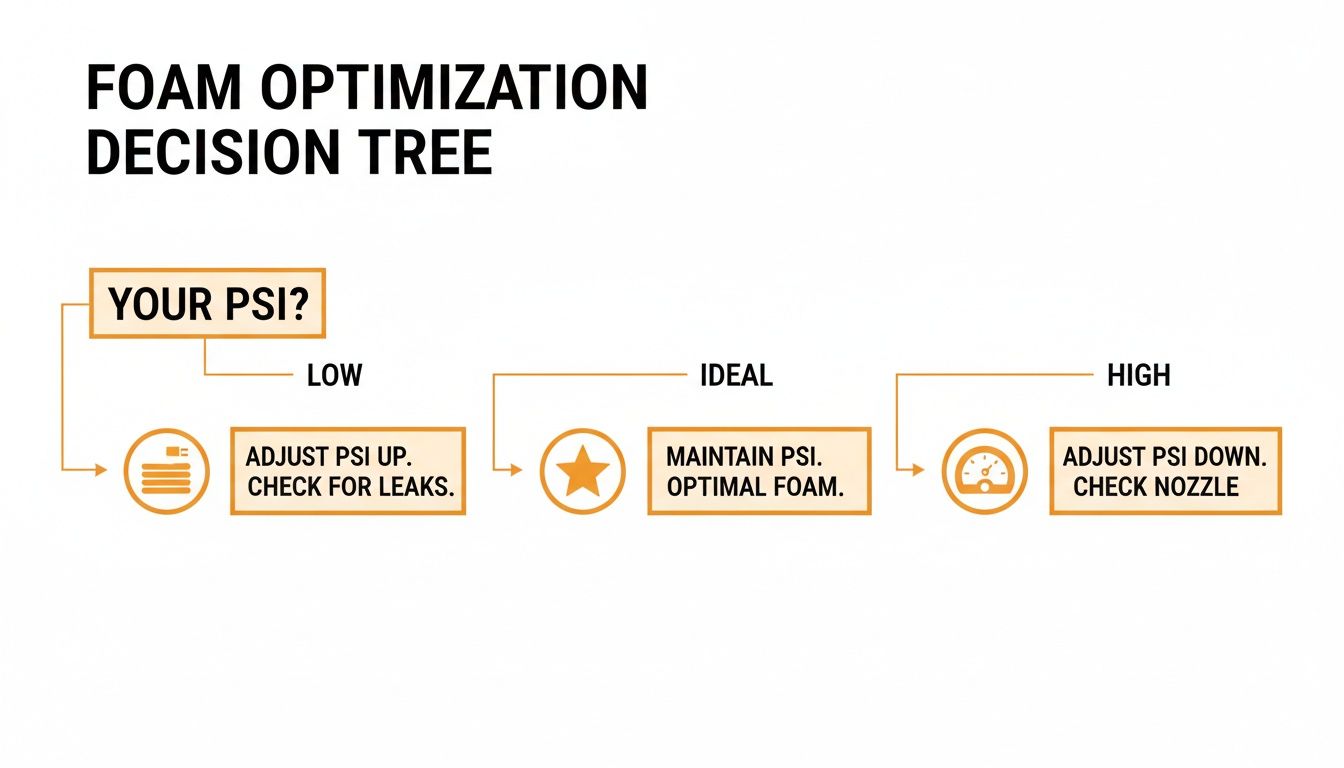
As you can see, no matter where you're starting from, a small tweak is usually all it takes to get that perfect, thick foam.
Diagnosing and Fixing Low Pressure
If you’re getting weak, runny foam, low pressure is almost always the problem. But before you start thinking you have a major plumbing issue, check for these simple things first. They’re the cause of low garden hose PSI nine times out of ten.
- Check the Spigot: It sounds almost too simple, but you’d be surprised how often the spigot isn't opened all the way. Make sure that valve is fully open.
- Look for Kinks: Take a walk along the entire length of your hose. A single sharp kink can choke off the water flow and absolutely destroy your PSI.
- Inspect Your Nozzle: Pop the foam gun off and check the nozzle for any grit, mineral deposits, or other gunk that might be clogging it up.
A common mistake is overlooking the simple things. Always start with the easiest potential fixes—the spigot, the hose, and the nozzle—before moving on to more complex solutions. Most pressure issues can be resolved in under a minute with a quick inspection.
What to Do About High Pressure
So what about the opposite problem? What if your pressure is so high it just creates a fine, misty spray instead of foam? Pressure that’s way too high (usually over 80 PSI) can be just as bad for foam production and puts a ton of stress on your equipment.
The best and easiest fix here is a simple, inexpensive pressure regulator.
This little brass fitting just screws onto your spigot, right before you attach the hose. It lets you dial back the pressure to that perfect 50-60 PSI sweet spot. You'll protect your foam gun and hose from wear and tear, and you'll get those perfect, thick suds every single time.
Got Questions About Garden Hose PSI? We've Got Answers.
Even after getting the hang of water pressure basics, you'll probably still have a few questions when you’re dialing in your car wash setup. Let's tackle the most common ones so you can get consistently incredible foam, every single time.
Can I Increase My Garden Hose PSI?
You can't really change the pressure coming from your city's water main, but you can absolutely make the most of what you've got. The goal is to reduce pressure loss—the natural drop in pressure as water travels from the spigot to your foam gun. Think of it like a commute: the fewer roadblocks, the faster you get to your destination.
Here’s how you can clear the path for your water:
- Go Shorter: A 50-foot hose will always deliver more power than a 100-foot one. Less travel distance means less friction, and less friction means more pressure at the business end.
- Go Wider: Upgrading from a standard 1/2-inch hose to a 5/8-inch or 3/4-inch model is like adding an extra lane to a highway. It allows more water to move with less resistance.
- Check for Bottlenecks: Make sure every connection is tight and there are no unnecessary nozzles or kinked spots restricting the flow before it reaches your foam gun.
While you could install a booster pump for a serious jump in pressure, it's usually overkill for just getting great foam.
Is Higher PSI Always Better for a Foam Gun?
Nope, and this is a big one. In fact, way too much pressure can work against you. If your garden hose PSI is pushing past 80 PSI, the water can blast the soap solution into a fine, watery mist instead of producing that thick, shaving cream-like foam you’re after.
The best foam happens in a "sweet spot." Quality foam guns, including the SwiftJet, are designed to work brilliantly within the typical home pressure range of 40 to 70 PSI. This range strikes the perfect balance between the force needed to mix the soap and the flow needed to create rich, clingy suds.
It's a bit like whisking eggs for a meringue. Going too fast and wild just splatters egg everywhere, but a steady, powerful motion creates perfect, stiff peaks.
Does the Length of My Garden Hose Affect PSI?
Absolutely. This is probably the single biggest factor you can control. The longer the hose, the more pressure you lose to something called friction loss. As water rushes through the hose, it scrapes against the inner walls, creating drag that slows it down. The result? Lower PSI when it finally exits the nozzle.
This drop-off is much more dramatic in long, skinny hoses. For the best possible foam gun performance, shorter is always better. If you absolutely need a long hose to reach around your vehicle, choosing a wider diameter can help make up for some of that unavoidable pressure drop.
What Is the Difference Between PSI and GPM?
It's easy to mix these two up, but they measure two very different—but equally important—things.
- PSI (Pounds per Square Inch) is all about force. Think of it as how hard the water is pushing.
- GPM (Gallons Per Minute) is all about volume. It's how much water is actually delivered over a set amount of time.
Here's an analogy: Imagine people exiting a stadium. PSI is how hard each person is shoving to get through the gate. GPM is how many people actually make it through that gate in one minute. For a foam gun, PSI provides the muscle to mix air and soap, while GPM ensures there’s enough water to create and sustain a thick layer of foam.
Ready to see what your home's water pressure can really do? The SwiftJet Car Wash Foam Gun is built to turn your standard garden hose into a foam-making machine. Upgrade your car wash game today at swiftjetusa.com.
