

You've probably had this happen. You fill a foam gun bottle, hook it to the garden hose, spray your car, and for one second it looks promising. Then the suds turn watery, slide down the doors, and vanish before they've done any real work.
That's frustrating because the whole point of foam is to give dirt a safe, lubricated pre-soak. If the foam runs off fast, it feels like you wasted soap, time, and effort. A lot of people blame the soap first. Others blame hose pressure. Both matter, but they're not the whole story.
The missing idea is foam density. Once you understand what makes suds light and runny versus thick and clingy, your wash gets easier to tune. The goal isn't just “more foam.” The goal is foam with enough body to stay put long enough to help loosen grime.
The Quest for the Perfect Clingy Foam
Most home washers start in the same place. They see those satisfying, blanket-like suds online, then try to recreate them with a garden-hose foam gun and get something closer to bubble bath water. It splashes on nicely, then disappears down the panels in thin streaks.
That's where people usually take a wrong turn. They add more soap, hoping brute force will fix the problem. Sometimes that helps a little. Often it just makes a messier version of the same weak foam.
A better way to think about it is this: foam has structure. If the structure is loose and airy in the wrong way, it collapses fast. If the structure is richer and tighter, it clings longer. That cling is what gives your wash solution time to sit on the paint instead of racing to the driveway.
Furniture foam offers a simple analogy. In upholstery, density is one of the best indicators of how well foam holds up over time. A standard 1.8 pounds per cubic foot cushion typically lasts 3 to 5 years, while 2.4 PCF foam can last over 10 years according to the Polyurethane Foam Association's foam performance guide. Car wash foam isn't measured the same way in your foam gun bottle, but the practical lesson carries over. More substance in the foam structure usually means better staying power.
Why your eyes care before your hands do
You can often tell within a second whether a wash is going well. Dense foam looks creamy and uniform. Thin foam looks patchy, wet, and transparent around the edges.
If you want a visual reference for the kind of rich, dramatic suds people chase, the finish shown in this Red Hot Lava car wash example is useful because it highlights what “cling” looks like on a vehicle surface.
Good foam should look like it wants to stay on the paint, not like it's trying to escape from it.
That's the shift that matters. Stop judging foam by how exciting it looks at the nozzle. Judge it by what it does on the panel.
Understanding Foam Density and Dwell Time
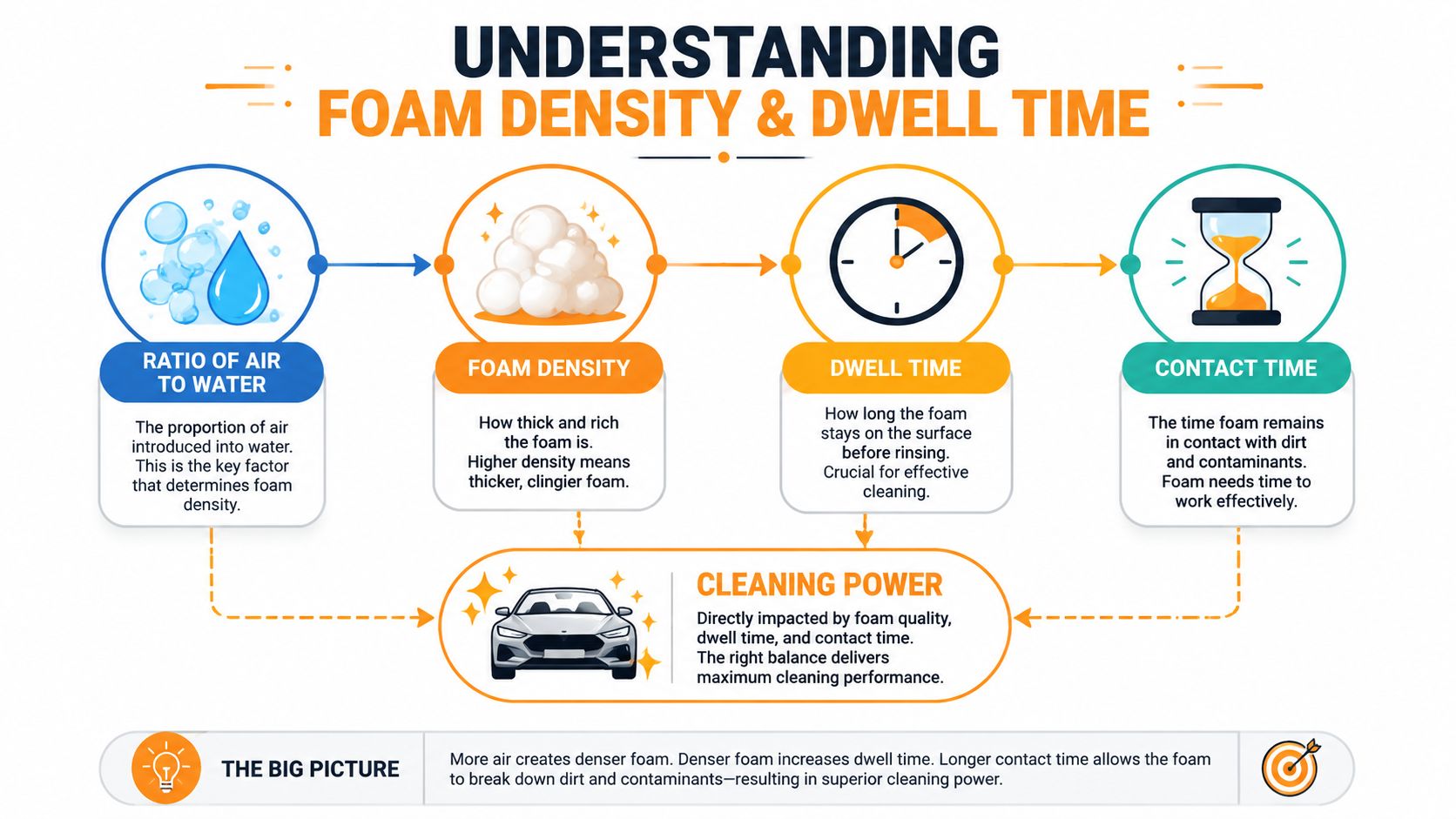
Foam density sounds technical, but the everyday version is simple. It's about how much actual soap-and-water solution is packed into the foam structure compared with how much air is whipped into it.
Think of three common textures:
- Watery dish suds break apart quickly and slide off fast.
- Shaving cream has body and stays where you put it.
- Whipped topping looks fluffy but can collapse faster than you expect.
For car washing, you want foam that behaves closer to shaving cream than watery sink bubbles. Not necessarily stiff. Just stable.
What density really means
In material science, density is mass per unit volume. A foam rated at 2.8 PCF means a 12 x 12 x 12 inch block weighs 2.8 pounds, which reflects how much material is packed into that volume, according to Sleep Foundation's explanation of foam density. More packed material helps foam resist collapse.
That same idea helps with car wash suds as a mental model. Your wash foam isn't being rated like a mattress topper, but dense suds still behave like a structure with more substance. They don't instantly flatten into water.
Why dwell time matters
Dwell time is how long foam stays on the car before it runs off or breaks down. If foam density is the body, dwell time is the result you care about.
Longer dwell time matters because soap needs contact with the dirt. Road film, light dust, and bug residue don't lift the second foam touches them. The cleaners need a little time to wet the grime and loosen it.
Here's the plain-language version:
- You spray the foam on.
- The foam clings.
- The soap stays in contact with dirt.
- The grime softens.
- Rinsing and mitt washing become easier and safer.
If the foam runs off too quickly, you lose that contact time.
Practical rule: Foam that looks dramatic for two seconds but turns into runoff immediately isn't helping much. Foam that hangs on the panel gives the chemistry time to work.
Dense doesn't mean cement-thick
Readers often get confused. They assume denser foam must mean insanely thick foam. It doesn't. The sweet spot is stable, clingy, and easy to rinse. You're not frosting a cake. You're laying down a lubricated cleaning blanket.
With a garden-hose foam gun, that balance is especially important because you don't have pressure-washer force doing part of the work for you. The foam itself has to earn its keep.
Why Foam Density Is Crucial for Car Washing
Dense foam isn't just satisfying to look at. It changes how the wash behaves on the paint.
If you wash with a hose-end foam gun, you're working with less mechanical force than a pressure washer setup. That means the quality of the foam matters even more. The suds need enough body to stay on vertical panels, soften grime, and leave lubrication behind for the contact wash.

Better foam gives the soap time to work
A direct relationship shows up in many types of foam products. Higher density materials tend to keep their performance longer because they contain more material in the same volume. McElheran's discussion of foam density notes that higher density means a longer functional lifespan, with 2.5 lb/ft³ memory foam lasting longer than lower-density options because it provides better support and resists collapse.
In car washing, the lesson is practical rather than literal. Foam that collapses fast leaves the panel fast. Foam that resists collapse gives the wash solution more time to loosen contamination.
It adds lubrication where your mitt needs it
A pre-foam stage isn't a magic shield, but it does help reduce friction. When the surface stays coated, your wash mitt glides over a wet, soapy layer instead of dragging across dry or barely lubricated dirt.
That matters most on horizontal surfaces and lower doors, where grime builds up and your hand pressure tends to increase without you noticing. Thick, clingy suds help you keep your motions lighter.
It can make the whole wash feel calmer
Thin foam makes people scrub harder because the surface looks unprotected. Dense foam changes your pacing. You rinse more deliberately. You work smaller areas. You trust the chemistry to do some of the loosening first.
For anyone who also handles towels, rags, and general cleaning workflows beyond car care, this broader guide on maintaining spotless commercial spaces is a useful companion because it reinforces how material choice affects surface results.
If you're still dialing in your wash solution, this guide to the best foam soap for cars is worth reviewing because soap choice and foam behavior always interact.
Thick foam doesn't clean by itself. It creates better conditions for the soap and your wash mitt to clean safely.
How to Control Foam Density with Your SwiftJet
A garden-hose foam gun gives you fewer variables than a pressure washer cannon, but the variables you do have matter a lot. Small changes in mixture, water flow, and technique can turn weak suds into clingier foam.
Start by changing one thing at a time. If you change soap amount, dial position, nozzle pattern, and water source all at once, you won't know what fixed the problem.
Start with the soap dilution
Use the shampoo's label recommendation as your baseline. That gives you a known starting point instead of a random guess.
Then test in small moves:
- If the foam is watery, increase concentrate modestly.
- If the foam feels sticky or doesn't rinse well, back the concentrate down.
- If the foam looks rich at first but dies quickly, the issue may be water flow or mix balance rather than soap quantity alone.
More soap doesn't automatically mean better foam density. Sometimes overloading the bottle creates heavy, messy suds that don't atomize well through the gun.
Adjust the top dial for structure, not drama
Most hose-end foam guns respond clearly to the mix dial. One direction gives you a wetter output. The other gives you a richer one.
The easiest way to judge it is on a vertical panel:
- Spray half the door with your current setting.
- Turn the dial one increment toward thicker foam.
- Spray the other half.
- Watch which side hangs on better and looks more uniform.
You're looking for even coverage with small, creamy bubbles. If the foam turns chunky or sputtery, you've probably gone past the useful range.
Use the spray pattern intentionally
Nozzle pattern changes foam behavior more than people expect. A wide fan often lays foam more evenly across a panel. A tighter stream can disturb the layer and push it downward before it has a chance to build.
Try this approach:
- Roof and hood often like a wider fan because it spreads foam quickly.
- Mirrors, grilles, and lower rocker areas sometimes respond better to a more focused stream.
- Second pass touch-ups work best with controlled overlap rather than blasting one area repeatedly.
That's also why technique matters. Sweep left to right with steady distance instead of flicking your wrist and creating patchy spots.
Don't ignore your hose and water supply
With a garden hose setup, your household spigot is part of the equation. If flow is weak, foam can come out thin even with a good soap and a good gun.
Check the simple stuff first:
- Hose kinks reduce flow.
- Partially open spigots starve the gun.
- Long, narrow hoses can make output feel softer.
- Attachments upstream can disrupt consistency.
For a deeper look at setup variables that affect output, this article on foam gun performance optimization is useful.
Water temperature and agitation both help
Warm water often helps soap mix more evenly than very cold water. You don't need hot water. You just want the solution to blend cleanly instead of feeling syrupy or separated.
Before spraying, gently shake the canister. Not like a paint shaker. Just enough to mix the concentrate and water thoroughly. If the bottle sits while you prep buckets and towels, shake it again.
A quick demo helps if you want to compare motion, spray pattern, and panel coverage in real time.
Build your own repeatable routine
The best results come from consistency. Once you find a combo that works, write it down on your bottle or in your phone notes.
A simple record might include:
- Soap used
- Approximate fill level
- Dial position
- Nozzle pattern
- Water source notes
- Weather conditions
If your foam was perfect last weekend and poor today, the cause is usually a changed variable, not bad luck.
That habit turns foam density from guesswork into a repeatable setup.
Practical Tests for Perfect Foam Density
You don't need lab gear to judge foam quality. Your eyes, a phone timer, and one clean panel tell you almost everything.
The trick is to test the foam on the car, not just in the air. Foam can look impressive coming out of the gun and still fail once it hits a vertical surface.
The vertical cling test
Spray a single door or fender evenly. Then watch how the foam behaves.
You're checking three things:
- Does it cover the panel evenly
- Does it hold together or separate quickly
- Does it slide off in sheets or creep down slowly
Slow, controlled movement is good. Immediate runoff is not. You don't need an exact stopwatch target to make this useful. Just compare one adjustment against the next and keep the setup that clings longer while still rinsing cleanly.
The shaving cream test
Stand close and look at the bubble structure. Good wash foam tends to look more like shaving cream than sink suds.
That means:
- Smaller bubbles
- More uniform texture
- Less transparency
- A creamy look instead of a frothy, loose look
Structure reflects stability. In foam materials, lower-density foam can lose far more height and structure under pressure. Foam by Mail's density comparison notes that 1.5 lbs/ft³ foam can lose over five times as much height as 2.2 lb/ft³ foam, which is a useful way to picture why weak structure breaks down faster.
Foam Density Cheat Sheet
| Foam Quality | Appearance | Dwell Time | Action Needed |
|---|---|---|---|
| Too thin | Large bubbles, watery edges, patchy coverage | Runs quickly | Increase solution strength slightly, improve mixing, check water flow |
| Just right | Creamy, even, shaving-cream look | Clings long enough to soften grime before rinsing | Keep settings consistent and repeat |
| Too thick | Heavy, uneven clumps, can feel sticky or hard to rinse | Hangs on, but may not spread or rinse evenly | Add more water or reduce concentrate slightly |
If you're comparing a hose-end setup with other foam tools, this guide to a pressure washer foam nozzle helps clarify why different tools produce different-looking foam.
Good foam should cling with purpose, not cling like paste.
Troubleshooting Common Foam Problems
Most foam problems come back to one of three things. Mix balance, water delivery, or expectations.
If you know what symptom you're looking at, the fix gets much simpler.
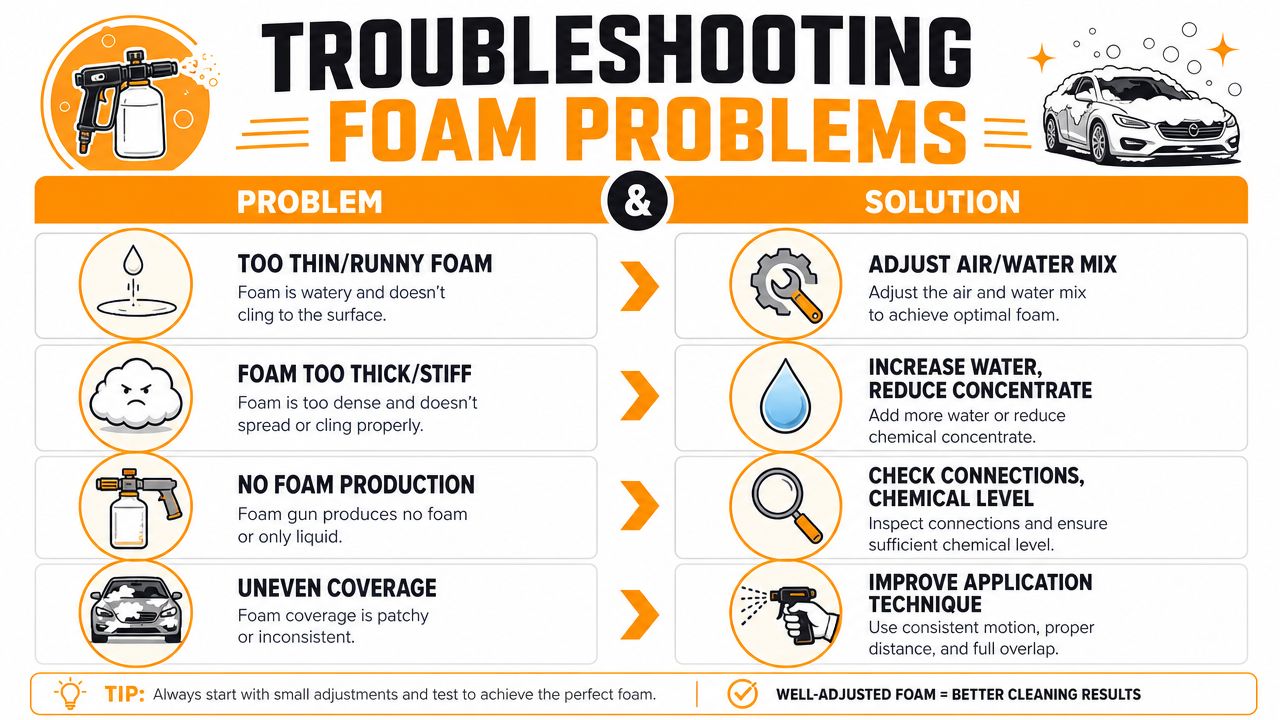
My foam is too runny
This is the most common complaint with garden-hose foam guns.
Check these first:
- Weak mix means there may not be enough soap in the bottle.
- Poor agitation leaves the solution unevenly blended.
- Low hose flow can flatten the foam before it forms properly.
- Wrong soap type can produce lots of bubbles in a bucket but weak cling through a foam gun.
Also look at your application method. If you spray from too far away, the foam can break apart before it reaches the paint.
My foam is too thick and clogs the gun
This usually happens when people chase “maximum foam” instead of useful foam. The output gets past creamy and into sludgy.
Try these fixes:
- Add more water to the bottle so the solution can move cleanly.
- Back off the concentrate a little.
- Clean the pickup and nozzle path if dried soap has built up.
- Test one dial step leaner and watch whether panel coverage improves.
Foam should flow. If it blobs, sputters, or leaves uneven ropes of soap, it's too rich for the setup.
My foam looks good but doesn't clean well
Looks can fool you. Nice visual foam doesn't guarantee strong cleaning.
Possible causes include:
- The soap is gentle by design, which can be fine for maintenance washes.
- The dwell time is okay, but not long enough for the level of grime.
- You're applying in direct sun, and the foam is drying before it can work.
- The vehicle needs a rinse-first approach because heavy grit is blocking the pre-soak from reaching the paint.
Dense foam helps, but it's still one part of the process. Pre-rinse, panel temperature, and wash technique still matter.
A common mistake is treating foam thickness like the whole game. Useful foam is balanced foam.
In foam products, density and firmness are separate properties. A 2.5 PCF foam can be very soft, while a 1.8 PCF foam can be very firm, as explained by FoamOnline's discussion of density versus firmness. The same mindset helps with car washing. Dense foam doesn't have to be absurdly thick to be effective.
That last point saves people a lot of wasted soap. The target isn't the stiffest suds possible. It's foam with enough structure to cling, enough moisture to stay active, and enough flow to rinse away cleanly.
If you want an easier way to get thick, controllable suds from a standard garden hose, take a look at SwiftJet. It's built for people who want more foam and better coverage without moving to a pressure washer setup, which makes it a practical fit for driveway washes, RV cleaning, and regular weekend maintenance.
