

You're probably here because you've seen those satisfying wash videos where a car gets buried under thick white foam, and your own setup gives you something closer to soapy rain. That gap frustrates a lot of people. The tool is easy to buy, but the results aren't automatic.
A pressure washer foam nozzle can absolutely change your wash routine. It can lay down a blanket of foam that clings, softens grime, and makes the whole process feel more controlled. But the key isn't chasing the thickest suds at all costs. It's matching the tool to your machine, your paint, and your goals.
If you're still figuring out soaps too, it helps to start with a guide to car wash foam soap options and how they behave. Soap chemistry matters, but hardware matters just as much.
From Suds to Science Why Foam Matters
Most enthusiasts start the same way. Bucket, mitt, hose, maybe a pump sprayer. The wash gets done, but it doesn't feel efficient, and it definitely doesn't look like what detailers post online. The car gets wet, soap slides off fast, and dirt still seems glued to the lower panels.
That's where foam earns its place.
Foam isn't magic. It's a delivery method. A good layer of foam spreads soap over the panel more evenly and gives it time to sit on the surface before you rinse or contact wash. Much like shaving cream versus splashing water on your face, one stays put long enough to do its job.
Why the visual matters less than the cling
A lot of beginners judge foam by how dramatic it looks. Thick foam can be satisfying, but what you're really after is coverage and dwell. If the soap clings long enough to loosen traffic film and road grime, you're getting the benefit. If it runs off instantly, you're mostly watching a show.
Foam works best when it matches the machine pushing it. A cannon can't overcome a weak pressure washer by itself.
That's the part many buyers miss. They assume the bottle or nozzle creates the result on its own. In reality, the washer's pressure and flow, the orifice in the foam cannon, and the spray pattern all work together.
The real reason detailers use foam
For a fellow enthusiast, foam solves three practical problems:
- Better pre-wash coverage helps you coat mirrors, grills, badges, and lower doors before touching the paint.
- More controlled soap application lets you use your wash chemical where you want it instead of flooding the whole driveway.
- Safer wash workflow makes it easier to loosen grime before your mitt touches the panel.
Used properly, foam makes the wash feel calmer. You're not rushing to keep soap alive on the paint, and you're not dragging a dry mitt across dusty panels.
What Is a Pressure Washer Foam Nozzle
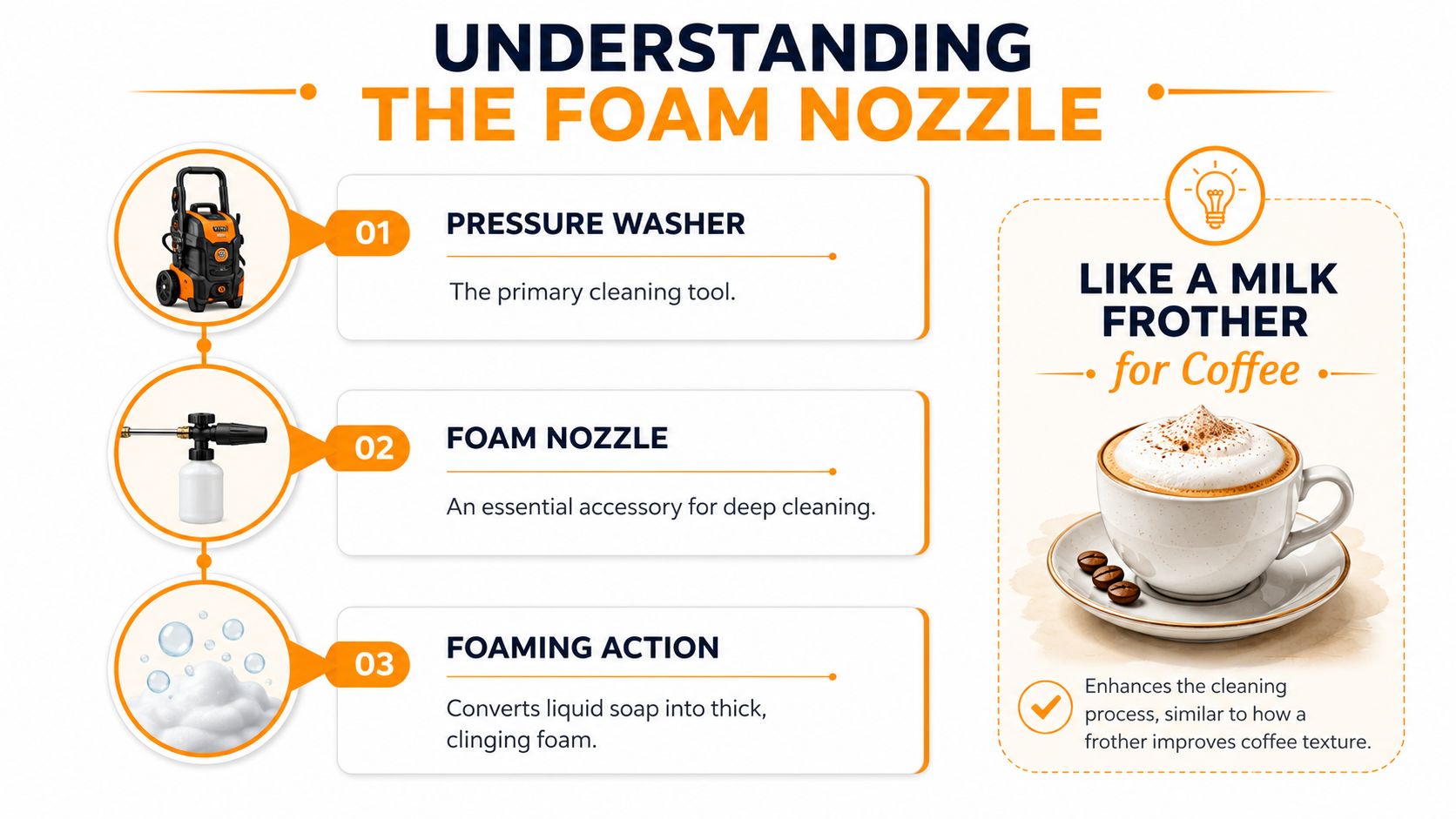
A pressure washer foam nozzle, often called a foam cannon, is a pressure washer attachment that mixes water, soap, and air into clinging foam. The easiest analogy is a milk frother. Your espresso is still coffee, but once a frother adds air and texture, it behaves differently. A foam cannon does the same thing for wash soap.
By the 2020s, consumer guidance clearly separated the tools: a foam cannon connects to a pressure washer, while a foam gun connects to a garden hose. That same guidance also notes that having at least 2,000 PSI generally produces better foaming than a low-pressure setup, which is why pressure washer systems are the usual choice when people want the thickest suds for detailing according to this foam cannon guide.
If you want a visual of what high-output foam setups are aiming for, this walkthrough on how to achieve a flawless showroom shine gives useful context on foam-cannon style washing.
The main parts that matter
Most foam cannons have the same basic anatomy:
- Bottle reservoir holds your diluted soap solution.
- Body and injector assembly mixes water and soap under pressure.
- Adjustment controls change the spray pattern and the soap-to-water behavior.
- Quick-connect fitting attaches to the pressure washer wand.
If you're still sorting out standard tip styles and wand fittings, a separate guide to pressure washer nozzle basics can help make the whole system less confusing.
How the foam forms
Inside the cannon, pressurized water rushes through a narrow passage. That fast-moving stream pulls soap solution from the bottle and mixes it with air. The result is a wet foam that sprays in a fan pattern onto the car.
You don't need to memorize fluid dynamics to use one well. Just remember this: the cannon is a mixer, not a miracle worker. It needs enough machine output to draw soap properly and break the mix into fine foam.
Practical rule: If your foam cannon feels inconsistent, don't blame the soap first. Check the machine, the fitting, and the nozzle setup together.
That's why two people can buy similar-looking cannons and get very different results. The hardware on the wand might match, but the pressure washer behind it may not.
The Physics of Foam PSI GPM and Orifice Size
This is the part that scares people off, but it's simpler than it looks. If you've ever put your thumb partly over a garden hose, you already understand the basics. Restrict the opening, and the water changes character. It shoots harder, but less volume gets through at once.
A pressure washer foam nozzle behaves the same way.
What the nozzle numbers mean
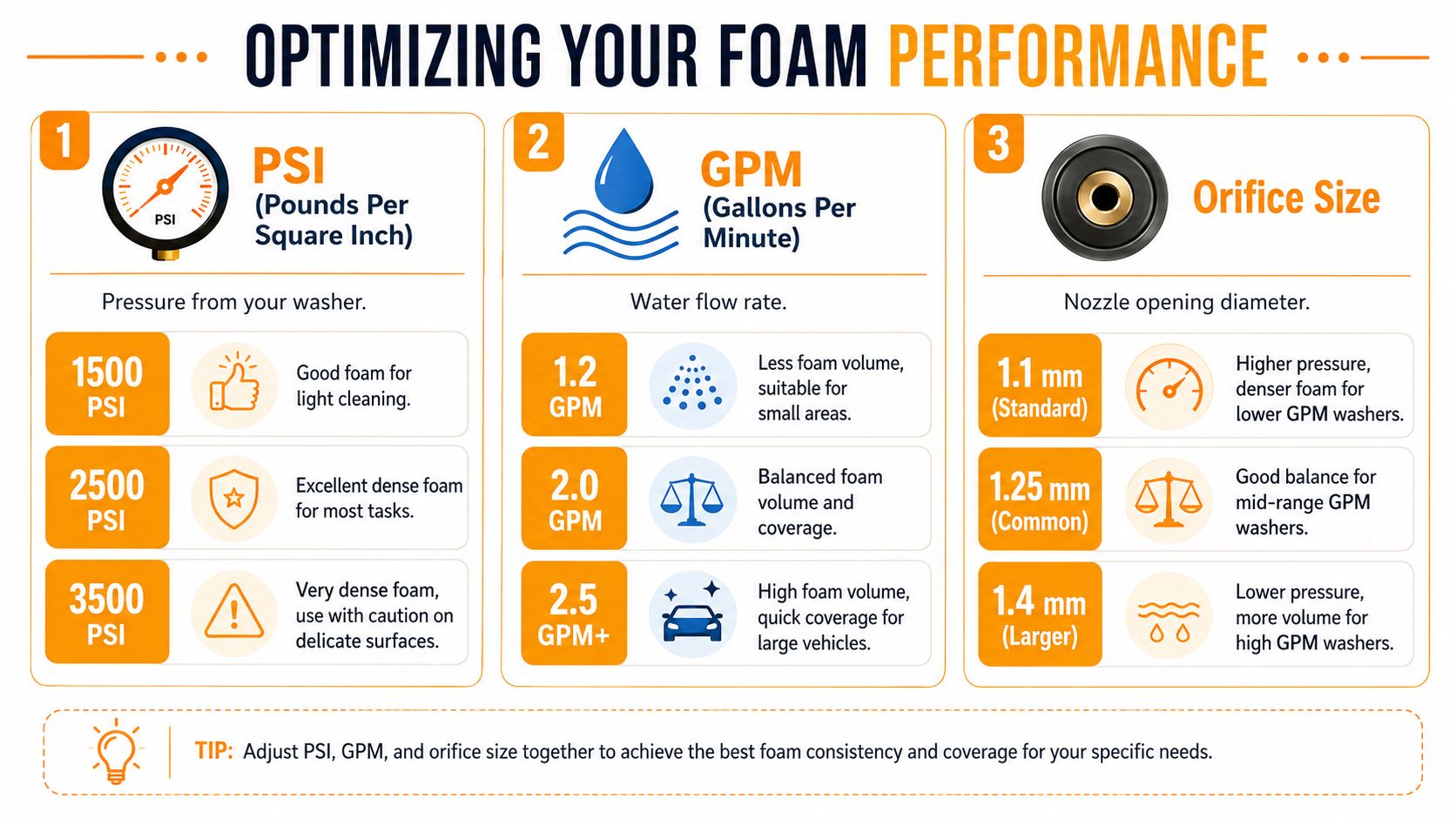
A pressure washer nozzle's performance is defined by spray angle and orifice size. In common coding, the first two digits show the fan angle and the last two show nozzle size. A tip labeled 15037 means a 15° fan angle with a 3.7 orifice rating. These sizes are calibrated at 4,000 PSI, and a 3.5 nozzle size is rated to pass 3.5 GPM at that pressure as explained in this nozzle guide.
That sounds abstract until you connect it to foam. Change the opening slightly, and you change how much solution moves through the system. That affects how dense the foam looks and how wide it spreads.
Why electric washers often need a different orifice
Foam cannons often work best when the orifice matches the pressure washer's real output. A smaller 1.1 mm opening is recommended for smaller electric washers, such as setups around 1600 PSI / 1.2 GPM, while 1.25 mm orifices suit medium electric machines. The opening controls the balance between pressure drop, flow, and foam density. Some industrial-style foam nozzles are also built for heavy-duty use, with examples rated to 220 bar / 3200 psi in this orifice guide.
If you're using a compact electric machine, especially a 2000 PSI electric pressure washer, this is usually where performance gets won or lost.
A quick way to think about compatibility
| Setup trait | What it usually means for foam |
|---|---|
| Lower flow electric washer | Often benefits from a smaller orifice to help produce denser foam |
| Mid-range electric washer | Often works well with the more common medium orifice setup |
| Stronger machine with more output | Needs enough opening to avoid choking the flow |
The key is balance. Too restrictive, and the machine struggles. Too open, and the cannon may produce thin, watery foam.
Dense foam isn't just a soap issue. It's the result of pressure, flow, and restriction working together.
Foam Nozzles vs Garden Hose Foam Guns
Many individuals often purchase the wrong product. They ask, “Which is better?” The more useful question is, which fits my setup and wash style?
A pressure washer foam cannon is built around pressure. A garden hose foam gun is built around convenience. Neither one is automatically the smarter tool.
What each tool does well
A pressure washer cannon usually gives you thicker, clingier foam when the machine has the output to support it. A hose-end foam gun gives you a wetter layer of suds, but it's faster to set up, easier to store, and less intimidating for casual washes.
The comparison gets clearer when you look at use, not hype.
| Feature | Pressure Washer Foam Cannon | Garden Hose Foam Gun |
|---|---|---|
| Foam density | Usually thicker when machine output is matched well | Usually wetter and lighter |
| Equipment needed | Pressure washer, wand, fittings | Standard garden hose |
| Setup time | More involved | Simpler |
| Surface safety feel | Requires more attention to pressure and distance | More forgiving for many users |
| Best fit | Enthusiasts, detailers, heavy pre-wash workflows | Casual users, quick washes, mixed household use |
When a hose foam gun is the smarter move
If you wash one or two vehicles at home and don't already own a pressure washer, a hose-fed tool often makes more sense. You lose some foam density, but you gain simplicity. You can wash more often because the process feels easy.
That's why products like the SwiftJet Car Wash Foam Gun exist in the first place. It connects to a standard garden hose and applies foam without requiring a pressure washer setup, which makes it a practical option for users who care more about convenience and safe routine washing than chasing cannon-level output.
When a foam cannon earns its keep
Choose a pressure washer foam nozzle if you already own a suitable machine, enjoy dialing in your setup, and want the detailing-style pre-wash experience. The machine and cannon need to be matched properly. As covered earlier, smaller openings like 1.1 mm are used on smaller electric machines around 1600 PSI / 1.2 GPM, while 1.25 mm suits medium machines, because orifice size controls pressure drop, flow, and foam density.
If your current washer is underwhelming, the foam cannon might expose that weakness instead of fixing it. In that case, a hose foam gun can be the more satisfying tool day to day.
How to Choose and Use Your Foam Nozzle
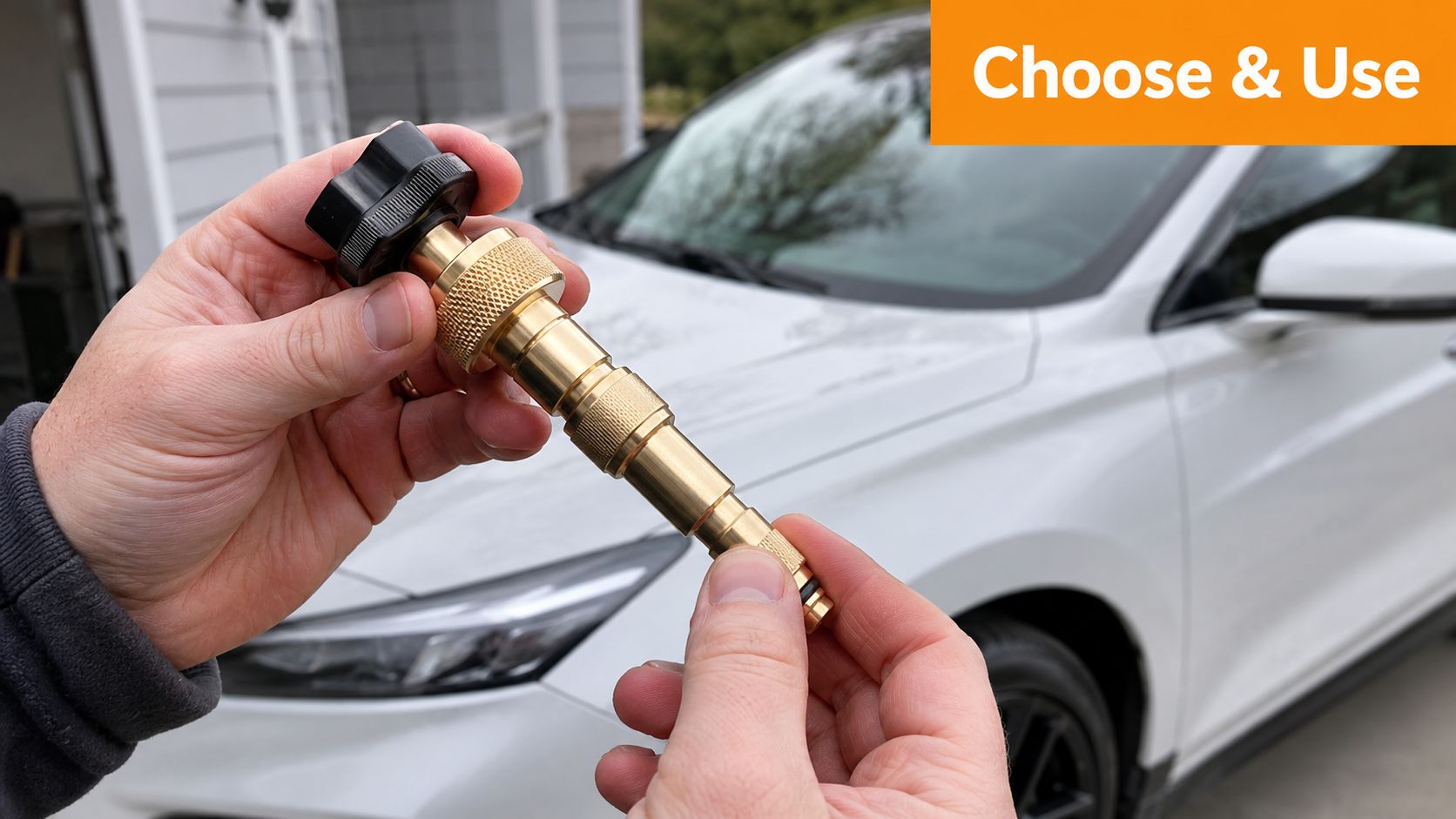
Buying the right foam cannon is easier when you stop shopping by bottle shape and start shopping by function. Good foam tools feel boring in the right way. They connect cleanly, adjust predictably, and don't make a mess when you set them down.
What to look for before you buy
Start with the parts you'll notice every wash:
- Stable bottle design keeps the cannon from tipping over while you fill it.
- Clear markings make soap dilution repeatable.
- Solid connector fit helps avoid wobble and leaks at the wand.
- Adjustable fan pattern lets you cover a hood differently than a rocker panel.
For paint, trim, and other delicate surfaces, wider spray angles are safer. General guidance recommends starting with the widest angle and testing first, and instructional content also notes that foam cannons can be adjusted from thick to thin foam as needed in this nozzle safety explainer.
A simple wash routine that works
Here's the routine I'd suggest to most enthusiasts:
-
Mix your soap carefully
Fill the bottle with water first, then add soap. That helps reduce excess frothing inside the bottle before you even start spraying. -
Set the cannon to a wider fan
Wider coverage is easier to control and gentler on sensitive panels. -
Apply foam from the lower sections upward
That sounds backward, but it helps you see where product has already been laid down and avoids patchy streaking. -
Let the foam dwell
Give the soap time to loosen grime, but don't let it dry on the surface.
Start wide, test on a small area, then tighten the setup only if the surface and machine can handle it.
A quick demo helps if you're more visual with wash technique:
Small adjustments that change everything
Most disappointing foam results come from tiny setup mistakes:
- Too much expectation from the dial means you're trying to tune around a machine mismatch.
- Too narrow a spray can make the foam look dramatic but reduce practical coverage.
- Poor bottle mixing leaves you with inconsistent output from panel to panel.
The best users make one change at a time. Change the soap mix or the top adjustment, not five things at once. That way you can tell what improved the result.
Common Troubleshooting and Maintenance
When foam turns watery, don't assume the cannon is defective. Start with the simple checks first. Most problems come from mismatch, blockage, or leftover soap drying inside the unit.
Why the foam looks weak
Run through this checklist:
- Check the orifice and pickup path for residue or blockage.
- Check your dilution because overly weak mix can make the cannon look worse than it is.
- Check the machine output because foam-cannon performance varies with pressure washer output.
- Check your workflow because the cannon is only one part of the wash system.
That last point matters more than people think. Guidance on foam cannon use notes that results vary with machine output and that after dwell time you need to switch back to a 40-degree rinse tip, which tells you the ultimate decision often comes down to compatibility and workflow, not foam alone in this step-by-step foam cannon guide.
The maintenance habit that saves headaches
Flush the cannon with clean water after every wash. Soap left inside can dry in the internal passages and slowly wreck performance. A cannon that worked great last weekend can spray weak foam this weekend because detergent dried inside the mesh and injector path.
Clean water through the cannon at the end of the wash is the easiest way to keep next week's foam from turning into disappointment.
Also check seals and threaded connections if you see drips. A tiny leak at the fitting can throw off the feel of the whole tool.
Pressure Washer Foam Nozzle FAQ
Can I use any car soap in a pressure washer foam nozzle
Use a soap that's meant to foam well and rinse clean. Some shampoos are built more for bucket washing than cannon performance, so they may produce less satisfying foam even when the cannon is working correctly.
Will a pressure washer foam nozzle damage paint
The foam nozzle itself isn't the danger. The pressure washer is what needs respect. Keep your spray pattern wide on delicate surfaces, maintain sensible distance, and test before committing to a whole panel.
Why does my foam cannon make runny foam
Usually one of three things is happening. The machine output is too low for the setup, the orifice isn't matched well to the washer, or the soap mix and adjustment settings need tuning. If you're using a smaller electric unit, compatibility matters a lot.
Is a foam cannon better than a garden hose foam gun
Not always. A foam cannon is often better for users who already own a strong enough pressure washer and want thicker foam. A hose foam gun is often better for people who want quick setup, simpler washing, and less equipment to manage.
Should I use thick foam on every wash
Not necessarily. Thick foam is useful, but usable foam matters more than dramatic foam. A consistent layer that clings and rinses clean is more valuable than chasing the densest possible output every time.
What spray setting should I start with
Start with the widest spray angle you can. That gives you a safer baseline and lets you test the panel before narrowing anything down.
Do I still need a rinse step after foaming
Yes. Foam is a prep and cleaning stage, not the finish line. You still need to rinse thoroughly, and on many washes you'll still follow with a contact wash using a mitt.
If you want the foam experience without building a full pressure washer setup, SwiftJet offers a garden hose foam gun option that fits the simpler side of the decision framework in this guide. It's a practical route for people who want easier wash days, regular maintenance washes, and foam application without pressure washer complexity.
