

You wash the car on a Saturday, step back, and the paint looks clean for about ten seconds. Then the sun hits the hood and you see it. Fine spider-web marks, faint streaks, and a dullness that wasn't there before. A lot of first-time owners blame the soap, the water, or their technique.
Often, the problem was the towel.
The cloth touching your paint is the final contact point in the whole wash. If that cloth drags grit, sheds lint, or doesn't absorb well, it can undo careful washing in a few passes. That's why car cleaning microfiber matters so much. It isn't just softer fabric. It's a tool designed around how dust, water, and tiny abrasive particles behave on a painted surface.
Once you understand what microfiber is doing at the fiber level, the rest gets easier. GSM stops looking like random packaging jargon. Mitts, drying towels, and glass cloths stop feeling interchangeable. You can build a simple towel system that makes each task safer and more predictable.
Why Your Towel Choice Can Make or Break a Car Wash
Your wash can go wrong in the last two minutes.
The soap did its job. You rinsed well. Then an old bath towel or bargain cloth slides across the paint, and the clear coat gets treated like a kitchen counter instead of a glossy, delicate surface. Under shade, the finish may look fine. Under sun, you see the result. Light swirls, streaks, lint, and that slightly hazy look that makes clean paint seem tired.
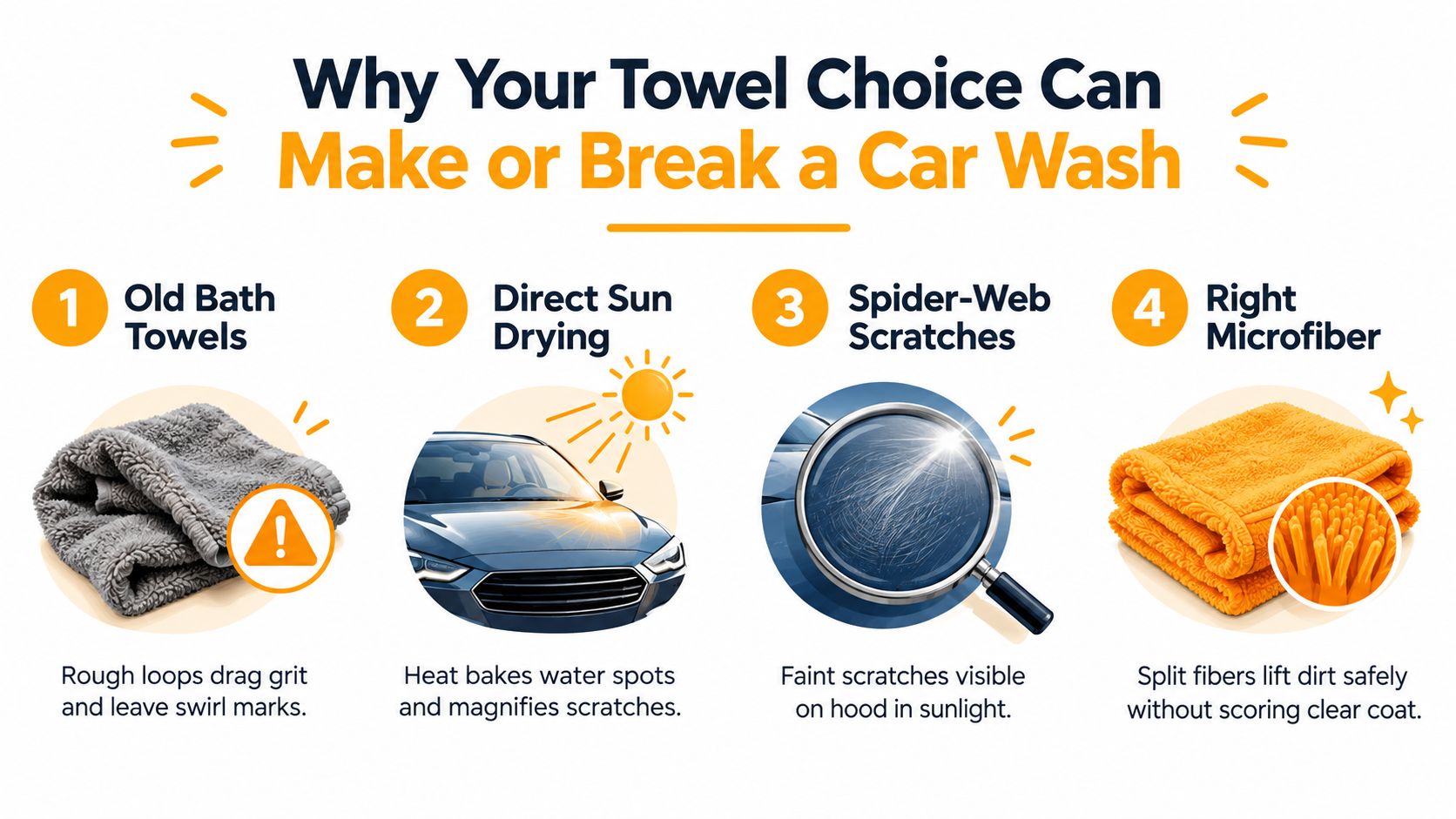
The towel controls the final contact
A car wash is really a series of contacts with the paint. First water and soap loosen grime. Then your wash media touches the surface. Finally, the drying towel makes long, broad passes over the panel. That last step matters because any tiny particle still sitting on the paint needs somewhere safe to go. A proper microfiber towel gives that particle space to move up into the towel instead of staying trapped between fabric and clear coat.
That is the difference many first-time owners miss. Softness by itself is not enough. A towel can feel gentle in your hand and still smear water, shed lint, or drag leftover grit in a straight line across the hood.
Practical rule: Keep any towel with unknown use, rough binding, stuck-on debris, or fabric-softener residue away from exterior paint.
Why the wrong towel leaves marks
Clear coat is harder than skin, but it is still easy to mar with fine debris. If a towel cannot absorb water quickly or hold particles away from the surface, your hand pressure turns that trapped grit into an abrasive point. The mark may be too small to notice indoors. Sunlight reveals it because the scratches scatter light instead of reflecting it evenly.
That is why towel choice changes what you see after the wash. Good paint care is not just about removing dirt. It is about controlling where dirt goes during contact.
If you want a broader material comparison, this guide to selecting commercial car wash rags shows how different wipe materials behave in real cleaning tasks.
Beginners do better with a towel system, not a random pile
Many new owners treat towels as interchangeable. In practice, each cloth has a job. One type works for wash contact, another for drying, another for glass, and another for dirty areas like wheels or door jambs. Once you separate those roles, the process gets much safer and more predictable.
A towel is not a minor accessory at the end of the wash. It is the tool that decides whether the invisible friction at the fiber level turns into visible gloss or visible damage.
What Microfiber Actually Is and Why It Works So Well
Microfiber starts making sense the moment you stop looking at the towel from arm's length and start thinking about what is happening where the cloth meets the paint.
A car panel looks smooth to your eye, but the cleaning job happens on a much smaller scale. Water, dust, road film, and tiny bits of grit all have to be pulled off the surface and moved into the towel. A material that only skims across the top tends to smear residue or drag it along. Microfiber works better because its structure gives that residue places to go.
Microfiber refers to very fine synthetic filaments, usually made from polyester and polyamide. Standard references describe those fibers as far finer than ordinary textile fibers, which is the basic reason they behave differently in cleaning use, as summarized in this microfiber overview.
What “split fibers” really means
The key idea is the split fiber.
During manufacturing, many automotive microfiber fabrics are processed so each strand separates into much smaller wedge-like filaments. Instead of a smoother, rounder strand, you get a network of microscopic edges, channels, and spaces. That increases surface area and improves the towel's ability to pick up and hold onto contamination, according to Microfiber Wholesale's explanation of how microfiber works.
A cotton rag tends to push residue across the surface. Split microfiber is better at lifting residue into the fabric, where it is less likely to stay pressed between your hand and the paint.
Why that changes what you see on paint
That tiny fiber geometry leads to a visible result. The channels between the filaments help pull in water through capillary action, which is the same basic effect that lets liquid travel through a paper towel. On paint, that means moisture moves into the towel instead of being spread into a thin film that you keep chasing around.
The same principle helps with dirt. A better towel does more than touch the panel. It separates particles from the surface and stores them deeper in the pile, away from direct contact as you wipe. Less smearing and less rubbing usually follow.
You can picture the difference in a simple way. One fabric behaves more like a surface wiper. Split microfiber behaves more like a sponge with thousands of tiny pockets at the point of contact.
A good microfiber towel improves paint safety by reducing how much water and debris stay trapped between the cloth and the clear coat.
Why car detailers adopted it
That combination of fine fibers, split structure, and strong absorption is why microfiber became standard in car care. It handles the two jobs that matter most during paint contact. It removes moisture efficiently, and it gives loosened dirt a place to move other than under your hand.
The benefit is easy to see after the wash. Panels dry with fewer streaks, buffing takes less pressure, and the finish keeps more of its even gloss because you are controlling contact at the fiber level instead of relying on force.
Reading the Label GSM Blends and Weave Types Explained
A microfiber label can look more technical than it really is. You usually see three specs: GSM, blend ratio, and weave. Read them together, and the label starts to describe how the towel will behave the moment it touches paint.
The simplest way to read it is to ask three questions. How much fiber is here? What are those fibers made of? How are they arranged?
Start with GSM
GSM means grams per square meter. It tells you fabric weight. A higher number usually means a thicker or denser towel, which often gives you more cushion and more water capacity.
That does not make high GSM automatically better.
A heavy towel with the wrong weave can still feel clumsy on glass or too bulky for tight trim. A lighter towel can be the better tool if the job needs control more than plushness. For paint contact, many car care guides treat roughly 350 GSM and up as a safer starting point because extra pile gives loosened residue more room to move away from the surface, as noted in this microfiber towel guide.
Then check the blend ratio
Most car care microfiber is a mix of polyester and polyamide. Polyester gives the towel structure. Polyamide helps it feel softer and improves how it handles water and residue.
That blend changes what your hand feels on the panel. An 80/20 towel is common for general-purpose work. A 70/30 towel usually feels softer and more forgiving, which is why many car owners reserve it for delicate paint, drying, or final wipe-downs.
You can read that spec like a recipe. More polyamide usually means a gentler, thirstier towel. More polyester usually means a more utility-focused towel.
Weave decides how the towel behaves
Weave is the part many first-time buyers skip, even though it often matters most in actual use. It controls the contact pattern between the towel and the surface.
A plush weave works like a deeper carpet. Dirt and leftover moisture have somewhere to go above the paint line instead of staying pressed between your hand and the clear coat.
A waffle weave has pockets and channels. That helps it collect water in a more orderly way, which is why it often works well on glass.
A twisted-loop weave is built for fast drying. It moves a lot of rinse water with fewer passes, especially on large panels like hoods and roofs.
A short-pile or suede-style face stays flatter against the surface. That makes it easier to level product, remove residue, or wipe in tight areas where a plush towel feels too grabby.
| Spec | Range or Type | What it usually does best |
|---|---|---|
| GSM | Around 350 and up | Paint-contact towels that need more softness and cushion |
| Blend | 80/20 | General detailing, interior work, utility wiping |
| Blend | 70/30 | Delicate paintwork, drying, final wipe-downs |
| Weave | Plush | Gentle paint contact, drying touch-ups, buffing |
| Weave | Waffle | Glass, mirrors, controlled wipe patterns |
| Weave | Twisted loop | Fast drying on large exterior panels |
| Weave | Short pile or suede-style face | Product leveling, residue removal, precise wiping |
If you want a brand-neutral explanation of how these specs change cleaning behavior, this primer on microfiber towels for cleaning gives a useful overview.
A simple way to choose
Use the label to match the towel to the task, not to hunt for the highest number on the package.
For dirtier jobs, choose more pile so particles have room to move up into the towel. For delicate jobs, choose a softer blend and a weave that reduces harsh contact. That is how the invisible fiber structure turns into a visible result. Fewer streaks, less dragging, and a lower chance of putting fresh marks into the finish.
The better question is not “What GSM is best?” It is “What kind of contact does this job need?”
Matching the Tool to the Task Towels Mitts and Drying Cloths
The easiest way to organize your kit is by job function, not by product category. A towel doesn't earn its place because the label says “premium.” It earns its place because its shape and pile fit one stage of the wash.
Which tool belongs where
A wash mitt belongs in the soap stage. Its job is to glide across the panel, hold wash solution, and pull loosened grime into the fibers while you work section by section. A mitt gives your hand a larger, more controlled contact patch than a folded towel.
A drying towel belongs right after the rinse. Plush and twisted-loop designs make sense. Their structure is built around fast water pickup, so you can remove rinse water with fewer passes.
A short-pile buffing towel fits product removal and final touch-up work. If you're wiping away detail spray residue or chasing small water traces near emblems and mirrors, a flatter face gives you more control than a huge drying towel.
A waffle-weave glass cloth is the specialist. It handles windows and mirrors without feeling too grabby or leaving the same kind of wipe pattern a plush towel can leave on glass.
For readers comparing options, product pages like Vorsprung Autowerk cleaning cloths can help you visually spot pile height, edging, and cloth style differences that matter in practice.
| Tool | Best Surface | Stage of Wash |
|---|---|---|
| Chenille or plush wash mitt | Painted panels | Soap wash stage |
| Dedicated wheel mitt or towel | Wheels and lower dirty areas | Before body wash |
| Plush or twisted-loop drying towel | Exterior paint and large wet panels | After final rinse |
| Short-pile buffing towel | Paint for detail spray or finishing wipe | After drying |
| Waffle-weave glass cloth | Windows and mirrors | Glass finishing stage |
A starter kit that actually works
For a simple home setup, keep separate tools with clear jobs:
- Two mitts for wash duties, with one reserved for dirtier zones
- Three drying towels so you're not forcing one saturated towel through the whole vehicle
- Two buffing towels for touch-up drying and product wipe-off
- One glass cloth reserved only for glass
If you're comparing mitt formats specifically, this breakdown of microfiber wash mitt vs sponge explains why mitt structure changes paint contact.
One practical option in this category is the SwiftJet Car Wash Foam Gun, which comes with a microfiber wash mitt and connects to a garden hose. In a home setup, that kind of bundle makes sense when you want to assign one mitt to the wash stage and keep the rest of your towels for drying and finishing.
A Simple Step-by-Step Wash and Dry Routine
A good microfiber routine works because every cloth has a role. You're not improvising with whatever's nearest.
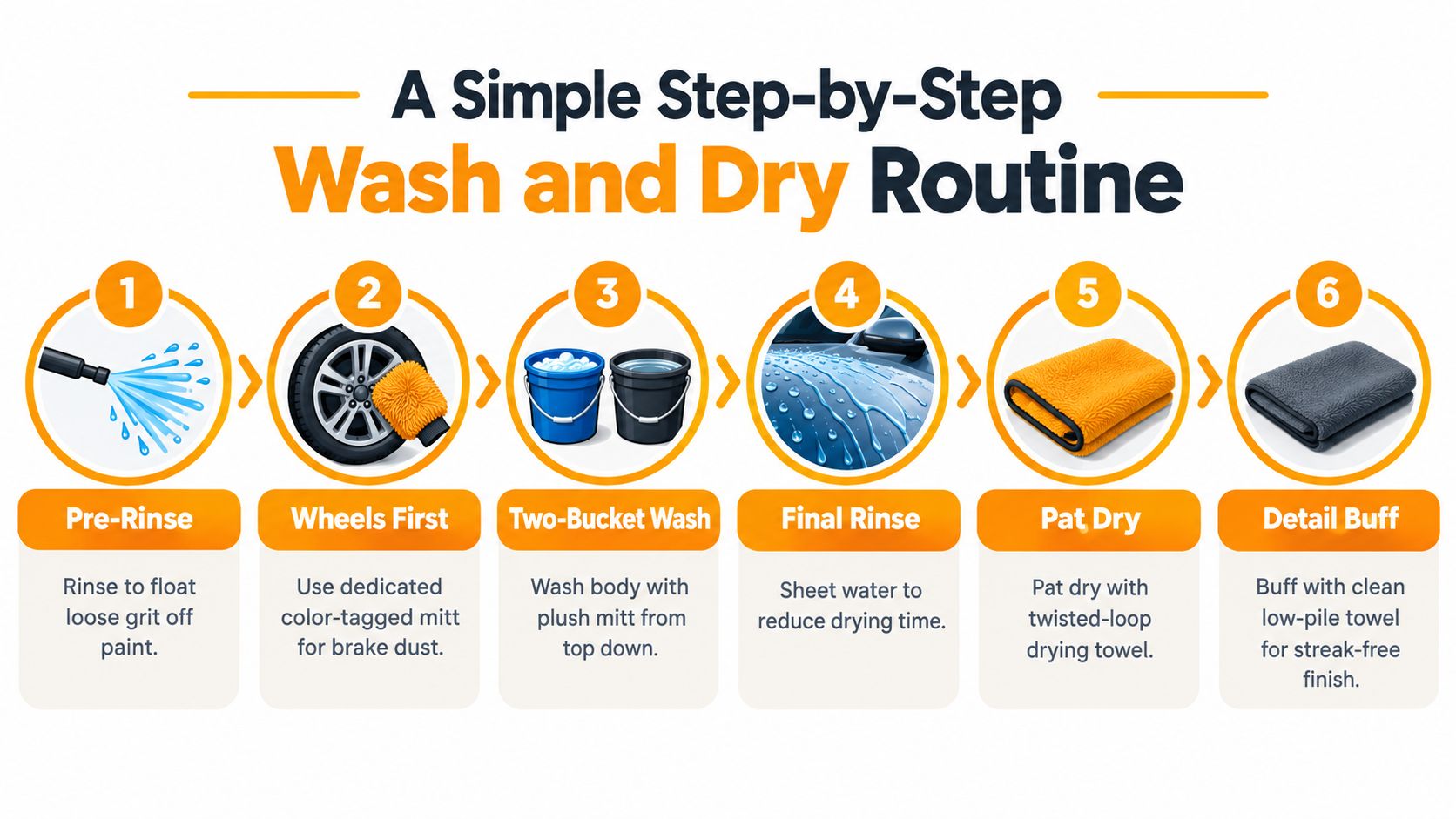
The copy-and-repeat workflow
Start with a pre-rinse. The goal is to float off as much loose grit as possible before any mitt touches paint. If dry dust stays on the panel, your mitt has to deal with it at close contact.
Wash wheels first with their own dedicated mitt or towel. Brake dust and heavy road grime live here. Keeping wheel tools first and separate prevents accidental crossover later.
Move to the body wash, starting at the roof and working downward. Use a clean chenille or plush mitt, and rinse it out after every panel so it doesn't carry trapped grime from one section to the next.
Then do a final rinse in a controlled, panel-by-panel way. Let water move off the surface rather than sitting on it while you search for towels.
Dry with less pressure, not more
Lay a large drying towel flat on the panel and use a pat-and-drag motion. You're letting the towel absorb, not scrubbing. If one side starts feeling heavy or stops picking up cleanly, flip to a fresh side or switch towels.
Later in the process, a quick visual walk-through helps. This demonstration shows the rhythm of wash-to-dry handling in motion:
Finish by using a short-pile towel on leftover edges around trim, mirrors, fuel doors, and badges. Those are the spots where water likes to creep back out.
One habit prevents a lot of swirls: don't keep using the same damp, partially loaded towel just because it still feels usable.
Where shortcuts usually go wrong
Most wash marring happens when someone combines steps. They wash wheels after the body. They dry with one overloaded towel. They scrub at leftover beads instead of switching to a fresh face.
The routine isn't fussy. It's protective. Each clean side you use lowers the chance that trapped debris gets another ride across the paint.
Why Mixing Towels Across Surfaces Causes the Damage You Are Trying to Prevent
The “one towel does it all” habit feels efficient right up until it scratches something expensive.
A towel can look clean and still hide abrasive contamination deep in the fibers. That's the part beginners miss. Microfiber is good at trapping particles. If those particles came from the wrong surface, that strength becomes a risk.
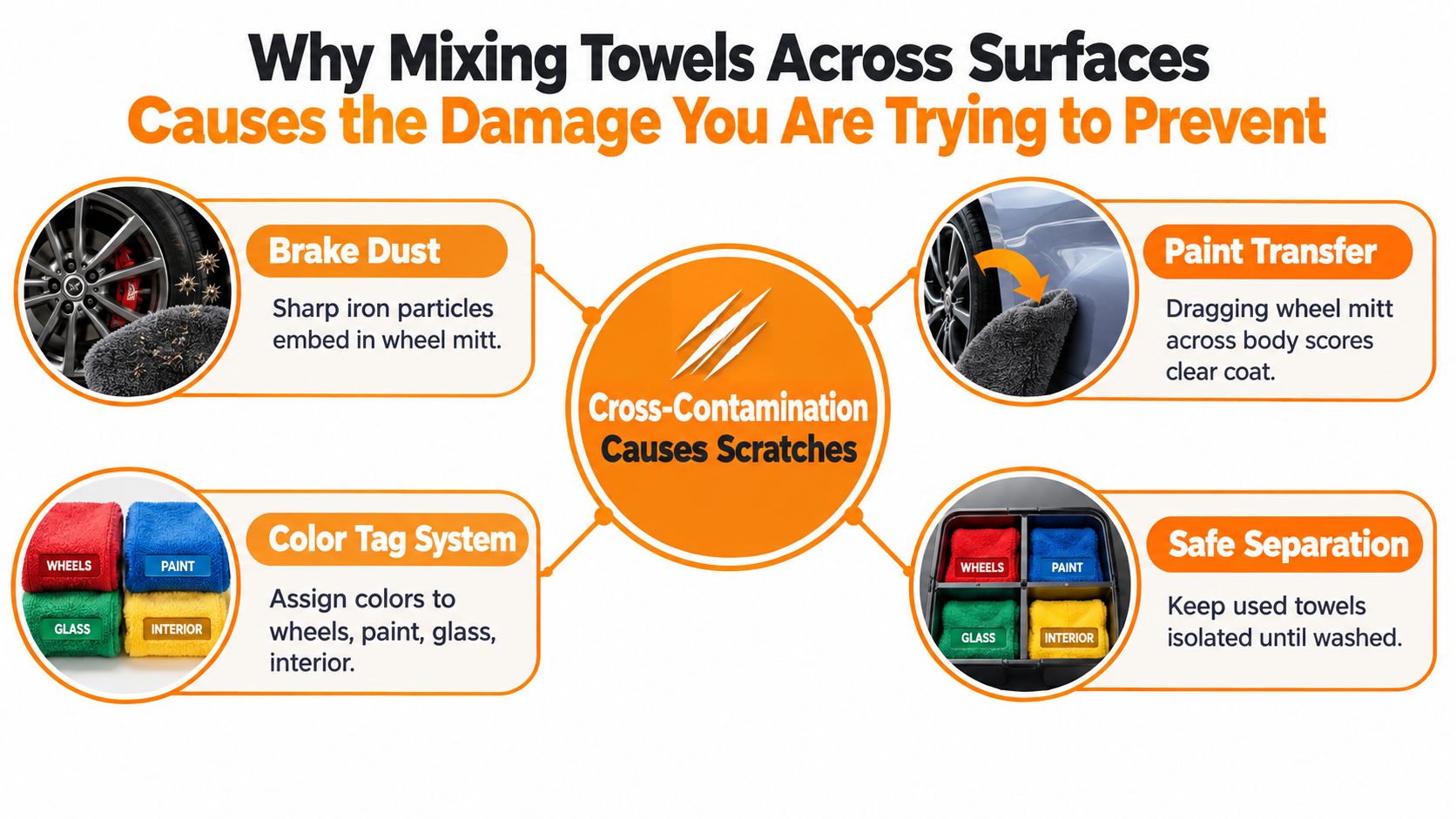
How the contamination path works
Wheel areas collect some of the harshest grime on the vehicle. Guides on microfiber care repeatedly warn against mixing towels by task because brake dust, grit, and other hard particles picked up on wheels or lower panels can transfer into paint towels and create scratches later, as explained in this microfiber care reference.
The path is simple:
- A wheel mitt or towel picks up abrasive debris.
- A quick rinse removes the visible dirt but not always the embedded particles.
- That same towel gets reused on paint, trim, or drying duty.
- Hand pressure presses the trapped particles into the clear coat.
That's not a microfiber problem. It's a separation problem.
Build a color system you can follow at a glance
You don't need a fancy shop setup. You need a system that prevents hesitation.
- One color for wheels and lower panels
- A different color for painted body panels
- Another for glass
- Another for interior work
Store each group separately after use. Don't make yourself inspect every towel from memory.
Even a visually clean towel can still hold sharp debris. Separation is safer than guessing.
Use separate bins and separate wash loads
If you toss wheel towels in with drying towels, contamination can spread before the next wash even starts. Keep each towel family in its own bin, shelf, or bag until laundry time, then wash by category.
That one organizational habit does more for paint safety than buying another fancy towel.
Washing Drying and Storing Microfiber the Right Way
Microfiber doesn't stay effective by accident. Its cleaning ability depends on open, intact fibers. If laundry products coat those fibers or heat damages them, performance drops.
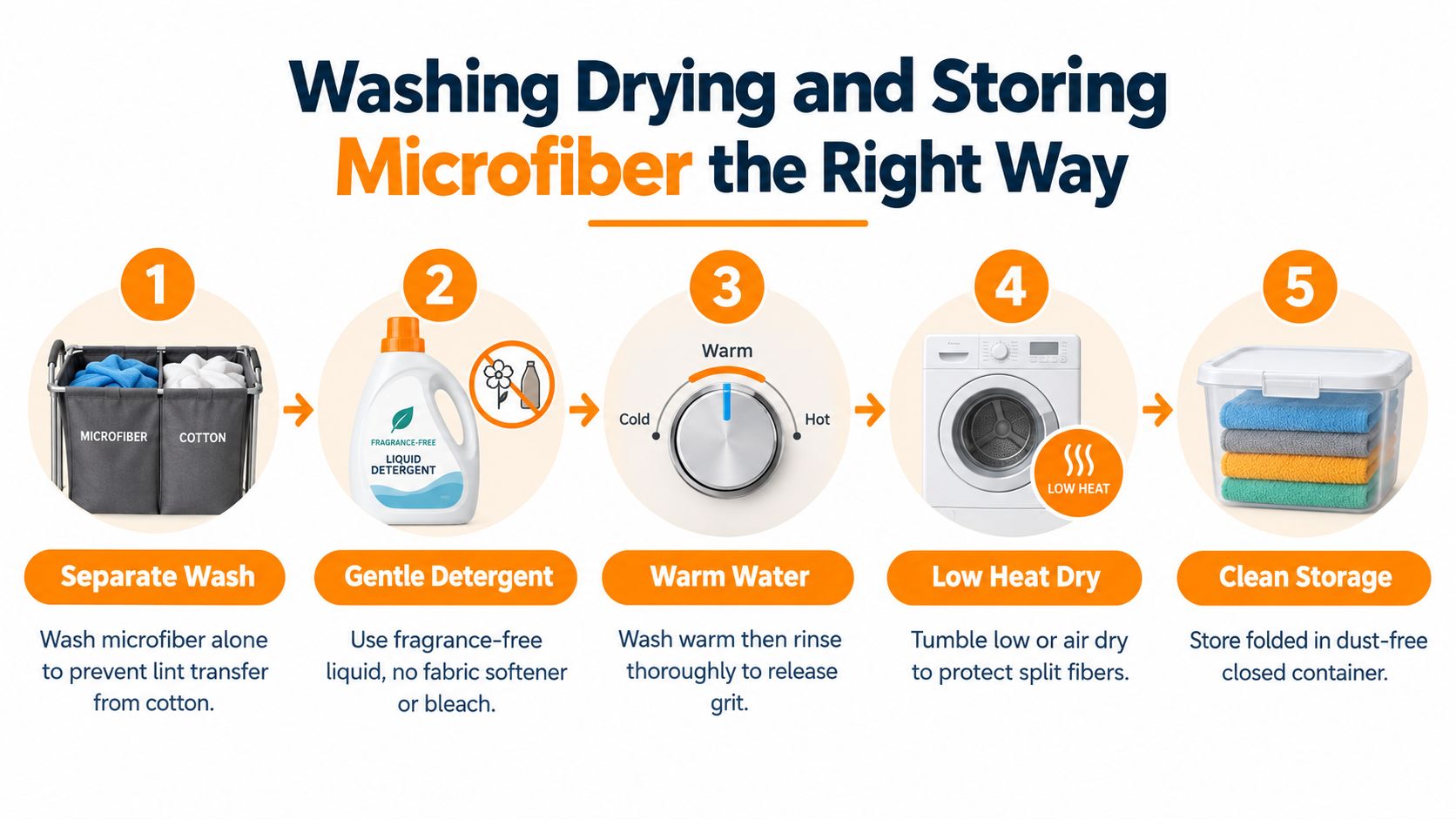
Wash for fiber function, not just appearance
Wash microfiber separately from cotton so lint doesn't load into the pile. Use a mild liquid detergent and skip fabric softener and bleach. Recent guidance also keeps stressing cool-to-warm washing and low-heat drying because softeners can coat fibers and high heat can damage the loops that make microfiber absorbent, as discussed in this detailing microfiber care guide.
A useful practical target for warm washing is around 104 F / 40 C. That's warm enough to help release oils and residue without pushing the fabric into unnecessarily harsh heat.
Dry gently and inspect after
Low-heat tumble drying or air drying works better than blasting towels on high. High heat can stiffen or distort the fiber structure that makes the towel useful in the first place.
After drying, inspect each towel before it goes back into your clean stack:
- Feel the pile: if it's matted, crunchy, or oddly slick, keep it off paint.
- Check the edges: hardened edges and rough binding can become contact risks.
- Hold it to the light: trapped specks or embedded debris often show up better there than in your hands.
For mitt-specific cleanup habits, this guide on how to clean a car wash mitt is a practical add-on.
Store clean towels like clean tools
A freshly washed towel isn't clean for long if it sits near workshop dust, oily rags, or overspray from automotive chemicals. Fold towels and keep them in a sealed bin or a clean cabinet.
If a towel no longer feels trustworthy for paint, don't throw it out immediately. Demote it. Move it from paint duty to interior duty, then later to wheels or dirtiest cleanup work. That gives you more life from the towel while keeping your most delicate surfaces protected.
Your Microfiber Buying and Care Cheat Sheet
A good microfiber setup works like a kitchen with separate cutting boards. One board handles raw chicken. Another stays clean for fruit. Towels work the same way on a car. The towel itself is not the whole story. The job you assign to it is what protects the paint.
Buy towels by task, then keep those jobs fixed.
What to buy
Start with the surfaces that punish mistakes most quickly. Paint and gloss-black trim need softer, more forgiving contact than wheels, door jambs, or engine-bay cleanup.
- For paint contact: choose a plush towel with enough thickness to hold grit away from the surface while the fibers lift it. A heavier paint towel is usually a safer choice than a thin utility cloth.
- For blend ratio: an 80/20 towel is a strong general-purpose starting point. A 70/30 blend usually feels softer and tends to handle water better, which is why many people reserve it for more delicate paintwork.
- For drying: choose a plush drying towel or a twisted-loop drying towel. Drying works because the towel pulls water into its structure through tiny channels between fibers, not because you rub harder.
- For edges and tags: check the places your hand may ignore. A rough sewn edge or stiff tag can become the first thing that touches the paint.
If you are unsure between two towels, choose the one with the clearer job description. “Drying towel,” “glass towel,” and “buffing towel” tell you more than vague claims about premium softness.
How to assign each towel
Color-coding helps because it removes guesswork in the moment, especially once several towels are wet and in use.
| Need | Best microfiber choice | Rule to remember |
|---|---|---|
| Wheels and lower grime | Dedicated mitt or towel | Keep off paint forever |
| Main wash | Clean wash mitt | Start high, then work downward |
| Drying | Plush or twisted-loop drying towel | Blot or glide lightly |
| Final buffing | Short-pile towel | Use for detail spray or light residue removal |
| Glass | Waffle-weave or glass-specific cloth | Keep it for glass only |
That last column matters more than it looks. The visible result on paint comes from invisible fiber condition. Once wheel dust, metal particles, or greasy road film get buried in a towel, the split fibers that used to trap contamination can also hold onto it until the next wipe.
Care rules worth following every time
A towel stays paint-safe only if the fibers stay open and clean.
- Wash separately: keep microfiber away from cotton, which sheds lint into the towel.
- Skip coatings: avoid fabric softener and bleach, which interfere with how the fibers grab dirt and absorb water.
- Use low heat: high heat can distort the fine structure that gives microfiber its gentle bite.
- Store clean: use a sealed bin or a clean cabinet, not an exposed shelf near dust or chemicals.
- Retire by task: move older towels down the ladder, from paint to interior, then to wheels or dirty cleanup.
The shortcut version is simple. Build a small towel system instead of a random towel pile. One set washes. One set dries. One set buffs. One set handles the dirty work.
SwiftJet offers home car-wash tools built around that same logic of safer contact, including a foam gun setup and microfiber-friendly wash accessories for driveway detailing. If you want a simpler way to build a wash routine that protects paint instead of fighting it, visit SwiftJet.
