

You're looking at a service that brings the whole car-care setup to you. Mobile car detailing is a professional cleaning, restoration, and protection service done at your home, workplace, or another approved location with a self-contained setup for water, power, and tools.
That's why a dusty SUV in the driveway isn't just “due for a wash”, it's often a candidate for a full mobile detail. The job goes beyond rinsing off dirt, because detailers clean, decontaminate, protect, and finish the vehicle where it already sits, instead of asking you to drive to a shop.
What Is Mobile Car Detailing Exactly
A parked car can need more than a quick rinse, and that is where mobile car detailing comes in. It is a professional service carried out at your home, workplace, or another approved location, with a self-contained setup for water, power, and waste collection. Professional mobile detailing is delivered at customer-specified locations using self-contained units. mobile car detailing definition
For a busy driver, the difference shows up fast. A wash clears away loose dirt. A detail cleans more thoroughly, improves the vehicle's appearance, and adds protection after the surface has been prepared.
The service also fits into a longer history of car care. Vehicle-care products became more specialized over time, with early finishing culture around “simonizing” in 1912, then product milestones like bottled car wax in 1944, polymer sealants in 1969, and ceramic coatings and other advanced protections in the early 2000s. history of detailing and product development
Practical rule: if a service includes surface cleaning, interior deep cleaning, decontamination, and protection, it falls into detailing, not basic washing.
That is the core of what is mobile car detailing. A mobile van works like a workshop on wheels, so the detailer can do the work where the car already sits while still bringing the equipment needed for a proper job.
How Mobile Detailing Works on Site
A mobile detailer arrives with a field-service workstation that has to work in a driveway, office lot, or other approved space. It is a workshop on wheels, with portable water, power, lighting, tools, and storage arranged so the technician can work without a fixed bay.
The job starts with logistics, not the wash
Before a mitt touches paint, the site has to be checked for access, safety, and local rules. The detailer matches the job to the water and electric supply, routes hoses and cords so they do not create a trip hazard, and inspects the vehicle before and after service. mobile detailing workflow and setup
That is why two bookings can feel very different. A driveway with power and open space gives the technician more freedom, while a curbside parking spot with no outlet nearby forces a tighter setup. Some locations also limit runoff, which matters for HOA rules, stormwater compliance, and where rinse water can go.
The mobile setup changes the pace
The travel kit usually includes vacuums, microfiber towels, brushes, polishers, steamers, carpet extractors, and foam or pressure-wash gear. The work stays thorough, but the technician has to set up like a field operator instead of working beside a permanent shop bay. mobile detailing equipment and on-site workflow
That setup affects time and package choice. A waterless rinse or battery-powered extractor can keep the job moving where hookups are limited, but larger vehicles and heavier soil often push the service into a higher time and price tier.
The process still follows a clear order. Inspection comes first, then washing, then decontamination, then protection, then final quality control.
Some sites make that order easier than others. A detailer working a curbside spot without an outlet will usually rely on battery tools and a water-saving rinse, which can add 30 to 45 minutes to the visit.
The Detailing Process From Foam to Finish
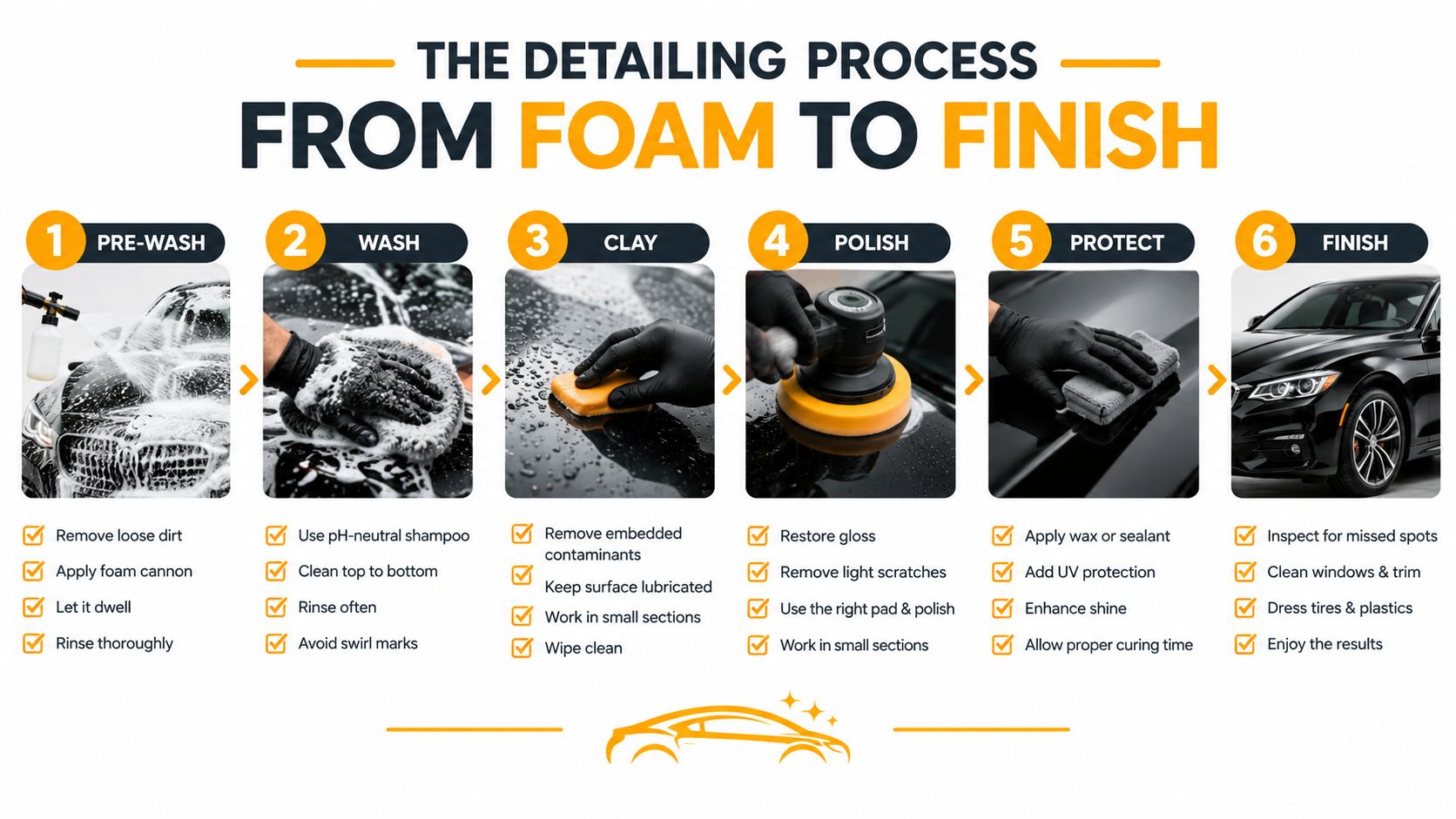
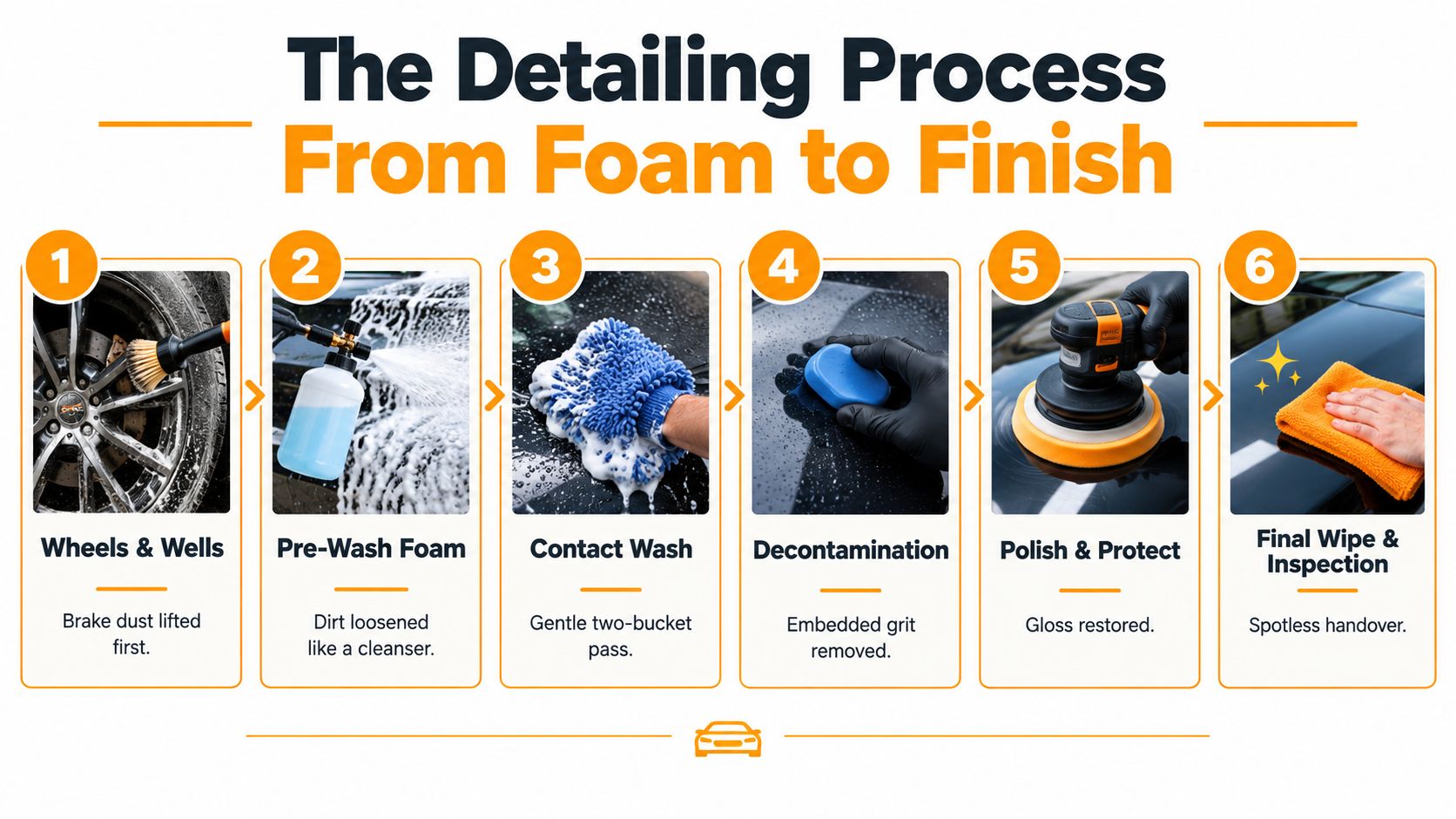
Professional detailing works in layers. That's the easiest way to understand it, and it's also why the order matters so much. If you've ever washed your face without removing sunscreen first, you already know the problem, loose surface grime isn't the whole story.
Exterior work follows a careful sequence
The exterior process usually starts with the wheels and tires, because they hold the heaviest brake dust and road grime. Next comes foam pre-treatment, which dwells for about 5–10 minutes to soften dirt before anything touches the paint. Then the detailer uses a two-bucket hand wash with a microfiber mitt, followed by clay-bar decontamination for bonded tar and rail dust, and finally sealant or coating application. professional detailing sequence
That order reduces scratch risk because abrasive debris is lifted or flushed before contact washing begins. It's the same logic as washing a pan before scrubbing it hard, you loosen the mess first so you're not grinding it into the surface.
Interior work targets deeper soil
On the inside, the tools change but the logic stays the same. Wet/dry vacuums handle loose debris, hot-water extractors reach into carpet and upholstery, and steam or targeted cleaners get into vents and crevices. That's why detailing can remove embedded soil instead of just making surfaces look presentable for a day.
A good detail isn't just “clean enough to notice from ten feet away.” It's a process that tries to leave less residue behind, less contamination on the paint, and less grime in the cabin.
A simple way to judge a provider is to ask what comes before the wash. If the answer skips wheel cleaning, pre-treatment, or decontamination, the service may be closer to a wash than a detail.
Mobile Detailing Versus the Shop
Choosing between mobile and shop detailing is mostly about trade-offs, not right or wrong. Mobile wins on convenience because the car stays where it is, you don't spend time driving, and you can keep an eye on the vehicle while the work happens. A shop wins when the job needs more controlled conditions, especially for higher-touch paint correction or other work that benefits from a dedicated indoor environment.
| Criteria | Mobile Detailing | Shop Detailing |
|---|---|---|
| Convenience | Comes to your home, workplace, or approved location | You drive to the location |
| Scheduling | Built around on-site access and the booking window | Built around shop hours and bay availability |
| Environment | Depends on driveway, parking, water, and power access | Controlled workspace with fixed equipment |
| Best fit | Routine maintenance, busy owners, families, larger vehicles | Jobs needing tighter environmental control |
| Supervision | Easy to stay close to your vehicle | Less direct oversight during the appointment |
If you're comparing options, the key question is not just “which is easier?” It's “which environment fits the actual work my car needs?” A light maintenance detail at home is one thing, but a more involved correction job may be better handled where lighting and access are fully controlled.
The decision gets even clearer for big vehicles. Mobile service can be a great fit for an SUV in the driveway, but the more space, time, and product a job needs, the more the price and scheduling can shift. If you want a broader side-by-side look at doing it yourself versus hiring out, this comparison of DIY and professional detailing is a helpful companion read.
Good rule of thumb: choose mobile when convenience and maintenance matter most, choose a shop when the work needs tighter environmental control.
The Tools and Products Behind Professional Results
A mobile detailer's van is a workshop on wheels. Its equipment must clean, correct, dry, and protect a vehicle without relying on a fixed bay. The kit usually falls into four groups: wash media, decontamination tools, machines, and protection products. Each handles a different stage, so omitting one can leave dirt, moisture, or paint defects behind.
What's in the kit
Wash media includes microfiber mitts, towels, buckets, and drying tools. Decontamination equipment includes clay bars plus cleaners for wheels, trim, brake dust, and narrow gaps. Machines may include polishers, extractors, steamers, and vacuums. Protection products range from waxes and polymer sealants to ceramic coatings.
The tools also determine how controlled the work can be. A dual-action polisher with a 5-inch pad can cover a sedan hood in about four passes, while an extractor removes roughly a gallon of water per seat cushion. Those machines reduce the effort required for correction and interior cleaning, but they still depend on the right pad, product, pressure, and technique.
A driveway setup can reproduce the first stage with a foam pre-wash. A garden-hose foam gun, such as the SwiftJet Car Wash Foam Gun, connects to a standard hose and applies foam through an on/off trigger. The SwiftJet SUV setup guide for foam washing shows how this type of setup fits a larger-vehicle workflow.
Foam helps loosen surface dirt before a mitt touches the paint. Pair the foam dwell with a clean microfiber mitt and a separate rinse bucket so the mitt does not carry brake dust back across the finish.
Practical takeaway: if you can add one step to a home wash, use foam pre-treatment before making contact with the paint.
Professional results come from sequencing, not from one miracle product. A detailer softens contamination, removes it with controlled contact, dries the surface, corrects defects when needed, and then applies protection. That layered process preserves the finish while improving its appearance.
What Mobile Detailing Costs and the Rules That Shape It
A mobile detailer brings a workshop on wheels, but the appointment still has limits. Price and timing depend on vehicle size, condition, service depth, and the rules at the place where the car is parked.
One independent provider lists starting prices of $199 for a small car, $325 for a larger tier, and $475 for the highest listed tier. Completion times range from roughly 2–3 hours to 4–6 hours. provider pricing and time tiers
Why size and condition change the bill
A larger vehicle needs more product, more movement around the body, and more time inside the cabin. Trucks, RVs, and multi-vehicle fleets also add surfaces, storage areas, seams, and hard-to-reach spaces. The job can become a longer service block rather than a quick driveway appointment.
Condition adds another layer. Heavy pet hair can add $75 to $150 to a mid-size SUV package, and a truck with a bed liner typically pushes the appointment past the four-hour mark. Ask for the exact package depth and how the provider prices heavy soil, pet hair, stains, and extra-large vehicles.
The legal side is part of the service
A mobile appointment must fit the site as well as the vehicle. Some cities regulate mobile washing through stormwater ordinances, while certain locations may require runoff controls or a portable water-reclamation system. stormwater and compliance guidance
The setup changes with those requirements. Waterless detailing may suit a restricted location, low-water rinse methods may work where limited discharge is allowed, and pressure-wash setups require closer control of runoff. The correct method depends on local rules, available water, drainage, and the surface beneath the vehicle.
Before booking, ask about water access, runoff handling, and HOA restrictions. Confirming those details early can prevent a cancellation and reveal whether mobile detailing is the practical choice for your location.
Choosing a Provider or Starting Your Own Service
The provider's van should function like a workshop on wheels, with the right tools, products, power, water plan, and waste controls for the job. Before booking, ask who is insured, read recent reviews, and request a clear explanation of the service sequence. Before-and-after photos can show whether the business documents its results rather than relying on package names.
A simple customer checklist
- Insurance and coverage: Confirm what protection applies if a product, tool, or technician causes damage.
- Process clarity: Ask what happens first, what the package includes, and how long the work usually takes.
- Site readiness: Check whether the technician needs your hose, outlet, driveway access, or another water source.
- Documentation: Request photos of comparable vehicles and completed work.
- Compliance: Ask how the setup handles runoff, HOA rules, and local restrictions.
The site can determine which method is practical. A waterless setup may suit a location with drainage limits, while a pressure-wash setup needs more equipment and tighter runoff control. Ask these questions before the appointment, not after the van arrives.
For someone starting a service, the business case rests on repeatable work rather than equipment alone. A realistic launch needs dependable portable tools, product storage, transport, scheduling, insurance, and a compliance plan. Market demand for mobile and on-demand formats is also receiving industry attention, as reflected in this market report on growth projections.
A practical example of how a service brand describes mobile operations and setup appears in this mobile detailing guide. Use it as a reference point, then adapt the setup to local rules and the jobs you intend to accept.
If a provider cannot explain the setup, waste handling, or service sequence, keep looking.
Is Mobile Car Detailing Right for You
Mobile car detailing is a professional cleaning, restoration, and protection service that comes to the vehicle instead of pulling the vehicle to the service bay. That makes it a strong fit for busy commuters, families with multiple vehicles, and owners of trucks or RVs who don't want to spend half a day driving to a shop.
It also fits people who care about keeping the car clean without turning the chore into a weekend project. If convenience matters, if the vehicle lives in your driveway, and if you want maintenance done where you can see it happen, mobile is often the right choice. If the job needs controlled lighting, more fixed equipment, or a more specialized environment, a shop can still be the smarter option.
The market keeps growing, too. One industry estimate puts the global mobile car washing market at US$10.9 billion in 2026, projected to reach US$19.7 billion by 2033 at an 8.8% CAGR, and North America held about 45% of the global share in 2024. global mobile car washing market outlook That growth lines up with what drivers want, easier access, less friction, and service that fits real life.
If you're trying to manage bookings for a small detailing business, a tool like car detailing phone automation can also help keep calls from interrupting work in the field. The main takeaway is simple, pick the service model that fits your car, your location, and your schedule, then use a system you can repeat.
If you want an easy way to improve your driveway wash routine, SwiftJet offers a foam gun that connects to a standard garden hose and helps you apply foam before hand washing. For more home-friendly vehicle cleaning gear and setup ideas, visit SwiftJet.
