

Your car is dirty, you finally have a free Saturday, and the question lands right in front of you. Do you pull out the buckets, soap, mitts, and hose, or do you hand the keys to someone who does this all day?
That choice sounds simple until you factor in everything that matters. Not just money, but time. Not just shine, but risk. Not just whether the car looks cleaner this afternoon, but whether the process helps or hurts the paint over time.
Most drivers don't sit at one extreme. They aren't either hardcore hobbyists with a full polishing setup or owners who outsource every wash. They're somewhere in the middle, trying to figure out when DIY makes sense and when calling a pro is the smarter move. That crossover point is where this decision gets interesting.
A lot of owners also get pulled toward coating talk before they've sorted out the basics. If you're already comparing protection options, this rundown of top car ceramic coating solutions is useful because it frames coating choices around real use, not marketing language.
The Weekend Dilemma Wash It Yourself or Hire a Pro
Saturday starts with good intentions. The car has road film on the doors, brake dust on the wheels, pollen on the hood, and a few water spots you keep pretending not to see. You tell yourself a home wash will be quick.
Then the job grows. You need to move the car into shade. Fill buckets. Find clean towels. Untangle the hose. Rinse, wash, dry, clean the wheels, wipe the jambs, and maybe apply some protection if you still have energy left. If the paint is dark, every missed step shows.
That doesn't mean DIY is a bad choice. For plenty of owners, it's part of the appeal. Washing your own car teaches you what the finish needs. You notice tar on the rocker panels, bug residue on the bumper, and the first signs of swirl marks before they become obvious.
Practical rule: If you enjoy the process, DIY can be a hobby. If you only care about the result, labor starts feeling expensive even when you aren't paying someone else.
The dilemma in the DIY vs professional debate isn't who cares more. Good DIYers care a lot. Good detailers do too. The difference is whether your current situation favors hands-on work or delegated expertise.
A newer car with decent paint, light grime, and an owner who enjoys maintenance often fits DIY well. An older car with oxidation, visible swirls, hard water spots, or neglected trim usually starts leaning toward professional help. The same goes for anyone who wants a polished result but doesn't want to donate half a day to the job.
Defining the Contenders Beyond a Simple Rinse
A fair comparison starts with clear definitions. "DIY" shouldn't mean splashing soap on paint with a single bucket and an old bath towel. "Professional" shouldn't mean every paid wash is expert detailing.
What real DIY detailing looks like
A proper home detail is a sequence, not just a rinse. The order matters because each step is meant to reduce friction and avoid grinding dirt into the clear coat.
A solid DIY wash usually includes:
- Pre-rinse and pre-wash: Loosen dirt before your wash mitt touches the paint.
- Wheel cleaning first: Brake dust and road grime are usually the filthiest part of the vehicle.
- Two-bucket wash method: One bucket for soapy water, one for rinsing the mitt.
- Careful drying: Clean microfiber towels or forced air reduce water spotting and towel marring.
- Protection step: Wax or sealant helps the surface stay slicker and easier to clean.
Done well, DIY detailing is disciplined. Done poorly, it becomes a swirl-mark factory.
What professional detailing actually covers
Professional service sits on a spectrum. At one end, you have maintenance-focused detailers who wash, decontaminate, clean interiors, and apply protection efficiently. At the other end, you have correction-focused shops that inspect paint under proper lighting, polish defects, and handle coating work indoors.
That distinction matters. A reputable fixed-location shop with controlled lighting and indoor space isn't offering the same thing as a fast volume wash. Neither is a skilled mobile detailer who arrives with water, power, products, and a repeatable process.
A detail isn't defined by foam or gloss in the first ten minutes. It's defined by prep, technique, and what the paint looks like a week later in direct sunlight.
Why the definitions matter
Most confusion in DIY vs professional comparisons comes from mismatched expectations. Someone compares a careful home detail to a basic paid wash, or compares a rushed driveway wash to a full correction service. Those aren't equivalent jobs.
The better question is this: are you comparing true DIY care to true professional detailing? Once you do that, the trade-offs become much easier to judge.
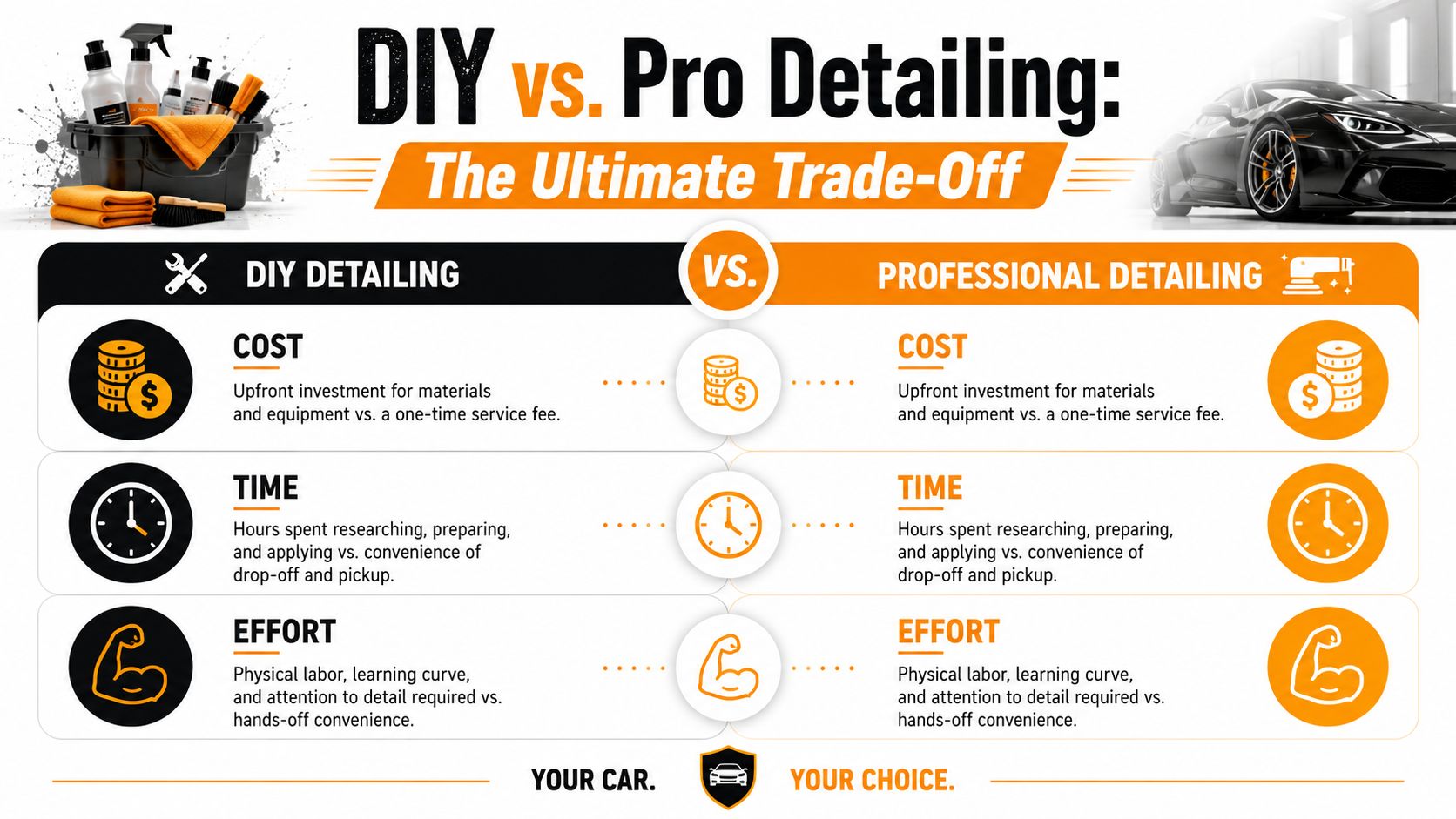
Cost Time and Effort The Ultimate Trade-Off
Saturday morning starts with good intentions. By the time the buckets are filled, the wheels are half-clean, and the sun is climbing, plenty of owners realize they are no longer choosing between two equal options. They are choosing between doing the labor themselves or paying for time, consistency, and lower risk.
That is the key crossover point.
| Factor | DIY Detailing | Professional Detailing |
|---|---|---|
| Cost | About $22 per session, plus an upfront kit investment of $735 to $1,435 for enthusiast-level gear like a foam cannon, pressure washer, and polisher, according to this detailing cost comparison | Typically $150 to $500 per service, according to the same comparison |
| Time | A thorough session takes 5+ hours, based on the same comparison | Your involvement is about 30 minutes of client time, according to the same comparison |
| Effort | You handle setup, washing, drying, product choice, and cleanup | You outsource the labor and judgment to the detailer |
| Learning curve | You need to learn safe wash technique, towel management, and product use | Skill is built into the service, assuming you choose a capable shop |
| Best fit | Routine maintenance, owners who enjoy the process, lighter cosmetic needs | Time-poor owners, neglected vehicles, higher-stakes paintwork |
Cost only looks simple on paper
DIY wins the price comparison only if two conditions are true. You already have the equipment, and you will use it enough to justify buying it.
Starting from zero changes the math fast. A pressure washer, foam cannon, buckets, quality towels, chemicals, brushes, and a machine polisher if you plan to do more than maintenance can push the home setup into real money. If you enjoy the process and care for multiple vehicles, that investment can pay off over time. If you detail twice, get frustrated, and let the tools collect dust, the cheap route was not cheap after all.
That is why understanding true ownership costs applies to detailing too. The invoice is only one part of the expense. Equipment, consumables, your time, and the cost of correcting mistakes belong in the same calculation.
A practical middle ground exists. Many owners do their own maintenance washes, then pay a professional once or twice a year for heavier work. If you want to tighten up your home routine before spending on bigger tools, these vehicle detailing tips for safer regular maintenance help you get more from basic DIY care.
Time is where the decision usually gets honest
Five hours in the driveway is realistic for careful DIY work. That number gets longer if the vehicle is large, neglected, or parked outside under trees. It also gets longer when you are still learning and have to stop, check products, rewash missed areas, or fix streaking.
Professional service costs more in cash, but it gives time back. For busy owners, parents, commuters, and anyone with one free afternoon a week, that matters more than the raw dollar figure. A detailer is not just selling soap and labor. They are selling completed work without taking half your day.
This is the point where DIY often stops making sense. If the job keeps getting postponed because it feels too big, the lower-cost option is failing in practice.
Effort is usually underestimated
A proper detail is physical work. Wheels strain your back. Drying large panels takes pace and attention. Interior cleaning means kneeling, reaching, and repeating the same motions for longer than many people expect.
Then there is the mental load. You have to keep dirty tools off clean paint, manage towels, work around heat, and decide which product belongs on which surface. Skilled DIYers enjoy that level of involvement. Other owners want the result, not the process.
That distinction matters. If you like the work, DIY can be satisfying and cost-effective. If you do not, rushed effort often creates extra expense later.
Use the trade-off as a decision test
DIY usually makes sense when the car is already in decent shape, you have space to work, and you do not mind spending a chunk of your weekend on maintenance.
Professional help becomes the smarter buy when the vehicle has fallen behind, your schedule is tight, or the paint and interior are important enough that a mistake would be expensive to fix. That is the crossover this guide is built around. Once the work demands more time, more correction, or more judgment than you can comfortably give it, paying a pro is not indulgent. It is efficient.
Comparing the Final Result and Finish Quality
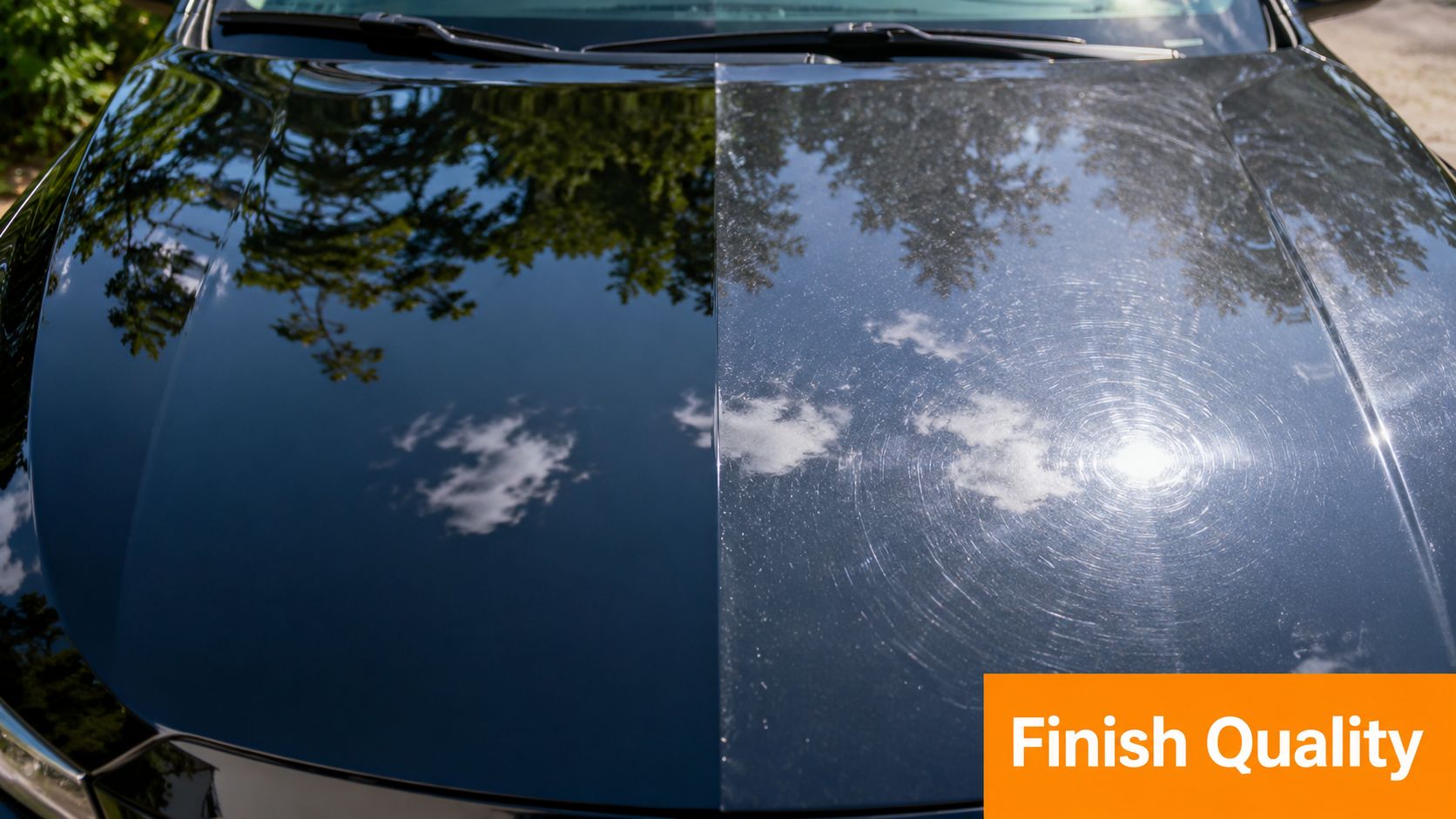
A clean car and a corrected car aren't the same thing. That's where many DIY efforts hit their ceiling.
A careful owner can absolutely produce a vehicle that looks sharp, glossy, and well maintained. On healthy paint, that may be all you need. But once the surface has swirl marks, embedded contamination, oxidation, or uneven gloss, the conversation changes from cleaning to refinement.
Where DIY usually tops out
DIY washing and protection work well for maintenance. You can preserve decent paint, keep dirt from building up, and make the car easier to clean the next time. That's already valuable.
What DIY often doesn't handle well is defect removal. Paint correction requires pad choice, machine control, product pairing, inspection lighting, and restraint. You aren't just making paint shiny. You're deciding how much defect removal is worth the material you're taking off.
For readers who want a solid maintenance foundation first, these vehicle detailing tips are a useful companion to the basics.
Why professionals get a different finish
The major separator in coating and correction work is preparation. According to this professional vs DIY ceramic coating discussion, professional shops handle polishing and defect removal in controlled environments, while DIY applications often run into contamination from dust and pollen that hurts bond durability.
That same source also notes another point many people miss. Professional services usually include guaranteed long-term protection, while most DIY users are in a no-warranty situation. If something fails, the cleanup and rework land back on the owner.
If the paint already has visible defects, adding protection without correcting the surface first often locks the problem in visually instead of solving it.
When professional quality is worth paying for
There are a few situations where the pro route stops being optional in practical terms:
- Visible paint defects: Swirls, haze, and oxidation need correction, not just another layer of product.
- Ceramic coating plans: Coating flawed or contaminated paint is usually false economy.
- Sale prep: First impressions matter when the vehicle needs to present at its best.
- Sentimental or high-value vehicles: Risk tolerance should be much lower.
A skilled DIYer can get impressively close on maintenance work. But showroom-level correction, especially on darker paint, usually comes from controlled prep, disciplined polishing, and experience spotting problems before they get worse.
Your DIY Arsenal Essential Tools and Techniques
DIY goes well when the setup matches the task. Most home washes go wrong before the mitt even touches the paint. The problem is weak pre-wash, poor towel discipline, or using the wrong tools because they're already in the garage.
A foam-based pre-wash is one of the easiest upgrades. It gives dirt a chance to loosen before contact washing starts.
Build the kit in layers
You don't need a full polishing lab on day one. Start with a safe wash setup that prevents damage and improves consistency.
A sensible home kit includes:
- Two buckets with grit management: One for soap, one for rinsing.
- Quality microfiber wash media: Clean, paint-safe mitts and drying towels matter more than people think.
- Dedicated wheel tools: Keep wheel grime away from your paint towels.
- Paint-safe soap: Use products made for automotive finishes, not household cleaners.
- Foam applicator: Pre-soak heavy dirt before contact.
If you're assembling a setup from scratch, this guide to a home car washing kit helps you organize the basics in the right order.
The pre-wash step does more work than people realize
Most scratching happens during contact. That's why pre-treatment matters. Thick foam isn't magic, but it does help soften and lift loose grime so your wash mitt has less to drag across the surface.
The SwiftJet Car Wash Foam Gun is one example of a hose-connected foam sprayer for DIY washing. It connects to a standard garden hose and lets owners add a foam step without needing a pressure washer. That makes it practical for people who want better wash prep without jumping straight into a more equipment-heavy setup.
Good DIY technique is less about chasing every premium product and more about reducing unnecessary contact with dirty paint.
Technique beats product hype
Even a modest kit can produce strong results if you use it with discipline:
- Rinse the vehicle first, especially the lower panels.
- Foam the surface and let it dwell briefly.
- Wash top-down, saving the dirtiest areas for last.
- Rinse thoroughly.
- Dry with clean microfiber, not whatever towel is nearby.
Later, if you enjoy the process, you can add clay decontamination, machine polishing, or longer-term protection. But the biggest jump from "basic wash" to "safe wash" usually comes from better prep and better habits, not buying everything at once.
Here's a quick look at foam application in action:
Safety Risks and Environmental Impact
DIY often gets framed as the careful, personal option. Sometimes it is. Sometimes it's the riskier one.
The biggest safety issue in home washing isn't dramatic damage. It's routine, avoidable paint wear. Wrong soap. Dirty wash media. Poor drying. Rubbing grit into the surface because the wash was rushed or the prep was weak.
Paint damage is easy to cause and expensive to undo
Improper home washing can do real harm. Sundance Wash notes that using products like dish soap or other non-paint-specific cleaners can cut into automotive finishes and lead to repair costs that far exceed professional wash fees in its article on DIY wash risks and paint damage.
That's the hidden crossover many people miss. The DIY wash itself looks cheap. The correction bill after repeated bad technique does not.
Low-skill professional work can also create problems, of course. A rushed operator, dirty brushes, or careless drying can leave defects behind. Paying for service doesn't automatically equal safe service. You still need to choose the provider carefully.
Water use changes the equation
The environmental side is often overlooked in DIY vs professional decisions. According to Andy's Autowash, professional car washes can use 60% less water than at-home washing and use reclamation systems that help prevent polluted runoff from reaching waterways in its piece on DIY vs professional wash water use.
That same source states a single DIY wash can use up to 120 gallons, compared with 40 gallons at Andy's Autowash. If water efficiency matters where you live, that difference is hard to ignore.
Home washing feels controlled because you're the one holding the hose. But water use, runoff, and soap choice still have consequences outside your driveway.
For owners who only wash occasionally and do it carefully, DIY can still be responsible. But if you're washing frequently, using lots of free-flowing water, or sending soapy runoff down the driveway, professional systems have a clear environmental advantage.
The Decision Matrix Choosing Your Detailing Path
Most owners don't need ideology. They need a practical answer.
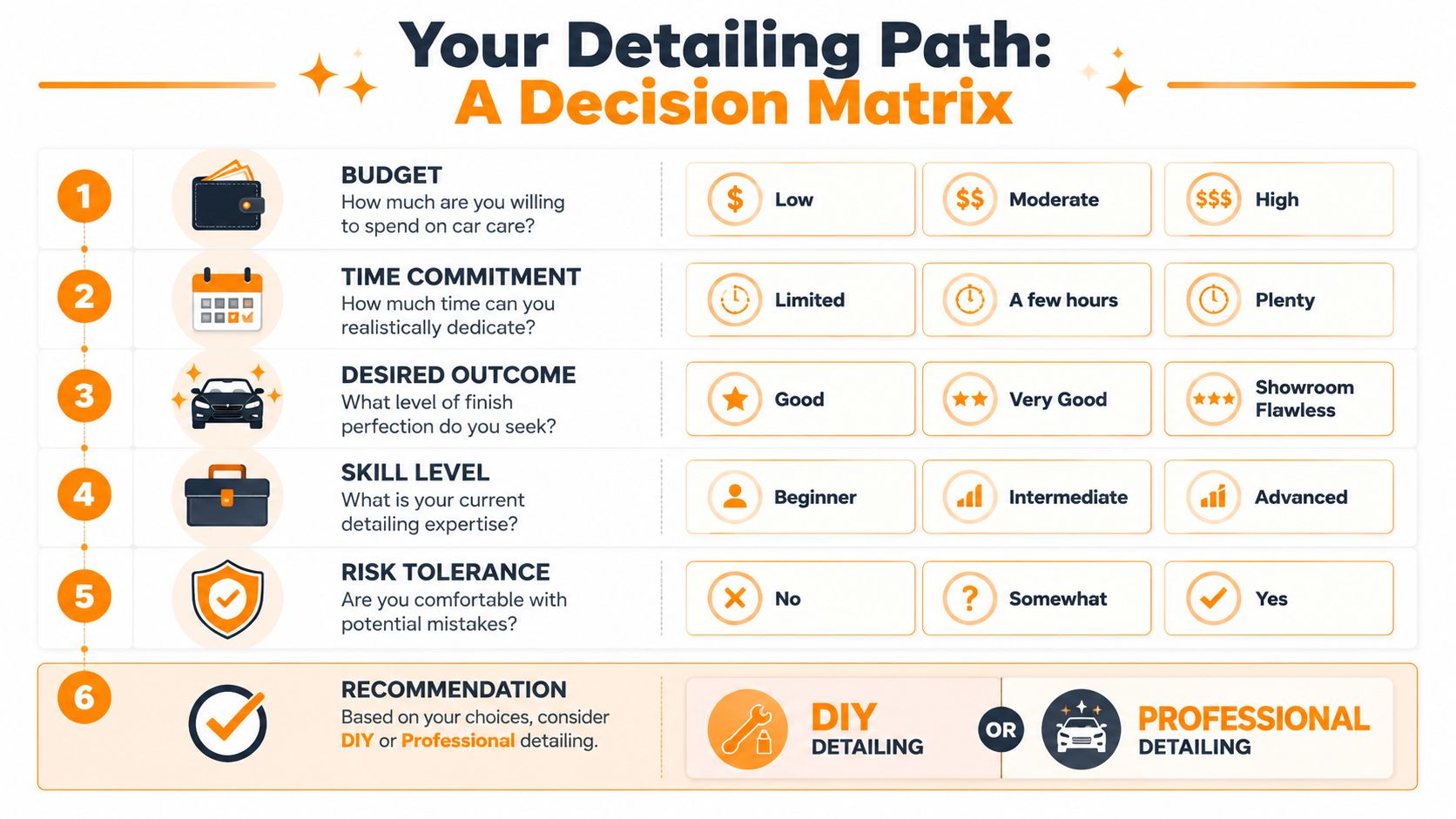
The easiest way to settle the DIY vs professional question is to judge your situation across five variables: budget, available time, paint condition, skill level, and risk tolerance. The more pressure you feel in those categories, the more likely professional help becomes a smart investment.
Start with the car in front of you
If the vehicle is already in good shape, DIY is easier to justify. Maintenance is where home care makes the most sense. You aren't fighting years of damage. You're preserving a finish that's still healthy.
If the paint shows obvious swirling, dullness, or neglected contamination, the car has likely crossed into correction territory. That's also where coating decisions become more serious. If you're thinking about long-term protection, it's worth reading about automotive ceramic coating with prep in mind, not just the coating itself.
Use this quick self-diagnosis
Ask yourself these questions:
- How much free time do you really have? If car care keeps sliding down the calendar, the process may not fit your life right now.
- Are you buying tools for one season or for a long-term hobby? Equipment makes more sense when you'll use it regularly.
- What bothers you about the current finish? Dirt is one problem. Defects are another.
- How comfortable are you with trial and error? Some owners don't mind learning on their own car. Others shouldn't.
- Do you need certainty? If the goal is polished presentation or durable protection, guaranteed work carries weight.
The crossover point in plain terms
DIY usually makes sense when these conditions line up:
- Your paint is already decent
- You enjoy hands-on work
- Your recurring budget is limited
- Your expectations are realistic
- You're focused on maintenance, not restoration
Professional detailing is usually the smarter move when these are true:
- Your schedule is tight
- The paint already has visible defects
- You want correction or coating work
- You don't want to risk avoidable mistakes
- The finish needs to look its best for resale, pride of ownership, or long-term preservation
The right path for many owners is hybrid, not absolute. Maintain the car yourself between appointments, then bring in a pro when the work requires correction, coating prep, or a higher level of finish than driveway conditions can support.
Frequently Asked Questions
Can I mix DIY maintenance with occasional professional detailing
Yes, and for many owners that's the most practical plan. Handle regular washing at home if you enjoy it and can do it safely. Bring the car to a professional when it needs decontamination, paint correction, coating prep, or a reset after a rough season.
That approach gives you control over recurring care without forcing you to learn every advanced process on your own.
Do I need a pressure washer to get good foam at home
No. A pressure washer can help in some setups, but it isn't the only route to a useful pre-wash foam step. Hose-connected foam sprayers make more sense for plenty of garages because they lower the equipment barrier and simplify setup.
The bigger issue isn't whether the foam looks dramatic. It's whether you're loosening grime before making contact with the paint.
Is DIY better for a brand-new car
Often, yes, if the paint is healthy and you're willing to learn safe maintenance habits. A newer vehicle is usually the easiest place to start because you're preserving condition rather than correcting years of neglect.
The caution is simple. Don't assume new means perfect. Even newer paint can have dealer-installed defects, wash marks, or contamination.
Is an older vehicle automatically a job for a pro
Not automatically. If the goal is simple upkeep, DIY can still be perfectly reasonable. But if the older vehicle has faded trim, oxidation, etched water spots, or obvious paint defects, professional help becomes much more sensible.
Older paint is less forgiving when you guess wrong.
How do I know I've crossed the line from DIY to professional work
A few signs usually make it clear:
- You keep washing the car but it still looks dull
- Swirls or haze show in sunlight
- You want ceramic protection but haven't corrected the paint
- The job feels stressful instead of enjoyable
- You care about the result more than the process
When that happens, hiring a professional isn't giving up. It's choosing the right tool for the job.
If you enjoy washing your own car and want a simpler way to add a proper foam pre-wash at home, take a look at SwiftJet. It fits the DIY maintenance side of the equation well for owners who want safer wash prep without building a full professional-style setup.
