

The most popular advice for a mobile detailing SUV setup is also the fastest way to build an unsafe rig: buy the same tank, generator, pressure washer, and extractor used in a van, then make everything fit. An SUV isn't a smaller van. It has a different payload ceiling, less usable floor space, a higher risk of rear-heavy loading, and usually a second job as a daily driver.
A profitable setup starts with the vehicle, not the equipment catalog. Water capacity, electrical output, chemical inventory, passengers, shelving, recovery equipment, and the tank itself all consume payload. If you ignore that arithmetic, a rig can look professional while handling poorly, wearing tires and brakes prematurely, or leaving you with no capacity for the customer's vehicle.
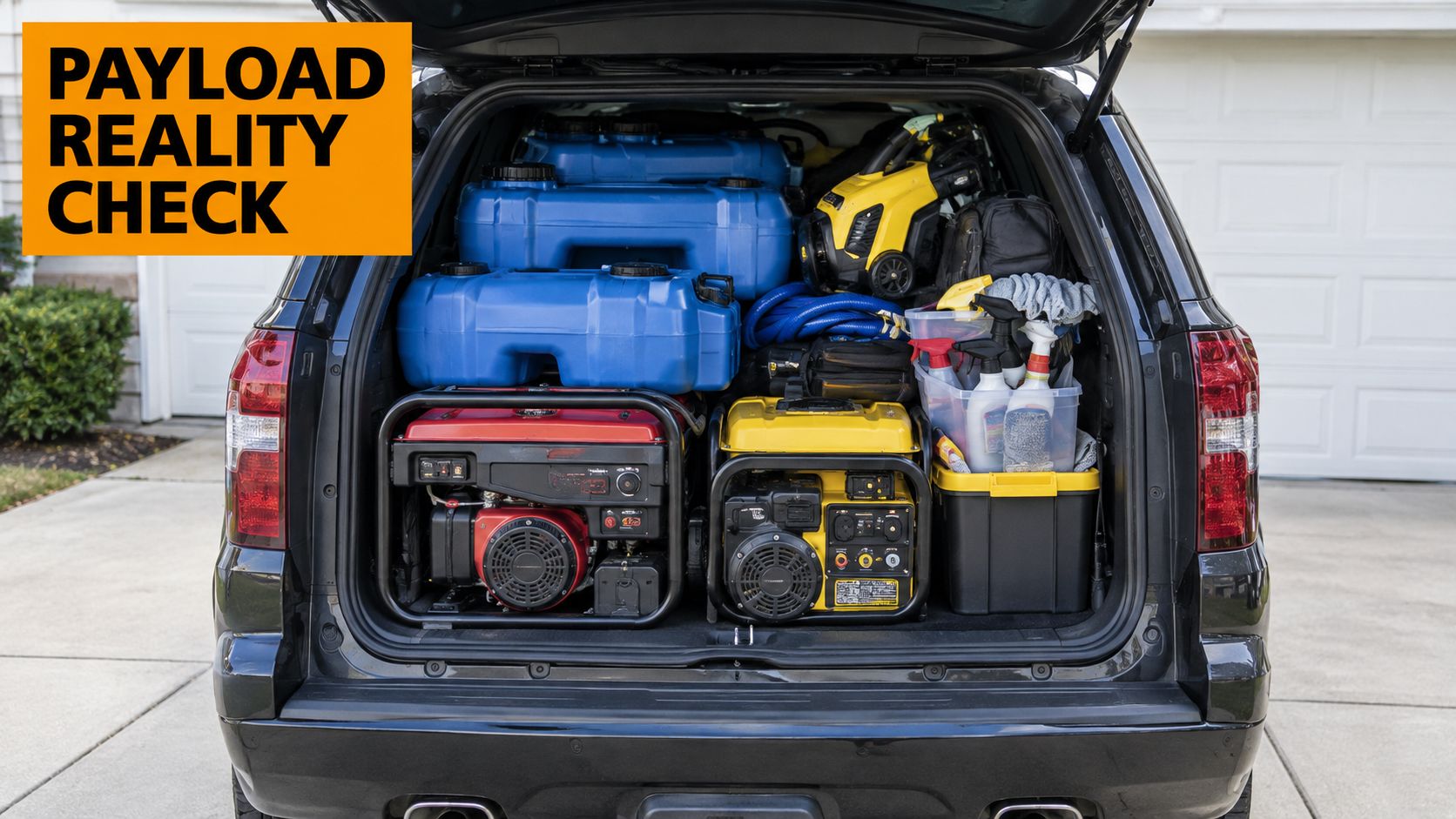
The Payload Reality Check for SUV Builds
A 50-to-100-gallon tank sounds like the professional choice because those ranges appear on many mobile-detailing checklists. In an SUV, however, the question isn't whether the tank fits through the hatch. The question is whether the loaded vehicle remains within its gross vehicle weight rating, with the weight distributed safely across its axles.
A full 35-gallon tank alone weighs about 290 pounds, according to this SUV mobile detailing equipment analysis. That figure comes before adding the tank, generator, pressure washer, wet vacuum, extractor, hoses, reels, chemicals, towels, shelving, containment mat, recovery pump, and the operator. A larger tank can consume the payload that would otherwise support an entire working system.
Calculate usable payload before buying gear
Start with the vehicle's GVWR, not its curb weight. GVWR is the maximum permitted loaded weight of the vehicle. Curb weight is the vehicle with standard equipment and operating fluids, but generally without your full working load. The difference between GVWR and the actual scale weight of your ready-to-work SUV is your available payload.
Use this process:
- Find the GVWR on the driver-door certification label or in the owner's documentation.
- Weigh the SUV as you'll operate it, including fuel, the driver, regular passengers, and any permanent accessories.
- Subtract the measured weight from GVWR.
- Reserve capacity for variable loads, such as extra chemicals, dirty-water recovery, towels, and a helper.
- Compare the remaining payload with every installed and carried item, including water.
A vehicle's payload label can help, but it isn't a substitute for weighing the finished rig. A tank that's empty during installation becomes a moving liquid load when full. If the vehicle carries the tank behind the rear axle, the effect on handling can be worse than the raw weight suggests because it increases rear axle loading and reduces the margin at the front.
Practical rule: If the numbers only work when the SUV is empty, the setup doesn't work.
For many SUV operators, the sensible starting point is a lean rig using customer water where permitted, rinseless or low-water methods where appropriate, and compact electrical equipment. The portable cleaning equipment guide is useful for comparing equipment categories, but the final decision still belongs to your vehicle's payload and axle ratings.
Build a payload worksheet before placing an order. List the tank at its working fill level, not just its empty weight. Add the driver, a normal chemical load, recovery water, and the equipment needed for the most demanding service you intend to sell. If the result leaves little reserve, reduce the tank or move the heavy work to a trailer or van rather than accepting unsafe compromises.
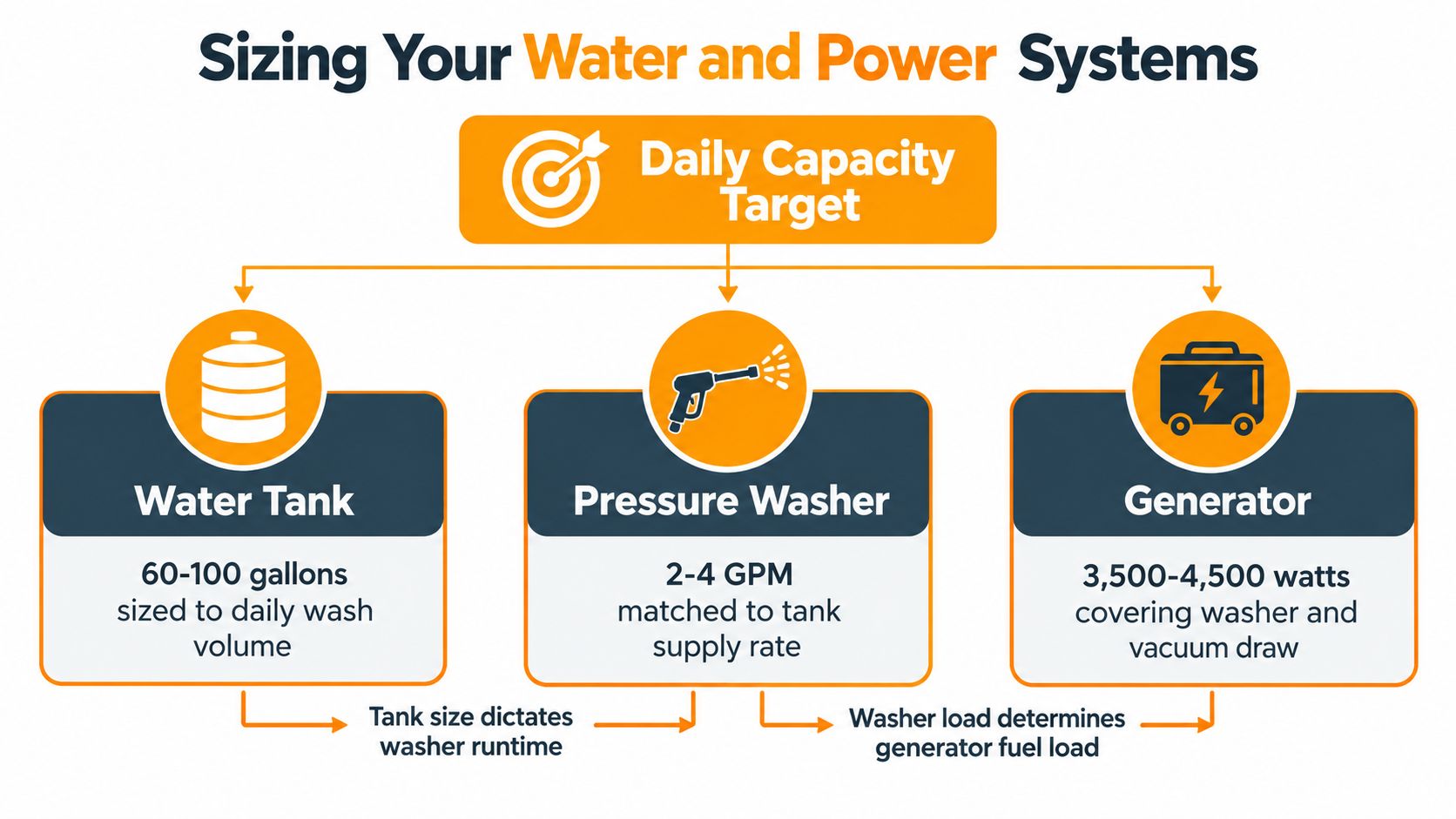
Sizing Your Water and Power Systems
The right equipment is the equipment your SUV can carry and your workflow can feed. A pressure washer that demands more water than the tank or pump can supply creates pulsing, interruption, and wasted time. A generator sized only for the pressure washer may trip when the vacuum or extractor starts.
Published mobile-detailing checklists commonly place a field-ready setup around a 50-to-100-gallon water tank, a 1,500-to-2,000 PSI pressure washer, and a 4,000-to-6,500 watt generator. Those ranges come from this mobile detailing startup equipment checklist, but an SUV operator shouldn't treat the upper end as a default. Treat it as a reference ceiling to test against the vehicle and service mix.
Match water capacity to the service
A large tank supports independence, but it also creates the largest payload penalty. If you mainly perform maintenance washes, a smaller onboard supply plus access to a customer spigot may be more practical than carrying a van-sized reserve. If you sell deep-cleaning packages that use an extractor, the tank calculation must also account for recovery capacity and disposal, not just clean water.
The pressure washer should deliver controlled cleaning rather than maximum force. The 1,500-to-2,000 PSI range is a practical reference for mobile vehicle work because it provides useful pre-rinse and rinse capability without making high pressure the cleaning strategy. Technique, nozzle choice, distance, and chemical dwell matter more than chasing a larger PSI number.
A foam gun can help spread detergent across an SUV's broad panels while reducing repeated passes. SwiftJet's Car Wash Foam Gun connects to a standard garden hose and applies foam through an on/off trigger, so it fits best in a customer-water or hose-fed workflow rather than a fully tank-independent system. It should be treated as an application tool, not a replacement for proper pre-rinse, contact washing, or runoff control.
Check electrical demand under startup load
Add the running wattage of the pressure washer, vacuum, extractor, lights, and any chargers. Then check startup or surge demand, especially for motors. A generator must cover the largest simultaneous load, not just the quiet average while each tool runs separately.
A 4,000-to-6,500 watt generator can support a broader set of electric tools, but its fuel, frame, and vibration also consume valuable SUV capacity. A smaller inverter or battery arrangement may work for a vacuum and low-draw accessories when the customer supplies power for the pressure washer. Before choosing a transfer pump, review its flow requirement and confirm that the tank outlet, filter, hose diameter, and pump can maintain supply.
This mobile pump guidance can help when comparing transfer-pump approaches. The practical test is simple: run the full intended tool combination before accepting paid work, including the extractor startup, vacuum operation, hose reach, and tank feed. Mid-job power loss damages throughput and makes a compact rig look less professional than a deliberately lean one.
Cargo Layout and Weight Distribution
A well-designed SUV should open like a workstation, not like a storage closet. Loading order affects safety, setup time, and whether one spill can disable the entire operation.
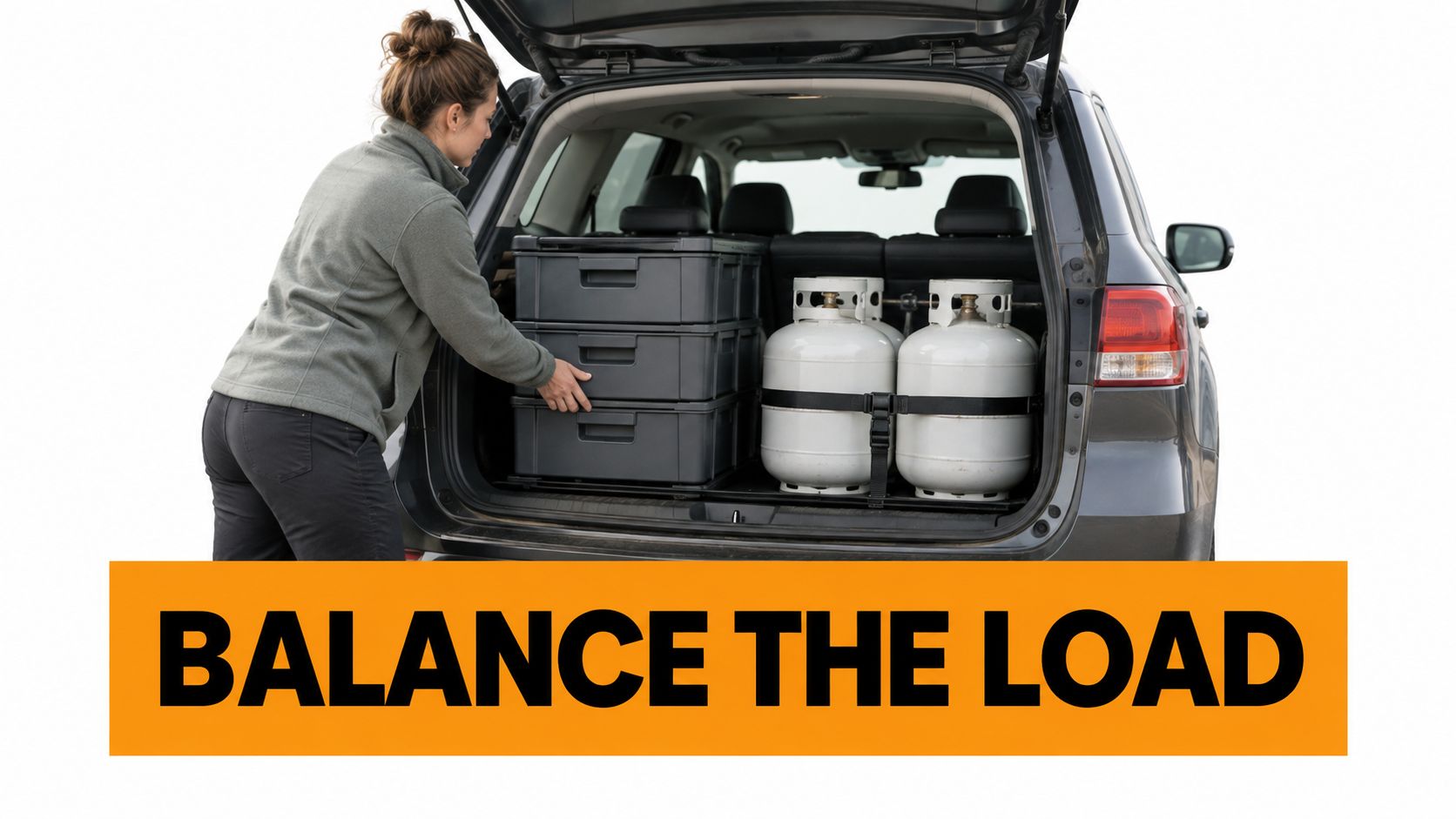
Keep the heaviest items low and close to the vehicle's center, ideally near the axle area rather than hanging behind the rear hatch. A tank, generator, and extractor placed at the back create a rear-heavy load and can make steering feel light. Never rely on the cargo floor's friction to hold a tank or generator during hard braking.
Load the vehicle in working order
Place equipment in the order you deploy it:
- Containment first. Keep the bermed mat, drain covers, and recovery hose accessible without unloading the entire vehicle.
- Water and power low. Secure the tank and generator to structural anchor points, keeping them away from loose chemical containers.
- Pressure-washing equipment next. Store the washer, inlet filter, pump, and high-pressure hose where they can come out without crossing the clean interior tools.
- Interior tools above or beside the heavy gear. Vacuums, extractors, brushes, and towels should be reachable after the exterior stage.
- Chemicals in sealed, upright bins. Use secondary containment and separate them physically from generators, battery packs, extension cords, and power strips.
A modular bin system is usually more useful than permanent shelving in an SUV. Shelves consume space even when a job needs different tools, while removable bins let you adapt the load to a maintenance wash, an interior detail, or a paint-care appointment.
Use ratchet straps, E-track, or bolted tie-down points rated for the equipment. Check that straps don't press against hose fittings, tank walls, or generator controls. The car wash caddy can help keep frequently used wash accessories together, but it shouldn't become a substitute for securing heavy equipment.
Route hoses before the first job
Plan a clean path from tank or spigot to pump, then from pressure washer to the vehicle. Keep electrical cables away from standing water and route them along the edge of the work zone, where customers and technicians won't cross them. Coil hoses in large loops instead of tight bends, and leave enough slack to walk around an SUV without dragging the machine.
Put clean towels in a closed container and dirty towels in a separate, ventilated bag. At the end of each job, reset every item to its marked location. A repeatable loadout exposes missing tools before you arrive and prevents the common mistake of carrying extra equipment when the cargo area becomes disorganized.
On-Site Workflow and Runoff Containment
The first thing to unload isn't the pressure washer. It's the containment equipment. Washing on a driveway or parking lot without controlling dirty water can send detergent, road film, brake dust, and sediment toward a storm drain, and local rules may require a specific recovery and disposal method.
Municipal vehicle-washing guidance commonly recommends placing the vehicle on a bermed wash mat, blocking runoff from reaching storm drains, and using a wet vacuum or submersible reclaim pump to move captured water into a storage tank. The mobile detailing wastewater guidance describes the containment-first logic and the need to use an approved disposal route where required.
Set the site before starting water
Walk around the customer's SUV and inspect the slope, nearby drains, hose route, power access, pedestrians, and overhead obstructions. Ask the customer to move objects that could be splashed, and position the vehicle so the mat can sit flat with its berms fully supported.
Place the mat before any rinse. Seal the edges, cover or protect nearby drains, and confirm that the recovery hose can reach the collection point without crossing a walkway. If the mat's edge is folded under a tire or left open at a low point, the system can fail before the wash is halfway complete.
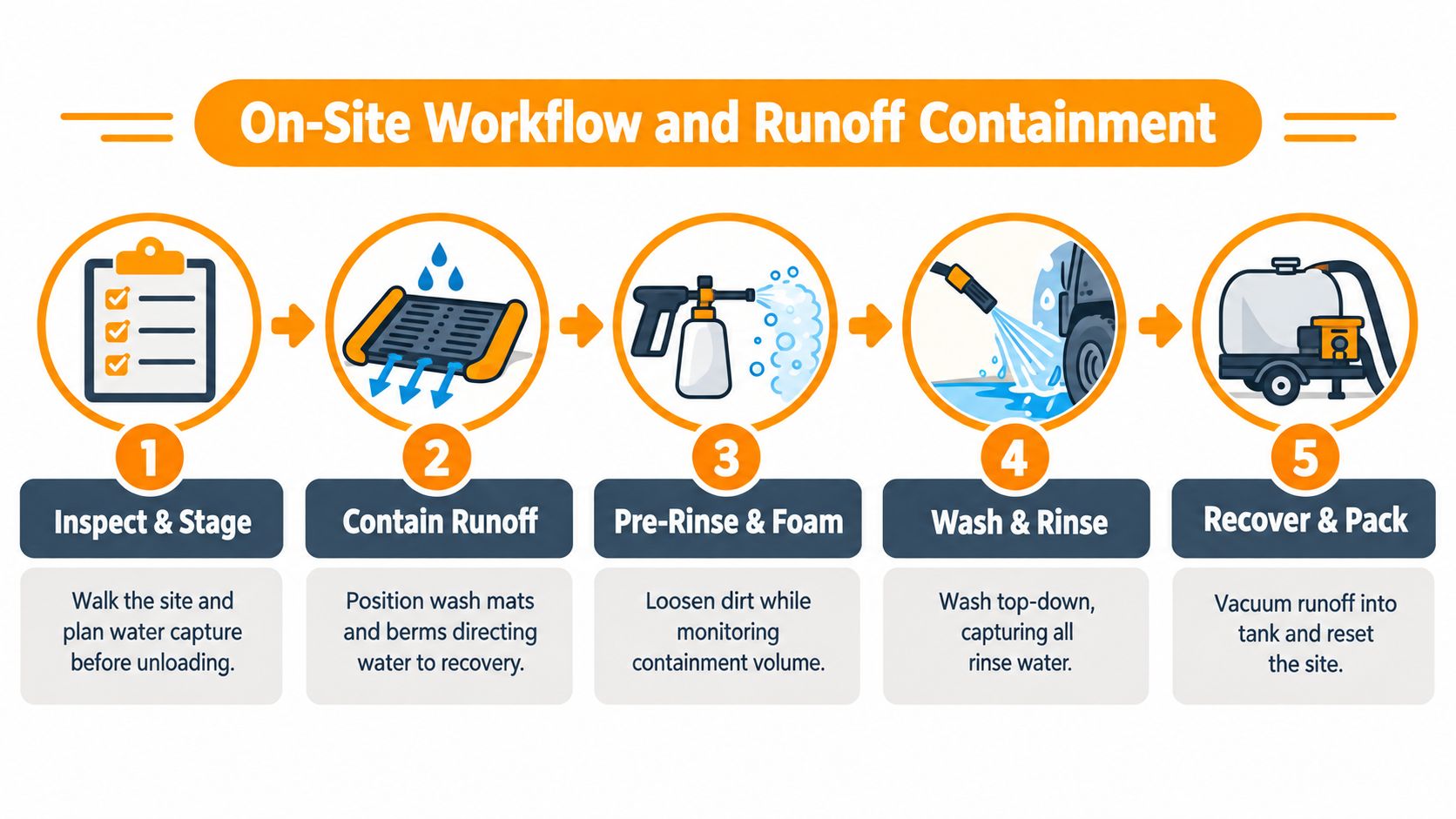
Then follow a disciplined sequence:
- Inspect and stage. Photograph existing damage, confirm the service, and place tools outside the contained zone where possible.
- Contain the runoff. Position the bermed mat and verify the drain path before opening the hose.
- Pre-rinse and foam. Use controlled pressure and a clinging foam to loosen contamination. Watch the mat's water level rather than allowing it to fill unnoticed.
- Wash and rinse. Work from the roof downward, changing mitts or towels as needed and keeping dirty tools away from finished panels.
- Recover and pack. Vacuum or pump captured water into the recovery tank, dispose of it through an approved route, remove the mat only after the area is clear, and inspect the pavement.
The SUV's larger panels make water management more demanding than a compact-car wash. Keep the recovery pump ready during the rinse, not after the puddle has spread. A dry, clean work area signals control to residential and commercial customers, while a wet trail leading toward a drain signals the opposite.
A visual demonstration can help technicians learn the sequence. Use the workflow below as a training reference, then adapt the process to local requirements and the customer's site.
Never assume curbside washing is acceptable because another operator does it. Runoff rules vary by location, and sanitary sewer discharge may only be allowed under specific conditions. Keep disposal records and confirm local requirements before offering water-intensive services in apartment complexes, office parks, or public parking areas.
Budget Tiers and Service Profitability
Build the first rig around booked services, not around the largest setup shown in a detailing video. A compact SUV can produce profitable work when the service menu stays controlled, customer utilities are used where appropriate, and unbooked equipment stays out of the vehicle. Every extra tank, generator, hose reel, and recovery container consumes payload that could otherwise support paid jobs.
Recent mobile detailing guides estimate lean personal-vehicle setups at $1,500 to $5,300, while dedicated commercial rigs are estimated at $8,050 to $15,100. The mobile detailing startup cost guidance describes these as different operating models, not two versions of one equipment list.
| Setup Tier | Estimated Cost | Water/Power Source | Best For |
|---|---|---|---|
| Lean SUV setup | $1,500 to $5,300 | Customer water and power, compact tools | Local appointments, maintenance washes, interior services |
| Dedicated commercial rig | $8,050 to $15,100 | Onboard water and generator systems | Self-contained service, broader locations, higher operational independence |
When customer utilities make sense
Customer water is practical when the site is suitable, the customer agrees, the connection is reliable, and local rules permit the workflow. It also keeps tank weight out of the SUV, leaving more payload for a vacuum, pressure washer, towels, chemicals, lighting, and containment gear. Confirm the hose connection before promising a water-intensive package.
Customer power can support interior cleaning when the outlet is accessible and the cord route is safe. Apartment complexes, offices, and some neighborhoods may offer no usable outlet, while a long extension cord can create a trip hazard. A battery or inverter system adds flexibility and quieter operation, but its capacity must be tested with the vacuum and extractor running under realistic conditions.
Price around the service, not the tank
A full-service SUV package should cover setup, containment, recovery, travel, labor, chemicals, equipment wear, and disposal. A tank does not automatically justify a higher price, and a lean rig is not automatically less valuable. Customers pay for a consistent result, a safe work area, reliable arrival, and the convenience of having an SUV serviced at home or work.
Payload control directly protects margin. If extra water and power force a heavier vehicle, reduce available cargo, or increase fuel and maintenance demands, the added capability must produce enough billable work to justify it. A disciplined SUV niche can be commercially meaningful because it reaches the $1,500 to $5,300 setup tier without immediately accepting the payload burden of a van-sized system. The wider market provides context, but the profitable decision is local: carry only what the vehicle, service menu, and gross vehicle weight rating can support. Analysts estimate the global car detailing services market at USD 46.7 billion in 2025, with on-demand and mobile detailing representing USD 10.8 billion, or 23.1% of revenue, according to car detailing services market estimates.
Scaling Your Mobile Detailing Business
An SUV rig scales only when it produces repeatable jobs without exhausting the vehicle, technician, or cash reserve. Start with a controlled service menu, measure which jobs require onboard water and power, then add capacity only when completed work supports the upgrade. The vehicle's gross vehicle weight rating remains the boundary. Revenue growth does not excuse exceeding it.
Mobile detailing is now a common service model. Industry summaries report that more than 60% of detailing businesses offer mobile services, while U.S. residential customers account for 82% of mobile detailing demand, according to detailing industry market data. For an SUV operator, that demand favors driveway-ready containment, compact equipment, dependable arrival windows, and a professional customer experience over maximum cargo volume.
Build around a focused customer
SUV and multi-purpose vehicles represent an estimated 41.26% of service revenue in 2025. Full-service SUV packages can support higher prices because they involve more exterior area and interior volume, but the service still has to fit the rig's payload and workflow. Build the menu around work the vehicle can complete safely, including maintenance washes, interior resets, stain treatment, and carefully scoped full details.
Recurring residential maintenance is usually easier to schedule and supply than unpredictable heavy-cleaning work. Use a clear inspection process, record existing damage, define the package boundaries, and leave the property cleaner than you found it. For commercial prospects, provide a service sheet covering water and power access, parking requirements, runoff controls, and disposal expectations.
Upgrade from evidence
Track why jobs become inefficient. If the pressure washer lacks supply, improve plumbing or customer-water procedures before buying a larger tank. If the generator overloads, measure simultaneous draw before replacing it. If the hatch area creates a safety issue, redesign the layout before adding another machine. Weigh the complete load, including water, chemicals, recovery equipment, tools, and textiles, rather than judging capacity from empty cargo space.
A traffic analysis tool for home service research can help assess competing local websites. Use this website traffic checker to see how nearby operators present their services, then refine your service pages and customer targeting. Let completed-job margins, payload measurements, and recurring demand determine equipment purchases.
Maintain the rig with the same discipline used on customer vehicles. Inspect straps, hose fittings, filters, electrical leads, recovery equipment, and chemical containers on a schedule. Keep a written loadout, separate clean and dirty textiles, and test the complete system before busy days. The strongest mobile detailing SUV setup carries the gear required for the promised service, arrives safely, and leaves enough margin to keep operating.
SwiftJet offers a garden-hose-connected car wash foam gun with an on/off trigger for controlled foam application when customer water is available. Review the SwiftJet option alongside the payload plan, containment equipment, and service menu before building the rest of the rig.
