

The pressure source decides more than foam thickness. A garden-hose soap dispenser can create a dramatic blanket of suds, yet low pressure and quick runoff may leave grime on the paint. A pressure-washer foam cannon can win with less impressive-looking foam when it delivers stronger coverage, holds detergent on the panel longer, and uses soap efficiently.
The foam cannon vs soap dispenser choice starts with the equipment already in your garage. A pressure-washer foam cannon typically operates around 1,100 to 5,000 PSI and 1.4 to 5.3 GPM. A garden-hose foam gun commonly works around 40 to 80 PSI. That pressure gap affects how the solution aerates, how long it clings, and how quickly you cover the vehicle. Jimbo's Detailing compares the operating pressure and dwell behavior of both tools.
Dwell time matters because detergent needs time on the panel before rinsing. A foam cannon generally holds its mix for roughly 5 to 10 minutes, while a soap dispenser often provides roughly 1 to 3 minutes. Soap use matters too. The cannon suits a heavier pre-wash and faster coverage, while the dispenser fits light maintenance washing when you only have a garden hose.
| Decision factor | Foam cannon | Soap dispenser |
|---|---|---|
| Pressure source | Pressure washer | Garden hose |
| Foam behavior | Dense and clinging | Thinner and wetter |
| Typical dwell window | Roughly 5 to 10 minutes | Roughly 1 to 3 minutes |
| Best use | Heavy pre-wash and fast coverage | Light maintenance washing |
| Main limitation | Needs a compatible pressure washer | Lower pressure limits cling and cleaning force |
| Best starting question | Do you already own a pressure washer? | Do you only have a hose? |
Why Foam Thickness Is the Wrong Place to Start
Foam thickness is easy to see, so it dominates product comparisons. It's also a poor starting point. Foam doesn't clean because it looks tall in the bottle. Pressure, dwell time, and soap concentration at the panel decide whether the pre-wash loosens road film before you touch the paint.
A strong foam application at pressure-washer force can spread chemistry across the vehicle quickly and hold it against vertical panels. A wall of airy suds from a low-pressure hose can look richer for a moment, then slide away before the detergent has done much work. The difference is especially obvious on rocker panels, rear hatches, and the lower doors where traffic film sticks hardest.
The three measurements that matter
PSI feeding the tool determines how effectively the cannon atomizes, mixes, and projects the solution. A garden hose can apply soap, but it can't reproduce the same mechanical delivery as a pressure washer.
Dwell time determines how long the detergent remains on the surface before rinsing. Pressure-washer foam commonly provides about 5 to 10 minutes of panel dwell, while garden-hose foam often provides about 1 to 3 minutes, according to this foam cannon and hose comparison.
Concentration controls how much active product reaches the paint. Working mixes vary widely. Foam-lance and cannon concentrates are commonly mixed around 1:3 to 1:12, while pressure-washer bottle setups often sit around 1:10 to 1:30 before further machine dilution. This professional dilution guide explains why the bottle ratio and panel ratio aren't the same.
Practical rule: Judge the tool by how effectively it wets, dwells, and rinses the vehicle, not by the height of the foam pile.
Use the guide to mastering foam thickness as a tuning reference, but don't let visual foam replace proper technique. Pre-rinse first, apply suitable car shampoo, allow safe dwell without letting the product dry, then rinse thoroughly before contact washing.
How a Foam Cannon and a Soap Dispenser Work
Foam thickness is not the mechanism that decides the wash. Pressure source, dwell time, and ounces of soap per wash determine whether each tool can loosen contamination before contact.
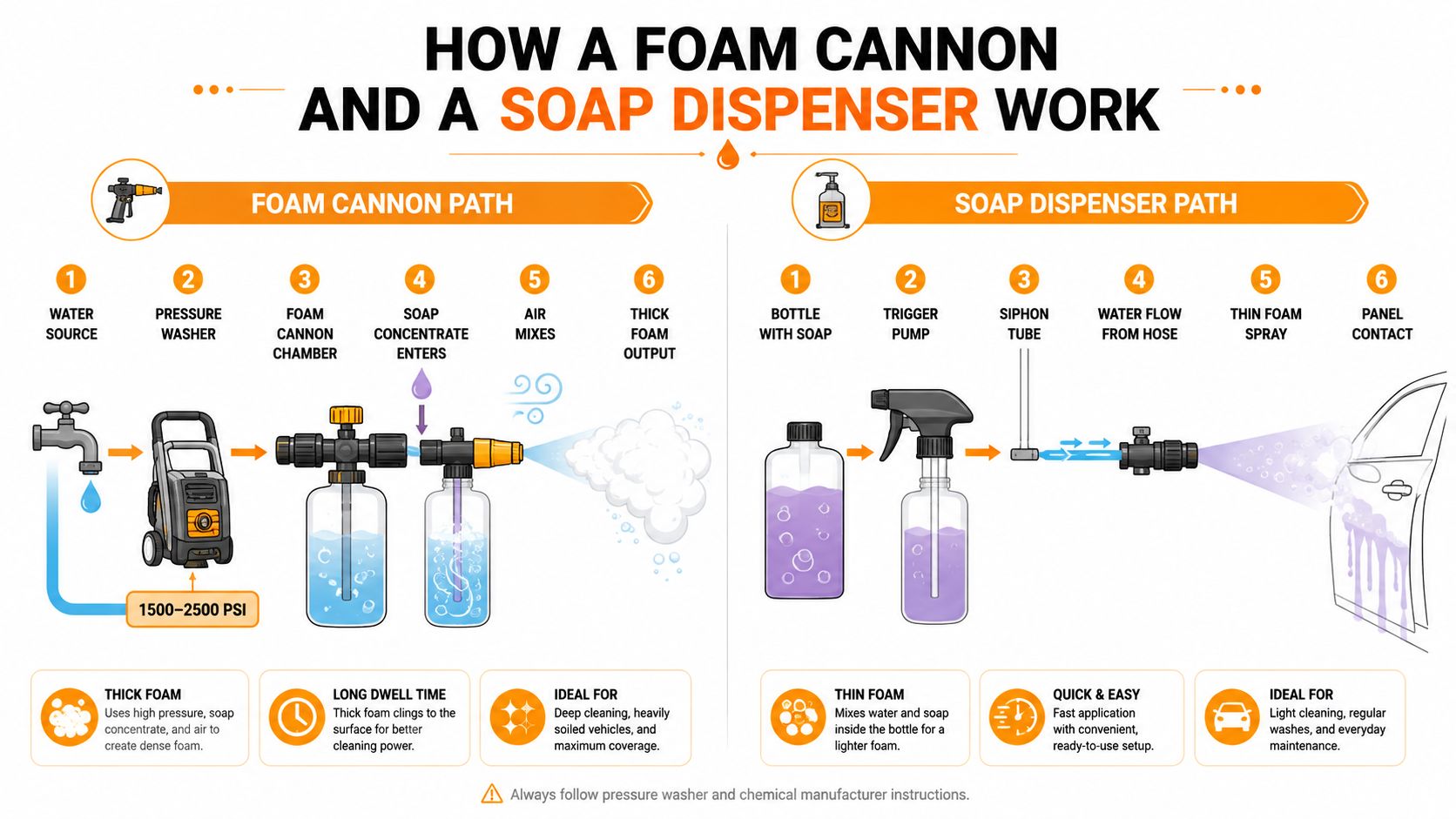
A foam cannon attaches to a pressure washer. Pressurized water passes through its metering system, draws concentrate from the bottle, and mixes the solution with air. The result is aerated foam that clings to paint longer than ordinary soapy water. Many consumer setups run at roughly 1,500 to 2,500 PSI, but flow rate, orifice size, soap, and adjustment settings control the final application. A bottle mix around 1:10 is a common starting point for active snow-foam concentrate. Treat that ratio as a starting point, then set it for the product and equipment.
A soap dispenser, also called a foam gun, connects to a standard garden hose. Water moves through the attachment while the device siphons or meters concentrate from its reservoir. Lower pressure creates lighter, wetter suds that run off sooner. Prepared-solution examples in professional dilution charts include roughly 1:80 to 1:130, while some body detergents reach ranges such as 120:1 to 360:1. The professional dilution reference gives useful context for reading these ratios.
Why the delivery path changes the wash
The cannon's pressure and air mixing produce a slower-running layer. Give it several minutes of safe dwell, then rinse before the product dries. That extra contact time helps soften road film and reduces the work required during the contact wash.
The dispenser wins when speed and simplicity matter. It applies soap directly from a hose, making it practical for a lightly dirty daily driver or a quick maintenance wash. Its wetter foam usually needs faster application and rinsing because it leaves the panel sooner.
Soap draw also changes the decision. A dispenser can run very lean because it meters chemical rather than maximizing visible foam. A cannon often uses a stronger working bottle mix, while controlled draw and aeration spread that solution across the vehicle. Judge the setup by the ounces of soap per wash and cleaning result, not by foam height.
For a visual demonstration of both application paths, watch the embedded walkthrough below.
Side-by-Side Comparison Across the Criteria That Matter
Foam thickness is a poor starting point. Compare the pressure source, useful dwell time, and ounces of soap per wash first. A cannon usually wins on pre-wash cleaning, while a dispenser wins when hose access and quick setup matter more.
| Criterion | Foam Cannon | Soap Dispenser | Winner |
|---|---|---|---|
| Foam quality and cling | Dense, aerated foam stays on vertical panels longer | Thin, wetter foam runs faster | Foam cannon |
| Dwell time | About 5 to 10 minutes when conditions allow | About 1 to 3 minutes | Foam cannon |
| Road-film cleaning | Stronger pre-wash support with adequate pressure and chemistry | Suits light dirt and maintenance washing | Foam cannon |
| Soap efficiency | Often about 2 to 4 ounces per wash | Draw varies with the attachment and mix | Depends on setup |
| Water behavior | Higher-pressure application covers the vehicle quickly | Continuous hose flow can increase water use | Foam cannon |
| Setup | Needs a pressure washer, fitting, bottle, and adjustment | Connects directly to a standard hose | Soap dispenser |
| Equipment commitment | Requires pressure-washer ownership or purchase | No pressure washer required | Soap dispenser |
| Best overall job | Heavy or neglected vehicles and low-contact pre-wash | Lightly dirty daily drivers and simple hose washes | Depends on the job |
The 2 to 4 ounces of soap per foam-cannon wash estimate appears in this comparison of foam cannons, pressure washers, and pump sprayers. Use it as a working reference, not a fixed setting. Truck size, product concentration, cannon adjustment, and repeated application all change the draw. For dilution choices, use this soap dilution guide to match the product mix to your equipment.
Where each tool earns its place
A cannon's advantage is functional. Pressure and air spread solution across the vehicle, then hold it on the paint long enough to soften road film before contact washing. Several minutes of safe dwell can reduce the grit dragged across the surface by a mitt.
A dispenser earns its place through access and speed. It works without a pressure washer, making it suitable for a lightly dirty daily driver, a quick maintenance wash, or a location with limited equipment. For exterior-cleaning context beyond vehicles, Dallas exterior cleaning methods from Water Works Power Washing shows why pressure selection should match the surface and task instead of defaulting to maximum force.
Water use needs a closer look. Richer foam does not automatically mean lower consumption. This guide on foam-cannon soap consumption notes that pressure-washer cannons may use about 2 to 4 ounces per wash, while garden-hose foamers may need about 4 to 6 ounces. Judge the dispenser by its cleaning result and chemical draw, not by its thinner appearance.
Which Tool Wins in Each Real-World Scenario
The right answer becomes obvious when you start with the equipment already in front of you. Don't buy a pressure washer just to justify a cannon if your actual wash is a light rinse outside an apartment. Don't buy a hose dispenser for serious mud removal if a capable pressure washer is already sitting in the garage.
| Scenario | Winner | Why It Wins |
|---|---|---|
| Hose-only driveway | Soap dispenser or hose-compatible foam gun | It works with the available pressure source and needs no additional machine |
| Pressure-washer owner | Foam cannon | Higher pressure creates denser foam and longer dwell |
| Mobile detailer | Foam cannon with controlled proportioning | Faster coverage and repeatable dilution suit customer-site work |
| Apartment wash with no hose bib | Neither, use a permitted rinseless method | Neither tool solves the missing water connection |
| RV or camping wash with limited water and no power | Soap dispenser, where a hose is available | Lower equipment burden and easier setup |
| Heavily soiled off-road truck | Foam cannon | Stronger pre-wash action reduces the amount of initial contact scrubbing |
| Weekly maintenance wash on a clean car | Soap dispenser or no foamer | A full cannon setup may add unnecessary preparation |
The hose-only driveway
If a garden hose is all you own, pressure is the bottleneck. A quality dispenser is the practical choice, and a hose-compatible foam gun can make the wash more controlled and enjoyable. It won't behave like a pressure-washer cannon, so use it for light or moderate soil and follow with careful contact washing.
The pressure-washer owner
A pressure-washer owner should buy the cannon. The machine supplies the force that makes dense aeration and useful cling possible. The result is faster vehicle coverage and a stronger pre-rinse stage, especially on lower panels and larger vehicles.
The mobile detailer
A mobile operator needs repeatability more than novelty. Controlled dilution, quick application, and fast coverage matter when the same process must work across multiple vehicles and water conditions. A dispenser can handle a light job, but it becomes a limitation when heavy road film demands longer dwell.
The limited-water traveler
RV and camping washes need a different mindset. If power is unavailable and water access is limited, a hose dispenser can be the practical choice where a hose is permitted. If neither water nor a connection is available, choose a low-water or rinseless process instead of forcing either foaming tool into the job.
Setup, Compatibility, and the Small Details That Decide Foam Quality
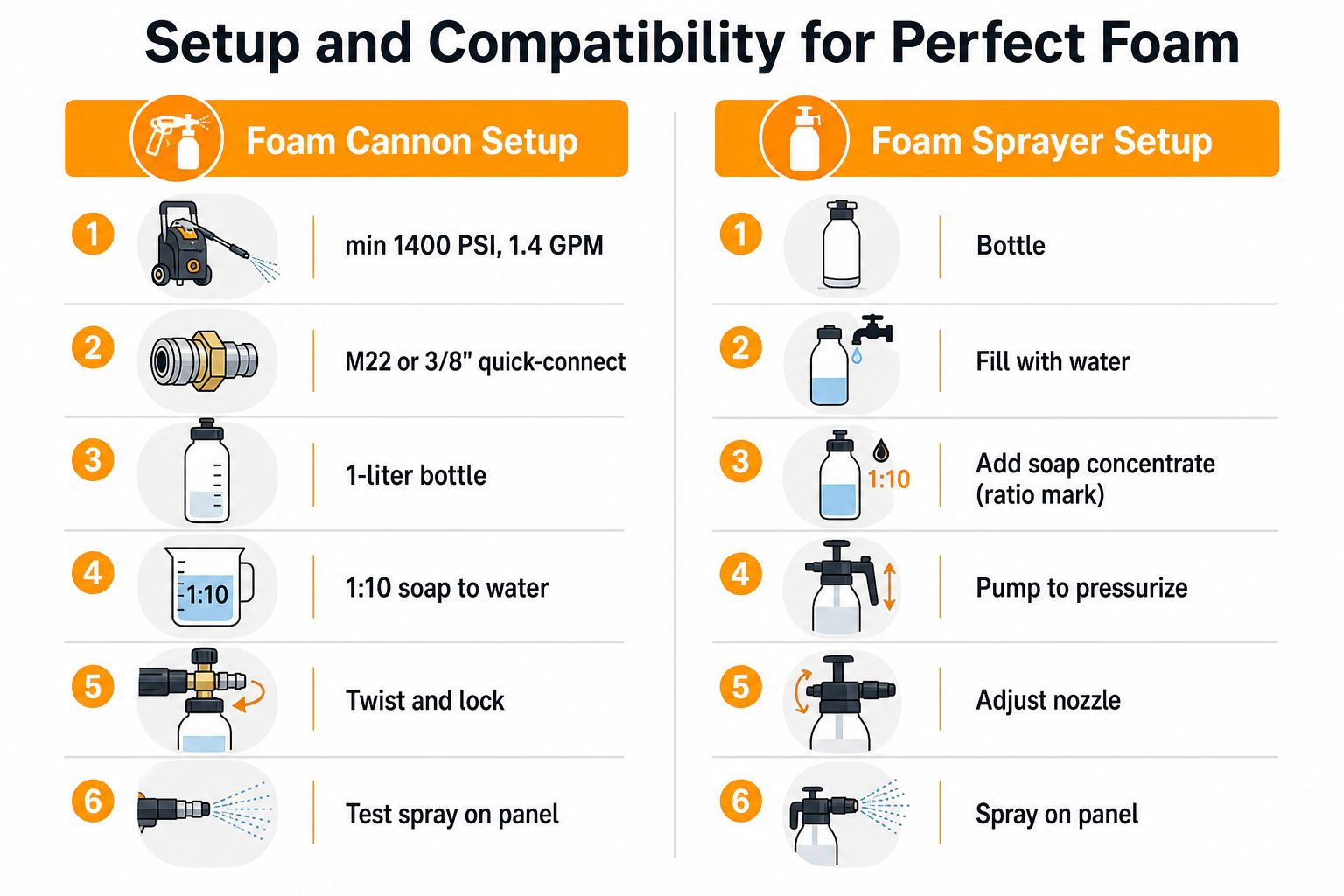
Foam thickness is not the setup target. Pressure, flow, dilution, and dwell time determine whether the product loosens grime before contact washing. A foam cannon needs a pressure washer capable of feeding it properly. Start with a machine rated at least around 1,400 PSI and 1.4 GPM, then confirm the wand connection. Common fittings include M22 and 3/8-inch quick-connect, but the connector must match your washer.
Fill the 1-liter bottle with soap and water according to the chemical maker's instructions. A starting mix around 1:10, or a stronger setting around 1:5 for some snow-foam concentrates, may suit the product. Dilution charts vary by formulation and dosing system, so adjust from the label rather than copying another setup. Pre-rinse the vehicle, attach the cannon, and test one panel before covering the car.
Set the top adjustment gradually. Aim for foam that clings for several seconds and moves slowly across the panel. A thick layer that dries in the sun is a failed setting, not better cleaning. Open the fan adjustment for broad coverage, give the product time to dwell, then rinse thoroughly before touching the paint.
A practical dispenser setup
A soap dispenser uses less hardware. Attach it to a standard garden hose, add water and car shampoo to the reservoir, select the setting, and move across the vehicle while squeezing the trigger. Keep the spray moving. A concentrated stream held on one area can waste soap and leave uneven coverage.
A prepared solution around 1:200 can suit some car shampoos and equipment combinations, but that ratio is not universal. This dilution chart explains why the same product can require different ratios in different dosing systems. After applying and rinsing the foam, use a proper two-bucket contact wash if the vehicle still needs mechanical cleaning.
Compatibility check: A cannon needs enough washer flow to make useful foam. A dispenser needs a sound hose connection, a clean filter screen, and chemistry that will not clog or collapse under hard-water conditions.
Orifice size and the inlet screen often affect foam quality more than the product label. An undersized pressure washer can make a cannon spray weak, watery foam. Mineral buildup can restrict a plastic dispenser's siphon path and make its output inconsistent. For hose-specific setup guidance, read how to connect a foam cannon to a garden hose. A hose foam gun and a pressure-washer cannon use different pressure sources, so they will not deliver the same dwell time or coverage.
Soap and Water Usage Compared Per Wash
Soap consumption is the practical difference between these tools, not foam thickness. A cannon may use less concentrate per application, while both setups still consume water for rinsing and any follow-up contact wash. Spraying longer than needed also turns attractive coverage into wasted product.
A pressure-washer cannon commonly uses about 2 to 4 ounces of soap per wash. A garden-hose dispenser may use about 4 to 6 ounces. Treat those figures as category comparisons, not an exact calculation for every sedan, because machine flow, metering, soap concentration, and spray time change the result.
| Metric | Foam Cannon | Soap Dispenser |
|---|---|---|
| Soap-use range | About 2 to 4 ounces per wash | About 4 to 6 ounces per wash |
| Product behavior | Aerated application spreads concentrate efficiently | Lower-pressure delivery may require more product |
| Refill burden | Usually lower when adjusted correctly | Can be higher with a wetter drawn mix |
| Rinse-water outcome | Fast coverage can reduce repeated passes | Continuous hose flow adds water during application |
| Main variable | Machine flow, orifice, soap, and metering setting | Hose flow, siphon setting, and reservoir design |
What the dilution ratio really tells you
1:64, or about 1.54% concentrate, and 1:128, or about 0.78%, are not interchangeable instructions across different equipment. A professional dosing system may use only 1% to 3% prepared solution in self-service applications, while some foaming brush detergents can be diluted to 1:200 with suitable hardware. The equipment determines how much concentrate reaches the vehicle, so follow the product's directions and test the output instead of copying a bottle ratio blindly.
The cannon generally wins on concentrate efficiency. The dispenser wins when avoiding a pressure washer matters more than minimizing ounces of soap. Water use depends on spray duration, rinse technique, and whether you complete a full contact wash afterward. Foam thickness does not answer the water question.
Use a pH-appropriate automotive product, not household dish soap. This car-wash soap guide helps match shampoo chemistry to foaming tools and the condition of your paint protection. If you are adapting a cannon to hose-only washing, follow this guide to connecting a foam cannon to a garden hose before judging its soap or water use.
Which One You Should Buy
Choose by pressure source, dwell time, and soap use, not by foam thickness. If you already own a pressure washer that can properly feed a foam cannon, buy the cannon. If you only own a garden hose, buy the dispenser. The right tool matches the equipment you use now.
| Setup / User | Recommended Tool | Why It Wins |
|---|---|---|
| Pressure washer owner | Foam cannon | Uses existing pressure for stronger aeration and longer dwell |
| Garden-hose-only homeowner | Soap dispenser or hose foam gun | Adds foam without requiring another machine |
| Mobile detailer with a high-flow pressure washer | Foam cannon with proportioning control | Delivers repeatable application and fast vehicle coverage |
| Clean daily driver washed frequently | Rinseless wash or simple bucket wash | Avoids setup that adds little value to light soil |
| Off-road truck with heavy contamination | Foam cannon plus proper decontamination process | Gives the pre-wash more mechanical and chemical support |
| Apartment resident without a hose connection | Neither | Access and wash rules matter more than attachment choice |
A foam cannon wins when a pressure washer is already part of your wash routine. The machine supplies the pressure needed for stronger aeration, quicker coverage, and longer dwell time. It also can use fewer ounces of soap per wash than a garden-hose foamer when the cannon, metering setting, and detergent are matched correctly.
A dispenser wins on access and simplicity. It suits a homeowner who wants to connect to a hose, apply soap, and continue without buying or storing a pressure washer. Expect a lighter layer and shorter dwell time. That is a fair trade for hose-only convenience, not a defect.
Mobile detailers should choose the cannon when the machine has adequate flow and adjustable proportioning. Repeatable soap output matters across customer vehicles, and a controlled pre-wash keeps the process consistent. Set the dilution for the product, verify the spray pattern, and judge cleaning by dwell and rinse results rather than the appearance of the foam.
Skip both tools for lightly soiled cars that you wash often. A rinseless wash or straightforward bucket wash may take less time to set up. For an off-road truck, use the cannon as the pre-wash, then follow with the contact and decontamination steps the contamination requires.
Apartment residents without an approved hose connection should buy neither. Wash rules, water access, and drainage determine the workable method before any attachment does.
If your current setup is a garden hose, start with a dispenser or hose foam gun. If you later add a suitable pressure washer, move to a cannon. Read this guide to connecting a foam cannon to a garden hose before adapting equipment. SwiftJet's foam gun is one hose-connected option for applying car-wash foam without a pressure washer.
Quick Answers to the Questions Readers Ask Next
Will either tool fit my existing equipment?
Most pressure-washer foam cannons use a quick-connect fitting, commonly a 1/4-inch quick-connect, and many setups also require an appropriate M22 adapter. Confirm the fitting and the machine's pressure and flow requirements before ordering. A cannon that physically connects but doesn't receive enough flow won't produce the foam you expect.
Soap dispensers and foam guns generally attach to standard 3/4-inch garden-hose threads. Check the connector, washer, and filter screen if the attachment leaks or stops drawing product. Hose pressure produces a lighter application, so don't judge a dispenser by pressure-washer-cannon standards.
Do I need either tool for a quick wash?
No. A light rinse followed by a detail spray may be quicker than setting up a cannon for a short job. If the car has minimal dirt and you can safely wipe it with the correct method, a bucket or rinseless wash can be more efficient.
Does thicker foam clean better?
Not by itself. Foam thickness improves the visual layer and can support dwell, but soap chemistry, pressure, dwell time, rinsing, and contact technique do the actual cleaning. A cannon's thicker foam becomes an advantage when you use it as a proper pre-wash, not when you spray it on and immediately rinse.
Do I need different soap for each tool?
No. A suitable pH-neutral car shampoo can work in both systems. You may need to adjust dilution and metering because the pressure source changes how the product aerates.
When does a cannon justify the upgrade?
The cannon earns its cost when a compatible pressure washer is already in your garage and you wash vehicles that benefit from a strong pre-wash. If you only have a hose, buy the hose-based tool first. Equipment compatibility matters more than chasing the thickest foam.
SwiftJet offers a garden-hose foam gun for applying car-wash foam without a pressure washer, which fits the hose-only scenario discussed here. Visit SwiftJet to review the foam-gun option and choose the setup that matches your current washing equipment.
