

You've screwed the foam gun onto the hose, opened the spigot, and pulled the trigger. Instead of a thick blanket of suds, a watery stream runs down the driveway. The problem usually isn't the soap. It's a mismatch between the fitting, water flow, and type of foaming tool.
For most North American homes, the connection starts with a 3/4-inch Garden Hose Thread, or GHT, not the M22 or 1/4-inch quick-connect fittings used with many pressure washers. Once you identify the right thread and understand what your hose can deliver, connecting a foam gun becomes straightforward. The harder part is tuning the system so it produces the thickest foam its available flow can support.
Foam Cannon vs Foam Gun and Why It Matters
A true pressure-washer foam cannon uses a machine-generated stream to mix water, detergent, and air. A garden-hose foam gun attaches to the hose end and uses ordinary household water pressure with an internal siphon to draw soap from its bottle. Those tools may look similar, but they don't produce foam in the same way.
Pressure-washer accessories commonly use M22 fittings or 1/4-inch quick connectors, while hose-end products are designed around the threaded end of a garden hose. Detailed Image's connection guidance describes this distinction clearly. A standard hose can power a useful pre-wash, but it won't atomize detergent with the same force as a pressure washer.

Set the right expectation
Many product listings call a hose-end foam gun a “foam cannon.” That wording causes trouble when someone buys a pressure-washer cannon, connects it to a spigot, and expects shaving-cream foam. A genuine garden-hose model should have a pickup tube and a mixing chamber designed to siphon soap at lower pressure.
A hose gun can still lay down rich, clinging lather. It's useful for loosening dust, road film, and light grime before contact washing. It just won't create the dense, hanging blanket associated with a pressure washer.
Practical rule: Match the tool to the water source before changing soap ratios. A pressure-washer cannon and a garden-hose foam gun aren't interchangeable just because both spray suds.
For a product-specific overview of hose-end operation, see SwiftJet's auto foam cannon guide. The important buying phrase is garden-hose compatible, not just “foam cannon.”
Checking Your Hose Thread and Faucet Compatibility
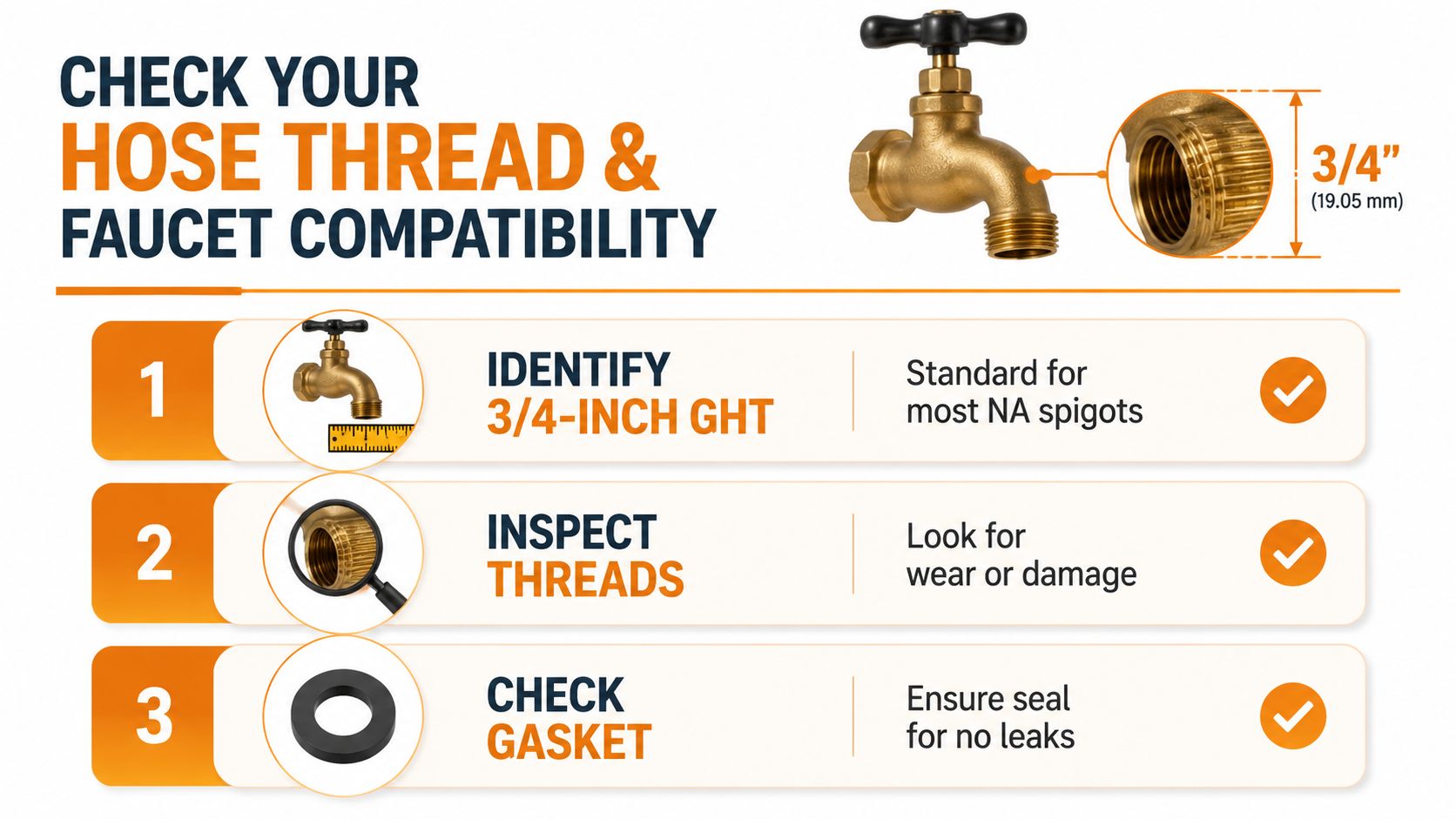
A garden hose can have the right diameter and still fail to connect if its end fitting uses the wrong thread standard. Most residential outdoor faucets and hoses in North America use 3/4-inch GHT, also written 3/4-11.5 NH or NHR. These are straight, non-tapered threads with a nominal outer diameter of about 1.0625 inches, or 27 mm, and a pitch of 11.5 threads per inch. A garden hose thread size chart shows why this interface is common across hoses with 1/2-inch, 5/8-inch, and 3/4-inch internal diameters.
Do not confuse hose diameter with thread size. A 5/8-inch hose can use a 3/4-inch GHT end fitting, so the printed hose diameter alone is not enough to select an adapter. Thread mismatch can restrict flow, create a leak, or prevent the foam gun from drawing detergent properly.
Inspect the faucet and hose end
Shut off the water before checking the fittings. GHT threads look coarse, straight, and visibly non-tapered. If you have a caliper, measure the outside of the faucet's male threads. Otherwise, compare it with a known GHT hose fitting.
NPT is different. It is a tapered pipe-thread standard used on many plumbing and pressure-washer components. NPT and GHT can look close enough to start together, but forcing them can damage the threads and still leave a leak.
Check the coupling and seal:
- Male GHT coupler: Usually connects to a foam gun with a female GHT inlet.
- Female GHT coupler: Usually receives the male end of a faucet or hose fitting.
- Rubber hose washer: Creates the watertight seal. The threads hold the parts together.
- Brass or stainless adapter: Handles repeated tightening better than fragile plastic when an adapter is necessary.
Many hose-end guns, including models like the SwiftJet, use a standard GHT female inlet, so a hose with a male GHT end should connect directly. Use SwiftJet's hose connector guide to compare common fitting styles before buying an adapter. Confirm both thread type and gender first. An adapter for the wrong mismatch only adds another leak point and can further reduce the flow available for foam production.
Attaching the Foam Gun to Your Garden Hose
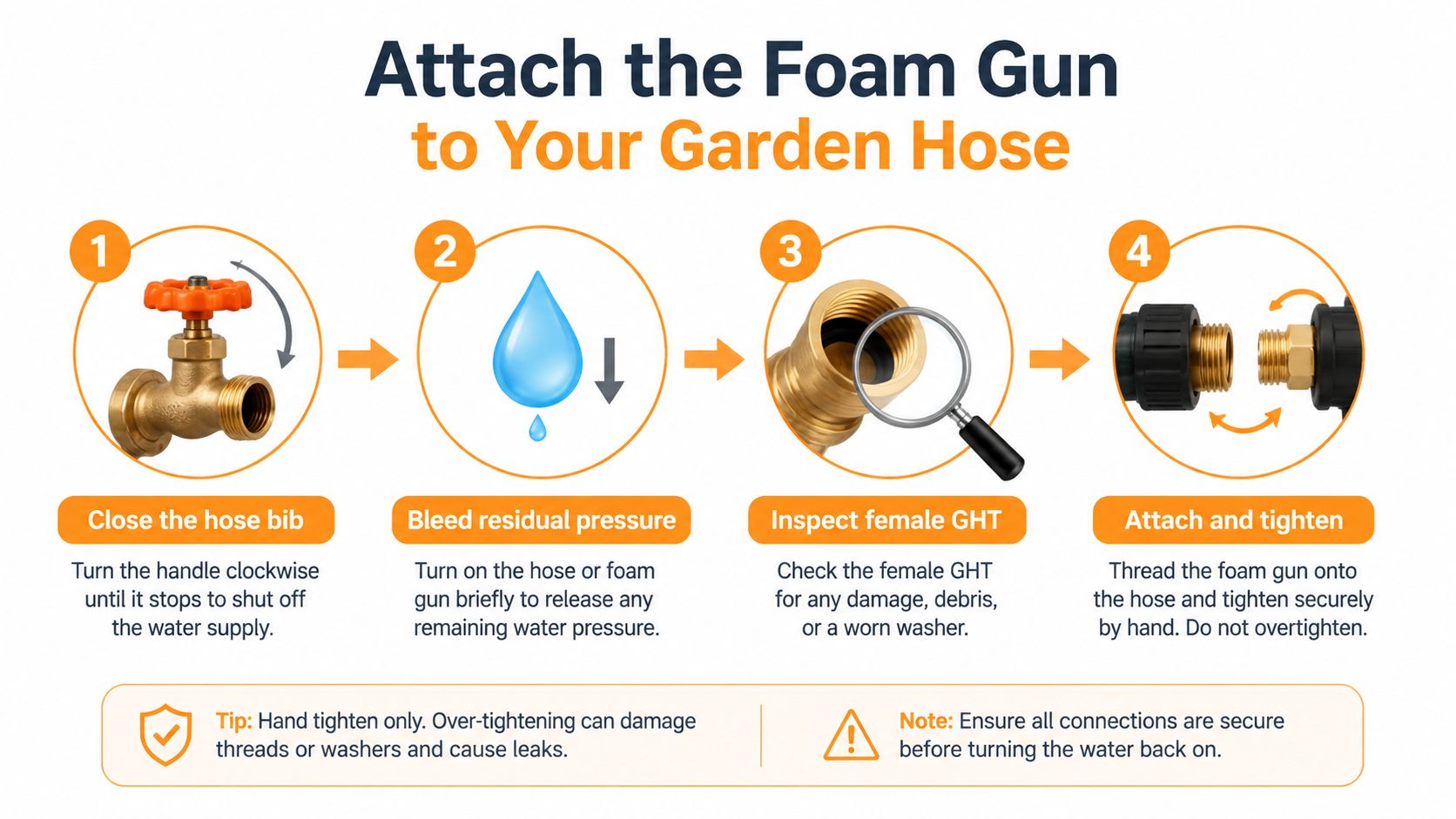
Make the connection with the water off and the line depressurized. Close the hose bib, then briefly open the hose nozzle or trigger to release trapped pressure. This makes the threads easier to start and prevents a sudden burst of water while you're inspecting the fitting.
Use the washer, not brute force
Look inside the foam gun's female inlet. A rubber washer should sit flat at the bottom of the coupling. If it's missing, cracked, hardened, or flattened, replace it before connecting the hose. Without that washer, tightening the threads harder won't create a reliable seal.
Follow this sequence:
- Position the hose: Hold the male GHT end squarely against the foam gun inlet.
- Start by hand: Turn the coupling clockwise. It should engage smoothly almost immediately.
- Stop at resistance: If it binds before the first full turn, back it out and realign it. Cross-threading is easier to prevent than repair.
- Hand-tighten: Bring the coupling snug against the washer.
- Add minimal tool pressure: If a drip remains, use channel-lock pliers for roughly a quarter-turn. Don't crush the washer or twist a plastic housing.
- Test slowly: Open the spigot gradually, inspect the joint, and then squeeze the trigger to prime the pickup tube.
A few drops at the joint usually point to a washer or thread problem, not a need for more torque. If the seal looks correct but water still escapes, disconnect the gun and inspect both mating surfaces for damaged threads.
Watch the connection sequence in this setup demonstration before testing your own unit:
Tuning Pressure and Dilution for Thick Foam
Thick foam depends on the balance between pressure and flow, not PSI alone. A garden hose can supply household pressure, but restrictions at the spigot, hose, coupler, or gun may leave too little flow for consistent soap draw. One hose-end guide from CommGear Pro gives an operating range of about 40 to 120 PSI with flow around 0.5 to 2.5 GPM for repeatable foam draw. That guide to hose foam cannons also points to low upstream flow, mismatched threads, and an oversized orifice as common causes of weak foam.
For a SwiftJet setup, confirm that the gun is designed for a garden hose, the inlet uses the expected hose-thread connection, the pickup tube reaches the solution, and the faucet and hose can provide steady flow. Check each coupler for internal restrictions. A fitting can appear compatible while its thread standard or narrow passage reduces output. See our guide to achieving thicker foam for more setup context.
Follow the soap manufacturer's dilution directions before adding more concentrate. If the bottle gives no useful starting point, mix a modest solution, spray a small vertical panel, and change one setting at a time. Extra soap cannot compensate for a restricted supply or an orifice that demands more flow than the spigot provides.
Diagnose the spray by its behavior
Foam that runs immediately usually means the gun is admitting too much water for its current setting, or the orifice is too large for the available flow. Sputtering indicates that the siphon is starving. Check the faucet, hose, trigger, couplers, and pickup tube for restrictions before changing detergent.
Use this troubleshooting order:
- Watery but steady spray: Increase detergent concentration slightly or use the gun's richer setting.
- Thin foam with weak coverage: Check for a kink, clogged screen, or restrictive connector.
- Sputtering draw: Open the spigot fully and confirm the pickup tube is seated.
- Foam that falls from the panel: Narrow the fan pattern and test a richer setting.
- Uneven spray: Inspect the nozzle and orifice for dried soap or mineral buildup.
The foam cannon orifice guidance from The Detail Supply Co. lists starting orifice sizes around 1.1 mm for light consumer electric systems, 1.25 mm for mid-range electric systems, and 1.35 to 1.5 mm for higher-flow setups. Those figures are not a universal prescription for a garden-hose gun, but they explain why a nozzle made for a higher-flow machine can produce poor foam on a standard spigot.
A bucket test shows what the faucet supplies. Time the fill, calculate the flow, and choose a soap setting the gun can siphon consistently. More available flow may require more detergent to maintain concentration, while restricted flow may call for a less demanding nozzle setup.
Common Connection Mistakes and How to Fix Them
Before reaching for an adapter, verify the thread standard and the water path. A fitting can look close enough while creating a restriction that weakens siphoning and leaves foam thin. Check these points before changing soap concentration or nozzle settings.
| Mistake | Symptom | Fix |
|---|---|---|
| Using the wrong thread standard | The fitting binds, leaks, or will not seat | Confirm 3/4-inch GHT before choosing a coupler. Do not force GHT onto NPT. |
| Confusing hose diameter with thread size | A hose marked 5/8-inch appears incompatible | Inspect the end fitting. Different hose diameters can still use the same GHT interface, as noted in the garden hose thread size chart above. |
| Skipping the rubber washer | Water drips from the female coupling | Install a properly seated 3/4-inch hose washer. |
| Adding unnecessary adapters | The assembly twists or leaks at multiple joints | Connect directly when the hose has a male GHT end. Add only the adapter required by the actual fitting. |
| Overtightening | The washer deforms or the plastic body cracks | Tighten by hand, then add only a small tool-assisted turn if needed. |
| Installing a pressure-washer cannon on a spigot | The tool produces weak or no foam | Use a hose-engineered foam gun with a siphon tube instead. |
The coupler itself can restrict flow. A cheap plastic part may flex when the hose is pulled sideways, while worn threads or a distorted washer can admit air and interrupt the siphon. Brass or stainless components generally tolerate repeated connection and removal better, but neither material fixes the wrong thread or a restrictive passage.
For a SwiftJet setup, confirm that the faucet-side connection is 3/4-inch GHT, the garden hose has the matching male end, and the gun includes its rubber washer and siphon tube. Check that any quick-connect does not reduce the passage noticeably, and keep the hose fully open without kinks. These details matter because a standard spigot supplies far less pressure and flow than a pressure washer.
Garden-hose foam guns have a lower ceiling than pressure-washer cannons. They can produce useful pre-wash lather, but they will not reproduce the dense foam of a high-pressure system. Judge the connection by whether the gun draws soap steadily, covers the panel evenly, and suits the available water supply and cleaning job.
Maintenance and Safety Tips for Long-Lasting Performance
A foam gun often fails gradually. The spray becomes patchy, the siphon weakens, or the trigger starts sticking, and the owner blames the detergent. In many cases, dried soap is blocking the pickup tube, mixing chamber, or orifice.
After every wash, empty the reservoir and refill it with clean water. Pull the trigger for 10 seconds to flush residue through the internal path. This routine prevents concentrated soap from drying inside the pickup system and changing the spray pattern.
Protect the seals and fittings
SwiftJet foam guns require extra care with aggressive chemicals. Avoid high-pH wheel cleaners and acidic solutions above pH 4, which can degrade internal seals more quickly than neutral car shampoos. Use a product intended for vehicle washing, and rinse the equipment rather than leaving chemical solution stored inside it.
Inspect the following regularly:
- Rubber washers and O-rings: Replace pieces that feel hard, flattened, or cracked.
- Pickup tube: Confirm it remains seated and isn't blocked with dried concentrate.
- Nozzle and orifice: Remove residue that causes an uneven fan.
- Quick-connect collar: Apply a small amount of silicone grease twice a year so it continues to slide smoothly.
- Body and bottle: Look for cracks, especially after cold weather or chemical exposure.
Store the gun indoors during freezing weather. Water trapped inside the brass body or plastic nozzle can expand and cause damage.
Shut off the spigot, squeeze the trigger to relieve pressure, and never leave a pressurized foam gun unattended. A stuck valve can make the hose move violently.
Wear eye protection when testing a new soap dilution. Concentrated surfactant can splash back from the nozzle, particularly when the fan is set narrow or the outlet is partially blocked. Before putting the tool away, check the hose, release pressure, and leave the bottle and fittings clean and dry.
SwiftJet offers a garden-hose foam gun with a standard threaded connection, adjustable foam control, an on/off trigger, and a free microfiber wash mitt. Visit SwiftJet to choose a hose-compatible setup and confirm the fitting details before your next wash.
