

You finish washing a black car, step back, and notice fine spiderwebs blooming across the bonnet. The paint looked clean when the bucket came out, but every pass may have pushed grit over the clear coat. That's the uncomfortable truth behind the car wash mitt or sponge debate: the tool doesn't merely carry shampoo. It controls where contamination goes when your hand applies pressure.
A soft surface isn't automatically a safe surface. A contaminated microfiber mitt can scratch paint, while a properly selected sponge can solve a specific low-water washing problem. The right choice depends on how the media holds dirt, how easily it releases that dirt, and whether your washing method gives you enough clean lubrication.
| Factor | Microfiber wash mitt | Traditional sponge | Closed-cell or hybrid sponge |
|---|---|---|---|
| General paint safety | Strong choice when clean and well maintained | Higher risk when grit remains on the face | Situation-dependent |
| Contamination management | Fibers can pull particles into the pile | Particles can remain against the contact face | Often easier to control in tight spaces |
| Water retention | High, especially with a dense pile | High | Varies by construction |
| Rinse-less washing | Good with the right technique | Can be useful in specific methods | Often practical for very low-water work |
| Large painted panels | Excellent coverage and glide | Fast, but less forgiving | Useful when controlled carefully |
| Heavy insects or bonded grime | May need a dedicated pre-treatment tool | Can provide focused agitation | Can be effective in limited areas |
| Best default for most cars | Yes | No | Only when the method calls for it |
The High Stakes of Your First Touch
A dusty bonnet can look harmless. Fill a bucket, wet a sponge, and the shampoo may make the first wipe feel smooth. That sensation says little about what is happening at the paint. Loose grit can stay trapped against the contact face, then travel across the clear coat under hand pressure. The car looks cleaner while the finish collects fine marks.
The same failure appears on dark paint, family cars, and vehicles washed carefully every weekend. Owners often blame road grit, automatic car washes, or weak paint. In many cases, the immediate cause is simpler: a contaminated wash medium has made repeated contact with the most visible part of the vehicle.
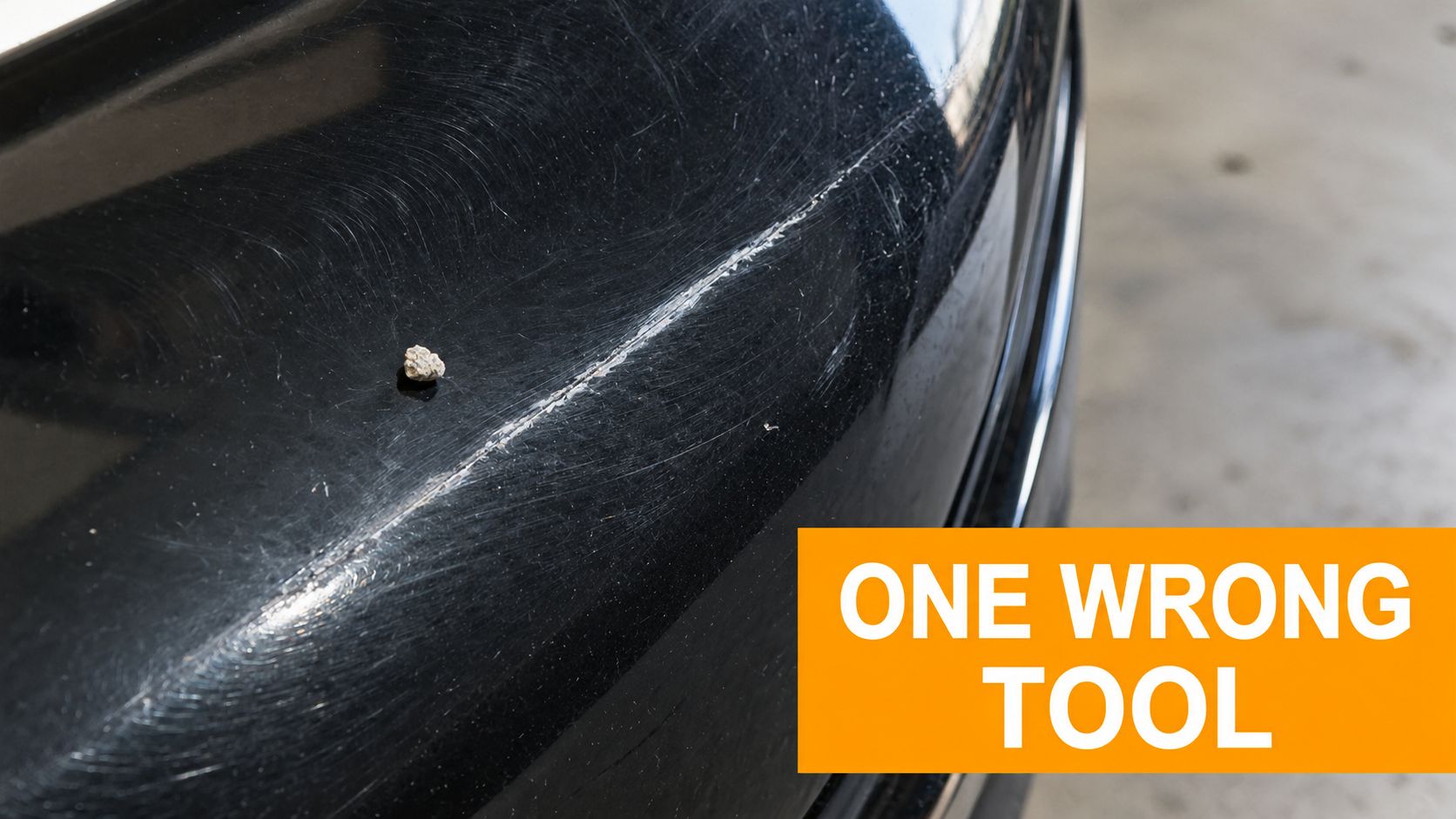
The first contact sets the risk
Paint safety depends on friction, pressure, contamination, and contact area acting together. A particle between your hand and the panel creates a hard abrasive point. Pressure pushes it into the clear coat, while each movement drags it through the finish. A large contact area can spread the contamination farther instead of reducing the risk.
A referenced University of Texas study found that a single home hand wash could create scratches reaching more than one-tenth of the paint thickness, as reported in comparative car wash mitt testing. The finding does not mean every wash causes deep scratches. It shows why the first contact deserves attention before the tool touches the paint.
Practical rule: If loose grit remains on the surface, do not scrub it. Remove or loosen that contamination before choosing a contact tool.
Why “soft” isn't enough
A sponge can feel soft while holding grit directly against the paint. Its broad face may be useful for controlled, low-water work or for a specialized task where predictable contact matters. Closed-cell and hybrid sponges can also suit tight areas, but they do not make contaminated contact safe.
A microfiber mitt generally provides more space for particles to move away from the panel. That advantage disappears if the mitt has been used on wheels, dropped on the driveway, or left dirty between washes. Rinse it often, keep wheel tools separate, and use fresh media for the upper panels.
Lower panels and wheel arches carry heavier contamination, so give them separate tools and a separate washing stage. If the particle may have come from the road, wheel well, or paint itself, use a structured process for identifying vehicle contamination before applying pressure.
For ordinary contact washing, a clean mitt remains the safer default. A specialized sponge makes sense when its construction and the washing method control contamination rather than merely spreading it. The tool matters, but rinsing, separation, and maintenance determine whether its design survives the first dirty panel.
Material Science Behind Wash Media
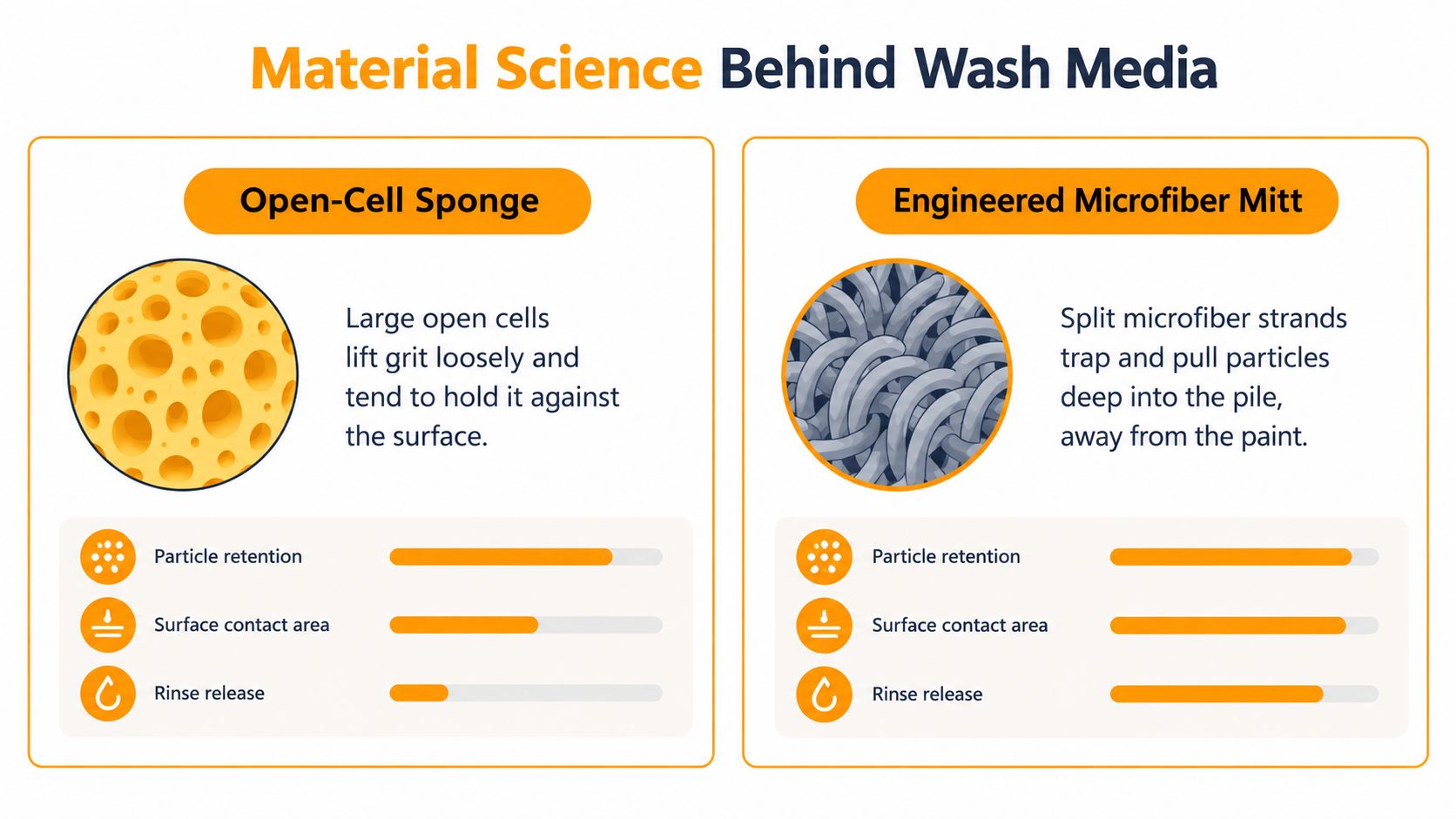
The difference between a sponge and a mitt is structural, not cosmetic. A conventional sponge presents a broad foam face to the panel. Its pores can hold water and shampoo, but the surface doesn't create the same deep, flexible network that allows particles to move away from the clear coat.
Engineered microfiber uses split polyester and polyamide fibers. Those fine strands form a tangled pile with spaces between them. When the mitt moves across a lubricated panel, the fibers can surround and hold contamination deeper in the material instead of leaving every particle at the paint interface.
What GSM actually tells you
GSM, or grams per square metre, describes microfiber density. Guidance for wash mitts commonly places 300 to 450 GSM in the balanced general-use range, while 450 to 600 or more GSM is positioned as a premium range for added absorption and cushioning, according to microfiber wash mitt specifications.
GSM isn't a complete safety score. A dense mitt can still trap abrasive contamination if you don't rinse it. A very thick pile can also make it harder to feel what's happening at the panel. Treat GSM as one buying signal, not permission to apply pressure.
The fiber blend matters too. A 70/30 or 75/25 polyester-to-polyamide blend is commonly recommended because polyamide improves softness and water retention. The same guidance cites absorbency of about 7 to 8 times the mitt's own weight in water, which helps a quality mitt carry more lubricating solution during a pass.
How the contact face behaves
A standard sponge tends to flatten against the panel. That creates a wide contact area, but it gives trapped grit fewer opportunities to move out of the immediate contact zone. If the sponge's face becomes contaminated, each stroke can redistribute that contamination.
A microfiber pile behaves differently. Long fibers bend, separate, and create depth. Chenille designs exaggerate that effect with raised strands, while hybrid tools combine a microfiber exterior with a foam center. Those constructions blur the old binary choice. A tool can offer the handling of a sponge while adding some of the particle separation associated with microfiber.
For shoppers who want to compare conventional foam options, find car wash sponges by construction rather than color or price. Look for a stated purpose, a surface that won't shed or crumble, and a design suited to your wash method.
You'll find that car-cleaning microfiber guidance is useful beyond the mitt itself. The same principles apply to drying towels, interior cloths, and any textile that touches a finished surface.
Swirl Marks and Paint Safety Performance
Swirl marks usually begin with one contaminated contact. A tool touches the panel, grit sits between the wash media and clear coat, and pressure turns that grit into a cutting point. The microfiber mitt gives that contamination more room to move away from the paint, so it remains the safer choice for routine body-panel washing. It can still scratch when loaded with road grit, brake dust, or a fallen stone.
The advantage comes from physical separation. A deep pile can surround particles and hold them above the clear coat during a light pass. That reduces the chance of dragging hard debris across the finish. It does not make an aggressive stroke safe, and it cannot rescue a mitt that has already collected heavy contamination.
A sponge has less tolerance for a dirty contact face. It may carry plenty of wash solution, but water retention does not isolate grit. Once particles collect on the face, lubrication can lower friction without removing the abrasive material from the panel.
Absorption supports lubrication
Independent testing found that microfiber mitts can retain substantially different amounts of wash solution, with higher-retention designs maintaining lubrication more effectively than lower-retention options. The practical benefit is a wet contact surface that keeps a film of shampoo between the fibers and paint. That film reduces the dry, dragging sensation that indicates the media is losing lubrication, but it does not guarantee a defect-free wash.
The better question is not which tool creates more suds. It is where dirt sits while the tool moves. A conventional sponge keeps contamination close to its working face. A microfiber mitt can bury and separate some of that contamination. Hybrid tools add another option, using a microfiber exterior with a foam core to combine controlled handling with greater internal space for wash solution and particles.
Specialized sponges still have a place. Their firmer shape can suit low-water methods, wheels, tires, door jambs, or areas where precise control matters more than maximum particle separation. Keep those tools away from glossy body panels unless they are clean, soft, and intended for that surface.
The two-bucket method still matters
Use one bucket for shampoo and another for rinsing. After each panel, agitate the mitt in the rinse water and release contamination before returning it to the clean solution. A grit guard can help keep heavier particles lower in the rinse bucket, but it does not replace inspection or water changes.
Wash the cleanest areas first, then work downward. Roof glass, roof paint, bonnet, and upper doors generally come before rocker panels, bumpers, and wheel-adjacent surfaces. Use straight, overlapping passes with light pressure. Treat stubborn marks with a suitable pre-treatment or dedicated tool instead of pressing harder.
The mitt is safer only while it remains a clean, controlled contact surface.
Dark paint reveals fine defects quickly because swirls catch reflected light. Light paint can hide the same damage, not prevent it. For a technique checklist covering safer contact and scratch prevention, use this guide to preventing car scratches.
Longevity, Maintenance, and Total Cost
The cheap sponge often wins at checkout and loses during ownership. Its purchase price may be lower, but the relevant question is how long it stays cleanable, flexible, and safe for the part of the vehicle where you use it.
Guidance on replacement timing suggests that sponges may need replacement every 6 to 12 months, while properly cared-for mitts may last 1 to 3 years, as summarized in the research on sponge versus wash mitt selection. Those are practical ranges, not guarantees. Wash frequency, contamination level, drying conditions, and storage all change the outcome.
Give microfiber a clean life
After washing the vehicle, rinse the mitt thoroughly until the water runs clear. Inspect the pile with your fingers. If it feels stiff, matted, gritty, or rough, don't put it back on delicate paint.
Wash microfiber separately from household laundry. Avoid fabric softener because it can coat and clog the fibers, reducing their ability to absorb and release contamination. Use a suitable detergent, rinse thoroughly, and dry the mitt in a clean environment where it won't collect dust.
Replace by condition, not by optimism
A mitt doesn't become safe again just because it went through a washing machine. Replace it when:
- The pile mats down: Flattened fibers provide less separation between grit and paint.
- The surface feels rough: Your fingertips can often detect damage before your eyes can.
- The cuff or backing fails: A loose backing can expose seams or cause uneven pressure.
- Contamination remains visible: Embedded particles are a reason to demote the mitt to wheels or discard it.
- The mitt was dropped: Driveway grit can lodge deep inside fibers.
Keep separate, clearly identifiable media for paint, wheels, and dirty lower areas. A mitt that has become unsuitable for bodywork may still serve safely on tires. That system extends useful life without transferring brake dust to the clear coat.
The economy is simple. A durable mitt costs more only if you ignore the value of the finish it helps preserve. Replacing a compromised tool is cheaper than correcting a panel covered in wash-induced defects.
Choosing for Specific Washing Scenarios
The best answer changes when the washing method changes. A large microfiber mitt is the right default for a conventional, well-rinsed contact wash, but it isn't automatically the most efficient tool for an apartment balcony, a rinse-less process, or a tightly contaminated grille.
Start with the environment. A dusty open-air driveway creates a different problem from a lightly soiled vehicle parked indoors. More loose contamination means you need stronger pre-rinsing and more capacity to move particles away from the surface. It doesn't mean you should scrub harder.
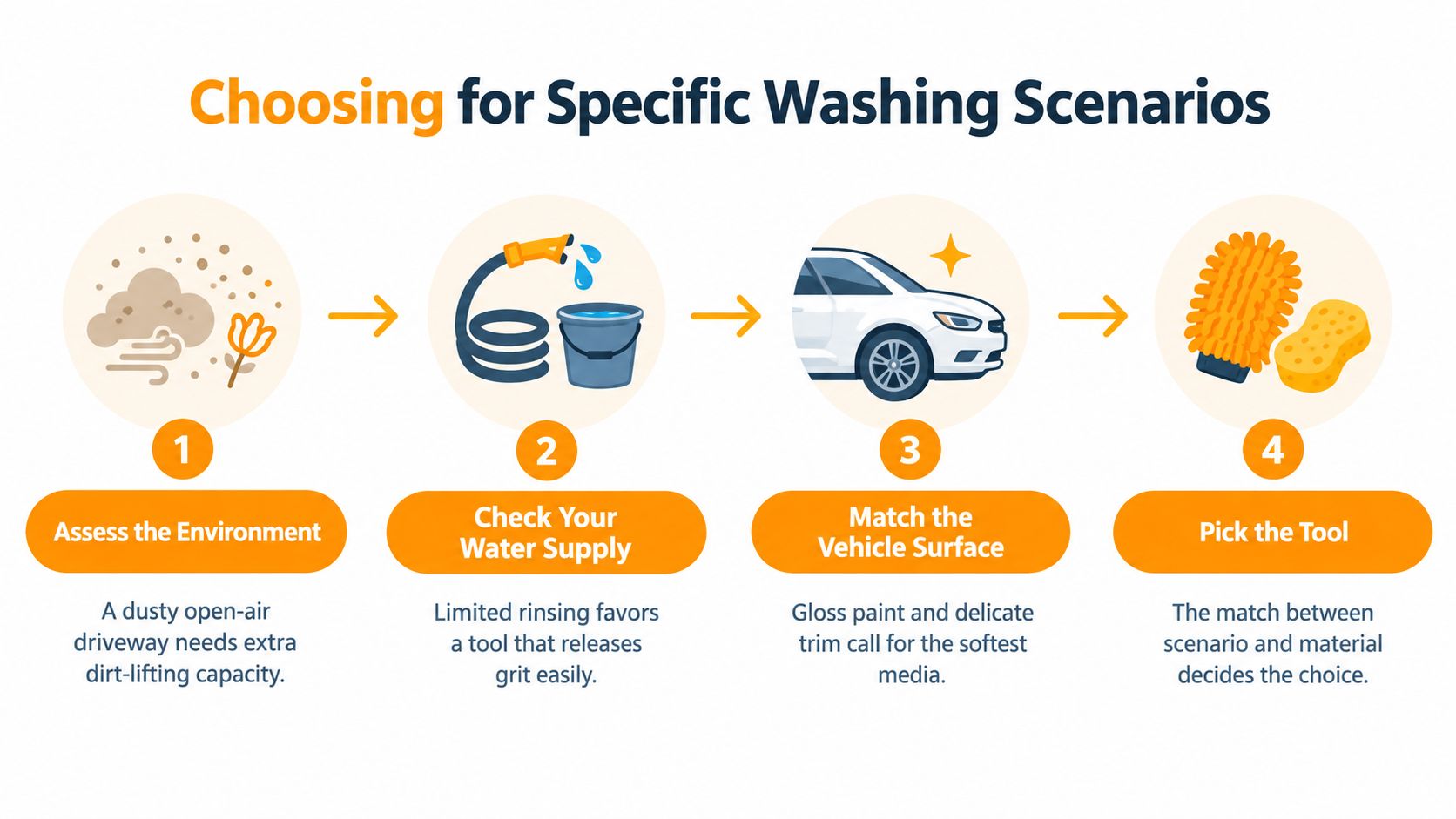
Match the media to the method
For a traditional hose wash, choose a clean microfiber or chenille mitt. Pre-rinse thoroughly, wash small areas, and rinse the mitt before loading it with fresh shampoo.
For a rinse-less wash, a closed-cell foam sponge may be useful in specific circumstances. One independent guide notes that this type of sponge can work effectively for rinse-less or very low-water washing and for tight spaces. The key is not the word “sponge.” It's whether the method keeps the solution sufficiently lubricated and lets you control contaminated passes.
For insect residue and stubborn deposits, don't turn the whole vehicle into a scrubbing project. Soften the contamination with a suitable product, allow dwell time, and use a focused tool only after the material has loosened. Some sponges can provide controlled agitation in a small area, but they still need frequent rinsing and careful pressure.
For hybrid wash pads, evaluate the outer material and the center separately. A microfiber outer with a sponge core may improve handling and water retention, but it doesn't remove the need to release grit. Modern construction changes the trade-off. It doesn't eliminate contamination management.
A simple decision tree
Ask four questions before you choose:
- Can you pre-rinse the vehicle properly? If yes, a microfiber mitt is the straightforward choice. If no, reduce contact and reconsider whether the vehicle is ready for a wash.
- Do you have enough clean solution for repeated rinsing? If not, use a method designed for low water rather than improvising with a dirty sponge.
- Are you cleaning paint or a non-paint surface? Wheels, tires, and engine-bay components should have dedicated media.
- Is the contamination loose or bonded? Loose dirt calls for lifting and rinsing. Bonded material needs chemical softening before agitation.
For broader process advice covering preparation, tool separation, and finishing, these car valeting and detailing tips provide useful context.
A sponge isn't the villain in every situation. It becomes a poor choice when someone treats its low cost and flat face as a universal solution for contaminated gloss paint.
The Verdict and Final Recommendation
For people washing a car at home, buy a quality microfiber wash mitt. It offers the best balance of paint safety, water retention, panel coverage, and contamination separation during a conventional wash. You'll still need good technique, but the material gives you more margin for error than a flat sponge.
That recommendation is strongest for clear-coated body panels. A clean mitt with a deep, flexible pile can move dirt away from the contact zone while maintaining lubrication. A sponge can hold plenty of wash solution, yet its broad face gives trapped grit fewer escape routes. Once that face becomes contaminated, the tool's low price stops being an advantage.
When the sponge earns a place
Keep a specialized sponge if you use a genuine rinse-less or very low-water method and understand how to manage contaminated solution. Closed-cell foam can also be practical in narrow spaces where a thick mitt is awkward. It may help with focused agitation after insect residue has been softened.
That's a niche role, not a reason to use the same sponge across every painted panel. Don't confuse a tool's usefulness in one method with universal paint safety.
Hybrid tools deserve consideration too. A microfiber outer and foam center can combine pile-based contact with sponge-like control, and newer chenille designs may suit users who value fast coverage or heavy solution retention. But marketing language doesn't replace testing. Check how the tool releases grit, whether the pile stays open when wet, and whether you can rinse it completely.
The purchase decision
Choose a mitt with a clearly stated microfiber construction, a comfortable cuff, and a pile suited to your paint and washing style. Keep one for bodywork and another for wheels. If the product feels rough when dry, sheds fibers, or has a backing that exposes hard edges, return it before it touches the car.
The decisive point is not that every sponge is unusable. It's that the microfiber mitt is the safer default for ordinary paint washing. Use the sponge only when its specific construction and your water-saving method justify the compromise.
Building a Safer Washing Routine
The tool works best as part of a contact-reduction routine. Begin by cleaning wheels and tires with dedicated media, then rinse the body thoroughly. A pre-wash stage removes loose contamination before your mitt reaches the paint.
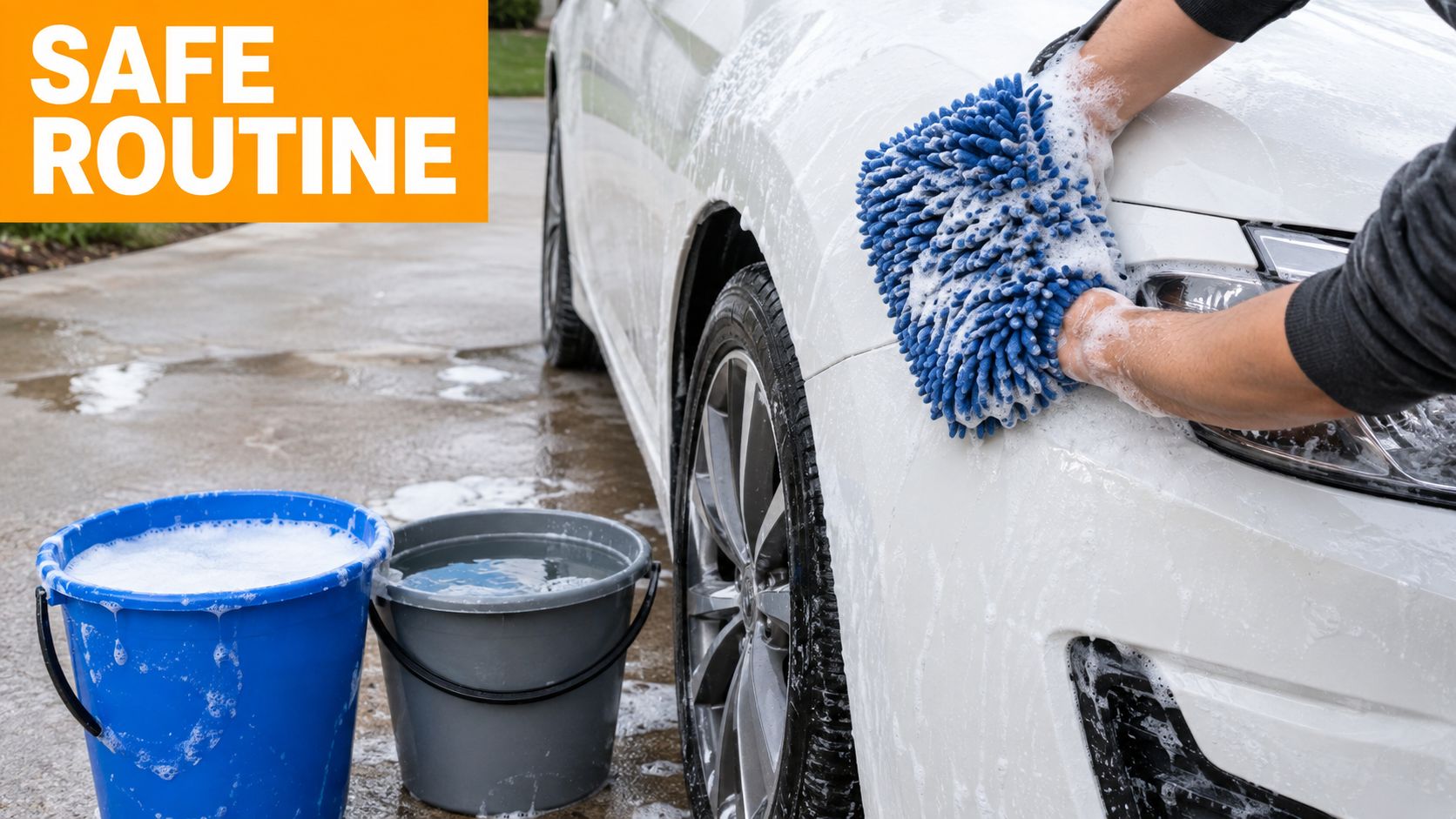
Use a lubricating car shampoo, two buckets, and a clean microfiber mitt. Wash from the top down in small sections, rinse the mitt after each section, and reserve the dirtiest lower panels for last. Never press harder to remove contamination that hasn't softened. Stop, add product, and let chemistry do more of the work.
Foam from a hose-connected foam gun can help loosen surface dirt before contact washing. It won't make a neglected or contaminated mitt safe, but it can reduce the amount of loose material your wash media has to manage. SwiftJet offers a foam gun that connects to a garden hose, along with a microfiber wash mitt in its bundle, so it can be considered as one option when assembling this type of routine.
Watch this practical demonstration before your next wash, then adapt the sequence to your vehicle, water supply, and paint condition.
Finish with a clean drying towel or controlled air drying. Keep drying media separate from wash media, inspect everything before storage, and retire any tool that feels rough. Your paint doesn't need aggressive cleaning. It needs fewer dirty contacts, better lubrication, and a tool that gives contamination somewhere safer to go.
If you want to reduce wash-induced scratching at home, visit SwiftJet to explore its hose-connected foam gun and microfiber wash mitt bundle. Use the foam stage to loosen dirt before contact washing, then follow the mitt, rinse, and drying routine described above.
