

You're three miles into a cold morning commute when the inside of the windshield turns milky. A motorcyclist pulls onto the shoulder because a rain-soaked visor has become a white wall. At the campsite, a pair of eyeglasses steams over as soon as the wearer crawls into a warm tent. Fog usually arrives at the worst possible moment, but it isn't mysterious or permanent.
An anti fog glass cleaner changes how moisture behaves on a surface. The right product can improve visibility on windshields, helmet shields, mirrors, goggles, and glasses. The wrong formula, or careless application, can leave streaks or damage coatings. The practical details matter just as much as the chemistry.
Why Foggy Glass Is a Real Problem You Can Solve
Fog forms when warm, moist air meets a cooler glass surface. Air inside a car carries moisture from breathing, wet clothing, rain, and damp floor mats. When that air touches the colder windshield, water condenses. The same process affects bathroom mirrors, helmet visors, swimming goggles, and eyeglasses.
The problem isn't just that the glass looks dirty. A fogged surface scatters light and blocks the clear view you need for driving, riding, hiking, or working. Turning up the defroster or wiping the glass may restore visibility briefly, but neither approach changes the surface that keeps attracting condensation.

Where the problem starts
A driver often notices interior windshield fog during a cold start, especially when the cabin warms faster than the glass. A rider can face the opposite frustration on a helmet shield, where humid air from the body meets a cooler surface after rain or a temperature change. Campers and hikers get a similar effect when they move between cold outdoor air and a warmer shelter.
Fog also points to a wider moisture issue in buildings. If condensation repeatedly forms between window panes or on surrounding frames, the solution may involve ventilation, seals, or window condition rather than cleaner alone. For that situation, a guide to when to replace windows due to condensation offers useful context.
Safety first: Treat fog as a visibility hazard before treating it as a cleaning inconvenience. Pull over or stop riding if you can't see clearly.
What a practical fix needs to do
A useful anti-fog treatment should spread across a clean surface, leave little residue, and remain compatible with the material underneath. It should also be applied thinly. Too much product can create the same haze you're trying to remove.
Once you understand that condensation becomes troublesome when it forms separate droplets, the purpose of an anti-fog cleaner becomes easier to recognize. The product isn't removing water from the air. It's controlling the way that water sits on the glass.
How Anti Fog Glass Cleaner Beats Fog at the Surface Level
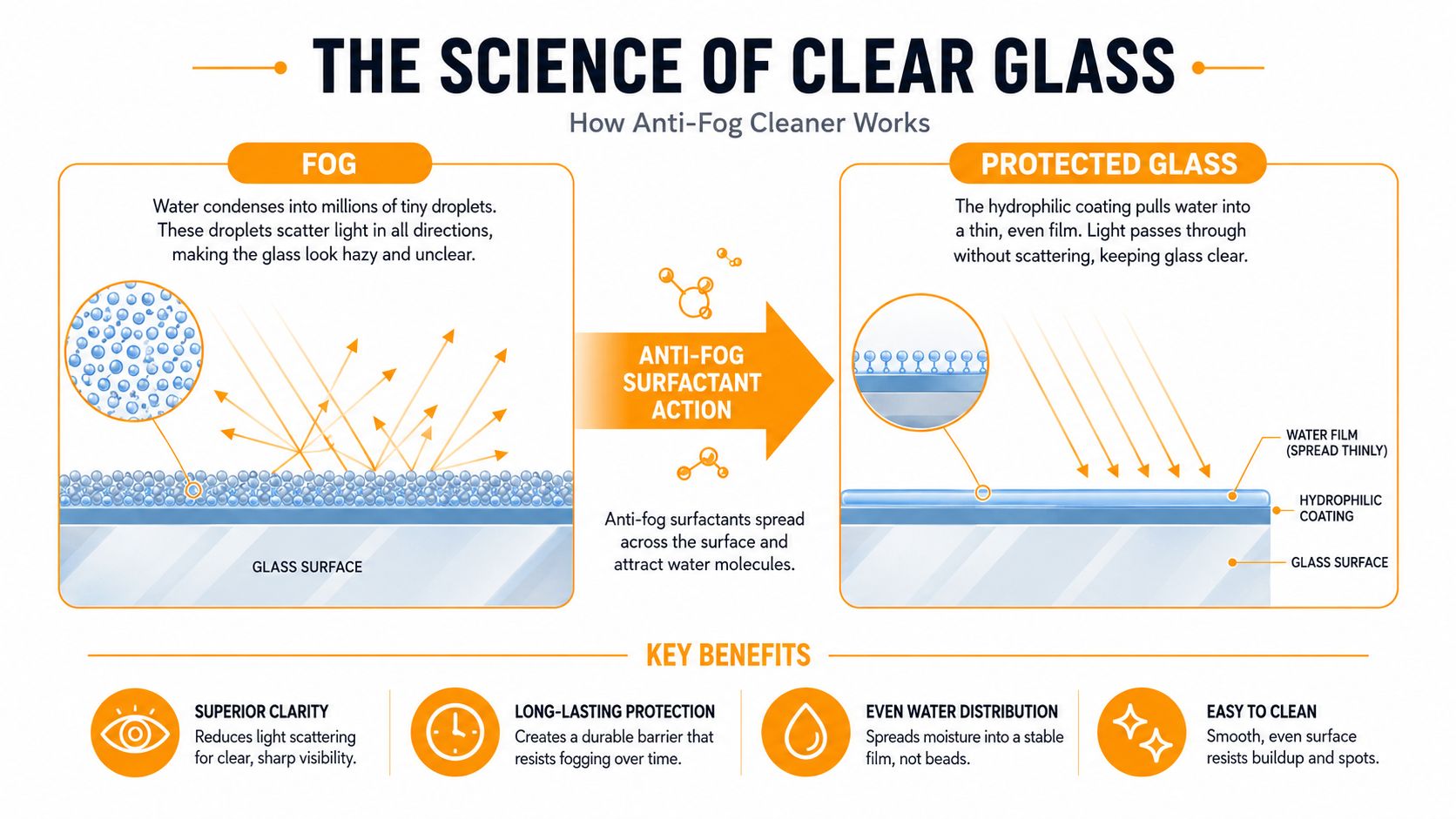
Untreated glass encourages condensed moisture to gather into separate beads. Each tiny droplet acts like a miniature lens, bending and scattering light in different directions. Millions of those droplets create the familiar cloudy appearance.
An anti-fog cleaner leaves behind a hydrophilic film, meaning a surface layer that helps water spread rather than bead. Technical descriptions of anti-fog cleaners identify this surfactant or polymer action as the central mechanism. The moisture becomes a more uniform, transparent film, so it scatters far less light than individual droplets. RadTech's technical material describes this principle in the context of anti-fog surface performance.
The bathroom mirror analogy
Put a trace of mild dish soap on a bathroom mirror, spread it thinly, and rinse or buff according to the product's directions. The remaining surfactant changes the relationship between water and the surface. Instead of pulling itself into round beads, moisture tends to flatten and spread.
That doesn't mean dish soap is automatically the best choice for every lens or windshield. It demonstrates the same surface-tension idea used by purpose-formulated anti-fog products. The formula has to balance wetting, clarity, residue, drying behavior, and material compatibility.
Why wiping alone doesn't last
A dry cloth removes existing droplets, but it doesn't prevent new condensation. If the temperature difference and humidity remain, the glass will fog again as soon as more moisture reaches it. Airflow from a defroster can help by warming and drying the surface, while ventilation reduces moisture inside the cabin, but those measures address the environment rather than the glass film.
A good cleaner works at the surface level. It creates a thin layer that guides condensed water into a clear sheet. The quality of that layer depends on the ingredients, the pH, the amount applied, and whether the glass was properly cleaned first.
Active Ingredients and Formulation Traits That Actually Matter
Product labels often use broad phrases such as “advanced protection” or “professional clarity.” Those phrases don't tell you much. Look instead for the formulation traits that determine whether an anti-fog cleaner spreads evenly, dries cleanly, and behaves safely on the intended surface.
A surfactant lowers the resistance between water and glass, helping moisture cover the surface. Nonionic surfactants and related blends are commonly used when formulators want wetting with controlled residue. Silicone glycol systems and polyether-modified silicones can add slip and help a film remain uniform, but silicone compatibility matters on specialty lenses.
Solvents can help lift fingerprints, skin oils, and road film. Isopropyl alcohol and ethanol are examples, but a fast-drying solvent isn't automatically a benefit. If the product flashes off before you can level it, it may leave streaks. Builders and water-softening ingredients can also support clarity by helping the formula work consistently in different water conditions.
Read for surface behavior
Technical formulation sheets show why pH and foam control deserve attention. One anti-fog cleaner specification reports a pH of 5, while another reports pH 8.0 ± 0.5, along with low foam and good wetting. Those examples show that products can sit in a mildly acidic to near-neutral range while still prioritizing rapid coverage and minimal filming. See the anti-fog cleaner formulation specifications for those documented examples.
Heavy foam can look active while leaving more material behind than you need. On a windshield, that may become haze. A low-foam product is usually easier to control with a wipe-on, wipe-off method.
| Ingredient | Role | Performance Outcome |
|---|---|---|
| Surfactants | Help water spread over the surface | Fewer discrete droplets and more even coverage |
| Silicone glycol or modified silicone systems | Add slip and support film uniformity | Smoother wiping, with compatibility requiring attention |
| Solvents | Loosen oils and speed drying | Faster cleaning, but possible streaking or coating concerns |
| Builders and water softeners | Support consistent cleaning in varied water | Clearer film and better residue control |
| Water | Carries the active ingredients | A workable base for controlled surface treatment |
For a broader explanation of why pH-neutral cleaning products can be useful around sensitive surfaces, review this guide to pH-neutral cleaning products. Before buying, skim the label or safety data sheet for surfactant type, solvent type, pH information, and explicit material restrictions.
Applying Anti Fog Cleaner on Interior and Exterior Glass
Preparation determines the finish. A cleaner applied over dust, skin oil, cigarette residue, or dashboard vapor won't create a reliable film because the product is sitting on contamination instead of glass.
Start by letting the cabin or work area cool. Park out of direct heat when possible. Use a clean microfiber cloth to remove loose dust, then clean the surface with a compatible glass cleaner and allow it to dry. Don't use a cloth that has touched wax, tire dressing, fabric softener, or oily interior products.
The interior windshield method
Use two lint-free microfiber cloths, one for application and one for final polishing.
- Spray a small amount onto the application cloth rather than flooding the windshield.
- Wipe the inside glass in overlapping passes, working across the full viewing area.
- Leave the film until it reaches a light haze stage, usually 60 to 90 seconds when the product directions call for that curing window.
- Turn to the second cloth and buff the surface until the haze disappears.
- Inspect from several angles, especially under dashboard reflections.
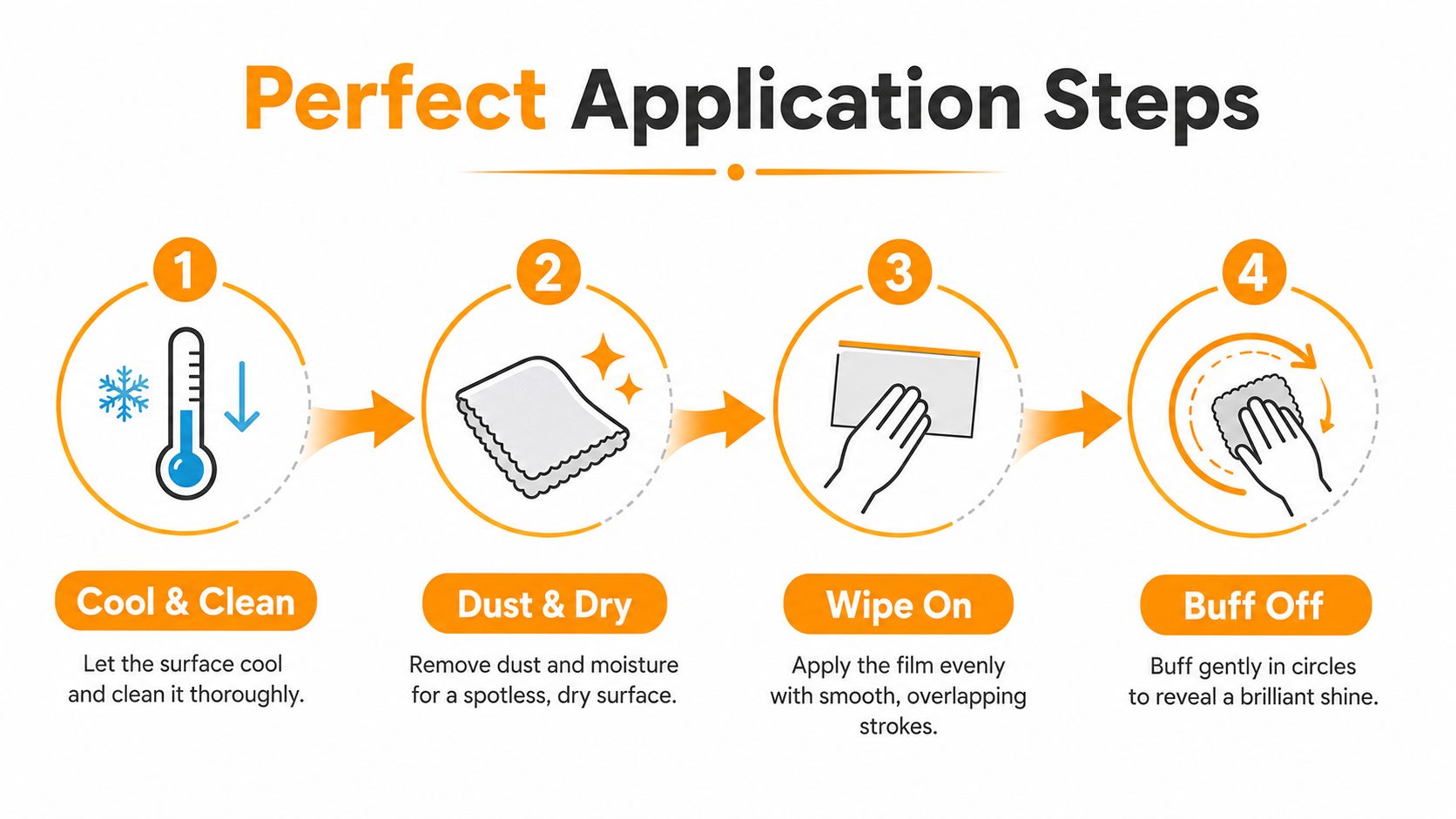
The thin-film approach matters. Over-saturating the glass makes buffing harder and increases the chance of streaks. Paper towels can shed fibers or leave lint, while a dirty microfiber redistributes grease. If the glass has hard-water deposits first, use a suitable process such as this guide on removing hard-water stains from car windows, then apply the anti-fog treatment to the clean surface.
Exterior glass and helmet shields
Exterior windshield use exposes the film to rain, washer fluid, wipers, and road dirt. Some products are designed mainly for interior fog and may not withstand that exposure. For rain-facing surfaces, follow the label carefully and consider whether the product needs a separate water-shedding treatment.
Use the same light application and two-cloth buffing method on a helmet shield, but confirm that the product is approved for that shield material first. Reapply when wiper use, repeated washing, heavy humidity, or visible loss of coverage tells you the film has worn away. Don't follow a rigid schedule if the manufacturer gives different instructions.
A clean, well-maintained window also makes every treatment work more predictably. For broader upkeep advice, see this resource on how to preserve your home's windows.
DIY Alternatives and How They Compare to Commercial Products
Household substitutes can help when you're stuck at a campsite or facing an unexpected fogging problem. They aren't interchangeable with a purpose-formulated anti-fog cleaner, especially on coated lenses or surfaces that must remain optically perfect.
Diluted dish soap is widely available and demonstrates the same spreading principle discussed earlier. It can provide clear initial results, but too much leaves a greasy or hazy film. Baby shampoo may wet the surface gently, though its fragrance, conditioners, or other additives can create residue.
White vinegar mixes are inexpensive and useful for some mineral or grime problems, but they aren't a dependable anti-fog treatment for every surface. Shaving cream can leave a temporary film, yet that film may attract dust. Toothpaste is the one to avoid most firmly on lenses because its polishing particles can abrade delicate coatings.
| Method | Initial Clarity | Durability | Residue | Coating Safety | Cost |
|---|---|---|---|---|---|
| Diluted dish soap | Often clear when applied very thinly | Short-term | Can streak if overused | Uncertain on specialty coatings | Low |
| Baby shampoo dilution | Usually mild wetting | Short-term | Possible conditioner or fragrance film | Check the lens maker's instructions | Low |
| White vinegar mix | Variable | Short-term and inconsistent | May leave odor or water marks | Test carefully, especially on tint | Low |
| Shaving cream | Can reduce fog briefly | Short-term | Film can collect dust | Not a reliable choice for coatings | Low |
| Toothpaste buffing | May appear clear after polishing | Not a true anti-fog film | Abrasive residue possible | Poor choice for coated lenses | Low |
| Commercial anti-fog cleaner | Designed for uniform clarity | Follow product directions | Formulated for controlled residue | Depends on label approval | Varies |
The practical comparison
Commercial formulas are built around a controlled balance of surfactants, carriers, drying behavior, and residue management. A kitchen mixture may work once, but it gives you less certainty about concentration and material safety. That difference matters more on prescription lenses, helmet shields, tinted glass, and expensive optics than it does on a disposable bathroom mirror.
DIY mixtures also create a cleaning problem. If you apply too much, you may spend more time removing the substitute than you would have spent applying a dedicated product. For general glass-care buying guidance, compare the best window cleaning products for spotless glass before choosing a household workaround.
Use a DIY option only as a short-term field fix when no suitable product is available. For regular driving, riding, camping, or eyewear use, a purpose-formulated anti-fog cleaner is easier to repeat consistently and easier to evaluate against the manufacturer's compatibility instructions.
Compatibility With Coated Lenses, Tint, and Specialty Glass
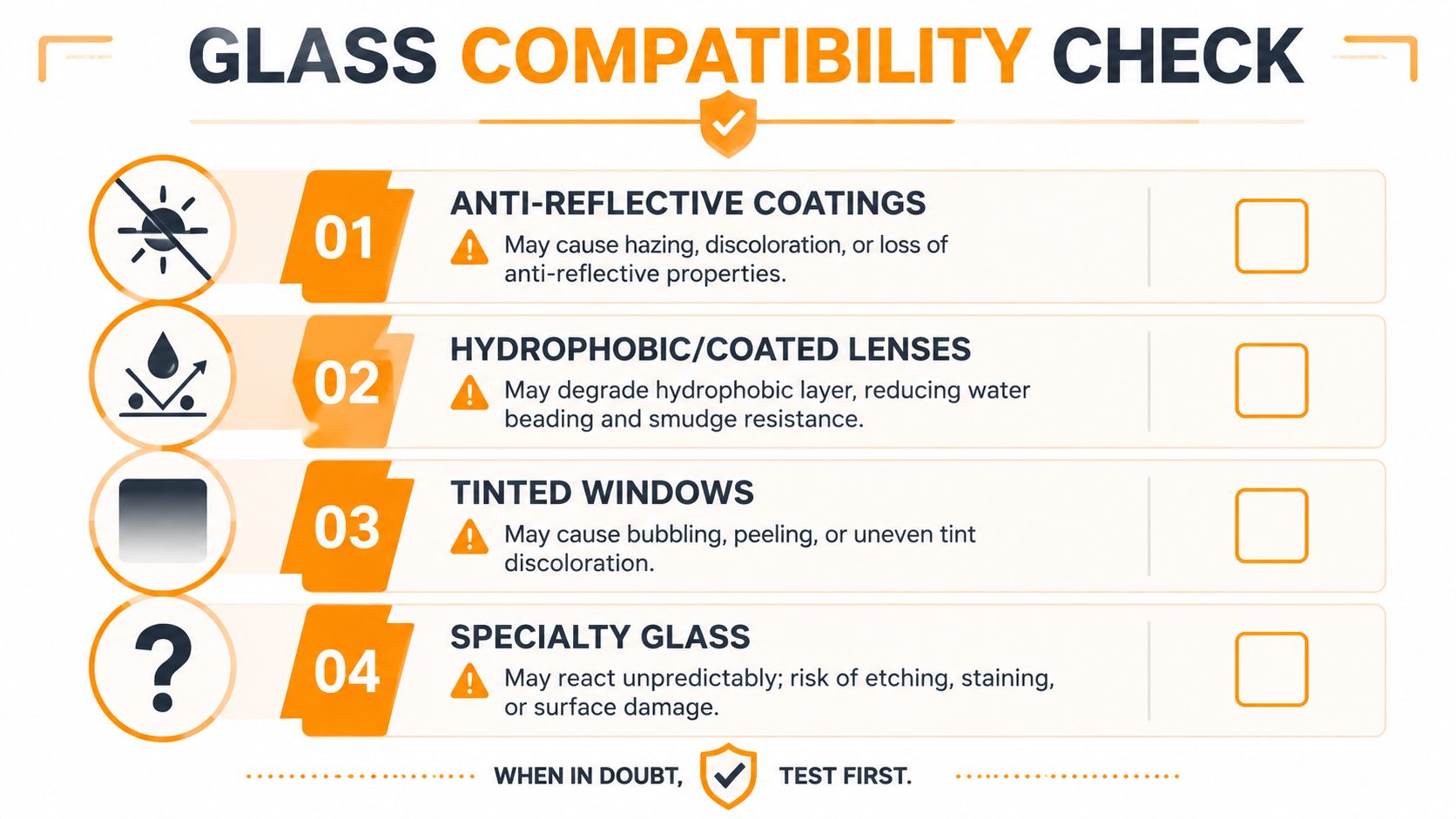
“Safe for glass” doesn't mean “safe for every optical surface.” A plain glass pane, an anti-reflective prescription lens, a tinted vehicle window, and a polycarbonate helmet shield may all look similar, but their surface treatments and tolerances differ.
The compatibility gap is real. One product source describes a formula as safe for plastic, glass, Lexan, and polycarbonate, while another says it can't guarantee results on coated lenses. Another warns that some anti-fog products aren't intended for AR, CAB, or CAP polarized coatings. Those conflicting instructions are why you should treat a broad safety claim as a starting point, not proof.
Match the formula to the surface
For coated eyeglasses, read the lens manufacturer's care instructions before applying anything. Anti-reflective, hydrophobic, oleophobic, polarized, and photochromic treatments can make a lens more sensitive to solvents, ammonia, abrasives, or incompatible surfactants. A dedicated eyewear defogger with explicit approval is safer than assuming a windshield product will work.
Tinted automotive glass needs care as well. Tint layers are commonly installed on the inside of the glass, so an interior anti-fog film may not directly contact the tint layer. Ammonia-bearing cleaners can still create problems around tint edges or with the adhesive system, so avoid them unless the tint manufacturer approves their use.
Polycarbonate helmet shields, face shields, instrument-cluster covers, and mirror-backed glass should be treated as specialty surfaces. Choose a non-abrasive product with clear compatibility instructions, and don't use toothpaste or aggressive polishing compounds.
Three-question rule: Is the surface coated? Is the formula solvent-based? Did the manufacturer approve it for this exact material?
When a surface is expensive or difficult to replace, test a small hidden area first and allow it to dry fully. If you're caring for other vehicle optics, the same caution applies to products discussed in this guide to ceramic coating for headlights. Compatibility should come before maximum fog resistance.
Your Quick Decision Checklist Before You Buy or Mix
A good purchase starts before you pick up the bottle. Identify the surface, read the restrictions, and decide whether you need an interior treatment, an exterior rain-facing product, or an eyewear-specific formula.
Identify the glass first
- Plain glass: A general anti-fog glass cleaner may be suitable if the label supports glass use.
- Tinted glass: Confirm that the product won't interfere with the tint or its adhesive.
- Coated lenses: Look for explicit approval for AR, polarized, photochromic, hydrophobic, or oleophobic surfaces.
- Polycarbonate: Choose a non-abrasive formula approved for helmet shields or face shields.
- Unknown surface: Treat it as sensitive and test a concealed area before full application.
Choose the formula deliberately
- Prefer controlled wetting: Look for surfactant-based anti-fog action rather than a product that only promises fast drying.
- Check the pH information: A mildly alkaline to near-neutral formulation can support spreading and residue control, but follow the surface manufacturer's care instructions.
- Check solvent warnings: Don't assume alcohol, ammonia, or strong solvents are harmless because the label says “glass.”
- Skip abrasive shortcuts: Toothpaste and polishing compounds don't belong on coated lenses or plastic shields.
- Read the use case: Interior windshield products may not be designed for rain, wipers, or submerged equipment.
Prepare before application
The glass should be cool, clean, dry, and free of grease. Use a clean microfiber, apply a thin layer, allow the product to reach its stated haze or drying stage, and buff with a separate dry section. If you see streaks, reduce the amount before changing products.
Reapply when wiper use, washing, high humidity, or visible loss of the film removes coverage. Some surfaces may need more frequent attention than others, so the product label should outrank a generic calendar schedule.
Rule of thumb: If the surface is coated, tinted, or polycarbonate, test a small corner first and choose a purpose-formulated anti-fog glass cleaner over an improvised household mix.
SwiftJet helps DIY detailers keep vehicles, camping gear, and outdoor equipment clean with practical tools such as its hose-connected foam gun and included microfiber wash mitt. Visit SwiftJet to explore equipment that can make the cleaning and preparation stage easier before you apply an anti-fog treatment.
