

You're usually looking at a 100 foot garden hose for one reason. Your current hose keeps coming up short.
That happens when you're halfway around the car, trying to rinse the roof of an SUV, or standing at the far edge of the yard with the nozzle stretched tight and the coupling tugging at the spigot. A longer hose feels like the obvious fix. Sometimes it is.
But a 100 foot garden hose isn't just a longer version of the hose you already own. It's heavier, harder to store, and more sensitive to poor diameter choices, cheap fittings, and pressure loss. That matters a lot if you're watering deep into a large property. It matters even more if you're washing vehicles and expecting a foam gun or high-flow nozzle to perform well.
Is a 100 Foot Garden Hose Your Best Option
The most common mistake is buying the longest hose on the shelf before deciding whether you need that reach every week. A 100 foot hose solves one problem fast. It can also create three new ones: drag, storage headaches, and weaker performance at the far end.
A long hose makes perfect sense when the farthest flower bed, RV pad, side yard, or driveway parking spot is consistently out of reach. If you're always moving the spigot connection or dragging a shorter hose until it binds, the upgrade pays for itself in convenience alone. On larger properties, that reach can also support better watering habits, especially when paired with expert water-wise landscape design that reduces waste and places watering where it matters.
The catch is that many people use a long garden hose as a substitute for a better setup. If most of your work happens close to the house, a shorter hose often feels better in the hand and wastes less time every single use.
Practical rule: Buy for your longest routine task, not the one rare corner of the yard you reach twice a season.
For car care, the right choice depends on what's connected to the end. If you're deciding between hose-based washing and a machine-driven setup, this breakdown of garden hose vs pressure washer helps clarify what each tool does best.
A 100 foot hose is best when reach is a real requirement, not just a nice idea. If you don't need the distance often, the extra length becomes something you wrestle with every time you uncoil it.
When You Really Need the Extra Length
Some homeowners absolutely need a 100 foot hose. Others just think they do.
The clearest sign is simple. If you routinely have to reposition your hose source, move your vehicle to get closer to the house, or leave sections of the lawn unwatered because your hose can't reach, the extra length isn't overkill. It's the correct tool.
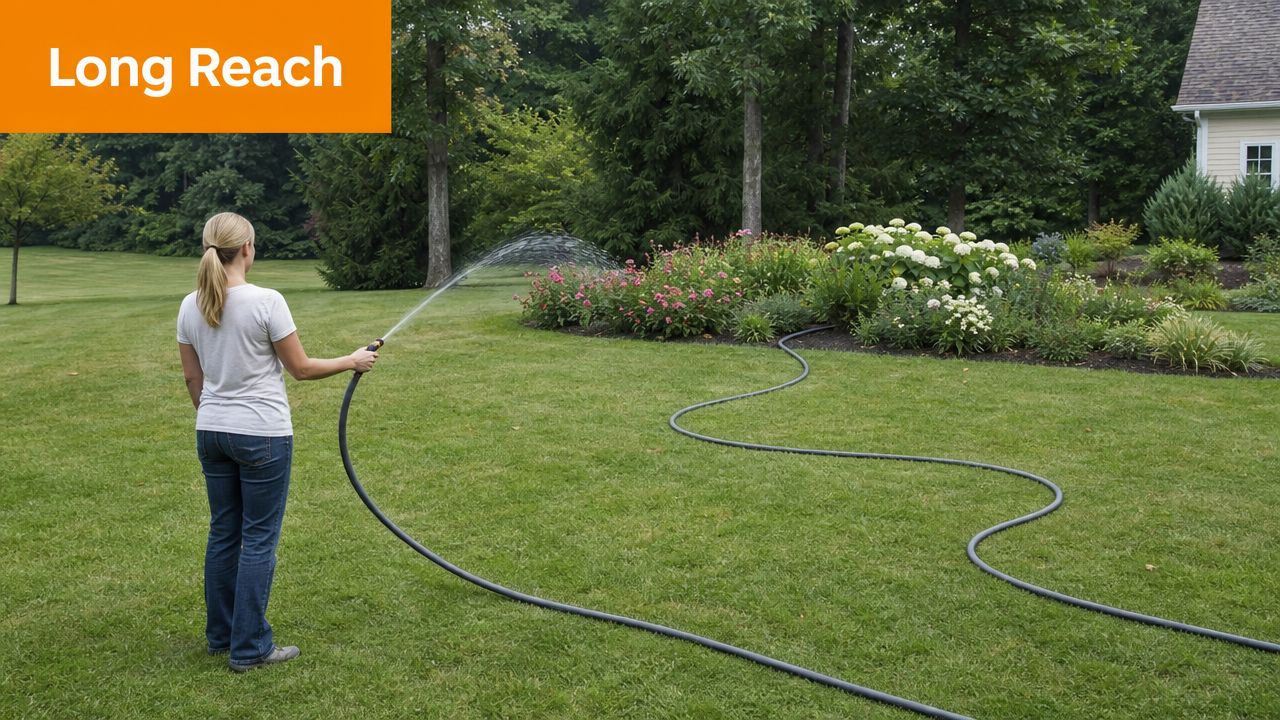
The popularity of this size isn't random. The 100-foot length was standardized in the mid-20th century as average American residential properties grew from 1,000 to over 2,000 square feet between 1950 and 1980, and it still represents roughly 45% of all garden hose sales in North America, according to The Blue Hose.
Good reasons to choose it
A 100 foot garden hose is the right call when you regularly handle jobs like these:
- Large backyards: You need one run from the spigot to the far fence line, vegetable bed, or tree row.
- Wide driveways and detached garages: You wash vehicles away from the house and don't want the hose stretched tight across concrete.
- RVs, trailers, and boats: Longer rigs force you to move around the vehicle, not just stand at one side.
- Fewer equipment moves: A long hose can let you keep your watering or wash setup in one place instead of stopping to relocate everything.
That last point matters more than people expect. When you don't have to stop and reset, you work faster and with less frustration.
When it's too much hose
A 100 foot hose is often the wrong buy for compact patios, townhome yards, and basic front-yard watering. In those cases, the hose spends more time piled up than stretched out.
Here's what usually turns into a nuisance:
| Situation | Better choice |
|---|---|
| Small garden close to the spigot | Shorter hose |
| Quick car rinses near the garage | Shorter hose or dedicated wash hose |
| Tight storage area | Lighter, more compact option |
| Frequent hand-carry use | Less weight, less fatigue |
The trade-offs you feel every day
The longer hose wins on reach. It loses on convenience if the rest of the setup isn't right.
Three issues show up fast:
- Weight: A long hose is harder to drag around corners, especially when it's full of water.
- Storage: Cheap storage turns a long hose into a kinked heap.
- Performance: Poor diameter and weak fittings make a long hose feel worse than it should.
If your property or wash routine calls for the distance, those trade-offs are manageable. If not, the longest hose on the shelf can become the least satisfying one to own.
Decoding Hose Materials and Diameter
Material and diameter determine whether a 100 foot garden hose feels like a useful tool or a stubborn piece of yard equipment. Length gets attention, but these two details decide how the hose handles, how long it lasts, and how well it performs at the nozzle.
Material changes the whole experience
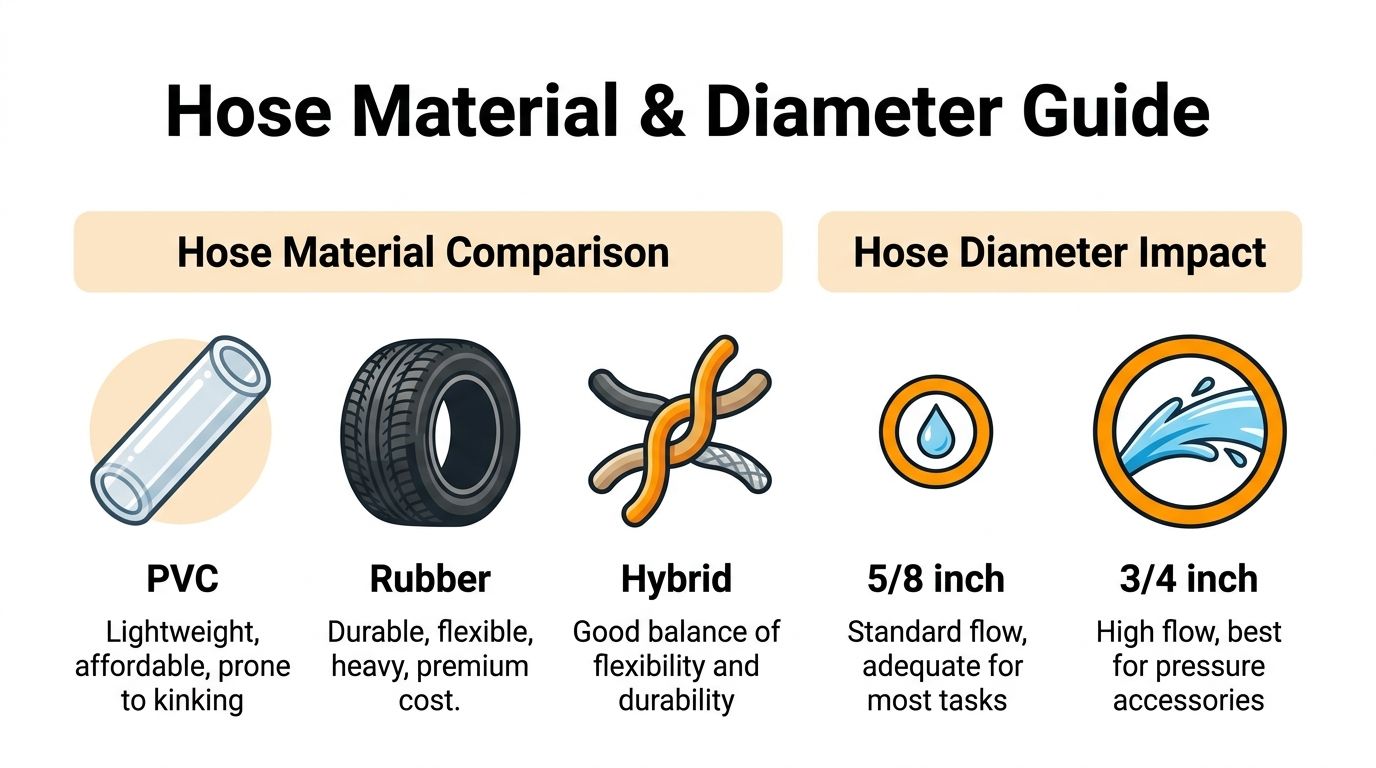
The basic choice usually comes down to vinyl, rubber, or hybrid polymer.
Vinyl hoses are easy to lift and usually easy on the wallet, but they're the most likely to kink, flatten under a twist, and feel disposable after enough heat and sun. For occasional light watering, they can work. For regular car washing or full-property use, they rarely stay enjoyable for long.
Rubber hoses are the workhorses. They handle abuse, resist collapse better, and usually feel more trustworthy when dragged over concrete, gravel, or around a vehicle. The downside is obvious the moment you pick one up.
A premium 5/8-inch rubber 100-foot hose weighs about 30 lbs and supports hot water up to 200°F, while a composite polymer version may weigh only 12.2 lbs and still maintain 600 PSI burst strength, according to Flexzilla's hose specifications. That's the clearest material trade-off in one sentence: rubber gives you toughness and heat handling, while polymer gives you far less arm fatigue.
A quick comparison
| Material | What it does well | What usually frustrates people |
|---|---|---|
| Vinyl | Light, inexpensive | Kinks easier, often feels flimsy |
| Rubber | Durable, stable, good for harder use | Heavy and tiring over 100 feet |
| Hybrid polymer | Easier handling with strong durability | Premium models usually cost more |
A long hose that feels good in the hand gets used properly. A hose that fights you gets dragged, twisted, and stored badly.
Diameter matters more on long runs
Diameter is where many buyers get burned. They focus on length and price, then end up with a narrow hose that starves the nozzle.
Picture drinking a thick shake through two different straws. The narrow straw makes the job harder. The wider straw lets more move with less resistance. Water in a long hose behaves the same way.
For a 100 foot hose, 5/8 inch is the practical baseline for most homeowners. 3/4 inch makes sense when you care more about flow than handling ease. 1/2 inch is where long-run disappointment starts to show up.
What to buy for real-world use
Choose based on your main task, not the product label:
- Mostly watering beds and lawn: A 5/8-inch hybrid or rubber hose is the safe default.
- Frequent car washing: Prioritize kink resistance, manageable weight, and solid fittings over bargain pricing.
- Heavy-duty cleaning or hot water use: Rubber earns its keep.
- High-flow accessories: Step up in diameter before you blame the attachment.
The right 100 foot garden hose doesn't need to be the most expensive one. It needs to match how you use it. This often means resisting the cheapest narrow hose and buying one that balances weight with real flow.
The Physics of Water Pressure and Flow
A long hose doesn't just move water farther. It also makes water work harder to get there.
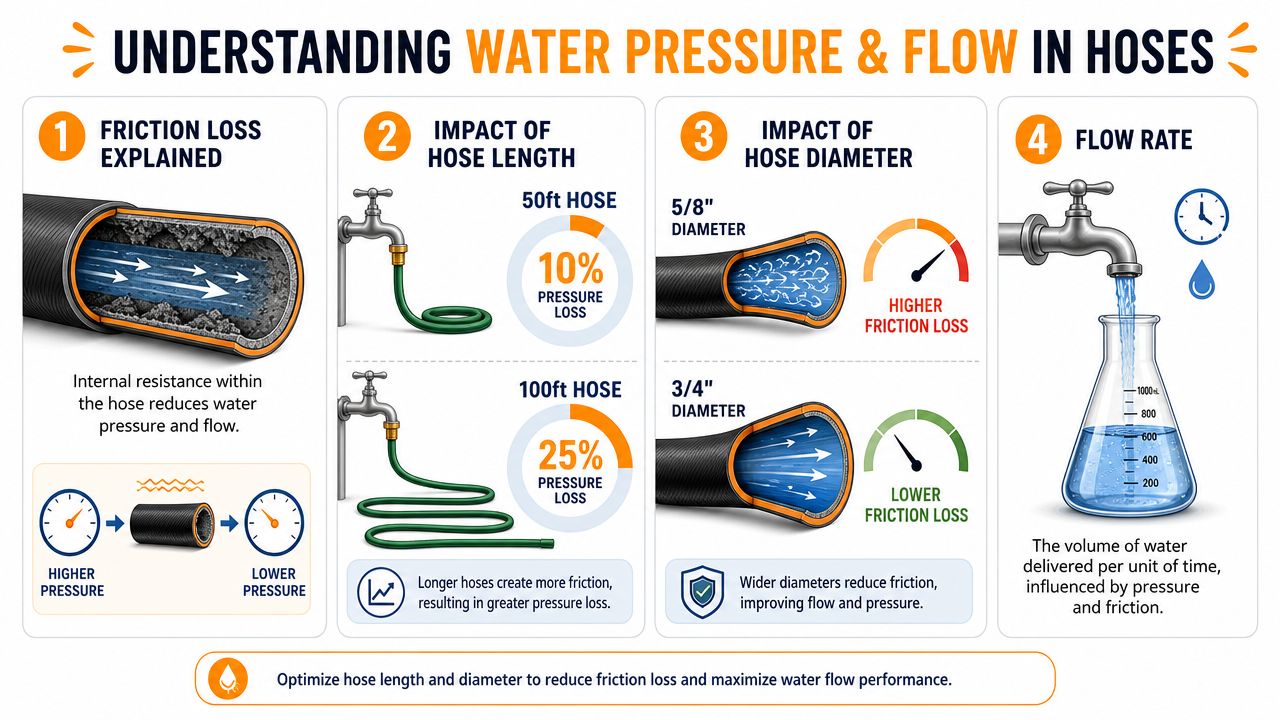
The reason is friction loss. As water travels through the hose, it rubs against the inside surface. Over a short distance, you barely notice it. Over 100 feet, you do. That's why a nozzle on a long run can feel soft and underpowered even when the spigot seems fine.
What pressure drop looks like in practice
For a standard 1/2-inch diameter hose, pressure can drop by about 15 to 20 PSI over 100 feet at typical residential flow rates of 5 to 7 GPM, taking you from 50 to 60 PSI at the spigot down to 30 to 40 PSI at the nozzle, as explained in this guide to garden hose PSI and pressure loss and supported by HanTech n Garden.
That drop is why long hoses can feel “weak” even when nothing is technically broken.
Pressure and flow aren't the same thing
People often use pressure and flow as if they mean the same thing. They don't.
- Pressure is the force behind the water.
- Flow is the volume of water moving through the hose.
You can have decent pressure at the source and still end up with disappointing output because the hose length and diameter are restricting what reaches the end effectively. That's also why moving from a 1/2-inch hose to a 5/8-inch or 3/4-inch hose can make a long run feel more capable without changing the house plumbing at all.
Small losses add up
A cheap long hose can lose performance in more than one place. The hose itself causes friction loss, but worn washers, poor couplers, and leaky fittings also chip away at what reaches the nozzle.
Here's what helps preserve performance:
- Use a wider hose: On long runs, diameter is one of the easiest ways to protect output.
- Choose better fittings: Brass fittings usually hold up better than softer, cheaper hardware.
- Replace washers early: A tiny leak at the spigot often points to a simple washer problem.
- Avoid sharp bends: Tight kinks don't just stop flow in the moment. They stress the hose wall and fittings.
If the hose works well for watering but struggles with a demanding attachment, the issue often isn't the attachment. It's the pressure loss built into the hose setup.
That's the practical side of the physics. Long hoses are useful. They just need smarter specs to stay useful at the far end.
Optimizing Your Hose for Car Washing and Foam Guns
Vehicle washing exposes every weakness in a long hose setup. Lawn watering is forgiving. Foam guns and other wash accessories are not.
If your hose is too narrow, too long for the available pressure, or prone to kinking near the spigot, the first thing you'll notice is weak foam and uneven spray. That's why so many people think the accessory is the problem when the issue starts with the hose.
Why foam quality falls apart on long runs
For automotive cleaning, pressure matters because the attachment has to pull soap, mix it well, and project it evenly across paint. A weak stream gives you thin, runny foam that slides off fast.
A standard 1/2-inch hose can lose about 15 to 20 PSI over 100 feet at 3 to 5 GPM, and that can seriously hurt foam cannon performance that needs 40+ PSI for thick foam, according to this discussion of long-hose pressure trade-offs for foam use. That's one of the most overlooked reasons a wash setup feels disappointing.
If you want to achieve a showroom shine, the hose feeding your wash tool deserves as much attention as the soap and mitt.
Best hose choices for driveway washing
For car washing with a 100 foot garden hose, these choices usually work best:
- Start with 5/8 inch at minimum: This is the sensible floor for most home wash setups.
- Use 3/4 inch if pressure is already modest: A larger diameter can help protect performance over the long run.
- Skip bargain hoses for this job: Thin walls and cheap couplers tend to kink right when you're moving around the car.
- Match the hose to the accessory: If your wash tool depends on good pressure, treat the hose like part of the system, not an afterthought.
A reinforced hose design also helps because the line stays more open as you move around mirrors, wheels, and bumpers. This overview of reinforced hose construction explains why stronger hose walls matter when attachments demand consistent flow.
A better setup beats a longer struggle
If you wash vehicles often, set up for control first and distance second. Keep the hose fully uncoiled, avoid hard bends at the faucet, and use the widest practical diameter you're willing to manage.
This short demo gives a useful visual reference for foam application and hose-fed washing technique:
What works and what doesn't
Here's the actual-world version.
What works is a quality long hose with enough diameter, solid fittings, and a layout that avoids kinks. What doesn't work is expecting a discount 1/2-inch hose stretched across the driveway to feed a pressure-sensitive wash accessory like a short premium line would.
For car washing, hose length only helps if the attachment at the end still gets the pressure it needs.
That's the trade-off most “best hose” roundups gloss over. Reach is useful. Reach with poor output is just inconvenience spread over a larger area.
Smart Storage and Maintenance for a Long Life
A 100 foot garden hose can last well if you store it like a piece of equipment instead of tossing it in a pile after each use. Most hose failures don't begin in the middle of the run. They start at the ends, at sharp bends, or where the hose sits twisted for weeks.
Storage that prevents frustration
Wall-mounted reels are great when your hose usually lives near one spigot. They keep the line off the ground, reduce tangles, and make it easier to wind the hose in a broad curve instead of a tight coil.
Hose carts make more sense when you work across a larger property or wash vehicles in different spots. They're bulkier, but they save your back and make rewinding less of a wrestling match.
If you're deciding between them, keep it simple:
- Wall reel: Better for fixed storage, tidy garages, and one main work area.
- Cart: Better for long driveways, side yards, RV pads, and multi-zone watering.
- Open hook storage: Fine for short hoses, usually a bad idea for 100 feet.
Maintenance that actually matters
Routine care is basic, but it makes a big difference.
Drain the hose before storage, especially before cold weather. Water left sitting inside adds weight, encourages mildew smell, and can cause damage when temperatures drop. Disconnect the hose after use if it will sit pressurized for long stretches.
Check the washers at both ends whenever you notice drips. A fresh rubber washer often fixes what people mistake for a failing hose. Also inspect the first few feet behind each fitting. That's where bending stress usually shows up first.
Habits worth keeping
A few habits prevent most headaches:
- Uncoil fully before heavy use: Twists become kinks once pressure builds.
- Avoid dragging over sharp edges: Concrete corners and metal thresholds chew up outer jackets.
- Store out of direct sun when possible: Heat ages every hose eventually.
- Don't yank by the nozzle: Pulling from the end stresses the couplings.
Good storage won't make a poor hose great. It will keep a good one from dying early.
Your 100 Foot Hose Buying Checklist and FAQs
Buying a 100 foot garden hose gets easier when you filter out marketing language and focus on your actual use.
The checklist
Use this before you buy:
- Measure the longest routine run: Don't buy 100 feet just because it exists.
- Choose the right diameter: For long runs, 5/8 inch is the practical starting point. Go larger if your accessories need stronger flow.
- Pick material by handling needs: Rubber for toughness, hybrid polymer for easier day-to-day use.
- Look closely at fittings: Better couplers and fresh washers save a lot of annoyance.
- Plan storage before checkout: A long hose without a reel or cart usually ends up kinked.
- Match the hose to the job: Watering beds, rinsing siding, and feeding wash accessories are not equally demanding.
FAQs that matter
Is one 100-foot hose better than two 50-foot hoses?
Usually, yes. Connecting two shorter hoses may sound convenient, but the extra connector can add about 2 to 5 psi of pressure drop per connection and creates another place for kinks and leaks, as noted in this discussion of the two-hose backup strategy.
Can a 100-foot hose handle hot water?
Some can. Premium rubber hoses are the better bet if hot water use is part of the plan. Always check the product specs before assuming a hose is suitable.
What's the fastest fix for a leaking hose connection?
Start with the washer. If the drip is at the spigot or nozzle connection, replacing the washer is usually the first and easiest fix. If the hose body leaks, a repair coupling can work, but it's still a compromise.
Any good maintenance resources for specialty hose care?
Yes. If you want a practical example outside garden use, this guide on maintaining window cleaning hoses is useful because many of the same rules apply: avoid kinks, protect fittings, and store long hoses with intent.
A good 100 foot hose should make your work easier, not just longer. If it reaches the job, stores cleanly, and still delivers the output your tools need, you bought the right one.
If you want a hose-fed wash tool that's built for easy driveway cleaning, take a look at SwiftJet. It connects to a standard garden hose and helps lay down thick wash foam without dragging out a full pressure washer setup.
