

You've got the hose, the foam gun, or the portable washer in your hands, and the faucet in front of you looks close enough to work. Then the threads don't line up, the adapter in the box doesn't seat cleanly, and water starts spraying in the wrong direction instead of feeding the tool. That's the moment you realize a washer sink adapter isn't a random add-on, it's the small bridge between a household faucet and a hose-fed device.
The confusing part is that the word sounds like one product, but in practice it covers a few different fittings. Some adapt at the faucet aerator, some split flow with a diverter, and some handle drain-side connections under the sink. The right choice depends on thread size, faucet geometry, and how much water your tool needs to move.
What a Washer Sink Adapter Actually Does
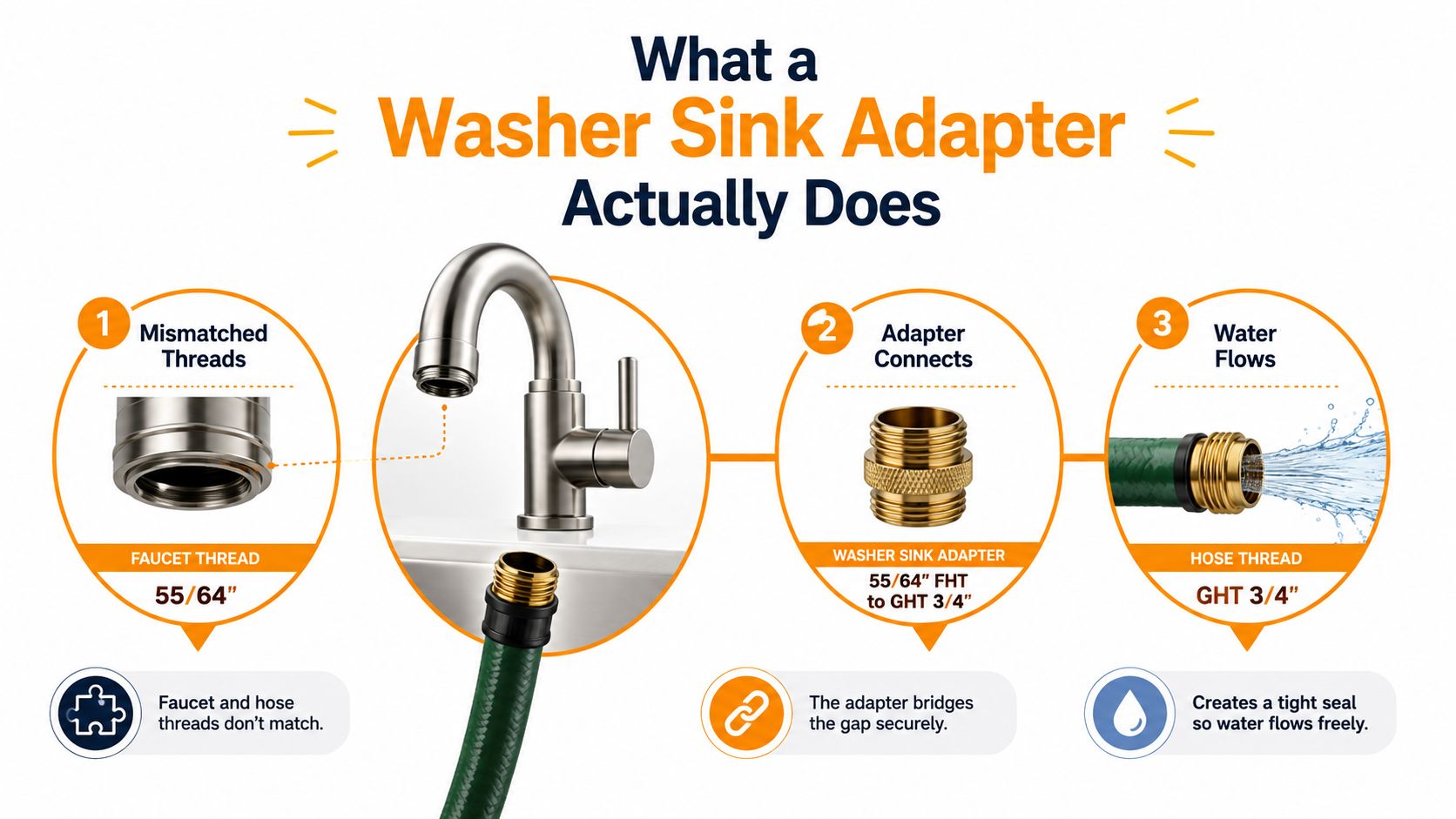
A washer sink adapter is the piece that lets two different plumbing worlds meet without forcing them together. On one side, you've usually got a faucet with a standardized thread. On the other, you've got a hose, a foam gun, or a portable washer inlet that expects a different connection.
That's why so many first-time buyers think the part is defective when the problem is a mismatch. A faucet can look “standard” and still not match the adapter body you bought. In practice, the adapter isn't magic. It just gives you a common interface so the hose-fed tool can draw water from a sink outlet without custom plumbing.
Who actually needs one
If you detail cars at home, rinse camping gear, live in a rental, or use a portable washer, this is the kind of fitting you end up learning by hand. It also shows up in kitchens and bathrooms where the faucet is the only easy water source.
Practical rule: if the tool is hose-fed and the faucet is your only water source, the adapter is usually solving a thread problem first, not a pressure problem.
The historical reason this category exists is simple. Portable cleaning and washing devices needed a reversible way to connect to sink outlets, so adapter fittings grew around that need. That's why you'll see these products sold as utility parts for laundry, kitchen, and portable appliance use, not as niche specialty hardware.
For SwiftJet-style use cases, the important idea is that the adapter is plumbing vocabulary. It tells the faucet and the hose to speak the same language. When that language is wrong, the water never gets a clean path into the tool.
Thread and Size Standards You Need to Know
Treat adapters like charging cables. The tips can look similar, but the plug shape decides whether they connect. With sinks, the same idea applies, only the mistake is easy to miss until you try to tighten the fitting and the seal never forms.
The faucet threads most people run into
In North American sinks, the most common faucet compatibility sizes are 55/64 in.-27 female and 15/16 in.-27 male. That standardization is why many adapter bodies are sold as dual-thread fittings, so one part can cover more faucets without special ordering. You can compare those sizes with a product guide on hose connector types if you want a broader connector overview.
Garden-hose style connections use a different standard, so you can't assume a faucet adapter will also fit the hose side without checking the listing. Some bodies include dual-thread or GHT compatibility so one adapter can bridge both sides cleanly. That's the safest direction for foam guns and portable washers, because the same body can mate to a sink faucet and a hose-style inlet.
How to read a listing without guessing
If you're measuring at the sink, look at the existing aerator and compare the thread diameter and pitch before you buy. A mismatch of even one thread pitch can stop the seal from forming, even if the part almost looks right. That's why force-fit thinking usually ends in leaks or stripped threads.
Match the thread first, then worry about the brand name on the box.
For buyers, the key words are 55/64"-27, 15/16"-27, GHT, and dual-thread body. Once you know those terms, product listings stop reading like gibberish. They start telling you whether the fitting belongs on your faucet or not.
Adapter Types and Where Each One Fits Best
The adapter aisle makes more sense once you stop treating every part as the same thing. A faucet-side adapter, a diverter, a drain-side fitting, and a quick-connect coupler all solve different problems. If you pick the wrong category, you can get a part that technically fits something, just not the thing you need it to fit.
The four types you'll actually see
Aerator-thread adapters replace or attach to the faucet aerator. These are the common choice for portable washers and foam guns, because they turn the sink outlet into a hose-compatible connection.
Diverter valves let you switch between the normal faucet stream and a hose-fed line. They make sense when you still want the sink to act like a sink, but also need temporary hose output.
Drain-side slip-joint adapters belong under the sink, not at the spout. They handle the outlet side of a sink setup and rely on washer compression and slip-joint geometry rather than just the outer shell.
Quick-connect couplers are for people who swap tools often. If you move between a foam gun, rinse hose, and other hose-fed accessories, the quick-connect style saves time because you're not threading and unthreading every session.
| Adapter Type | Connects To | Best For |
|---|---|---|
| Aerator-thread adapter | Faucet aerator to hose-style line | Portable washers, foam guns |
| Diverter valve | Faucet stream plus hose output | Shared sink use |
| Drain-side slip-joint adapter | Sink drain components | Under-sink retrofits |
| Quick-connect coupler | Hose-fed accessories | Frequent tool changes |
A drain fitting deserves special care because the seal depends on washer and slip-joint geometry, not just the outside body. One common design uses a 1-1/2" Schedule 40 solvent-weld outlet with a slip-joint inlet and a leak-proof washer, and some versions include a reducing washer for 1-1/4" and 1-1/2" tubular drain sizes. That matters because many homes mix those sizes at different points in the sink assembly. As the drain dimensions vary, the adapter choice does too, even when the faucet side looks standard.
Installing and Sealing an Adapter Step by Step
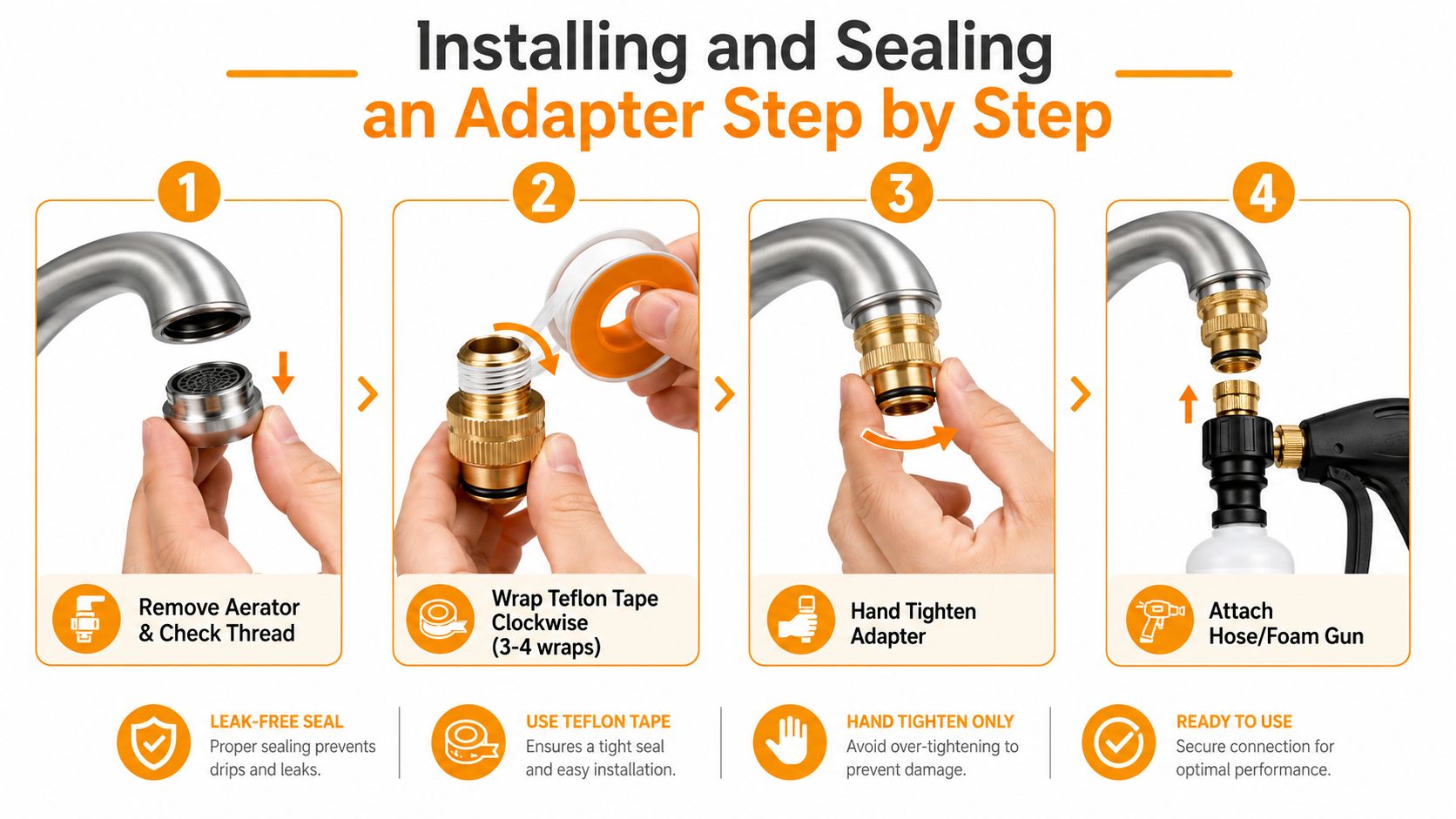
The cleanest installs happen when you slow down before the first twist. Remove the aerator, wipe the threads, and look closely at the shape of the connection. If the thread pattern doesn't match, no amount of tightening will turn the wrong part into the right part.
The sequence that prevents most leaks
Start by removing the aerator and checking whether the faucet uses the thread size printed on the adapter box. Then wrap Teflon tape clockwise around the adapter threads, so the tape tightens as you screw the part on. A few clean wraps are better than a thick pile of tape that just muddies the fit.
Hand-tighten first. That gives you the best feel for whether the threads are engaging or just crossing. If the part stops early or rocks side to side, back off and inspect the match before you go further.
Attach the hose or foam gun after the adapter is seated. Then test the connection over a towel or sink basin before you open the faucet fully. A sound seal should hold water at the joint, not throw it sideways.
Practical rule: if you need pliers to force the fit, you're already solving the wrong problem.
What to do when the seal doesn't behave
A leak at the seal stage usually means one of two things, the thread match is wrong or the washer isn't seated correctly. A rubber gasket can help if the fitting is close but not fully sealed. If the leak appears immediately and sprays sideways instead of dripping, stop and re-check the thread size rather than adding more tape.
Over-tightening is the other common mistake. Brass can crack under abuse, and plastic threads strip fast when you crank down with pliers. The adapter should feel snug, not buried.
Before turning on full flow, verify these points:
- Thread match: the faucet and adapter size correspond.
- Washer presence: the seal ring is in place and seated flat.
- Tape direction: the tape is wrapped clockwise on the male threads.
- Tool connection: the hose or foam gun is locked on fully.
- Leak check: the joint stays dry under a slow water test.
If you want a deeper look at sealing habits, the seal integrity guide is a useful companion read for the same basic problem.
Matching Adapters to Foam Guns, Hoses, and Portable Washers
A foam gun like SwiftJet connects to a garden hose thread, so the faucet-side adapter has to end in a compatible hose output, not just any plumbing fit. That's where many buyers get tripped up. They buy a faucet adapter that looks correct on one end, then discover the accessory side won't accept the hose without an extra coupler.
Foam guns and hose-fed tools
The cleanest setup for a foam gun is a faucet adapter that translates the sink thread into the hose thread the tool expects. If you're comparing accessory paths, the 3/4 quick connect fittings guide gives a useful sense of why quick-change hardware matters when the same hose gets swapped between tools. For a detailer, that means less time threading and less time hunting for the right insert after every wash.
That same logic applies to hoses and portable cleaning tools. Brass, threaded, quick-connect bodies tend to survive repeated connect-disconnect cycles better than soft plastic, especially when the fitting gets handled wet and often. The connector needs to hold alignment as much as it needs to hold water.
Portable washers and the faucet reality check
Portable washers bring in another issue that buyers miss until setup day, flow and faucet shape. GE states that a portable washer pump can move water at 15 GPM while a normal sink drain is typically about 7 GPM. In practice, that means the sink may need to hold roughly 15 gallons of water minus the drain rate to avoid overflow, which is why deeper sinks are often recommended in portable-washer guidance. The numbers matter because the adapter is only part of the system. The sink has to keep up too. GE appliance guidance makes that flow mismatch easy to understand when you're planning a hookup.
The other overlooked issue is pull-out or pull-down faucets. Common guidance works best with fixed spouts and removable aerators, while portable washers are often not suitable for pull-out or pull-down spray faucets. In those kitchens, the question isn't the washer, it's whether the faucet geometry gives you a thread you can use.
For broader installation context, the expert guide for home appliances is a helpful reference point because it shows how sink hookups are usually treated as a plumbing compatibility problem, not just a product problem.
The under-sink path
In older homes and rentals, the durable answer may be under the sink rather than at the spout. A tee, dual shutoff valve, or quick-connect coupler can make more sense than fighting a nonstandard faucet. That kind of retrofit takes more planning, but it can solve a bad faucet fit without forcing the wrong adapter onto the wrong thread.
Buying Guide and Common Mistakes to Avoid
A good purchase starts with four checks. First, confirm the thread match, and treat dual-thread as the safe default when the faucet side isn't obvious. Second, look at the body material, because brass handles repeated use better than plastic when you're connecting and disconnecting often.
Third, check whether the adapter includes the right seals and washers. If the gasket is missing or poorly seated, the part can leak even when the thread size is correct. Fourth, decide whether you want quick-connect or fixed threading based on how often you swap tools. If you're using one foam gun on one sink, fixed may be fine. If you change accessories constantly, quick-connect saves time and frustration.
The most common buying mistakes are easy to spot once you know what to look for. People assume any adapter fits any faucet. They choose plastic because it looks cheaper and lighter. They ignore the drain side entirely. They also add extra Teflon tape to “fix” a leak that's really caused by a thread mismatch.
Bottom line: if the thread doesn't match, tape is not the cure.
For SwiftJet-style setups, portability and fast setup matter more than permanent plumbing changes. That's why the adapter choice should support repeat use, clean sealing, and easy removal when you're done. A part that saves two minutes but strips threads on the third use isn't a good buy.
Quick Answers and Final Recommendations
If the adapter fits the faucet thread but not the tool, you need a different connector body, not more force. If the faucet is a pull-out or pull-down design, the fix may be an under-sink retrofit or a different faucet, because many portable washer setups don't work well with that geometry. For drain-side work, choose the slip-joint washer that matches the tubular size first, then confirm the adapter keeps the centerline aligned.
For more background on sink-side plumbing choices, read our plumbers blog and compare the hookup approach before you buy parts you may not need. The fastest path is the one that matches the thread, the faucet shape, and the flow demand together.
SwiftJet offers a hose-fed foam gun that connects to a standard garden hose, which makes compatibility planning a lot easier when your faucet adapter is right. If you want to match your setup to the right cleaning tool and avoid guesswork at the sink, visit SwiftJet and check the connection style before you order.
