

A thick foam car wash looks impressive, but visual drama isn't the same as cleaning power. The richest layer of bubbles can still slide off a door, dry on warm paint, or leave bonded road film behind. The useful goal isn't maximum foam. It's the right balance of cling, drainage, and surfactant strength.
Foam is a delivery system. It spreads car-wash soap across the panel, keeps the chemistry in contact with the surface, and helps loosen contamination before your wash mitt touches the paint. The mitt, rinse technique, soap formula, water quality, and working conditions still determine whether the wash is gentle and effective.
One global car-wash wastewater case study estimates that washing one car uses approximately 200 liters of water, while a bus requires about 400 liters. That benchmark helps explain why foam-assisted systems attract attention in major markets, even though foam alone doesn't guarantee lower water use. A responsible wash still depends on controlled application, thorough rinsing, and avoiding unnecessary repeat passes. The tested foam-cannon guidance provides useful context for comparing traditional spray washing with foam-assisted methods.
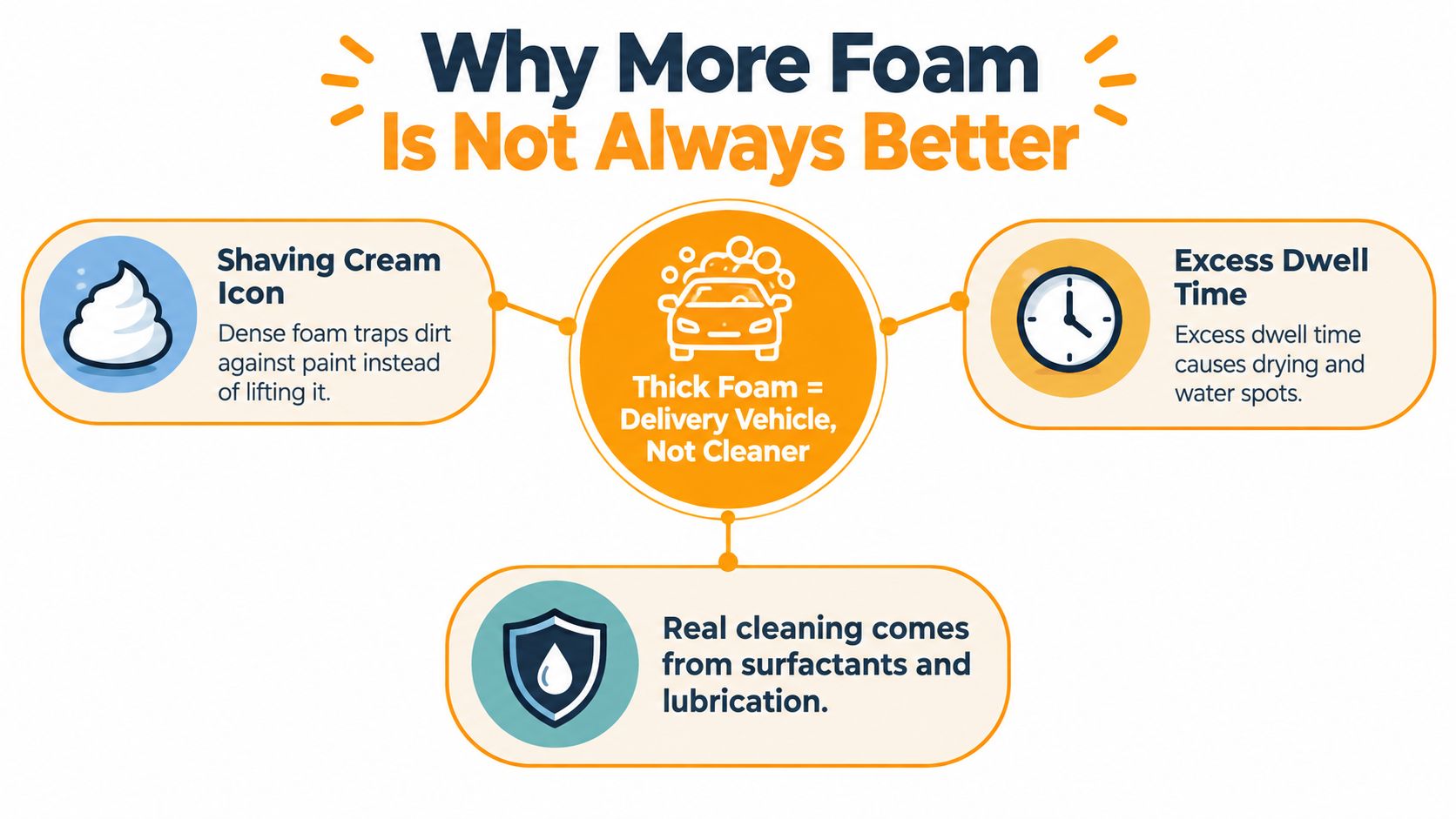
Why More Foam Is Not Always Better
The popular advice is simple: make the foam as thick as possible. That advice misses the part that matters most. Foam doesn't clean because it contains more visible bubbles. Surfactants do the cleaning, while foam helps deliver those surfactants and extend their contact with the paint.
Dense, shaving-cream-like foam can trap a great deal of air. It may look substantial when it leaves the nozzle, yet it can slide down vertical panels quickly or cover the surface unevenly. If the layer dries before rinsing, it creates a new problem rather than improving the pre-wash.
Three variables matter more than bubble count
Cling describes how well the foam stays on a panel instead of immediately running away. Good cling gives the soap time to work across doors, fenders, and the rear hatch.
Drainage describes how the foam moves and releases liquid as it sits. A layer that never moves may look stable but fail to refresh surfactant contact or mobilize soil. A controlled drain can help carry loosened contamination downward.
Surfactant strength determines whether the soap can emulsify oily road film and loosen grime. More foam can't compensate for weak or badly diluted chemistry.
A controlled study found that unstable foams cleaned better than stable foams through mechanisms including imbibition, movement of the foam, oil, and glass contact line, and drainage at higher liquid fractions. That doesn't mean every car needs unstable foam. It means maximum stability isn't automatically the ideal setting. The study of foam stability and cleaning behavior supports a more useful target, foam that clings to vertical surfaces while still draining gradually.
Practical rule: Judge foam by how evenly it covers, how long it remains wet, and how cleanly it rinses. Don't judge it by height alone.
How Thick Foam Actually Works
Think of foam as a temporary scaffold holding soap and water against the vehicle. Air creates the volume, water carries the cleaning solution, and surfactant molecules help form the thin walls around each bubble.
A surfactant has a water-friendly end and an oil-friendly end. The water-friendly end remains oriented toward the water, while the oil-friendly end interacts with greasy road film and other contamination. During rinsing and the later contact wash, that chemistry helps separate soil from the panel so it can move away instead of remaining firmly attached.
Most of what you see in a bubble is air. The bubble wall is a thin liquid film supported by surfactant molecules. Thicker foam usually means more air is being held in a structure that resists immediate collapse, but that structure depends on the soap formula, dilution, water characteristics, and the way the device mixes air and liquid.
What changes the result
A soap mix that's too lean may produce watery foam with poor coverage. A mix that's too concentrated can waste product, create difficult rinsing, or produce a visually rich layer without improving soil removal. Hard water can also reduce foam quality because dissolved minerals interfere with surfactant behavior.
The device matters as well. A restricted nozzle can increase the visual density of the output, while stronger airflow and water movement can create a different bubble structure. A garden-hose foam gun and a pressure-washer cannon won't produce identical foam, so copying a ratio from one system to another can lead to disappointing results.
For a clearer explanation of how density affects application, see SwiftJet's guide to foam density. The practical lesson is straightforward: adjust soap concentration, water flow, and air mixing together. Don't keep adding soap when the issue is low pressure, hard water, or a blocked orifice.
The Real Benefits of a Foam Pre-Wash
A foam pre-wash earns its place by reducing unnecessary contact with dirty paint. It doesn't replace a proper hand wash, and it won't dissolve every contaminant without agitation. Its value comes from preparing the surface so the contact stage can be gentler and more controlled.
Paint-safe preparation
A quick rinse removes loose grit, but some dust and road film remain attached. Applying foam before the mitt gives the soap a chance to soften and surround that contamination. When you rinse the foam away, some of the loosened material leaves before a microfiber mitt ever reaches the panel.
That matters because a mitt can drag remaining grit across the paint if you begin scrubbing too soon. Foam doesn't eliminate that risk, but it can reduce the amount of loose and softened soil present during the contact wash.
Contact time and lubrication
A properly tuned foam layer gives surfactants time to work on bug residue, organic buildup, and oily road film. The layer needs to remain wet, not merely remain tall. If it dries, the chemistry stops behaving as intended and mineral residue may remain behind.
Foam also leaves a lubricated wash environment after rinsing. The following shampoo solution and microfiber mitt can move more smoothly across a pre-cleaned surface than across dry, dusty paint. That lubrication supports safer movement, but it still requires light pressure and frequent mitt rinsing.
| Factor | Foam Pre-Wash | Plain Rinse |
|---|---|---|
| Loose grit | Helps loosen and carry away contamination before contact | Removes only material water can dislodge |
| Contact stage | Prepares the panel for a gentler mitt wash | Leaves more soil for the mitt to encounter |
| Dwell | Keeps cleaning solution on the surface while it works | Provides little chemical contact |
| Lubrication | Adds surfactant-based slip before hand washing | Doesn't provide wash lubrication |
| Visual result | Can improve coverage and preparation | Looks cleaner only where loose dust leaves |
Independent car-care guidance cautions that foam height is a proxy for stability, not cleaning power, and identifies ISO 696 as the standard test method for measuring foam stability. This explanation of dwell time and foam behavior reinforces the central point: chemistry and controlled contact matter more than a dramatic blanket of bubbles.
Choosing the Right Foam Equipment
Your water source should determine your equipment choice. A garden-hose foam gun is convenient for a homeowner who wants a compact setup, while a pressure-washer foam cannon suits someone who already owns the machine and wants denser output. Neither tool turns poor dilution or bad technique into a safe wash.
A standard hose with a spray nozzle can rinse the vehicle, but it doesn't create foam. A pressure washer used without a cannon gives you useful rinsing power, yet it skips the lubricating pre-wash layer. A foam gun uses venturi siphoning to draw soap into the water stream, while a cannon attaches to a pressure-washer wand and mixes soap, water, and air at higher pressure.
| Setup | Water Source | Foam Thickness | Cost Range | Best For |
|---|---|---|---|---|
| Garden hose with foam gun | Standard outdoor faucet | Moderate, depending on pressure and mix | Low to moderate | Weekly washes and compact storage |
| Pressure-washer foam cannon | Pressure washer | Denser, with stronger coverage potential | Moderate to high | Enthusiasts with existing pressure-washer equipment |
| Garden hose alone | Standard outdoor faucet | No foam | Low | Pre-rinsing and final rinsing |
| Pressure washer alone | Pressure washer | No dedicated foam layer | Moderate to high | Rinsing, not foam pre-washing |
A dedicated car-wash soap formulated for foam equipment is a better choice than household detergent. Avoid dish soap because it can strip protective products and often produces thin, unstable bubbles that aren't designed for automotive finishes. Add a suitably long hose for vehicle access, a microfiber wash mitt, and a grit guard so the wash process remains controlled after the foam has been rinsed away.
Winter introduces another layer of risk. Cold panels, road salt, wind, and rapid drying can change how the wash behaves, so readers dealing with seasonal conditions may benefit from troubleshooting winter car wash risks before choosing a wash location or schedule.
For a garden-hose setup, SwiftJet's auto foam cannon guide offers a practical reference for matching a foam device to a home washing routine. Focus on repeatable coverage and manageable cleanup, not on reproducing professional equipment output.
Applying Thick Foam the Right Way
Start with a cool vehicle in shade. Direct sunlight heats panels unevenly and shortens the time available for the foam to remain wet. A quick pre-rinse knocks off loose grit and cools the surface, but don't use the rinse as a substitute for the chemical pre-wash.
Mix the soap according to the device manufacturer's recommendation. Ratios vary between products and delivery systems, so a number copied from another bottle may not suit your water or equipment. Test the output on the ground first. You want a wet, cohesive layer that clings without becoming a dry, brittle blanket.
Apply evenly from the lower panels upward and move from front to back. Starting low helps prevent the upper foam from carrying loosened grime across areas you've already treated. Straight passes also make it easier to identify missed sections and avoid heavy overlap.
Keep the dwell period wet
Give the foam roughly three to five minutes to work, while keeping an eye on drying. That dwell guidance is also reflected in a practical car foam wash process, but weather should control your decision. Wind, heat, and direct sun can make a shorter dwell safer than waiting for the foam to reach a particular visual thickness.
While the foam sits, prepare two wash buckets, a grit guard, and a clean microfiber mitt. Rinse from top to bottom after the dwell period, then begin the contact wash at the roof and work downward. Keep pressure light, rinse the mitt often, and don't let the panel dry between passes.
Follow the contact wash with a thorough sheeting rinse. Pat the vehicle dry with a clean waffle-weave towel rather than dragging a saturated towel across the paint. Hard-water minerals can leave spots if rinse water sits on the surface, regardless of how attractive the foam looked.
Use this video as a visual reference for the overall sequence, especially the relationship between foam coverage, rinsing, and contact washing.
Troubleshooting Common Foam Problems
Weak foam doesn't always mean you need more soap. Start with the mix, then inspect the equipment, and only after that consider water pressure or water hardness. Changing several variables at once makes it difficult to learn what fixed the problem.
Diagnose the symptom at its source
- Thin, watery foam: Check whether the dilution is too lean, the device has a clogged orifice, or inlet pressure is too low for the venturi to draw correctly.
- Uneven stripes: Look for inconsistent passes, a bottle held too close to the panel, or a mix so concentrated that the bubbles collapse instead of spreading.
- Foam drying on paint: Move into shade, shorten the dwell, or work one area at a time. A light mist of water can reactivate wet surfactants, but dried residue still needs a careful rinse.
- Persistent water spots: Consider mineral-rich rinse water and drying technique before blaming the foam. Water left sitting on paint can deposit minerals after any wash method.
The fix isn't always a thicker mixture. If the foam looks weak because hard water is interfering with the soap, adding product may increase waste without solving the underlying problem.
Streaking can also indicate poor application rather than poor chemistry. Hold the device at a consistent distance, overlap passes naturally, and watch how the foam drains on vertical panels. A good result should rinse cleanly without leaving a heavy soap film.
Why SwiftJet Fits the Foam-First Approach
A garden-hose foam gun fits the foam-first method when the priority is controlled soap delivery without adding a pressure washer to the setup. SwiftJet's foam gun connects to a standard garden hose and uses siphoning to draw car-wash soap into a mixing chamber, where air and water create a clinging foam layer.
That design addresses the practical needs of renters, apartment dwellers with outdoor hose access, and weekend detailers who don't need workshop equipment. There's no electric pressure washer, compressor, dedicated washer hose, or extra machine to store. The user still needs suitable soap, shade, a pre-rinse, a careful dwell period, and a proper contact wash.
The useful connection is conceptual. The tool supports controlled coverage, but it doesn't make foam chemistry irrelevant. Users should tune the mixture for wet cling and easy rinsing rather than treating maximum volume as the goal.
A free microfiber wash mitt is included with the product, according to the publisher's product information. That makes the package relevant to someone building a basic foam-wash setup, although the mitt still needs proper rinsing and care to avoid carrying grit back onto the paint. For broader technique guidance, SwiftJet's professional-result advice can help readers think beyond the appearance of the foam itself.
Foam Car Wash Questions Worth Answering
How often should you use a foam pre-wash?
Use it when the vehicle has enough dust, road film, bugs, or grime to make direct contact risky. A lightly dusty car may need only a careful rinse and normal wash, while a heavily soiled vehicle benefits more from chemical preparation. The deciding factor is contamination, not a fixed calendar.
Does the same soap work in every season?
A car-specific foaming soap can serve across seasons, but the technique changes. Winter grime may need more patience and thorough rinsing, while summer heat may require shade, smaller working areas, and a shorter wet dwell. Never allow foam to dry on the surface.
What does hard water change?
Hard water can reduce foam quality and leave mineral deposits after drying. It may change the appearance of the foam, but the bigger concern is how easily the final rinse dries into spots. Adjust the mix carefully and dry promptly rather than adding soap indefinitely.
Do waxed or coated cars need foam?
They still benefit from removing loose contamination before contact washing. A waxed or ceramic-coated surface may shed water and dirt differently from bare paint, but the wash still depends on suitable chemistry, lubrication, and gentle technique. Foam doesn't replace maintenance of the protective layer.
Is thicker foam better than longer cling?
Not necessarily. A shorter, wetter layer that stays attached and drains gradually can be more useful than tall foam that collapses or slides away. Treat cling time, drainage, and surfactant performance as separate qualities.
Can foam prevent water spots?
No. Foam can help with cleaning, but rinse-water minerals can spot any finish if they dry on the panel. Sheeting, shade, and prompt drying remain important even after a successful pre-wash.
SwiftJet offers a garden-hose foam gun for applying car-specific soap without a separate pressure washer, making it a practical option for controlled foam coverage at home. Visit SwiftJet to explore the foam gun and build a wash routine around cling, drainage, and chemistry instead of chasing maximum thickness.
