

Saturday morning, the wash starts well. Then the 50-foot hose catches a tire, folds into a tight kink, and starves the foam gun until the suds turn thin. By the time the car is rinsed, the hose is wet, gritty, and piled beside the driveway instead of neatly stored.
A small water hose reel fixes more than the mess. It changes how you pull water to a car, camper, or garden bed. The right reel keeps the hose aligned, preserves usable flow, and lets you finish with a guided rewind instead of fighting a memory coil. The wrong reel becomes another bottleneck, especially when its drum is too small, its hose is too narrow, or its spring can't control the return.
Why a Small Water Hose Reel Changes the Whole Routine
The important shift is to stop treating a reel as a storage bin. It's a workflow accessory. It controls how the hose leaves the faucet, crosses the work area, feeds the tool, and returns when the job is done.
On a driveway, that matters immediately. A loose hose drags through dust and tire grit, then rubs against wet paint during the rinse. A kink can restrict flow just when a foam gun needs steady supply. A reel mounted near the spigot keeps the hose lifted or aligned, so you pull only the reach you need and keep the rest out of the vehicle's path.
The same logic applies at an RV pad. A cart reel can move with the water source instead of forcing you to drag a long coil through gravel. In a small garden, a compact wall-mounted or hideaway reel keeps the hose ready beside the beds rather than buried behind a shed.
Practical rule: Buy the reel around the job you repeat most, not around the largest hose length printed on a box.
The before-and-after is simple
Without a reel, the hose develops a memory coil, catches on corners, and takes deliberate effort to pack away. With a properly sized reel, deployment becomes one pull or one crank, and rewind becomes a controlled operation rather than a wet wrestling match.
That improvement depends on fit. A reel that holds the hose loosely and guides it evenly can protect the hose from sharp bends and reduce surface drag. A drum packed beyond its intended capacity does the opposite, even if the housing itself still looks compact.
For car care, I prefer a dedicated reel near the driveway faucet and a separate rinse setup when the layout allows it. That keeps the foam application hose from becoming the same hose dragged through dirty runoff. For garden work, I'll accept a cart if I need to move between zones, but I won't use one on a slope where the frame can tip while the hose is under tension.
A small reel earns its place when it removes a repeated nuisance from the routine. If it makes pulling, flowing, and rewinding easier, it's doing useful mechanical work. If it only hides a badly matched hose, it's expensive clutter.
What Counts as a Small Water Hose Reel
A small water hose reel is best defined by capacity and use case, not by the width of its housing. In practical shopping terms, this class usually serves a single driveway, one RV pad, or a compact garden zone. It may be wall-mounted, carried by hand, or built into a wheeled frame.
Start with the hose rating. A small reel commonly handles roughly 25 to 65 feet of 5/8-inch hose, or as much as 100 feet of 3/8-inch hose, depending on the model. Fully loaded units can weigh roughly 8 to 25 pounds, and many fit beneath a workbench or attach to a single structural mounting point. Those figures are useful classification guides, but the actual rated capacity matters more than the outer dimensions.
A medium contractor reel usually targets substantially longer, heavier hose runs and often uses a larger four-handle frame. A hose pot may look compact, but it doesn't count as a reel in the mechanical sense if it only stores the hose and provides no crank, drum drive, or rewind system.
Use the job to classify the reel
| Category | Hose Capacity (5/8 in) | Typical Footprint | Loaded Weight | Best Fit |
|---|---|---|---|---|
| Small reel | 25 to 65 ft | Under a bench or on one wall section | 8 to 25 lb | One driveway, RV pad, or garden zone |
| Medium contractor reel | 100+ ft | Larger four-handle frame | Heavier and less portable | Multiple zones and demanding site work |
| Compact hose pot | Storage only | Ground-level container | Depends on hose | Patio storage where rewinding isn't required |
A retractable reel with a short leader hose can still be small if its internal drum carries a modest hose length. The leader only separates the reel from the faucet. It doesn't change the working capacity.
The reverse confusion happens with cart reels. A cart may have a wide frame and large wheels, yet remain a small-capacity reel if it carries only enough hose for one working area. Capacity, hose diameter, and task coverage tell you more than the cart's silhouette.
Measure the actual path, not the straight-line distance from faucet to target. Include the route around a vehicle, shed, camper, or raised bed. Then leave room for the hose to wind without being forced tightly against the drum edges. A compact reel should make a routine easier, not make you choose between reaching the target and preserving the hose.
Main Reel Formats and When Each One Makes Sense
The four common formats solve different layout problems. Don't choose automatic rewind just because it sounds convenient, and don't choose a cart just because it avoids drilling. The faucet position, surface condition, and work pattern should decide.
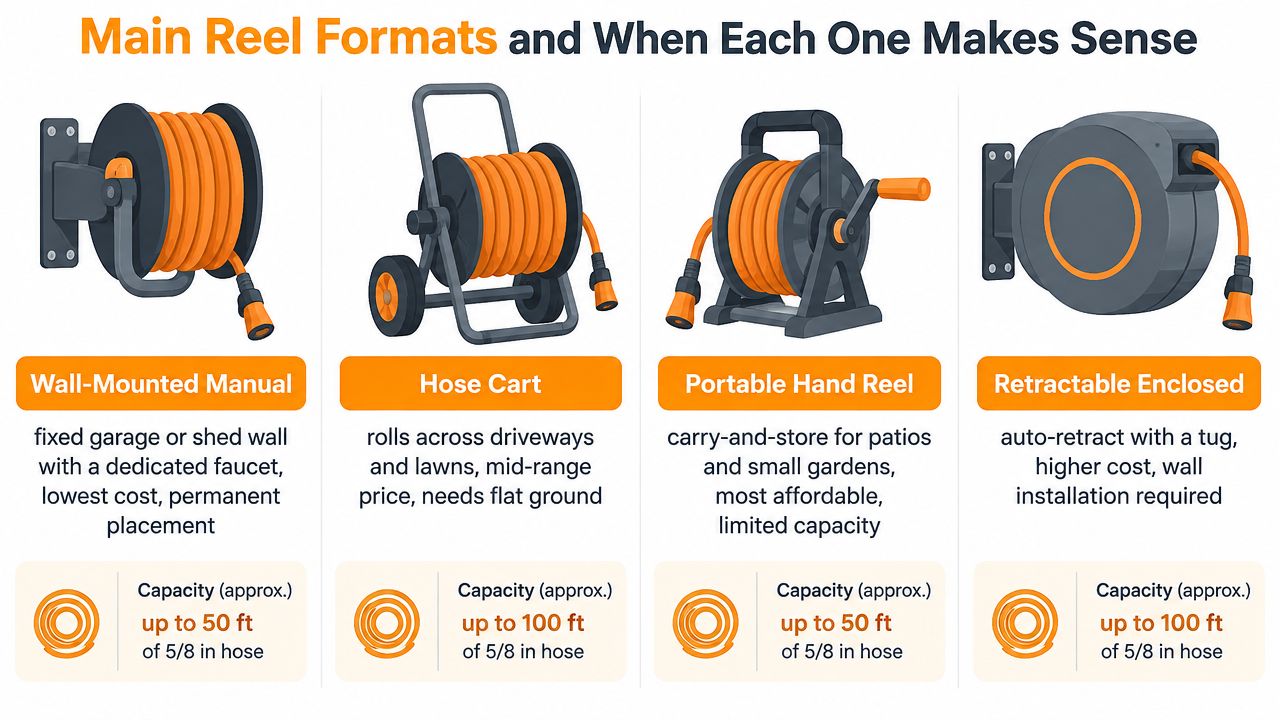
Wall-mounted manual reels
A manual wall reel is my first choice for a fixed garage or shed station. It takes little floor space, usually costs less than an automatic unit, and gives you direct control through a hand crank. Mount it near the dedicated faucet, keep the hose path clean, and you have a dependable setup for one main zone.
The trade-off is obvious. You must crank the hose back, and the hose won't automatically stop at a convenient length unless the reel includes a locking feature. This format suits homeowners who value simplicity and serviceability over instant rewind.
Portable cart reels
A cart earns its keep when the faucet location changes relative to the task. Roll it from the driveway to the garden, or from the garage to the RV pad, then lock the wheels before pulling hard on the hose.
Carts trade wall space for mobility. They work best on flat, firm ground. Slopes, uneven pavers, and soft lawns can make the frame tip or twist while you're pulling, so a cart is a poor choice for a permanently fixed wash station.
For a broader perspective on compact equipment design and product evaluation, this Reef Reels1 review Water Filter Advisor offers useful context about how small water-handling products are assessed. If your project also includes compressed air, compare the mounting and storage logic with this guide to a 100-foot air hose reel.
Hideaway box reels
A hideaway box encloses the hose in a housing that looks tidier beside a patio or narrow side yard. It can sit on a flat pad or mount to a wall, and the enclosure helps shield the hose from sun and incidental abrasion.
Choose this format when appearance and compact storage matter more than maximum repair access. The plastic shell can be convenient, but a cracked casing or damaged internal guide may be harder to service than a simple exposed manual drum.
Retractable spring reels
A retractable reel is the most convenient option for a fixed car-wash or garden station. Pull the hose to the working point, use the lock, and release it through the reel's return mechanism when finished.
The cost is higher, and the spring system adds a failure point. A smaller drum may also force tighter winding and reduce practical hose capacity. For foam-gun work, I'll choose a retractable reel only when its hose diameter, drum geometry, and return control are clearly matched to the tool.
Five Specs That Decide Real-World Performance
A reel can look excellent on a product page and still perform badly at the faucet. The deciding factors are length, diameter, drum geometry, rewind system, and material. Treat them as one system, because improving one while ignoring the others often creates a different restriction.
Length and diameter set the working reach
Hose length determines how far you can move from the spigot without dragging the reel. Buy for the longest routine path, not for unused reserve. Hose diameter controls how much water reaches the nozzle. A narrow hose may be light and easy for a spring to retract, but it can restrict flow to a foam gun or washer.
The reel also needs enough room for the hose construction it carries. Technical documentation states that the hose bending radius should be no more than half the reel drum diameter. A drum that forces repeated tight bends increases deformation, kinking risk, and flow restriction, as explained in this hose reel engineering documentation.
The mechanism controls effort and safety
A hand crank gives you mechanical control and is easy to understand. A geared crank reduces effort but adds components. A retractable spring stores torque as you pull the hose out, then releases that energy during rewind. If the spring is too weak, the hose sags and returns slowly. If it's too strong, the hose can snap back aggressively.
Pressure loss also depends on the route through the reel, the hose diameter, the total length, and the couplings. One technical bulletin uses 10 psi at a 90 psi inlet as a practical upper guideline when exact equipment requirements are unknown, so don't assume a compact reel is automatically harmless to flow. The guide to garden hose ratings is useful when comparing hose construction and pressure suitability.
Material decides how the reel ages
Polypropylene housings are light and easy to move, but prolonged sun can make lower-grade plastic brittle or deform it. Powder-coated steel brings stability and impact resistance, though wet storage can invite rust. Resin composites sit between those choices and can work well when the housing, drum, and bracket are all properly protected.
| Spec | What It Controls | Under-Sized Effect | Right-Sized Effect |
|---|---|---|---|
| Hose length | Working radius | You fall short or drag the reel | One-zone coverage without excess coil |
| Hose diameter | Flow volume | Weak rinse or thin foam | Better tool performance |
| Drum diameter | Bend stress | Kinks, deformation, harder rewind | Smoother winding and longer hose life |
| Rewind system | Return speed and tension | Sagging, snapback, or jams | Controlled storage after each task |
| Material | UV, freeze, and abrasion resistance | Cracks, warping, corrosion | Stable use in the intended environment |
The correct purchase is the combination, not the most impressive single specification. A long, narrow hose on a tiny spring reel may reach the far end of the driveway but still starve the tool and rewind poorly.
Matching Hoses, Connectors, and Foam Guns
Treat the reel as one link in a water path. The chain begins at the spigot, passes through the leader and reel, travels along the working hose, and ends at the spray nozzle or foam gun. A mismatch anywhere in that chain can reduce flow or create a leak.
Match the inner diameter of the hose to the reel rating. A 5/8-inch supply hose belongs on a reel designed for 5/8-inch hose, while compact detailing systems often use 3/8-inch hose for easier handling. Don't judge by the outer jacket alone. A thick jacket can make a hose look larger than its actual water passage.
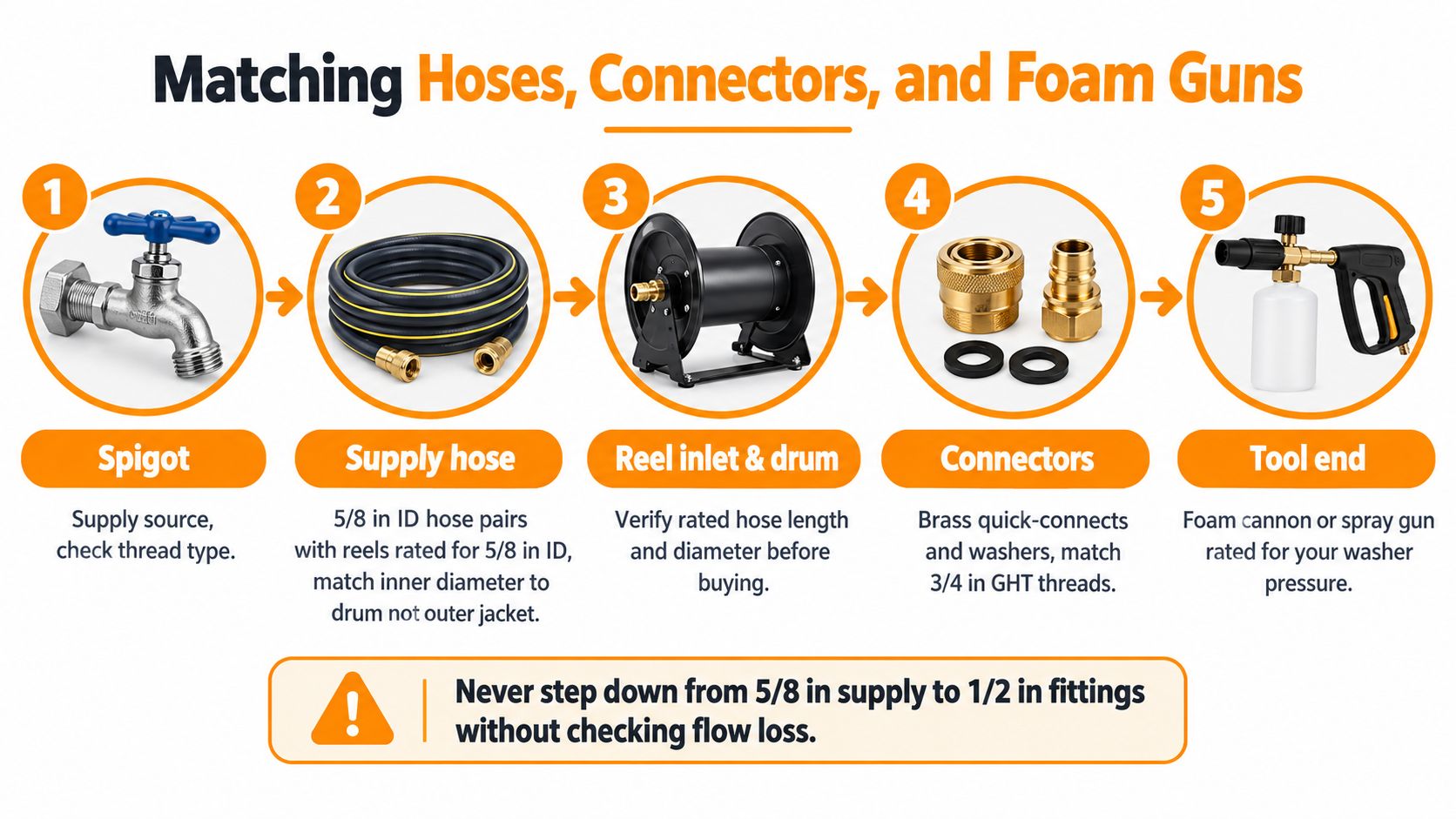
Check the threads before you buy
Most garden-side fittings use 3/4-inch GHT, while quick-connects and some foam guns or pressure washers use smaller couplers. If you switch between a foam gun such as SwiftJet and a standard spray nozzle, plan the adapter path before installing the reel. Use washers at threaded connections, avoid forcing mismatched threads, and choose brass or appropriately rated connectors where repeated removal is expected.
A leader hose isolates the reel from the faucet and gives the inlet swivel room to work. It also makes service easier because you can shut off the spigot and disconnect the reel without disturbing the wall plumbing.
Protect the foam-gun workflow
For foam-cannon work, keep the total hose path, including the reel, leader, and gun hose, under about 75 feet, because friction loss can reduce foam quality. That recommendation comes from the practical setup guidance in the source material, and the exact result still depends on hose diameter, inlet pressure, couplers, and the gun itself.
A smooth internal core path is preferable to a corrugated plastic hose when foam density matters. Rubber or flexible smooth-wall hose generally feeds a detailing tool more consistently than a sharply corrugated line that adds internal disturbance and resistance.
If your yard care extends beyond hose hardware, planning the delivery schedule can help too. This resource on smart watering schedules for fescue is a useful companion for matching the watering routine to the yard rather than just increasing hose reach.
Installation and Seasonal Maintenance
Installation isn't difficult, but a reel must carry pulling force without twisting. The wall surface, fasteners, inlet alignment, and hose path all matter more than a perfectly centered appearance.
For a wall-mounted reel, anchor the bracket into two studs or suitable masonry anchors at chest height. Keep the supply hose level with the inlet fitting, and leave about 6 inches of side clearance for the swivel arc. A bracket mounted into thin siding or unsupported trim may look secure until a full hose is pulled sideways.
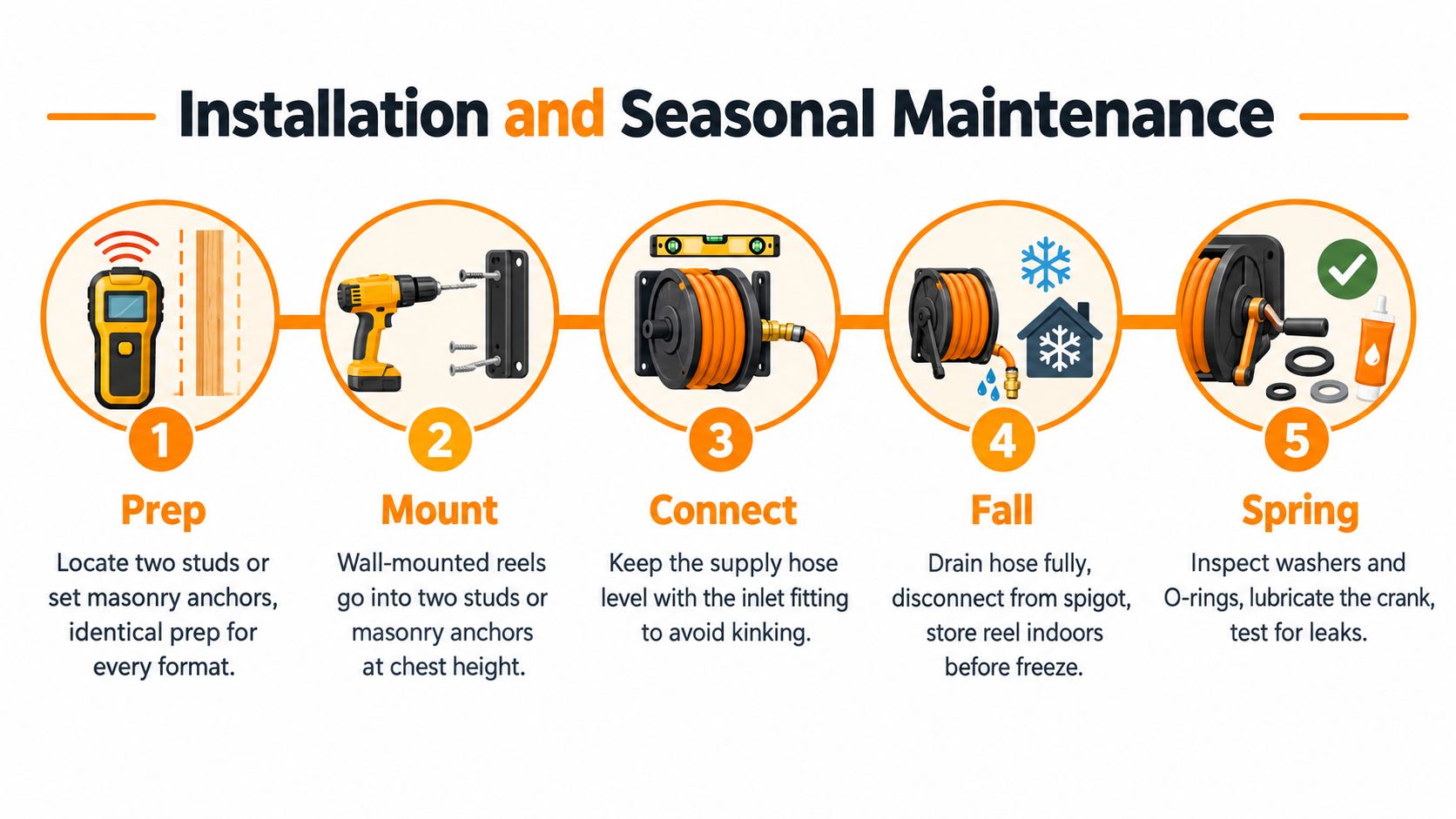
Set up carts and boxes correctly
A cart should stand on flat ground with its wheel lock engaged before you pull the hose. Check that the axle pin is seated and that the frame doesn't rock. That small inspection prevents the reel from twisting while the hose is under tension.
Place a hideaway box on a stable pad with a slight rear tilt so residual water can drain. Keep the inlet free of sharp bends. A box that traps water inside becomes a freeze problem even if the exterior shell is marketed as weather resistant.
Follow the seasonal loop
In spring, inspect the hose, washers, inlet swivel, housing, and mounting hardware before applying pressure. If a retractable hose returns slowly, check for dirt at the guide and verify that the hose is winding evenly. Lubricate the inlet swivel with silicone grease when the manufacturer's instructions allow it, but don't open a spring housing under tension.
During summer, rinse fertilizer, salt, and mud from the exterior. Look for sun damage in plastic and leaks around connectors. A short inspection after heavy use catches a loose washer before it becomes a soaked wall or a flooded vehicle pad.
In fall, shut off the water, disconnect the reel, and drain it completely. In a freezing climate, a short burst of air through the line can help remove trapped water. The freeze protection guidance from SwiftJet is relevant to any hose-fed cleaning setup exposed to winter temperatures.
Winter rule: A weather-resistant housing doesn't make trapped water safe. Drain the hose, the reel, and the connectors before freezing weather arrives.
Store portable carts under cover or indoors when possible. Even compact reels built from lightweight plastic or corrosion-resistant alloy need climate-aware care, because ice expansion can crack hose walls, fittings, and housings.
Real-World Setups for Cars, RVs, and Small Gardens
The best reel is the one that removes a specific obstruction from a familiar job. I use different formats for vehicles, campers, and plants because each workflow asks the hose to behave differently.
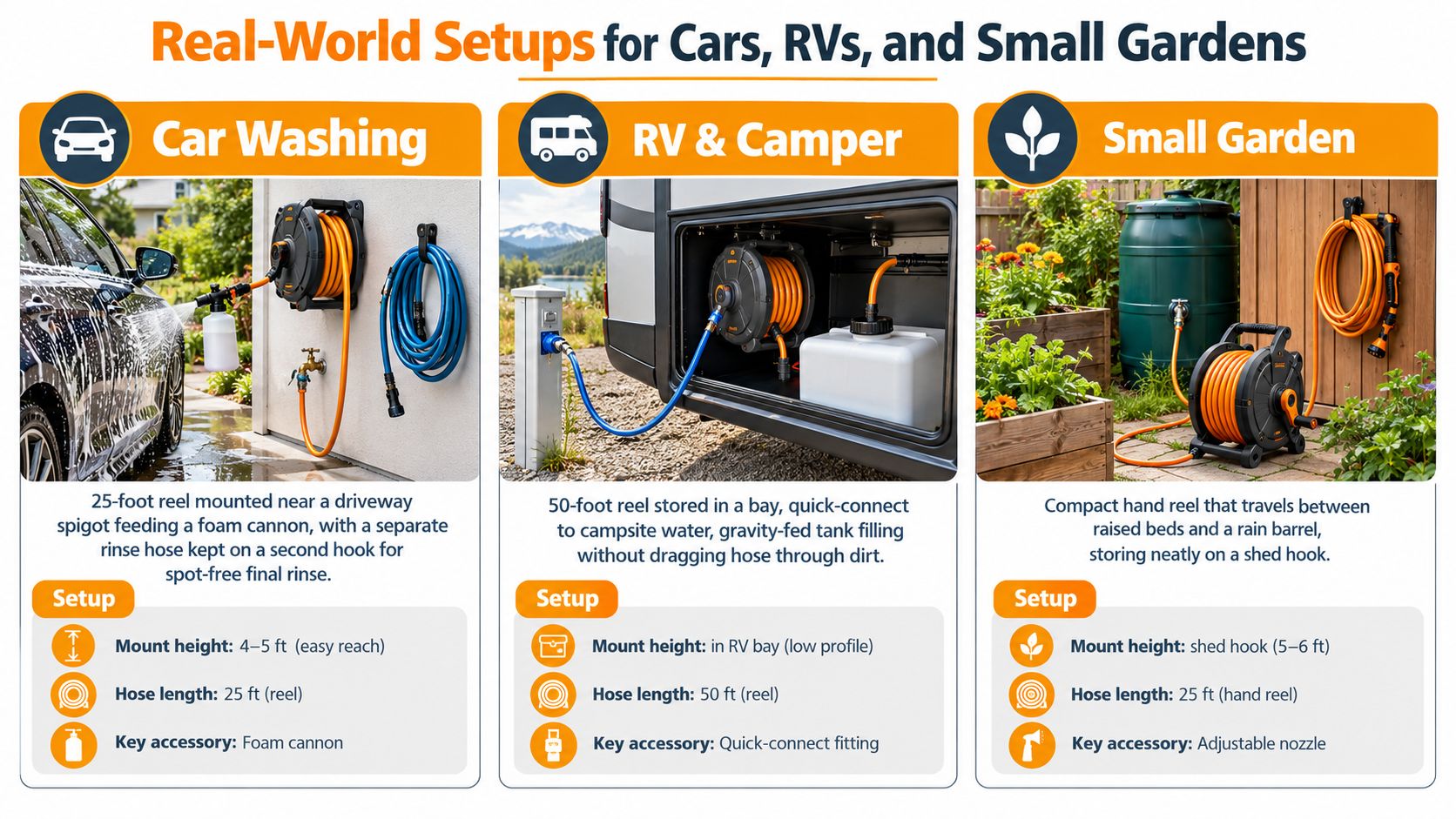
Car washing
For a driveway wash, a 25-foot reel mounted near the spigot can feed a foam gun while keeping the hose close to the vehicle perimeter. Pull the hose to the driver's side, connect the gun, apply foam, rinse the gun or disconnect it, then use a separate rinse hose on a cart or wall hook if the layout permits.
That separation matters. The foam hose stays cleaner and easier to rewind, while the rinse hose handles runoff and the longer path around the vehicle. A reel with a controlled return is especially useful here because an uncontrolled snap can strike paint, trim, or your ankles.
A garden-hose foam gun such as SwiftJet can sit at the tool end of this chain. Check its connector, the reel hose diameter, and the available supply before expecting consistent foam.
RV and camping
A 50-foot, 5/8-inch cart reel makes sense when the water source may be a campsite hydrant, a portable tank, or a connection outside the vehicle bay. Roll the cart beside the hookup, secure it on firm ground, connect the supply, and use the hose for an exterior rinse, awning wash, or campsite cleanup.
Keep potable-water use separate from dirty wash water and use fittings intended for the task. The cart format gives reach without requiring a permanent installation, but it needs a stable storage spot during travel and protection from freezing when the season ends.
Small garden
For potted plants and a patio cooler rinse, a 25-foot, 1/2-inch hideaway or wall-mounted reel keeps the hose near the work zone without dominating a narrow side yard. Pull to the raised beds, water the pots, rinse the patio, shut off the faucet, and guide the hose back while it's still clean.
Don't oversize this setup. Extra hose creates extra coil, extra weight, and more surface to manage. If you're planning a new planting layout, a garden ai design tool can help organize zones before you decide where the reel and faucet should sit.
For a visual demonstration of a compact foam-gun wash workflow, this video shows how the tool can fit into a home car-care setup.
Buyer Mistakes to Avoid and a Quick Decision Checklist
Most reel failures begin before installation. The buyer chooses capacity by the largest number on the package, then forces an incompatible hose into the drum and blames the mechanism when it kinks or rewinds slowly.
Avoid these mistakes:
- Overpacking the drum: Don't cram 100 feet of hose into a reel rated for 25 feet. The hose needs room to wind without pressing hard against the drum edges.
- Ignoring bend radius: A small drum can force repeated high-curvature bends, increasing stress and flow restriction.
- Skipping winterization: Water left inside can freeze, expand, and damage the hose, housing, or connections.
- Using a cart on bad ground: Uneven pavers or an uphill pull can tip the frame and twist the inlet.
- Over-tightening plastic fittings: Tighten enough to seal, not enough to distort the connector or crush the washer.
Use this quick decision filter:
- Choose wall-mounted manual for a fixed driveway station.
- Choose a cart for an RV, camper, or multi-zone yard.
- Choose a hideaway box for a narrow side yard where appearance and protection matter.
- Choose retractable for a fixed station where controlled rewind is worth the added mechanism.
- Match the drum to the hose and leave roughly 20% extra capacity so the coil isn't packed to the limit, following the sizing guidance in this hose reel buying advice.
- Verify 3/4-inch GHT compatibility or budget for the correct adapter.
- Confirm that you can drain the reel before freezing weather.
- If you're feeding a foam gun, choose a pressure-rated hose and verify the complete connector path.
Measure your working route, select the format that matches it, and buy the smallest reel that performs the job without restricting the tool.
SwiftJet offers a garden-hose foam gun with adjustable water pressure and soap-ratio control for vehicle and outdoor cleaning. If your small water hose reel is part of a driveway wash station, visit SwiftJet to pair the hose workflow with a compatible foam-gun setup.
