

You've probably had the same moment in the garage or van bay. The hose is stretched across the floor, the compressor keeps getting nudged out of the way, and the tool at the end of the line starts feeling lazy just when the job gets tough. A 100 foot air hose reel fixes the clutter, but the primary win is more specific than that, it gives you reach without turning your air system into a guessing game.
A lot of buyers stop at length, then wonder why the impact feels weak or the spray gun starts acting inconsistent halfway across the bay. That's where the matching matters. A 100 foot air hose reel can be the right answer for a full garage, a mobile detail van, or a small commercial bay, but only if the hose ID, compressor output, and tool demand line up.
Why a 100 Foot Reel Changes the Way You Work
A loose hose changes the entire rhythm of a shop. You step over it, drag it around a fender, coil it back against a tire, then move the compressor because the hose still won't quite reach the far corner. With a 100 foot air hose reel, the workspace starts to feel built in instead of improvised.
That's why this size matters in real garages and service spaces. A 3/8-inch × 100 feet reel with a 300 PSI working rating, like the common Goodyear retractable format, gives you a practical mix of reach and pressure capability for many compressed-air tasks, not just quick inflation work (Goodyear retractable reel listing). Longer hoses improve coverage around vehicles and equipment, but they also need to be matched to the job, so the reel becomes part storage, part utility infrastructure.
Practical rule: the best reel is the one you stop thinking about during the job.
The main shift is mental as much as physical. Once the hose lives on a reel, you stop treating compressed air like a portable afterthought and start treating it like a fixed service line. That's useful in a garage, and even more useful in a van or bay where every minute spent untangling hose is one more minute the tool isn't earning its keep.
How a 100 Foot Air Hose Reel Actually Works
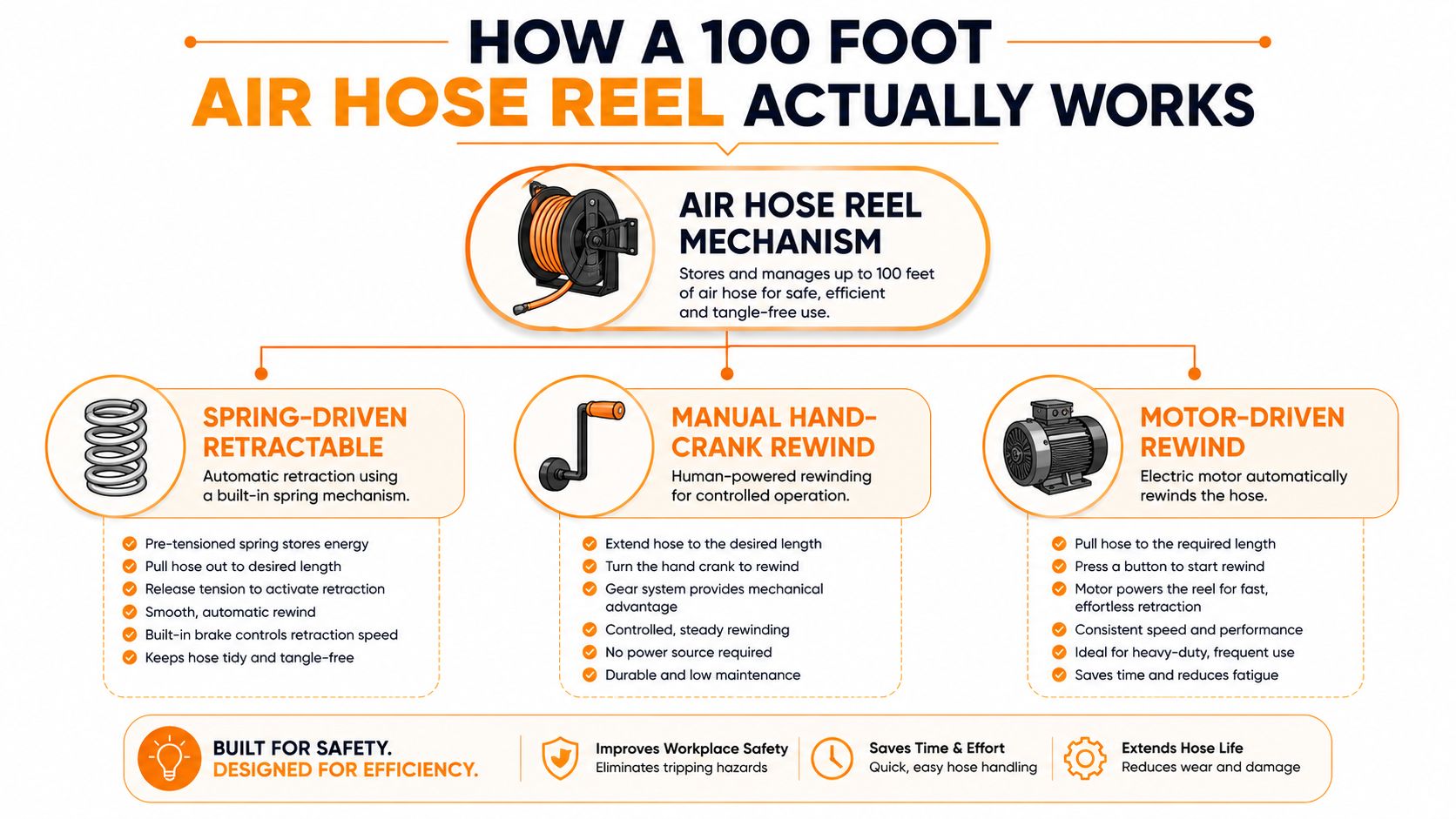
At a basic level, a reel is a controlled storage drum with an inlet, a leader hose, and a swivel that lets the hose move while the air path stays sealed. That swivel joint is one of the first places cheap hardware starts to complain, because it has to rotate smoothly while carrying pressure and staying leak-free. The drum itself is just the spool, but it's the whole reason the hose stays orderly instead of becoming floor clutter.
Spring, hand-crank, and motor drive
Spring-driven retractable reels work like a tape measure that wants to go home. You pull the hose out, the spring takes over, and the line rewinds itself when you're done. Manufacturer guidance for first-time users emphasizes smooth retraction and mounting the reel close to the compressor, because the mechanism is designed to manage the pull for you, not to be yanked around (air hose reel basics guide).
Manual hand-crank reels are plain and rugged. You do the work, so there's less to fail, and that's exactly why they still make sense where durability and simplicity matter more than speed. Motor-driven reels sit at the premium end, and they earn their place where the hose gets cycled constantly, such as high-traffic bays and mobile detail setups.
The cheapest reel usually fails where motion and sealing meet, not where the metal looks thin.
What the parts actually do
The inlet brings air in from the system. The leader hose bridges the stationary plumbing to the rotating drum. The stop mechanism keeps the hose from disappearing too far back onto the spool, which matters more than people think when a long line is under tension and someone gives it one hard tug.
A reel that feels smooth in the store can still be annoying in the shop if the swivel drags or the spring loads unevenly. Those are the parts that decide whether the reel feels like a tool or a fight. That's why the internal build matters more than the shiny finish.
Sizing Math That Actually Matters
The most common mistake with a 100 foot air hose reel is treating all 100-foot hoses as basically the same. They're not. Inside diameter is the spec that changes how the reel behaves at the tool, because a smaller hose creates more friction loss as air travels down the line.
Why diameter beats length in the real world
A 3/8-inch hose on a 100-foot reel can be perfectly workable for intermittent tools, but it will deliver less pressure at the end than a 1/2-inch hose at the same length. That difference matters because the compressor has to overcome resistance in the line before the tool ever sees the air. If the hose is undersized, the compressor works harder, the tool feels softer, and the cycle gets less efficient.
Here's the useful way to think about it. Longer hose gives you coverage. Larger inside diameter preserves airflow. You usually want the largest hose ID that still makes sense for the tool and the reel you're buying.
| Hose ID | Best Suited Tools | Typical Pressure Drop | Compressor Size Needed |
|---|---|---|---|
| 3/8-inch | Impact wrenches, tire inflation, light maintenance | Higher than larger IDs at the same length | Smaller to mid-size compressors for lighter duty |
| 1/2-inch | Sanders, higher-demand air tools, longer duty cycles | Lower than 3/8-inch at the same length | Mid-size to larger compressors with stronger flow |
The reason this table matters is simple. A longer run increases the amount of air volume that has to fill and empty every time you pull the trigger. That lag is usually fine for short bursts, like impacts and inflators, but it becomes obvious with continuous-flow tools such as blow guns and paint equipment.
If you want a deeper look at hose construction before you commit, the internal breakdown in reinforced hose construction guidance is worth reading once you've narrowed your diameter choice.
Retractable vs Manual vs Motor Driven Reels
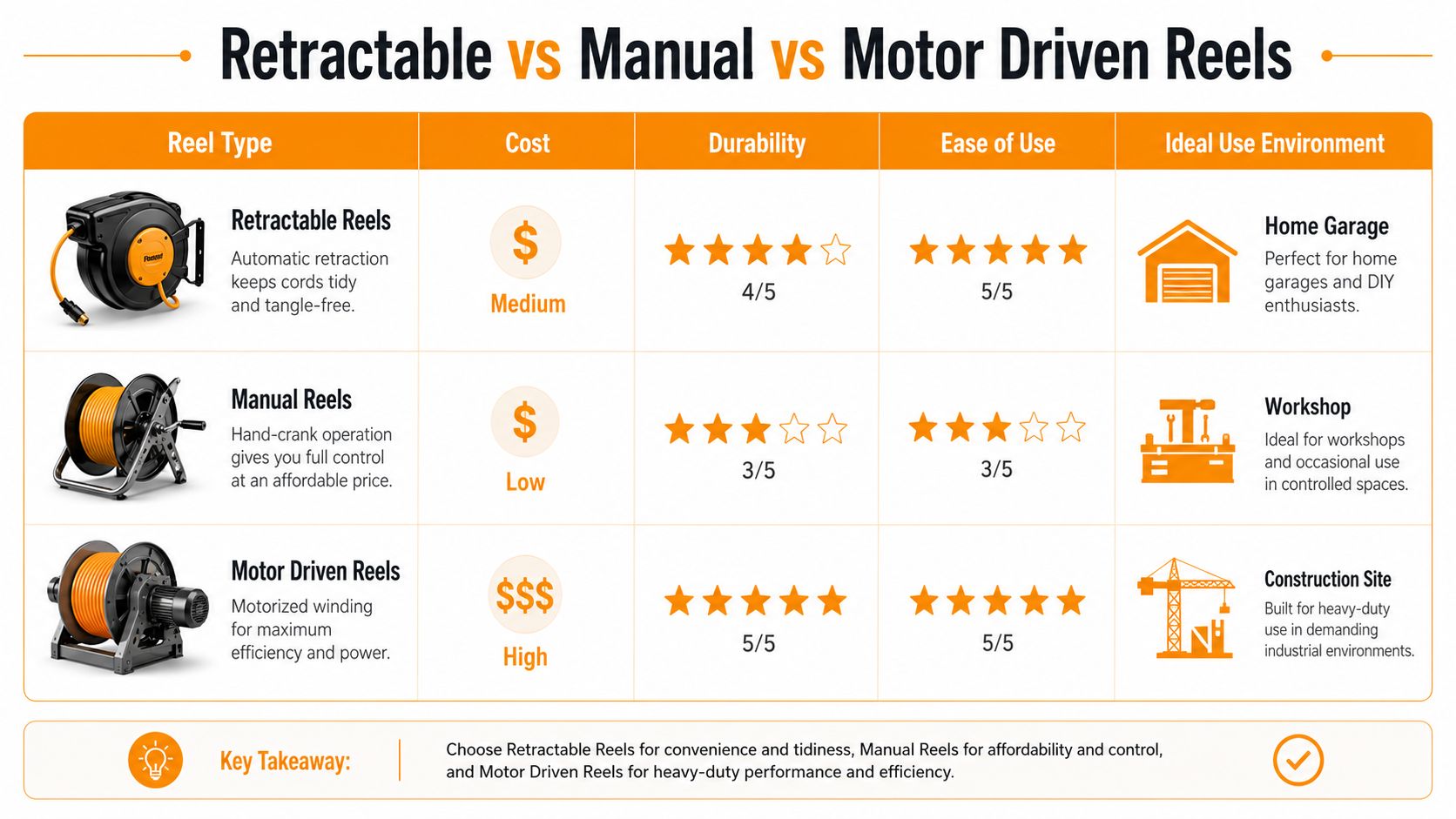
A reel type should match the abuse it's going to take. A spring reel is the everyday shop standard because it balances convenience and footprint. A manual reel is the straightforward workhorse when you want fewer moving parts. A motor-driven unit makes sense when constant cycling would wear people out faster than it wears the reel.
How they compare in actual use
| Reel Type | Cost | Durability | Ease of Use | Ideal Use Environment |
|---|---|---|---|---|
| Retractable spring | Medium | 4/5 | 5/5 | Home garage, general repair bay |
| Manual hand-crank | Low | 5/5 | 2/5 | Budget installs, heavy-use shops |
| Motor-driven | High | 4/5 | 5/5 | Mobile detailing, high-traffic bays |
Retractable reels win on convenience because they cut down on drag, tangles, and half-finished coiling jobs. Manual reels win when you care more about simple hardware and don't mind the extra step of rewinding by hand. Motor-driven reels are for places where the hose gets deployed and stowed all day, and where operator fatigue starts to matter.
What to choose by workflow
If you're in a home garage and mainly run an impact, inflator, or trim tools, a spring reel usually feels natural. If you're running a service bay and the reel sees rough treatment, manual can be the smarter long-term call because there's less mechanism to baby. If your hose is getting pulled and put away constantly, the powered option earns its keep through speed and consistency.
The right choice is rarely about the fanciest mechanism. It's about which one keeps the line ready without asking the user to fight the hardware every time the job changes.
Mounting and Installation the Right Way
A reel that's mounted badly feels wrong from day one. It pulls crooked, the hose rubs, the swivel ends up under stress, and the whole assembly starts acting like it belongs somewhere else. The fix is to treat mounting as structure, not decoration.
Wall, ceiling, and mobile setups
On a wall, fasten the reel into studs or into masonry with the right anchors, and don't trust drywall alone for a full-size hose reel. Ceiling mounting works well when you want maximum sweep across a bay, but only if the support structure can handle the load and the reel's rotation clears lights, doors, and stored gear. In a van or trailer, reinforce the mounting surface first, because road vibration will punish a weak attachment faster than normal shop use will.
Installation habit: mount where the hose naturally reaches the work, not where the compressor happens to sit today.
Plumbing matters too. Keep the inlet connection clean, and give the leader hose a sensible path so it doesn't bind when the reel turns. If the reel fights the pull angle, the user will feel it every time the hose comes out. That's when people blame the reel, even though the primary issue is the mounting angle.
For connector choices and what fits what, the breakdown in hose connector types is useful before you tighten the final fittings.
The mistake I see most often is hanging the reel high enough to feel convenient, then discovering the hose scrapes on everything below it. Another common miss is ignoring the swivel orientation, which makes a good reel seem sticky or noisy because the plumbing is pulling it sideways. Install it once with the actual sweep of the hose in mind, and it behaves like fixed equipment instead of a compromise.
Matching the Reel to Your Compressor and Tools
A 100 foot air hose reel either works beautifully or turns into a bottleneck. The reel itself doesn't create pressure, it preserves access to it, so the compressor and the tool still have to be a good match. A small compressor feeding a long, narrow hose can only do so much before the line losses show up at the trigger.
Pair the reel to the job, not just the space
A 6 CFM pancake compressor can make sense for trim work, inflators, and light intermittent tools if you keep the hose demand reasonable. A 20 CFM two-stage unit is the sort of compressor that belongs with higher-demand shop work, especially when a longer reel and a bigger hose ID are part of the setup. In between, a mobile detailer usually needs a balance of reach, manageable weight, and a hose that won't choke the workflow.
The practical rule is simple. If the tool needs steady air and the reel is 100 feet long, favor the larger hose ID that the compressor can support. If the tool is burst-based, like an impact wrench, a 3/8-inch reel is usually easier to live with than people expect.
For buyers comparing compressed-air equipment, the catalog at industrial air products at MHUSA is a useful reference point because it shows how broad the compressed-air category really is, from storage to delivery to tool support. If you're also sorting out the pressure side of your system, the guide on 100 PSI air compressor basics helps frame what that rating means in day-to-day use.
Four match checks before you buy
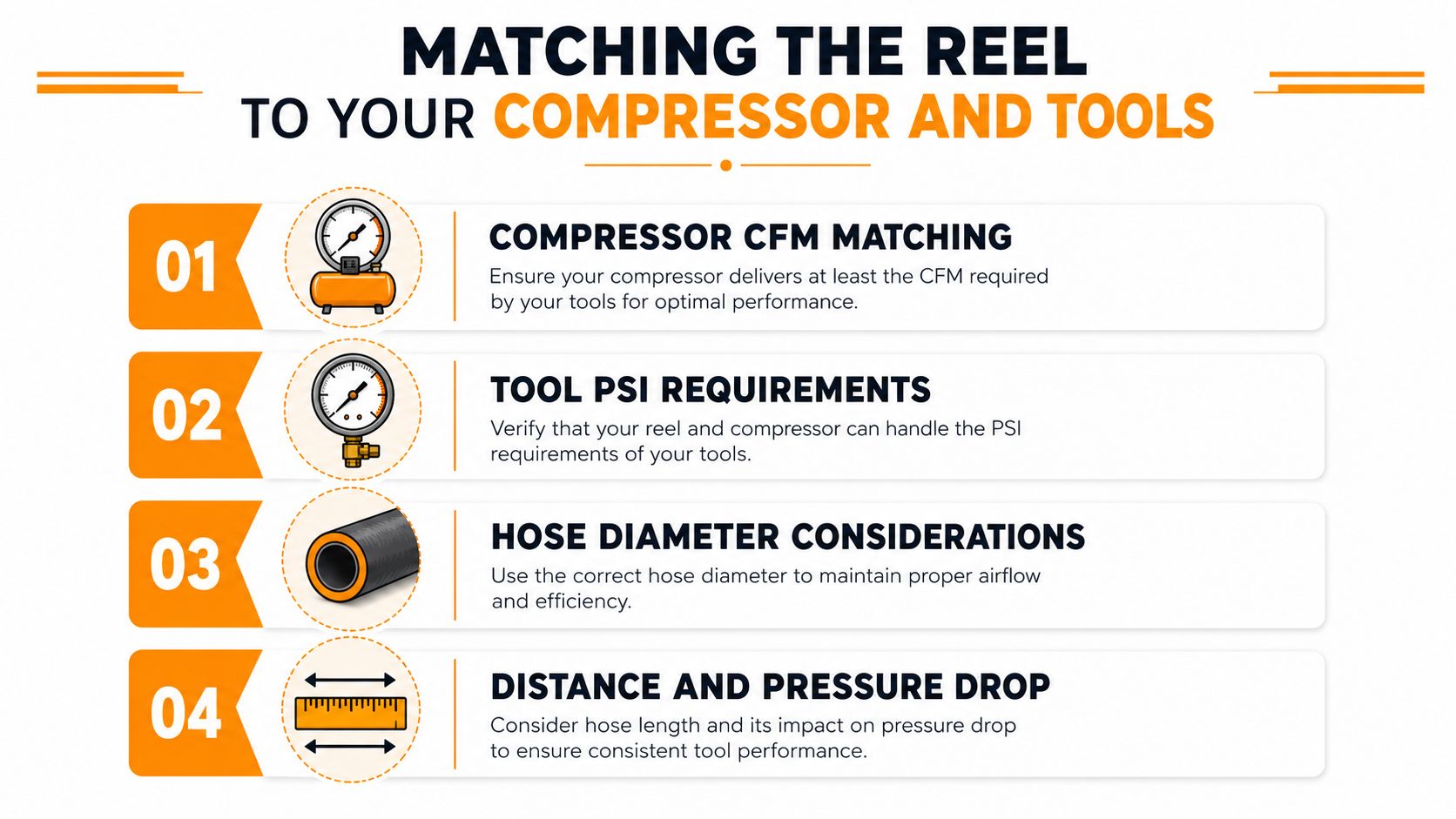
- Compressor CFM matching: Make sure the compressor can keep up with the tool's air appetite, or the reel just extends the problem farther from the tank.
- Tool PSI requirements: Confirm the reel's working rating and hose setup can support the pressure your tools are built around.
- Hose diameter considerations: Use the largest ID that still fits the tool and compressor combo, because flow loss grows fast when the hose is too small.
- Distance and pressure drop: Treat the full 100 feet as part of the air path, not just extra convenience, because length changes how the tool feels under load.
The right pairing keeps the tool responsive at the far end of the line. That's the point of the reel in the first place, not just tidy storage.
Maintenance and Troubleshooting Essentials
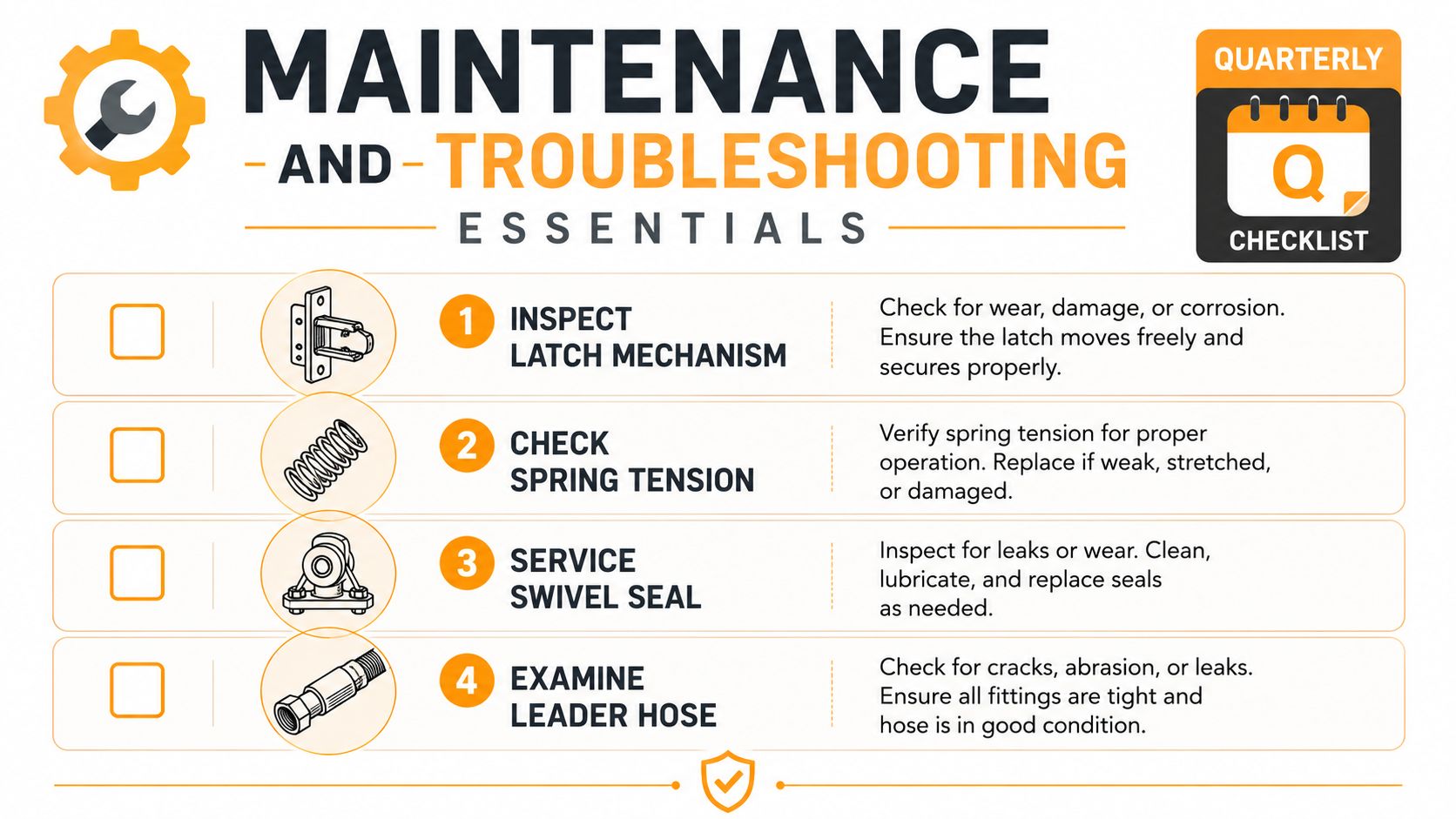
A reel that's ignored tends to fail in small, annoying ways first. The hose retracts too fast, the latch stops catching cleanly, or the swivel starts hissing just enough to make you doubt the whole setup. A short quarterly check keeps those problems from turning into downtime.
Quick checks that catch most failures
- Inspect the latch mechanism: If it won't lock or releases at the wrong time, clean the mechanism and check for wear on the catch.
- Check spring tension: A hose that snaps back too hard or won't retract fully usually needs tension adjustment, not a new reel.
- Service the swivel seal: Hissing at the swivel often points to a seal issue, so look for looseness, debris, or a damaged seal path.
- Examine the leader hose: Cracks, hardening, and abrasion near the inlet end show up early there, because that's where movement and stress concentrate.
The squeak you hear from the drum is usually a clue, not a mystery. It often means the reel wants cleaning, light lubrication where appropriate, or a check for misalignment in the mount. Don't ignore it until the pull gets rough enough to make the reel feel defective.
A reel rarely fails all at once. It gives you warning sounds and sloppy motion first.
If the hose won't latch, look for dirt in the catch or a misadjusted stop. If it retracts too fast, the spring tension is usually too aggressive or uneven. If the swivel leaks, fix the seal before the leak becomes normal to live with, because that's how small losses turn into shop habits.
Buyer's Checklist and Final Recommendation
A good 100 foot air hose reel should pass a short list before it ever goes on the wall. The hose inside diameter has to match the tools you use, the reel's PSI rating has to fit the system, the swivel needs to turn smoothly, the latch has to hold, and the spring or rewind mechanism should be covered well enough that you're not gambling on the core moving parts.
If you mainly run impact tools and inflate tires, a 3/8-inch × 100 feet reel is usually the cleaner fit. If you run sanders, paint equipment, or other tools that hate flow restriction, step up to the larger hose ID you can support and don't let the extra reach tempt you into undersizing the line.
The simplest yes-or-no test is this. Choose the 100-foot reel if the reach solves a real workspace problem and the compressor can keep up. Skip it if you only need a short run and would be forcing extra hose length into a system that already struggles with pressure loss.
If you're trying to build a cleaner, more usable air setup, SwiftJet has practical gear built for real home and auto-care routines. Take a look at SwiftJet and see how a better setup can make the whole job feel less scattered and a lot easier to finish well.
