

The popular advice is simple: random orbital and dual action mean the same thing, so buy any DA polisher and start working. That advice is incomplete, and it can put the wrong machine in your hands.
Some manufacturers use DA for free-spinning random orbital tools, long-throw machines, and forced-rotation polishers. Those tools don't behave the same when you add pressure, change pad size, or work across a large panel. The useful question isn't which label sounds safer. It's what motion the machine uses, how much orbit it has, and whether the pad keeps driving under load.
| Polisher type | Pad movement | Typical throw or orbit | Best fit |
|---|---|---|---|
| Standard free-spinning random orbital | Rotation plus off-center oscillation | 6–8 mm | Light correction, finishing, DIY work |
| Long-throw random orbital | Free rotation plus a larger orbit | 12–21 mm | Faster correction with a forgiving feel |
| Forced-rotation dual action | Gear-driven rotation plus orbital movement | Long-throw designs vary | Heavy correction and large panels |
| Rotary | Fixed rotation on one axis | Not an orbital movement | Maximum cut for experienced users |
The specifications and motion matter more than the word printed on the box. Here's how to separate the categories and choose the machine that will earn its space in your detailing setup.
Why the Random Orbital vs Dual Action Question Is More Confusing Than It Looks
The first problem is the label. In everyday detailing language, random orbital and dual action often describe the same broad family of polishers. Both can move the pad through an orbit while the pad rotates. But some manufacturers and detailing sources use dual action more narrowly for a gear-driven, forced-rotation machine, while others use it as a general term for any orbital polisher. That inconsistency is why two tools marked DA can feel completely different on a hood.
The historical naming doesn't make things clearer. Random orbital technology in modern polishing traces back to the late 1960s, when Rupes introduced a commercially used random orbital sanding system in 1968. Rupes later documented the LHR150 as the first random orbital polisher in its timeline, with a 10 mm orbit, compared with the 8 mm orbit common in many orbital tools at the time. Detailing users also adapted familiar wood-sanding tools for automotive work in the 1980s, attaching buffing pads to a format ordinary consumers already understood. The documented history of random orbital tools shows how sanding equipment evolved into mainstream paint-correction machines.
Shop by motion, not horsepower
A free-spinning random orbital relies on pad momentum. Put the machine flat on the paint and it oscillates efficiently. Tilt it, press too hard, or use a large aggressive pad, and the pad can slow or stop rotating. That behavior is frustrating during heavy correction, but it also limits heat and helps protect inexperienced users.
A forced-rotation DA uses gears to keep the pad turning as it orbits. It won't surrender rotation as readily when you increase pressure, so it cuts more consistently across broad panels. The tradeoff is direct operator responsibility. More consistent drive means more correction potential, but it also means poor technique can create heat, haze, or edge damage faster.
Practical rule: Ignore “DA” until you confirm whether the machine is free-spinning or gear-driven.
The decision comes down to four things: orbit or throw, rotation type, panel size, and your tolerance for correction risk. Speed controls matter too, but a large throw doesn't automatically make a machine aggressive, and a gear-driven label doesn't automatically make it suitable for every paint finish.
How Each Polisher Moves and What That Means for Your Paint
“Dual action” does not identify one motion. In product listings, it can describe a free-spinning random orbital or a gear-driven machine. Confirm the drive system before comparing tools.
A free-spinning random orbital combines pad rotation with an offset orbit. The pad can rotate around its center while that center travels in a separate path, constantly changing the abrasive direction across the clear coat. Tilt the machine, add too much pressure, or use a heavy pad, and rotation can slow or stop.
A standard dual-action machine also combines rotation and orbit, which explains the overlapping labels. This explanation of dual-action and forced-rotation movement separates free-spinning movement from forced rotation and explains why the combined motion creates less heat and a lower hologram risk than a rotary that only spins.
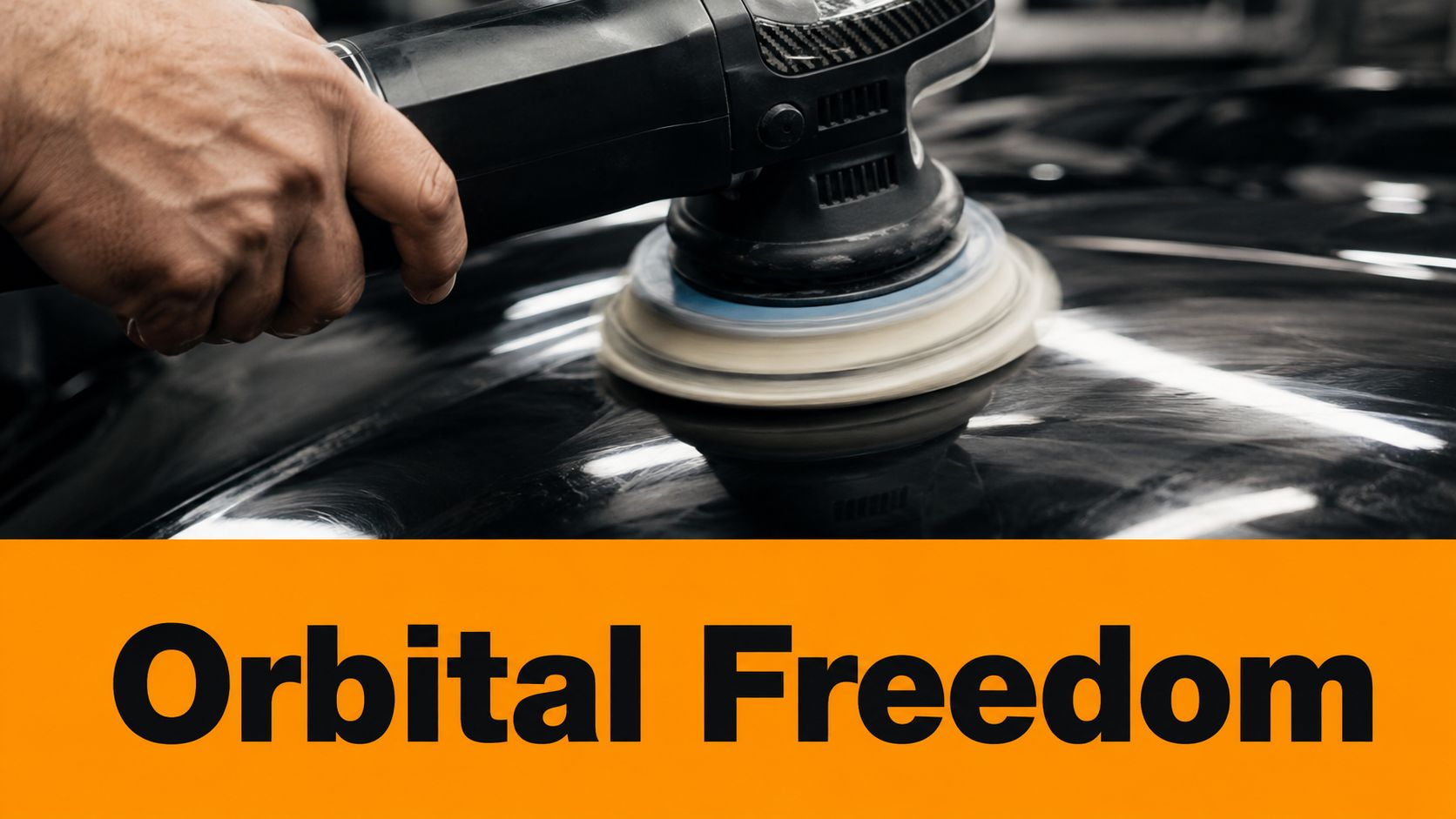
Free spinning favors control
A free-spinning random orbital is the calmer choice on soft clear coat. Its changing pad path reduces the chance of rotary-style holograms, while a stalled pad warns you that pressure, angle, or pad choice has become too aggressive. That behavior gives newer users more room to correct technique before the paint pays for it.
The limitation is inconsistent cutting. Once rotation drops, correction slows. Expect to adjust your section passes, backing plate, pad, or compound rather than forcing the machine through the panel.
Forced rotation stays engaged
A gear-driven DA keeps the pad rotating while it orbits. That drive maintains cutting motion under pressure, making it the better tool for large panels with substantial defects and for detailers who need consistent correction across broad sections.
It also demands discipline. Keep the pad flat, keep the machine moving, and test a small area before increasing cut. The motion is safer than a fixed rotary pattern, but it can still build heat, create haze, or damage an edge when held in one place.
A useful overview of electric polishers for cars helps place these motion types within the wider tool category. Choose by rotation type, panel size, and correction risk, not by the “DA” label alone.
The following demonstration gives you a visual reference for how pad movement looks on the panel.
Orbit Size, Speed, and the Specs That Separate the Two Categories
The label on the box tells you less than the machine's motion. Throw, oscillation rate, and rotation control determine how quickly a polisher covers paint and whether it keeps cutting when you apply pressure.
Traditional DA machines commonly use a 6–8 mm backing-plate throw. Long-throw tools move through 12 mm, 15 mm, or 21 mm orbits. A larger orbit covers more paint per oscillation and can speed correction, but it requires better pad control around curves, mirrors, and tight body lines. Rupes' documented 10 mm orbit milestone sits between the older 8 mm standard and newer long-throw designs.
The table below separates the labels from the working specifications. Published equipment comparisons show DA machines with roughly 8–21 mm throws and variable speed ranges around 2,500–6,000 OPM. They list a forced-rotation DA example at 225–700 rpm no-load speed and 27,400–8,700 orbit rate. A Makita unit is listed at 0–6,800 OPM in normal mode and 0–13,600 SPM. See the published dual-action polisher specification comparison for those figures.
| Category | Orbit throw | OPM range | RPM range | Typical correction ability |
|---|---|---|---|---|
| Standard random orbital | 6–8 mm | Around 2,500–6,000 OPM | Free-spinning, load-dependent | Light correction and finishing |
| Long-throw random orbital | 12–21 mm | Around 2,500–6,000 OPM | Free-spinning, load-dependent | Faster moderate correction |
| Forced-rotation DA | Varies by design | Published examples include 8,700–27,400 orbit rate | 225–700 rpm in one example | Strong correction under load |
| Makita dual-action example | Varies by mode | 0–6,800 OPM | Mode-dependent | Broad polishing and correction range |
What the numbers don't tell you
A high OPM figure does not guarantee strong correction. If the pad stalls under pressure, the machine can deliver less useful cutting than its specification suggests. A larger throw can cover a large panel quickly, yet feel awkward on narrow pillars or sharply curved sections.
Use the figures to predict behavior, not to crown a winner. Short throw means easier refinement and control. Long throw means faster coverage. Forced rotation means more consistent drive when the panel fights back. For large panels, test whether the pad keeps moving under load. That result matters more than the most impressive number in a product listing.
Real Tradeoffs Between Random Orbital and Dual Action Polishers
The free-spinning random orbital wins the first-contact battle. It tolerates imperfect technique, handles light polishing cleanly, and gives a beginner a manageable way to learn pad pressure and arm speed. On the other hand, it can stall when you lean on it, especially with an aggressive pad or a large working area.
The forced-rotation DA wins when the defect is stubborn and the panel is broad. Its gears keep the pad moving through pressure, so heavy compound work feels more predictable. That same drive creates more responsibility around edges, curves, and heat-sensitive paint.
| Criterion | Random orbital | Dual action |
|---|---|---|
| Pad compatibility | Foam polishing and finishing pads are easy starting points | Handles heavier foam and microfiber cutting setups |
| Correction potential | Strong for light and moderate defects, limited by stall behavior | Stronger, more consistent cut under pressure |
| Heat output | Generally lower when used correctly | Can build heat faster under sustained pressure |
| Learning curve | Forgiving and easier to control | Requires flatter pad placement and better monitoring |
| Finish quality | Often leaves a clean finish with the right combination | Can correct and finish well, but setup and technique matter |
| Large-panel efficiency | May lose time when the pad slows | Maintains drive across broad, demanding sections |
A random orbital also tends to be the better ownership choice for occasional users. It can spread wax, refine clear coat, and perform a one-step polish without asking you to manage the machine aggressively. A long-throw version adds useful correction speed while preserving the free-spinning behavior that makes the category approachable.
Where the forced-rotation tool earns its keep
A gear-driven DA earns its place when you repeatedly face hard clear coats, deep wash marring, large SUVs, trucks, RVs, or mobile jobs where stalled rotation turns into lost working time. The machine doesn't eliminate the need for test spots or pad cleaning. It keeps the cutting system engaged when a free-spinning machine starts to bog down.
Use a suitable heavy cut compound only when the paint condition demands it. A powerful machine paired with an unnecessarily aggressive compound wastes clear coat and leaves more finishing work.
The safest machine is the one you can keep flat, moving, and under control for the entire job.
Neither category is universally superior. Buy the random orbital if your priority is forgiveness and predictable finishing. Buy the forced-rotation DA if your priority is consistent correction under load and you already understand how quickly pressure changes the panel temperature.
Which Tool Wins for Common Detailing Scenarios
A silver daily driver with light wash swirls doesn't need a wrestling match. For a one-step polish, choose a free-spinning random orbital, preferably with a manageable plate and a polishing foam pad. It gives you a clean finish, handles ordinary defects, and lets you concentrate on coverage instead of fighting pad rotation.
The owner also benefits from a simpler setup. A medium one-step abrasive on a polishing pad can improve clarity without turning a maintenance job into a multi-stage correction. If the test spot meets the visual target, stop there. Removing every trace of every defect isn't always the right trade for a daily vehicle.
A dark truck with heavy trails
A black or dark-colored truck with pronounced buffer trails is a different job. The broad hood, roof, and side panels expose inconsistent correction, while the darker finish makes haze and micro-marring easier to spot. Here, a forced-rotation DA has the advantage because its gear-driven pad keeps cutting when you apply controlled pressure.
Work in measured sections and inspect after the compound stage. The machine's extra drive can remove defects efficiently, but it can also leave a finish that needs refinement. Follow with a polishing or finishing combination rather than assuming the first pass should deliver the final gloss.
For this job, a long-throw random orbital remains useful for refinement and general panel work. Many working detailers keep both types available because the best tool can change from a damaged flat panel to a delicate contour within the same vehicle.
Weekend enthusiast versus mobile professional
A weekend hobbyist polishing a personal car should buy a random orbital. The job usually rewards low risk, easy control, and a finish that looks sharp in normal inspection lighting. A forced-rotation machine can do the work, but its extra capability won't help if the operator spends more time worrying about pressure and heat than correcting the paint.
A mobile professional handling several vehicles in a working day has a different calculation. Time lost to stalled rotation, repeated passes, and slow correction across large panels affects the entire schedule. That operator should lean toward a forced-rotation DA, while keeping a free-spinning long-throw tool for finishing and situations where restraint matters more than maximum cut.
Match the machine to the defect and the panel, not to the badge on the tool case.
Matching Pads, Plates, and Compounds to the Right Motion
Treat the backing plate, pad, and compound as one system. A random orbital with a five-inch plate and a sensible foam pad can deliver dependable one-step correction. A forced-rotation DA can support a more aggressive microfiber or heavy foam setup, but the machine won't rescue a mismatched combination.
Start with the backing plate. The pad should match the plate size or be slightly larger, and the hook-and-loop face should stay properly supported. An oversized pad can flex at the edge and reduce control. A plate that extends beyond the pad can grab trim or paint edges.
A practical pairing guide
- Random orbital: Use a five-inch backing plate, a foam polishing or light-cutting pad, and a one-step polish. This gives the free-spinning machine enough control without asking it to drive an unnecessarily heavy pad.
- Dual action: Use a five- or six-inch plate, a microfiber or firm foam cutting pad, and a heavier compound when the defects justify it. Keep a softer foam pad and finishing polish ready for the refinement stage.
- Tight areas: Switch to a smaller plate and pad for mirrors, spoilers, bumpers, and narrow body sections. Don't force a large pad into a contour it can't follow.
- Pad maintenance: Clean the face between sections and change pads when product begins to cake or the foam feels hot. A saturated pad cuts poorly and transfers more heat.
Too-soft a pad paired with too-heavy a compound creates a messy compromise. The pad may collapse, absorb product, and lose its ability to keep the abrasive working evenly. Too-aggressive a pad on soft paint can remove defects while leaving a haze that costs you another polishing step.
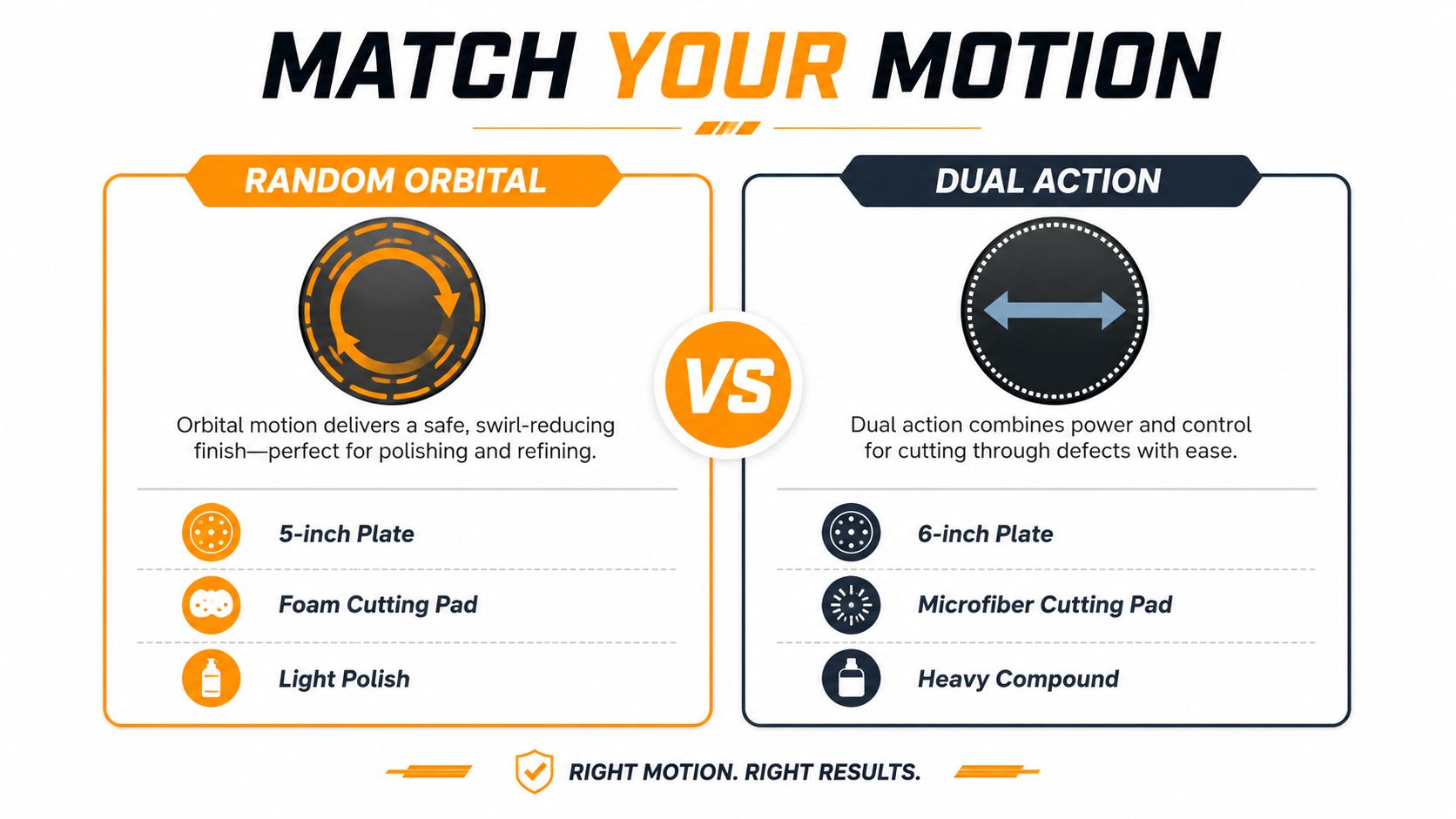
For a first setup, pair a random orbital with a five-inch plate, foam polishing pad, and light or medium one-step polish. For a correction-focused setup, pair a forced-rotation DA with a five- or six-inch plate, microfiber cutting pad, heavy compound, and a separate finishing pad. You can find additional guidance on choosing buffing and polishing pads.
Choosing Between Random Orbital and Dual Action by User Type
Don't match the machine to a marketing tier. Match it to the operator's experience, the paint condition, the panel size, and the number of hours the tool will run.
| User type | Recommended tool | Orbit or throw | Why it wins |
|---|---|---|---|
| First-time DIY user | Free-spinning DA random orbital | 15 mm long throw | Forgives pressure mistakes while improving light swirls |
| Monthly hobbyist | Long-throw random orbital | 15–21 mm | Adds correction speed without forced pad drive |
| Mobile detailer | Forced-rotation DA | Model-dependent | Maintains cutting action across large, varied panels |
| Multi-stage correction specialist | Long-throw random orbital plus forced-rotation backup | 15–21 mm for primary work | Uses the gentler tool broadly and adds drive when time or defects demand it |
The first-time owner
For a first weekend job on a personal daily driver, choose a five-inch, free-spinning DA random orbital with a 15 mm throw. It gives you useful movement and correction without making every mistake immediately expensive. Use it flat, keep your working sections controlled, and let the test spot decide whether the pad and polish are sufficient.
The serious hobbyist
If you polish your own cars regularly and want stronger one-stage correction, choose a 15–21 mm long-throw random orbital. It covers panels efficiently and remains more forgiving than a forced-rotation machine. You'll still need to manage pad temperature and avoid excessive pressure, but the machine won't demand professional-level aggression.
The working professional
A mobile detailer who needs throughput should choose a forced-rotation DA for demanding correction. The consistent pad drive earns its keep on hoods, roofs, trucks, and large vehicles. A professional handling multi-stage work should still keep a long-throw random orbital for most general correction and finishing, then use forced rotation when the defect, deadline, or panel size justifies it.
The decision rule is simple: shorter throw for control, longer throw for coverage, free spinning for forgiveness, and forced rotation for sustained correction under load. Brand prestige doesn't change that mechanical reality.
A Safe Polishing Workflow That Works on Either Tool
Technique protects paint more reliably than a product label. Start with a clean, decontaminated surface so abrasive particles don't drag across the clear coat. Wash thoroughly, remove bonded contamination, and inspect the panel under direct lighting before you choose a pad or compound.
Tape sensitive trim, badges, and edges with low-tack automotive tape. Then perform a test spot on a less noticeable section. That small trial tells you whether the chosen combination corrects enough, finishes cleanly, or needs a lighter pad and polish.
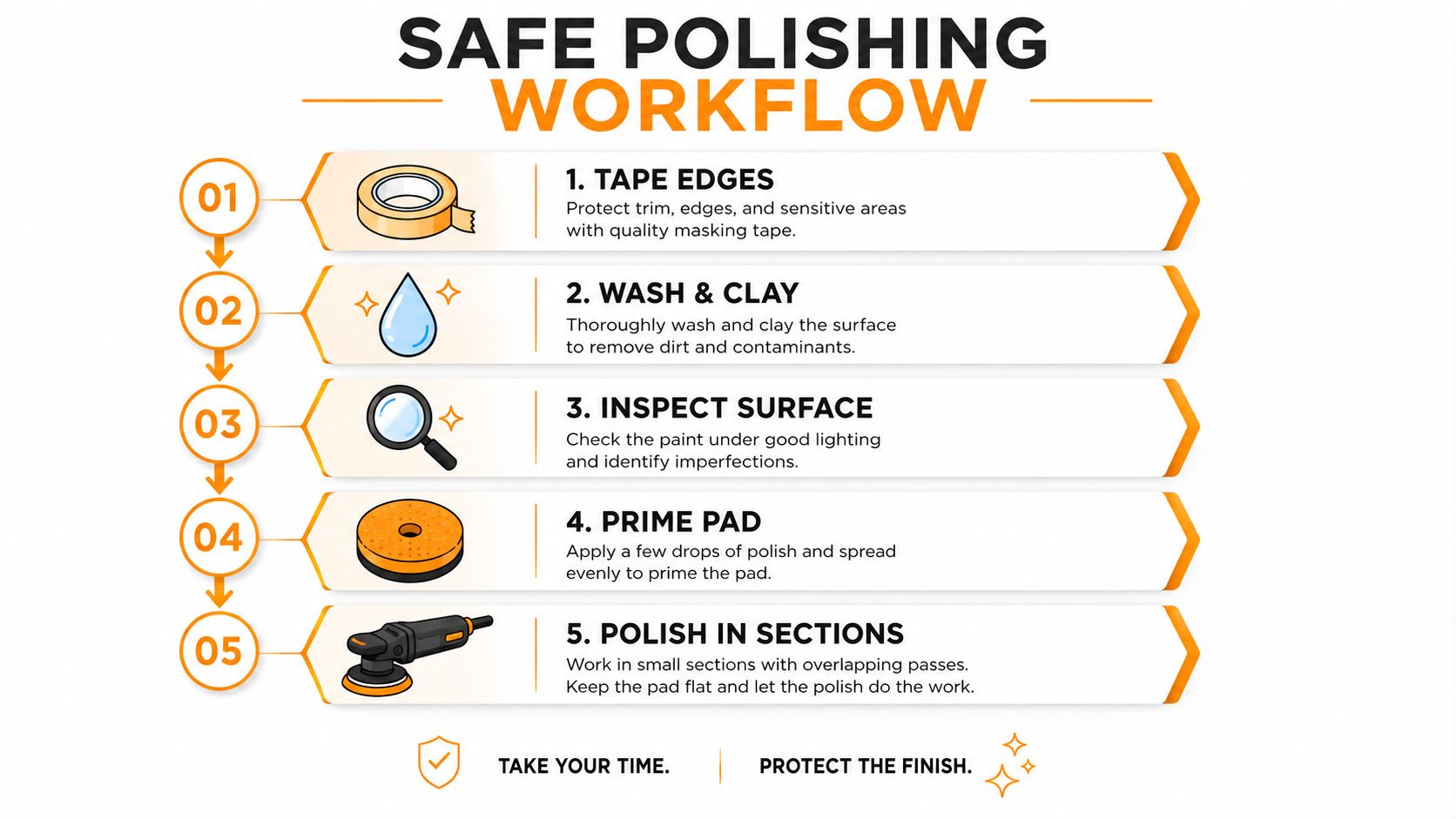
Use a controlled section method
Prime the pad with four pea-sized drops of compound, spread the product at a low speed across a roughly two-by-two-foot section, then increase to a working speed suited to the machine. For a free-spinning dual-action tool, work around speed four to five. For a forced-rotation unit, use a lower working range around speed three to four and watch the surface closely.
Keep the pad flat. Use the machine's weight plus firm hand control rather than leaning into the panel. Make three to four slow passes in a crosshatch pattern, moving up and down, then side to side. Wipe residue with a clean, plush microfiber and inspect under a swirl-finding light before repeating the section.
- Control pressure: If the random orbital stalls, reduce pressure or change the setup instead of forcing it.
- Control heat: Don't park either machine in one place, especially with a cutting pad and compound.
- Control product: Too much polish glazes the pad and weakens correction.
- Control inspection: Check the result before committing to the whole hood, roof, or trunk.
- Control pad condition: Clean or change a pad when it cakes, feels hot, or stops cutting consistently.
A wet edge can make product flash unpredictably, while a tilted pad concentrates movement at the edge and raises risk. Keep the work deliberate. The right random orbital versus dual action choice helps, but flat pad placement, clean pads, and regular inspection determine whether the finish survives the process.
SwiftJet offers a hose-connected foam gun for thick vehicle-wash foam, with an on/off trigger, a microfiber wash mitt, and a choice of finish options. If you want cleaner preparation before polishing, visit SwiftJet and review the car-care equipment available for your wash routine.
