

Snow foam is often sold as a cleaning solution, but its most important job is the one it can't finish alone. It loosens and lubricates contamination before a wash mitt reaches the paint, which means its value depends less on how dramatic the foam looks and more on what remains on the panel after rinsing. Used properly, guidance describes it as capable of reducing the dirt load before hand washing by 60–80%, while another detailing source claims correct use can reduce swirl marks by up to 70%, though both figures depend heavily on contamination, dwell time, chemistry, and technique. Independent detailing guidance on snow foam performance
The Question That Decides Whether Snow Foam Is Worth It
Snow foam is worthwhile only when its reduction in contact dirt outweighs the added time, water, product, and equipment. For a heavily soiled vehicle, it can make the main wash safer. On lightly dusty paint, or when the foam dries before rinsing, it may add effort without meaningfully lowering swirl risk. It also cannot replace shampoo or careful contact washing.
The useful question is whether a foam pre-wash, placed between the initial rinse and hand wash, removes enough abrasive contamination to justify those costs. That depends on three factors:
- How dirty the vehicle is. Loose dust and road grime give the foam material to soften and lift. Bonded traffic film and embedded contamination usually need further cleaning.
- How safely the main wash is performed. Foam only helps if it is rinsed away before a mitt is moved across the paint. Poor technique can erase the benefit.
- How much paint preservation matters. Black paint, ceramic-coated panels, and carefully maintained classics show the consequences of repeated abrasion more readily than neglected work vehicles.
The strongest case is a two-step wash. A pre-rinse and foam stage reduce the loose dirt load, then shampoo and a mitt deal with what remains. Snow foam is preparation, not the complete wash, because its value comes from making the friction stage less risky through lubrication and softened contamination, as explained in this guide to snow foam's role as a lubricant and contamination softener.
The calculation therefore includes technique, not just foam performance. Dwell time, rinse timing, product formulation, contamination level, and the owner's tolerance for swirl marks determine whether the extra step earns its place. Skipping foam can be entirely reasonable when the vehicle is lightly dirty and the wash is already controlled.
What Snow Foam Actually Does to Your Paint
Snow foam forms a surfactant film that wets the clear coat, loosens surface contamination, and suspends loose grit before rinsing. It does not remove every mark, but it can reduce the amount of abrasive material left for the mitt to move across the paint.
The chemistry begins with surfactants. They improve wetting, weaken the bond between dirt and the panel, and surround suspended particles so they are less likely to remain fixed to the surface. The mechanical benefit depends on the rinse. If that stage removes more loose particulate before contact washing, the mitt has fewer abrasive particles to drag across the clear coat.
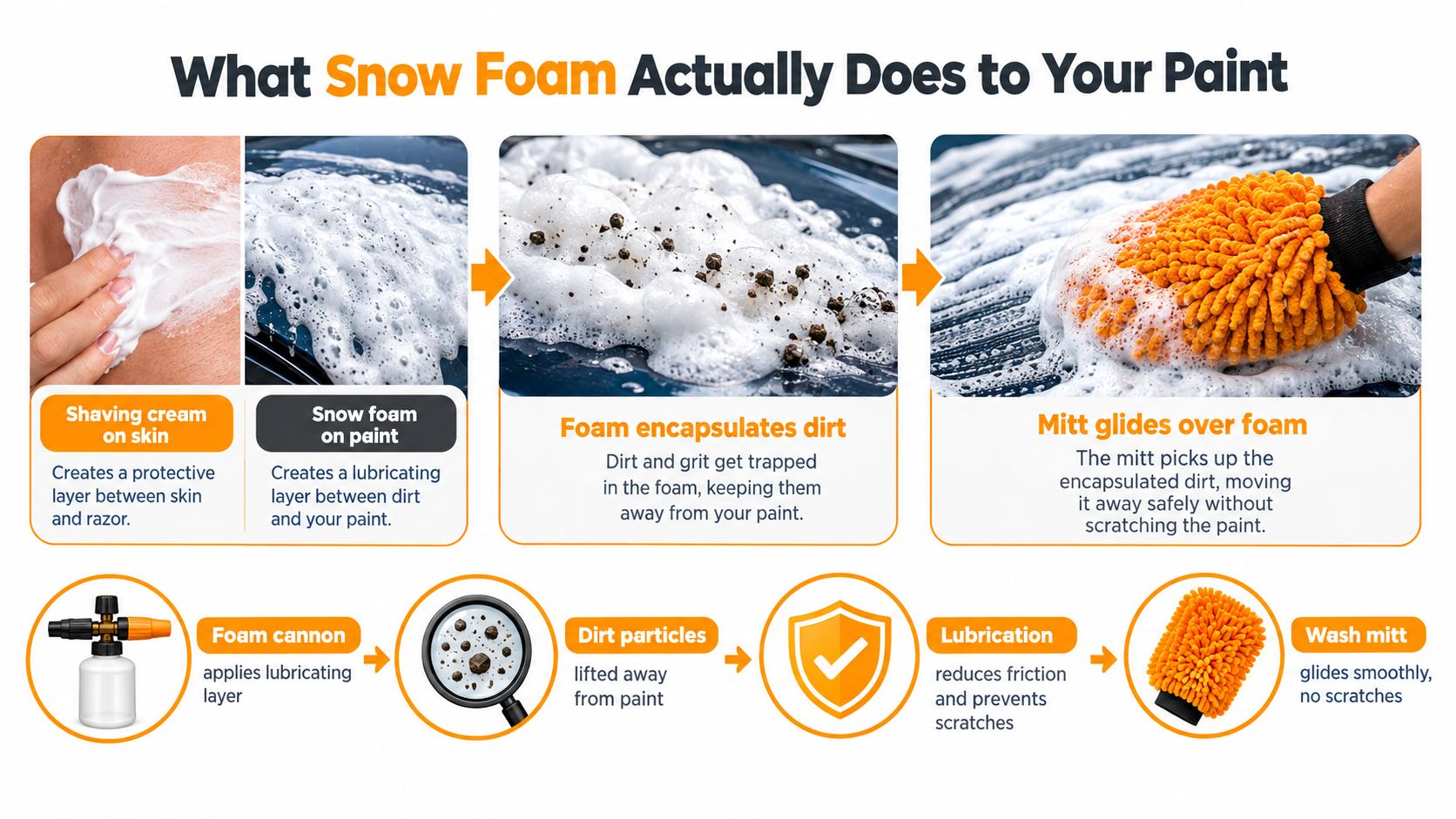
Foam thickness isn't the same as cleaning power
A dense, shaving-cream appearance looks impressive, but it does not reliably indicate stronger cleaning. A thinner film that clings to vertical panels may soften contamination more effectively than a thick blanket that slides off or dries before rinsing.
Product guidance commonly places useful dwell time within roughly 3–5 minutes, while other guidance describes a broader working range of about 1–10 minutes, provided the product does not dry on the paint. Nanolex's pre-wash foam guidance supports the practical conclusion: the film needs enough contact time to work, while evaporation must not leave residue behind. Dwell time therefore has a working limit, not a simple “longer is better” relationship.
It handles different contamination in different ways
Depending on its formulation, foam can soften oily road film, bug residue, and other organic material. It can also wet and lift inorganic dust and loose grit, allowing the rinse to remove part of the contamination without direct contact.
That difference sets a useful boundary. Snow foam performs best on dusty to moderately dirty vehicles, where loose contamination can be softened and flushed away. Bonded contaminants usually remain and require another cleaning method. Carclean's explanation of foams and pre-washes describes the relevant mechanism: rinsing loosened contamination before the mitt touches the paint reduces the amount of trapped grit that can create wash marring.
Practical rule: Judge snow foam by the cleanliness of the rinse water and the reduced need for aggressive mitt passes, not by the height of the foam blanket.
The Measurable Benefits That Justify the Step
Snow foam earns its place through abrasion control, not through the appearance of a thick blanket. Detailing guidance describes pre-wash foam as capable of reducing the dirt load before hand washing by 60–80%, depending on contamination and dwell time. Another source claims that correct use can reduce swirl marks by up to 70%. Those figures are process-dependent benchmarks, not universal results for every product, vehicle, or operator. Car Detailing's comparison of snow foam and shampoo provides the comparison, but the technique determines whether the potential benefit appears in practice.
The underlying mechanism is more dependable than either headline percentage. Foam softens loose contamination, surrounds particles, and gives the pressure rinse an opportunity to remove part of the abrasive load before a mitt reaches the paint. The result matters most on lower doors, sills, bumpers, and panels beside the wheels, where road film commonly collects.
The contact wash becomes a lower-risk operation
A proper wash still requires contact. Snow foam changes the surface conditions before that contact begins. With less loose grit remaining, the mitt has less material to trap, drag, and press against the clear coat.
The benefit is cumulative, especially for owners maintaining dark paint or polished classic cars. Reducing unnecessary scrubbing can help limit haze and preserve gloss, provided the operator does not compensate by rubbing harder after rinsing. Foam also encourages a consistent sequence: soften first, rinse second, then use shampoo for the contamination that remains.
| Metric | Contact Wash Only | With Snow Foam Pre-Wash |
|---|---|---|
| Loose contamination before mitt contact | More remains on the surface | Guidance describes a potential reduction of 60–80%, depending on conditions |
| Abrasive contact risk | Higher when grit remains trapped | Lower when loosened dirt is rinsed away first |
| Swirl-mark potential | Depends heavily on soil load and technique | One source claims a reduction of up to 70% with correct use |
| Cleaning completeness | Requires shampoo and mechanical action | Still requires shampoo and mechanical action |
| Best application | Light to heavy washing, with careful technique | Most useful on dusty or moderately contaminated paint |
The product itself affects the result. Choosing a formula suited to the vehicle's soil level and equipment is more useful than selecting foam by thickness alone. This guide to foam soap for cars can help compare product characteristics before testing one on a daily driver or show car.
Efficiency is secondary, but still real
Foam can reduce hand scrubbing on panels carrying loose road film and may improve rinse-off, leaving a cleaner surface for drying. The size of that gain varies with formulation, dilution, water quality, pressure, and application equipment.
The financial value therefore comes mainly from reducing paint-damage risk, not from removing labor altogether. If the operator still rubs every panel aggressively after foaming, poor technique has erased the step's main measurable advantage.
The Honest Trade-Offs in Time, Water, and Money
Snow foam is an added process, not a shortcut. Connecting the equipment, mixing the product, applying it, allowing dwell time, rinsing thoroughly, and then completing the contact wash all take time. On a lightly dusty car, a careful rinse and wash may achieve the needed result with less preparation.
Cost varies because dosing varies. Neutral foam-cannon mixtures may fall around 1:20 to 1:50, while other products call for roughly 20–30 ml per litre in a sprayer or substantially heavier concentrations, including 100–200 ml per litre, depending on the formula and soil level. Parker's overview of snow foam use and dosing variability
A decision grid for the practical trade-off
| Factor | Cost / Time Added | Measurable Benefit |
|---|---|---|
| Product mixing | Extra preparation before washing | Consistent coverage when dilution matches the product |
| Foam application | Adds a separate pre-wash stage | Loosens contamination before contact cleaning |
| Dwell period | Often around 3–5 minutes when the foam remains wet | Gives surfactants time to soften and suspend loose dirt |
| Rinsing | Requires another thorough rinse | Removes loosened particles before the mitt arrives |
| Equipment | Requires a suitable foam gun or cannon | Improves coverage compared with a narrow spray pattern |
| Product selection | Dosing and performance differ by formulation | Allows chemistry to match routine maintenance or heavier contamination |
Dwell time only creates value when the foam stays wet. Guidance on snow foam also indicates that the product may leave dirt behind when coverage, chemistry, or rinsing is poorly matched to the vehicle's condition. The added stage therefore has a measurable purpose, but poor setup can reduce its return.
Owners who wash infrequently may see little practical benefit. If the car is usually clean and protected, extra preparation can outweigh the contamination removed.
Frequent washers face a stronger case because the same friction-reduction step can be repeated whenever the vehicle carries dust, pollen, traffic film, or damp road residue. A lower-water process can also suit owners without a full pressure-washer setup. This low-water car wash guide offers a useful comparison for matching the method to available equipment and water use.
The financial value comes mainly from lowering paint-damage risk, not eliminating labor. If the operator still scrubs every panel aggressively, the technique has cancelled much of the foam stage's advantage.
The break-even question is personal: does preserving the finish matter more than minimizing each individual wash? For a show car, coated daily driver, or frequently washed dark vehicle, the answer is often yes. For a lightly used car stored indoors, it may not be.
How to Use Snow Foam the Right Way
Technique determines whether snow foam reduces friction or creates more work. The product must remain wet, match the contamination, and be rinsed before contact washing. A hot panel, incorrect dilution, or dried residue can erase much of the intended benefit.
Build the process around friction reduction
- Pre-rinse first. Remove loose grit with water before applying the chemical product. This leaves the foam to work on the remaining film and reduces the chance of dragging larger particles across the paint later.
- Mix for the equipment and product. The guidance here includes roughly 1:20 to 1:50 for foam-cannon use, but dilution varies by formulation and sprayer. A stronger mixture does not automatically clean better or protect the finish.
- Apply from bottom to top. Lower panels commonly hold more road film, so bottom-up coverage gives those areas an even coating. Consistent coverage matters more than producing the thickest possible blanket. An auto foam cannon can suit owners who want controlled application, while other sprayers may fit different equipment.
- Allow a short dwell. A practical dwell period is around 3–5 minutes, only while the foam remains wet. On warm panels or in direct sun, rinse sooner. Evaporation shortens the working time and can leave residue behind.
- Rinse from top to bottom. Begin with the cleaner upper areas and move loosened contamination downward and away from the vehicle. The foam and suspended dirt should be fully rinsed off before a mitt touches the paint.
- Complete the contact wash. Use shampoo, a clean mitt, and a sensible two-bucket process. Snow foam reduces the abrasive load, but it does not replace mechanical cleaning where bonded or remaining contamination needs contact.
Match the chemistry to the finish
A pH-neutral foam is a sensible starting point for routine maintenance and protected vehicles. Stronger or mildly alkaline products may suit neglected paint and heavier road film, but their compatibility with existing protection requires consideration. Hygiene Supplies Direct's maintenance guidance links the starting contamination to the choice between neutral foam, a stronger pre-wash, and additional rinsing.
Avoid direct sun and hot panels. The useful test is whether the product stays wet and controllable, not whether the surface reaches a particular temperature. Once the foam dries, its dwell time has effectively ended.
Tool choice changes coverage and handling, not the underlying method. Pressure-washer cannons, hose-connected options, and other sprayers can all work when the operator controls dilution, dwell, and rinsing. Snow foam is a lubricant first and a cleaner second, so the value comes from lowering friction before the wash mitt arrives.
Who Gets the Most Value From Snow Foam
The daily driver parked beneath trees is an obvious candidate. Pollen, dust, sap, and road film create a mixed contamination load that can turn a harmless-looking wash into a high-friction event. A regular pre-wash gives the owner a safer starting point, especially when the vehicle has a ceramic coating or a dark finish where haze and marring are easier to notice.
A professional detailer preparing a black car for paint correction has a different reason to use foam. The detailer isn't trying to make the car perfect with foam alone. They're trying to remove as much loose abrasive contamination as possible before the decontamination and polishing stages, so the correction process starts with a cleaner, safer surface.
The RV owner gains through coverage and access. Long panels, lower sections, road film, and awkward ladder work make aggressive brushing a poor substitute for a controlled pre-wash. Foam can cover broad areas quickly and soften the film before the operator reaches for a brush or mitt, although the final result still depends on rinsing and contact cleaning.
Where the calculation weakens
A garage-kept weekend car in a dry climate may carry very little loose contamination between washes. If the owner inspects the surface, uses a careful rinse, and maintains the finish with minimal contact, foam may add ceremony without adding much protection.
The same applies to an owner who uses foam as a visual shortcut. A vehicle can look clean after rinsing while still carrying bonded grime that requires shampoo, clay, or another appropriate decontamination method. The best candidates are therefore not people who like thick foam. They're owners who regularly face abrasive contamination and care about controlling contact.
Common Mistakes That Make Snow Foam Feel Pointless
Thicker foam doesn't equal a cleaner car. Foam height depends on product chemistry, equipment, water, and air mixing. A clingy layer that stays wet and reaches the lower panels can outperform a thick layer that collapses quickly or slides away.
The most damaging mistake is allowing product to dry. Heat and direct sunlight shorten the working window, and dried residue can leave the operator with more cleanup rather than less. Work in shade, keep panels cool, and rinse while the foam remains wet.
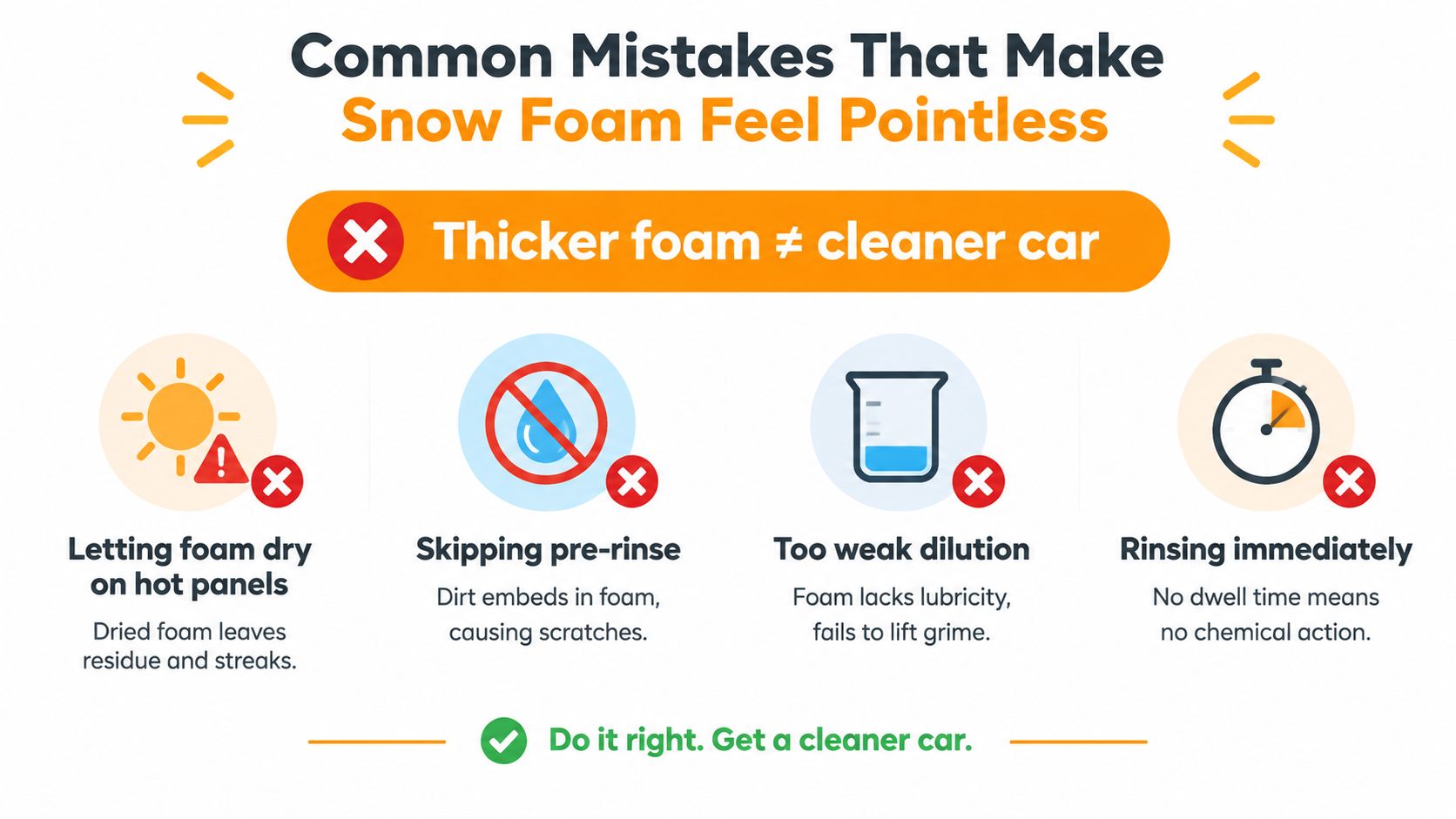
The errors that undermine the chemistry
- Skipping the pre-rinse. Large grit can remain in place beneath the foam. Rinse first so the product can focus on softening and suspending what remains.
- Using the wrong dilution. Too weak may provide little lubrication, while excessive product can raise cost and create unnecessary residue. Follow the formulation's instructions rather than copying a ratio from another bottle.
- Rinsing immediately. The surfactant film needs contact time. Useful applications commonly cite around 3–5 minutes, but the product must not dry during that period. Independent snow foam guidance
- Skipping the contact wash. Foam removes loose contamination, not every bonded mark or traffic-film deposit. Finish with shampoo and a clean mitt.
- Choosing aggressive chemistry for routine maintenance. A high-strength pre-wash may be appropriate for neglected paint, but neutral foam is generally the safer maintenance choice for protected surfaces.
Hard water can add another problem by leaving mineral residue during drying. If the rinse water is mineral-heavy, work efficiently, dry carefully, and avoid allowing any wash product to sit on the surface.
Final Verdict and Quick Answers for Busy Owners
Snow foam makes the most sense for frequent washers, dusty-climate daily drivers, dark paint, coated vehicles, RVs, and professional detailers. Monthly washers can still use it, but the added stage may not justify the equipment and product cost. Weekend hobbyists with clean storage and a lightly contaminated car can safely skip it if their contact-wash technique is disciplined.
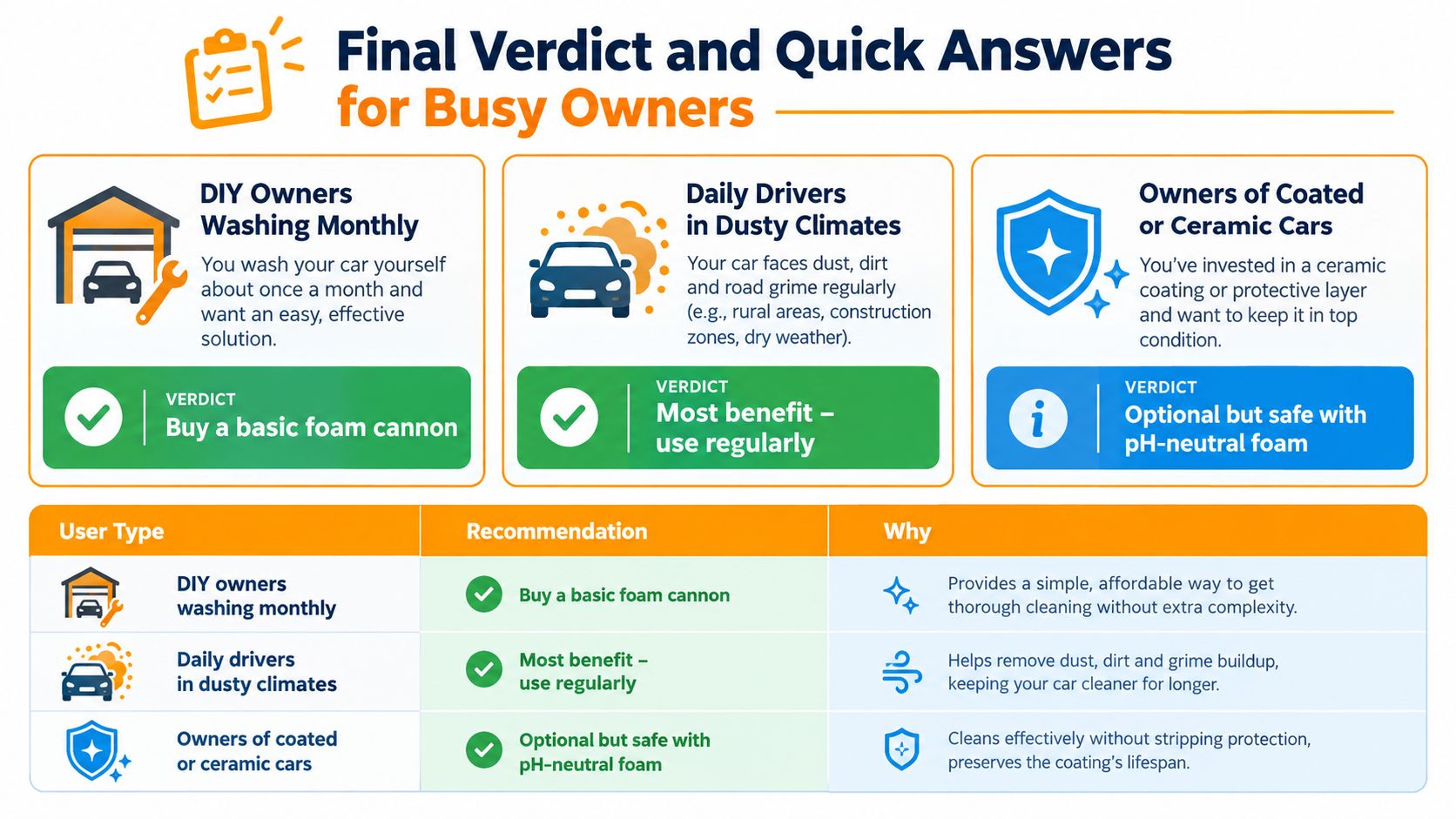
Quick answers
- Does snow foam replace washing? No. It's a pre-wash.
- Can it remove wax? Chemistry varies. Neutral foam is intended for maintenance, while stronger alkaline formulas can affect existing protection.
- Can you use it every wash? Yes, when the process and product suit the vehicle.
- Is it safe on ceramic coatings? Neutral-pH foam is the appropriate maintenance choice.
- Does it work with a garden hose? Hose-connected foam guns and pressure-washer systems use different equipment, so follow the tool's requirements.
Verdict: snow foam is worth it when it reduces abrasive contact on a frequently contaminated vehicle, but it isn't worth buying merely to create thicker suds.
If you want to add a controlled pre-wash to your routine without building a complex setup, visit SwiftJet to explore a hose-connected foam gun designed for applying car wash foam before the contact wash. Choose your tool based on your vehicle, water access, and washing habits, then use the same disciplined rinse, dwell, and mitt process described above.
