

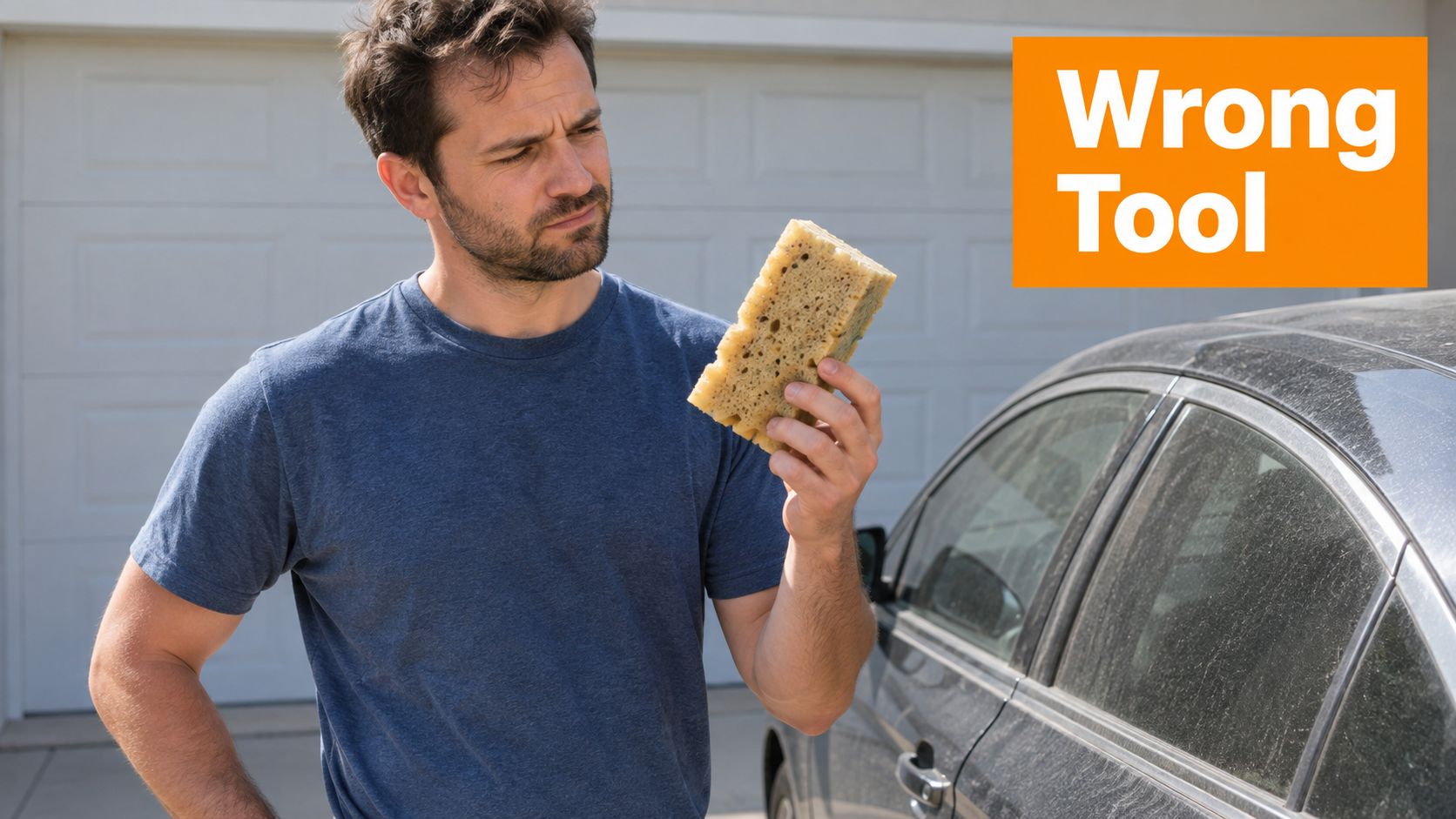
You're standing beside a dusty sedan with a bucket of soapy water, ready to give it the careful wash it deserves. Then you notice the only convenient tool nearby is a kitchen sponge. It seems harmless, but its flat surface can hold grit against the paint instead of lifting that grit away. A chenille microfiber wash mitt is designed for this exact moment, with a hand-shaped form and thousands of fine fibers that carry suds while drawing loose particles into the pile.
The difference isn't about washing faster or scrubbing harder. It's about controlling what touches the clear coat, how much lubrication sits between the tool and the paint, and where dirt goes after the mitt picks it up. If you're building a reliable home-wash routine, resources such as the VIP Car Wash homepage can complement your own learning, but the mitt and the technique still determine how safely you make contact.
The aim isn't a flawless professional detail on your first attempt. It's a safer first pass, followed by a repeatable system that keeps contamination away from the paint and keeps the mitt usable for the next wash.
The First Wash That Actually Matters
A sponge creates a familiar trap. You wet it, add soap, press it against the door, and start wiping. Its broad, relatively flat face gives grit fewer places to move, so particles can remain between the sponge and the paint while your hand pushes them along.
A chenille mitt changes that contact point. The mitt's long microfiber strands form soft, finger-like projections that load with wash solution and surround loose debris. Instead of treating the tool like a scrub pad, you let the wet pile glide lightly across the panel and allow the fibers to do the gathering.
Start with the tool, not the pressure
The first useful habit is simple: never try to compensate for a poor tool by pressing harder. Extra pressure forces whatever contamination remains on the surface into the clear coat. A plush mitt gives you more room to work gently because its fiber volume can carry lubrication and provide a buffer between your hand and the panel.
You'll still need a pre-rinse, a suitable wash solution, and a clean rinse process. The mitt doesn't make careless washing safe by itself. It gives the rest of your routine a better contact surface.
Practical rule: If a tool feels rough, flattened, contaminated, or difficult to rinse clean, retire it from painted panels rather than hoping more soap will solve the problem.
This guide follows the mitt from construction to technique. You'll see why the chenille “noodles” act as a debris trap, how a foam gun fits into the sequence, and which maintenance habits preserve the fibers. Once the process becomes familiar, washing stops feeling like a risky chore and starts feeling like controlled paint care.
What a Chenille Microfiber Wash Mitt Actually Is
A chenille microfiber wash mitt is a glove-shaped cleaning tool made from a synthetic microfiber blend, usually polyester and polyamide. The surface is built from long, twisted strands often called noodles or fingers. Those strands attach to a backing pad, while an elastic or knitted cuff helps keep the mitt secure on your hand.
The common blend ratios include 70/30, 80/20, and 85/15 polyester to polyamide, according to product specifications compiled by The Rag Company's chenille wash mitt listing. Polyester contributes structure and durability, while polyamide generally adds softness and absorbency. A higher polyamide share can make the material feel more plush, though the exact feel also depends on pile design and fabric density.
Understanding GSM without overcomplicating it
GSM means grams per square meter. In practical terms, it describes how much material is packed into a given area of fabric. A denser mitt usually has more fiber volume available to hold liquid and cushion contact. Some premium chenille mitts are listed at 1,000 GSM or 1,500 GSM, while product dimensions commonly sit around 8 x 10 inches to 10 x 8 inches, as shown in the specifications reviewed by Microfiber Madness IncrediMitt.
Think of a stiff brush dropped into a pile of sand. The grains sit on the bristles and flick around as the brush moves. Now replace that brush with a dense bundle of soft microfiber noodles. A grain can settle deeper into the pile, away from the paint-facing tips, where rinsing can help release it.
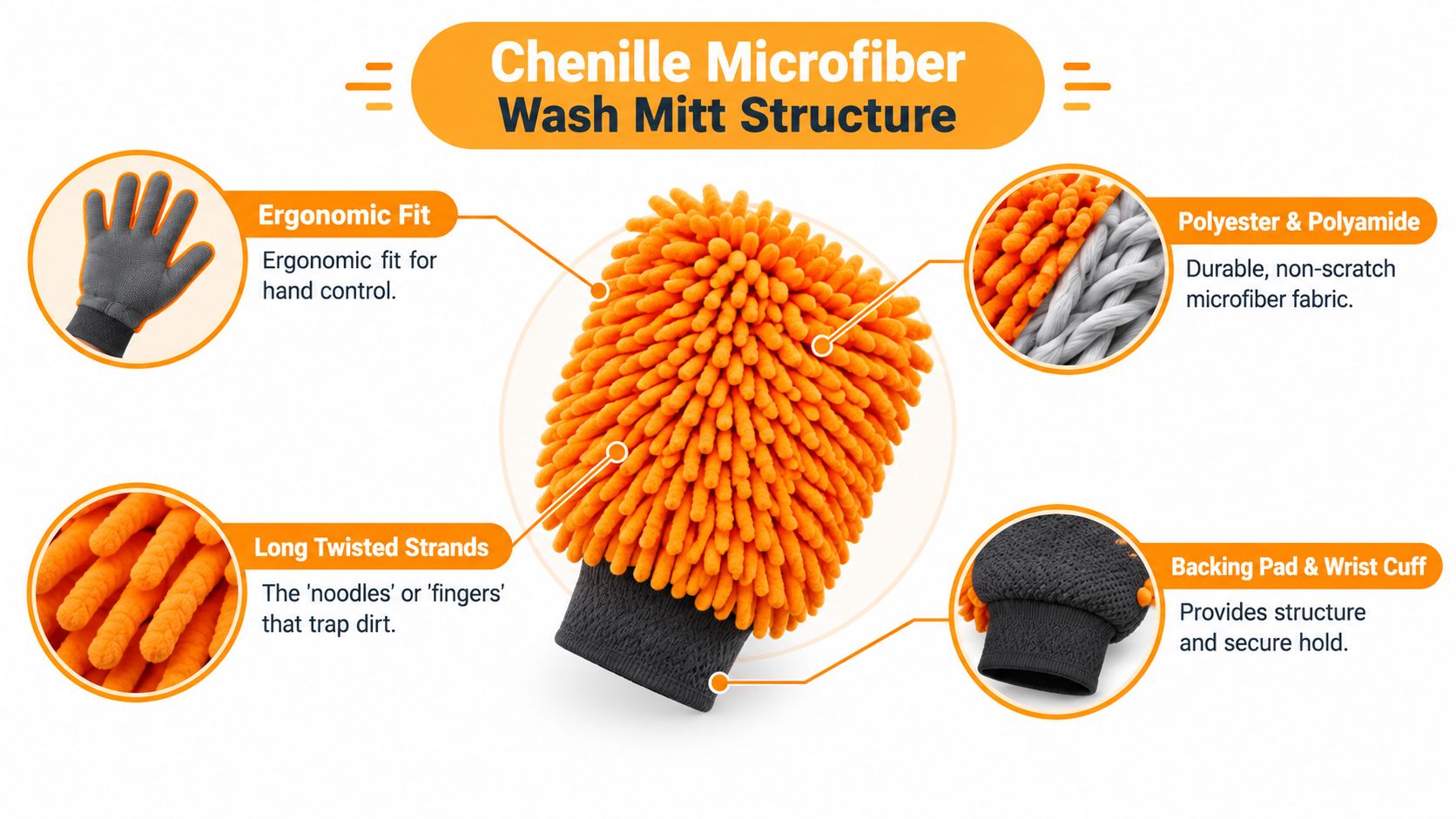
The cuff and inner liner matter, too. A mitt that stays on your hand helps you keep pressure even during overhead passes, rather than bunching up or slipping toward the fingertips. That control makes a gentle technique easier to maintain.
Why the Noodle Construction Beats a Sponge
The chenille surface works because it combines several useful behaviors in one contact tool. The strands hold wash solution, increase the available fiber surface, collect particles into the pile, and spread your hand's force over a broader area.
Independent product information reports absorbency around 5.8 ounces per square foot and water retention of about six times the mitt's own weight, while higher-quality versions may be marketed at seven or eleven times their weight. These figures come from the ROC Goods explanation of chenille car-washing mitts. Treat them as product-category guidance rather than a guarantee for every mitt.
Four contact advantages
Lubrication comes first. The noodles carry soapy water onto the panel, creating a wet film that helps the mitt glide. A squeezed-out sponge can leave a thinner, less consistent layer, which encourages dry dragging.
Absorption keeps the tool loaded. A dense pile can hold a substantial reservoir of wash solution, so you're not forced to return to the bucket after every small movement. That doesn't mean you should wash an entire vehicle without rinsing. It means the mitt can remain wet and lubricated while you work one controlled area.
Debris capture changes where grit travels. A particle caught inside the pile is less likely to remain pressed directly against the paint than one trapped between a flat sponge and the panel. The fibers don't eliminate contamination, but they give it somewhere to move.
Gentle pressure protects the surface. Long strands conform to curves, creases, and body lines. Your hand's force spreads through the pile rather than concentrating at a hard, flat edge.
| Feature | Kitchen Sponge | Chenille Microfiber Wash Mitt |
|---|---|---|
| Contact surface | Broad and relatively flat | Long, plush microfiber strands |
| Liquid behavior | Holds solution, but can lose lubrication as it compresses | Designed to retain wash solution within the pile |
| Debris path | Grit can remain between the face and paint | Particles can settle deeper among the noodles |
| Hand control | Can slide or fold during passes | Cuff and liner keep the glove positioned |
| Best use in paint washing | A poor choice for contaminated exterior paint | Built for lubricated, careful contact washing |
The mitt is still only one part of the system. If you place it on dry, heavily contaminated paint or never rinse it, the construction can't prevent every mistake.
How to Use It With a Foam Gun Step by Step
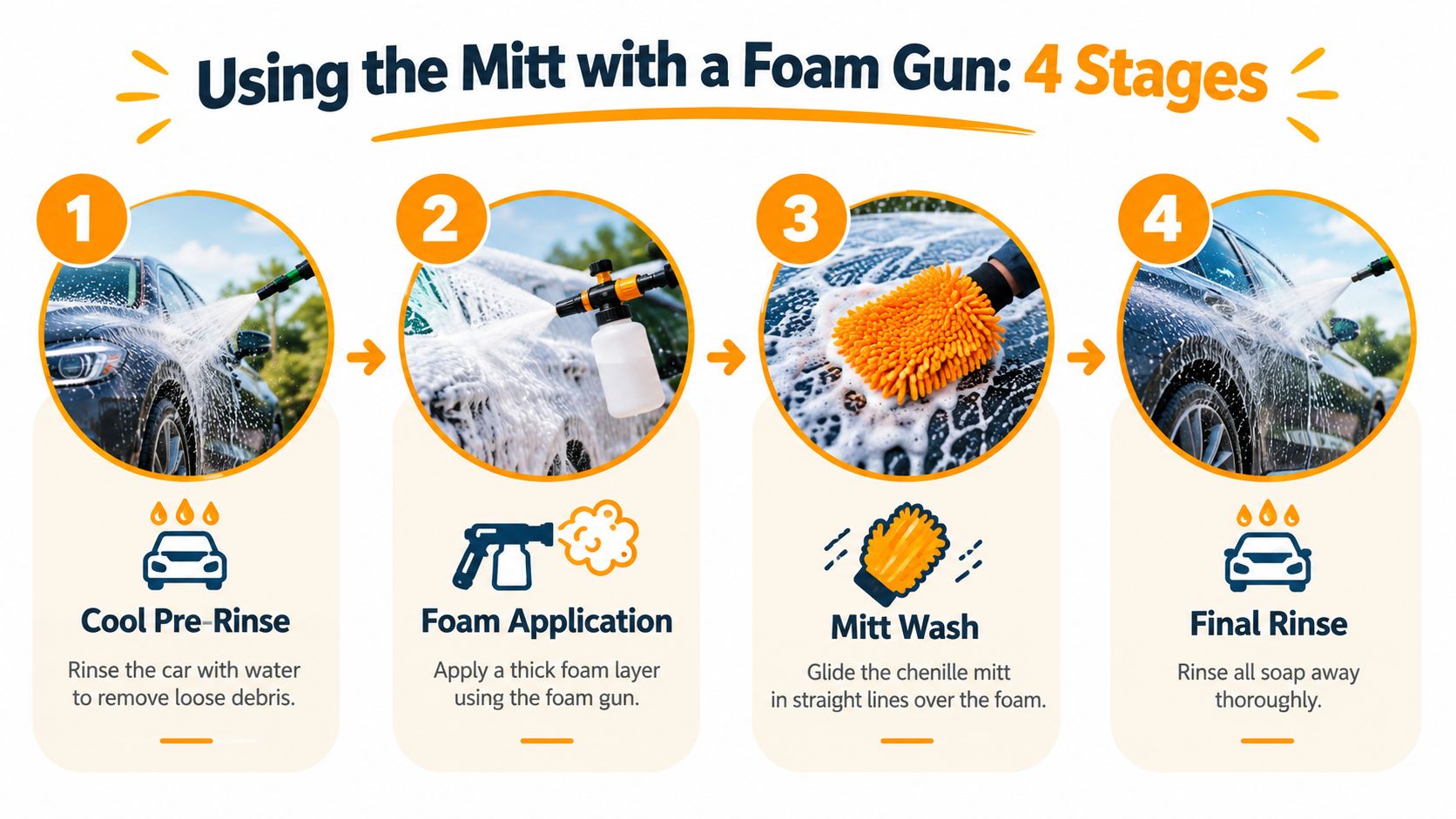
A foam gun such as SwiftJet belongs before and around the contact wash, not after it. Its job is to apply a layer of cleaning solution that helps loosen surface contamination before the mitt makes direct contact.
Stage one, pre-rinse before touching paint
Start with cool water and a pressure-free rinse. Work from the roof downward, allowing loose dust and grit to run off the vehicle instead of letting your mitt collect it during the first stroke.
Don't rush this stage. A pre-rinse reduces the amount of loose material waiting on the paint, which gives the mitt less contamination to manage later. Pay attention to mirrors, panel gaps, rocker panels, and the lower edges of doors, where dirt often gathers.
Stage two, apply foam and allow dwell time
Set the foam gun for a thick, clinging layer rather than a watery spray. Cover the vehicle methodically, then let the foam sit long enough to loosen bonded grime without allowing it to dry on the surface.
Foam isn't a replacement for the mitt. It's a way to make the contact stage more controlled by softening and surrounding contamination first. For setup details, see this guide to using a foam gun.
Stage three, wash one panel at a time
Prepare a soap bucket and a separate clean-water rinse bucket, ideally with grit guards. Load the mitt with solution, then begin at the cleanest upper surfaces. Move in straight-line passes, not circles, using light hand pressure.
A practical order is roof, glass, hood, upper doors, trunk, lower doors, and rocker panels. Rinse the mitt after each panel, working it against the rinse guard or water to release sediment before returning it to the soap. Keep the mitt on foamy, lubricated paint, and stop if a panel dries before you finish it.
Keep the lower areas last. They usually carry heavier contamination, so washing them earlier can move that contamination onto cleaner sections.
Stage four, rinse and dry without reintroducing risk
Sheet clean water over the vehicle from top to bottom, making sure soap leaves panel gaps, trim edges, and mirrors. Then use forced air or a clean waffle-weave drying towel, again with light, straight passes.
The drying stage deserves the same care as the wash. A clean surface can still pick up marring if a dirty towel or circular rubbing introduces unnecessary contact.
Washing and Maintaining the Mitt for the Long Run
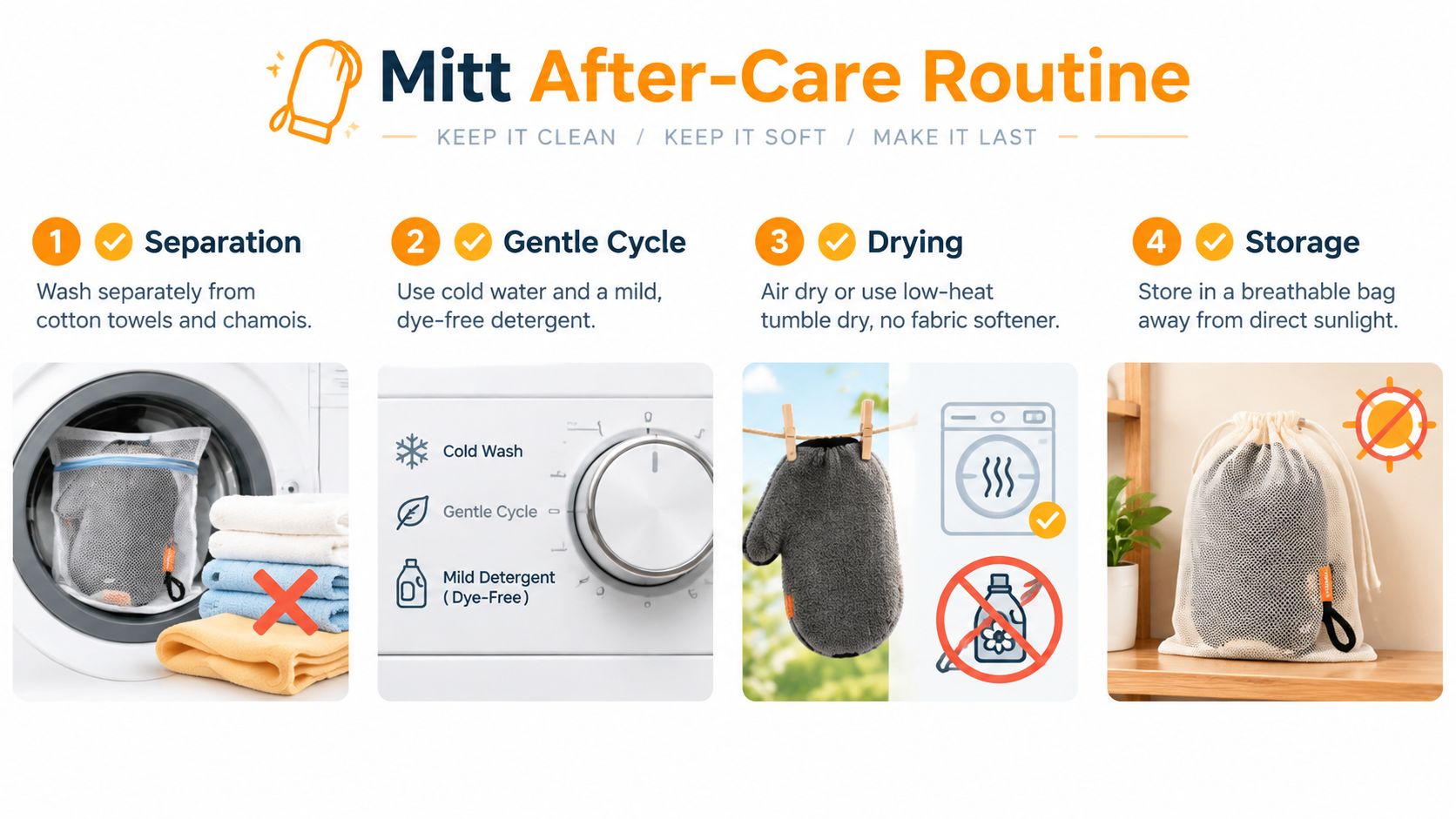
A mitt can perform well during the wash and still become a problem if you launder it carelessly. Microfiber should have its own cleaning routine because cotton, chamois, and lint-producing fabrics can leave fibers behind or transfer contamination into the pile.
The microfiber towel care guide from SwiftJet reinforces the same separation principle that applies to wash mitts. Keep the mitt away from fabric softener and bleach, both of which can interfere with the material's performance.
The wash-after-the-wash routine
Shake out loose debris, then place the mitt in a separate load. Use a liquid detergent rather than a pod, and choose a gentle cycle with cool water. Fabric softener can coat the fibers with a residue that reduces absorbency, while bleach can weaken the material.
Dry the mitt on low heat or air-dry it on a rack. High heat can damage synthetic fibers, especially polyamide strands. Don't store it while damp, because trapped moisture and remaining organic contamination can create a persistent odor.
The Addict Auto care guide notes that proper maintenance can help mitts last two to three times longer than neglected ones. It also recommends separating mitts used on upper bodywork from those used on lower, dirtier sections.
Know when cleaning isn't enough
Retire the mitt from painted surfaces if you notice:
- Persistent odor: A smell that remains after proper laundering suggests contamination is staying inside the fibers.
- Flattened noodles: A collapsed pile offers less cushioning and fewer places for debris to settle.
- Cuff or stitching failure: Loose seams can allow the mitt to shift, bunch, or fall during use.
- A drop on bare concrete: Concrete can embed sharp particles that ordinary laundering may not remove.
A mitt isn't valuable because it lasts forever. It's valuable when you can trust its condition during contact washing.
Common Mistakes That Still Cause Swirls
A premium mitt won't protect paint if the routine keeps feeding it contamination. The most common errors come from treating the vehicle as one uniform surface instead of separating clean areas from dirty ones.
One mitt for every surface
Wheels, rocker panels, lower doors, glass, and upper paint don't carry the same type or amount of contamination. Using one mitt everywhere transfers the dirtiest material into the tool you later place on the roof or hood.
Use a two-mitt or color-coded system. Reserve one mitt for upper painted surfaces and another for wheels and lower panels. If you wash glass separately, give it its own clearly identified tool.
Circular scrubbing
Circular motion feels natural because it seems to cover an area efficiently. It also repeats the same path around any trapped particle, creating a pattern of abrasion that's more difficult to control.
Use straight passes that follow the panel's general length. Keep your pressure light and let lubrication carry the mitt.
Skipping the rinse bucket
A soap bucket alone allows sediment to accumulate in the same solution used to reload the mitt. A dedicated rinse bucket gives contamination a separate place to leave the fibers before the next soap load.
Rinse after each panel, and rinse sooner if the vehicle is heavily soiled. Don't wait until the mitt looks visibly dirty.
Working from the bottom upward
Lower panels often contain more road film and grit. Starting there and moving upward transfers that contamination to cleaner paint, including the roof and hood.
Better sequence: Cleanest surfaces first, dirtiest surfaces last, with a full rinse between panels.
Choosing the Right Mitt for Your Setup
Start with the pile, not the color on the shelf. The market includes mitts around 1,000 GSM and 1,500 GSM, while other products use lighter constructions, so compare the stated fabric density and pile design rather than assuming every chenille mitt performs identically. Higher density generally provides more fiber volume for liquid retention and cushioning, though a thick mitt can also hold more contamination if you don't rinse it carefully.
Blend ratio is the next useful checkpoint. 70/30 and 80/20 polyester-to-polyamide blends are common choices because they balance durability, softness, and absorbency, as documented in the Microfiber Madness IncrediMitt specifications. A budget mitt made entirely from polyester may feel slick and durable, but the construction still matters more than a single label.
Match the mitt to your workflow
Look for an elastic or knitted cuff that stays secure during roof passes. A loose cuff makes it easier to drop the mitt, touch a dirty surface, or lose control while reaching across a panel.
Color coding helps prevent cross-contamination. Use distinct mitts for paint, wheels, glass, and lower trim, then store them separately so the assignments remain obvious.
A dense, two-tone mitt pairs naturally with a hose-connected foam gun such as SwiftJet, while a thinner mitt may suit a foam-spray bottle workflow where you're applying smaller amounts of solution by hand. For more buying criteria, this microfiber wash mitt selection guide is a useful reference.
Avoid mitts with rough backing exposed through the pile, weak cuff stitching, shedding fibers, or unclear care instructions. A low price doesn't compensate for a surface you can't trust on paint.
Putting It All Together for a Safer Wash
The chenille microfiber wash mitt works best as part of a foam-first, two-bucket process, not as a standalone shortcut. Pre-rinse the vehicle, apply foam, allow it to dwell, then wash from the roof downward with straight passes. Rinse the mitt between panels, finish with a thorough rinse, and dry using a clean waffle-weave towel or controlled forced air.
Keep the wheels and lower panels separate from upper paint with a second mitt. Use a grit-guard rinse bucket, avoid circular motion, and replace any mitt that snags, sheds, smells persistently, has flattened noodles, or has touched dirty concrete.
Your next wash can follow four simple rules:
- Pre-soak with foam: Reduce loose contamination before the mitt touches paint.
- Change mitt sections frequently: Rinse after every panel and sooner when the pile collects visible debris.
- Launder mitts separately: Keep them away from cotton, softener, bleach, and excessive heat.
- Retire damaged fibers: Don't ask a worn mitt to protect a surface it can no longer safely cushion.
Fewer particles carried into the contact stage means less correction work later. Good washing won't remove every imperfection, but it can keep a routine cleaning session from becoming the source of new ones.
SwiftJet offers a garden-hose foam gun that applies thick cleaning foam before contact washing, and its package includes a microfiber wash mitt for a coordinated setup. Visit SwiftJet to review the foam gun and build a more controlled pre-rinse, foam, mitt-wash routine for your next vehicle wash.
