

You wash the car carefully, rinse it well, and step back thinking you're done. Then ten minutes later, water creeps out of the mirror caps, the grille, the fuel door, and every trim seam you forgot was there. By the time it dries, the finish has fresh spots and little drip trails down the paint.
That's the moment you realize towel drying only gets the surface water. It doesn't deal with the water hiding in badges, lug holes, weatherstripping, emblems, and body gaps. In a workshop, it's the same story with dust and debris. A rag smears it around. An open air hose blasts too wide and wastes air. You need control.
An air blower gun is the tool many detailers and mechanics reach for when they want to move water or debris exactly where they want, without touching the surface. Used well, it helps dry delicate areas, clear tight spaces, and cut down on the scratching that can happen when you keep wiping a car that should already be dry.
The Pro Secret to a Spotless Finish
The first time you use an air blower gun after a wash, the difference is obvious. You point it at the mirror housing and water pours out. You run it along the window trim and another hidden line appears. You hit the grille, fuel filler area, door handles, and wheel hardware, and suddenly all the places that usually drip onto clean paint are empty.
That's why detailers like these tools so much. They don't just dry a car. They chase trapped water out of problem areas before it has a chance to come back and ruin the finish.
Why towels alone miss the real problem
A drying towel works on open, flat panels. Hood, roof, doors, trunk. It struggles in the places where modern cars hide water:
- Mirror caps and housings collect rinse water behind edges.
- Badges and trim trap moisture in small recesses.
- Grilles and vents hold water deeper than a towel can reach.
- Wheel details like lug recesses and calipers keep dripping after the wash.
On dark paint, those leftover drips stand out fast. On coated cars, they're especially annoying because the broad panels may already be almost dry while the hidden areas still keep leaking.
Practical rule: If a part has a seam, a cavity, or a decorative recess, it probably holds more water than you think.
It's not just for car detailing
The same habit carries over into home and workshop jobs. After rinsing a tool, cleaning a part, or clearing dust from a bench area, a focused stream of air often works better than wiping with a dirty cloth. It's a simple tool, but it solves a very specific problem. Targeted drying and targeted cleaning.
That's the secret. The air blower gun isn't magic. It just gives you control over air in the same way a good nozzle gives you control over water.
What Is an Air Blower Gun and How Does It Work
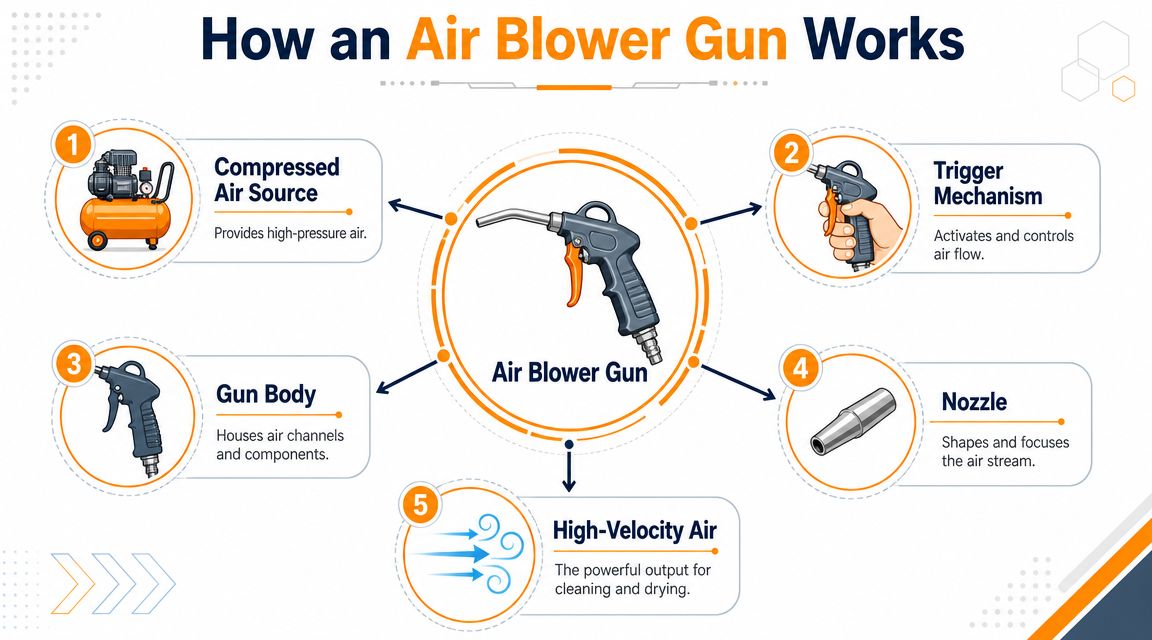
An air blower gun is a manually operated compressed-air tool that turns stored air from a compressor into a focused jet for cleaning, purging, or drying. According to GlobalSpec's overview of air blow guns, the key technical variables are the inlet pressure rating and air-line connection type, because those affect exit velocity and flow stability at the nozzle.
The simple way to picture it
Think of blowing air through a straw. Your breath doesn't change much, but the straw focuses it into a narrower stream. That narrow stream feels stronger because it's concentrated.
An air blower gun does the same thing, but with compressed air and a purpose-built nozzle. That's why it's more effective than waving an open hose around. The tool shapes the airflow instead of dumping it.
The parts that matter
Most air blower guns are simple to understand once you break them into pieces:
| Part | What it does | Why it matters |
|---|---|---|
| Body | Holds the internal air passage | Gives the tool its shape and grip |
| Trigger | Starts and controls airflow | Helps you meter air instead of blasting full force every time |
| Air inlet | Connects to your air hose | Must match your setup for steady delivery |
| Nozzle | Shapes the outgoing stream | Changes reach, force, and pattern |
| Handle or grip area | Supports control during use | Reduces fatigue during longer jobs |
The nozzle is where much of the tool's behavior is decided. A narrow nozzle creates a more concentrated stream. A wider pattern covers more area but hits with less focused force. That tradeoff is why a good air blower gun feels precise while a bare hose feels sloppy.
Why it works better than an open hose
A lot of beginners assume more compressor pressure automatically means better cleaning. In practice, the tool's design matters just as much. Stable airflow, the right connection, and the right nozzle shape make the stream easier to place and easier to control.
A focused nozzle increases jet velocity and cleaning force, while a broader pattern trades force for coverage.
That's the main idea to remember. An air blower gun isn't just “air, but louder.” It's a way to direct compressed air so it does useful work at the exact point you need.
Common Types and Essential Specifications
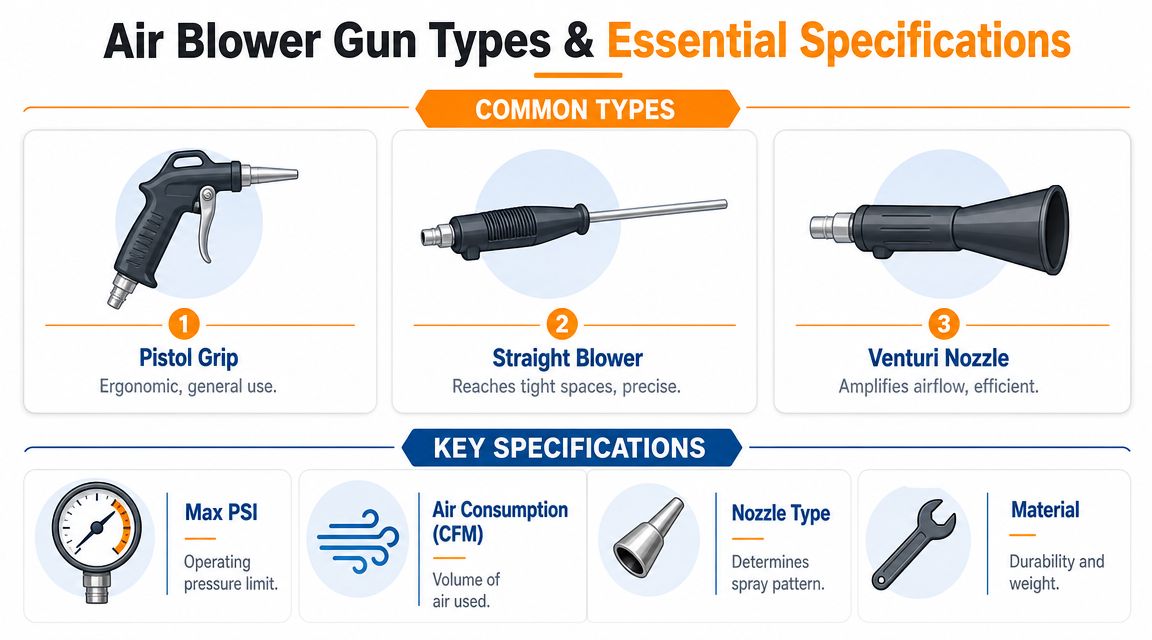
Walk through any tool supplier's catalog and you'll see that not every air blower gun is built for the same job. Some are compact and general-purpose. Others are made to snake around engine parts or reach behind brackets. The best choice depends less on “most powerful” and more on where the air has to go.
Nozzle shape changes the job
Workshop Stock Direct's right-angle blow gun listing highlights something many buyers overlook. Access geometry can matter more than brute force. Bent and extended nozzles can reduce wrist strain and improve control in hard-to-reach spaces.
Here's how that plays out in real use:
- Short straight nozzles work well for bench cleaning, quick drying, and broad access areas.
- Long-reach wands help when the target sits deep inside an engine bay, behind a wheel barrel, or under trim edges.
- Right-angle or bent nozzles let you aim around corners without twisting your wrist into awkward positions.
If you've ever tried drying behind a grille or around brake components with a stubby nozzle, you already know the problem. You're fighting the tool instead of cleaning with it.
The specs buyers usually misread
People often focus on PSI and CFM because those are easy numbers to compare on product listings. They matter, but they don't tell the whole story on their own.
A better way to think about specs is this:
PSI
This tells you the operating pressure range the tool is designed to handle. It matters for compatibility and safe operation. It does not guarantee a useful spray pattern.
CFM
This refers to air consumption. It matters because your compressor has to keep up. A gun that consumes air faster than your compressor can supply it may feel weak in actual use, even if the listing looks impressive.
Nozzle type
This is often the deciding factor for detailing and workshop work. A narrow precision nozzle behaves differently from a venturi-style nozzle or a broad-tip design.
Material and ergonomics
A tool that feels cheap in the hand usually gets tiring fast. Trigger feel, body shape, and overall balance matter more than many buyers expect, especially if you're drying an entire vehicle.
Buy for the space you need to reach, not just the pressure your compressor can make.
Matching type to task
If your work is mostly car drying, trim gaps, mirrors, wheels, and occasional engine-bay cleanup, a general-purpose pistol-grip model with good trigger control is often the easiest starting point. If you spend more time around chassis parts, suspension areas, or machinery with deep recesses, a long or angled design can be the smarter choice.
The important takeaway is simple. The best air blower gun is the one that lets you place the air exactly where the job demands it.
Top Uses for Auto Detailing and Home Maintenance
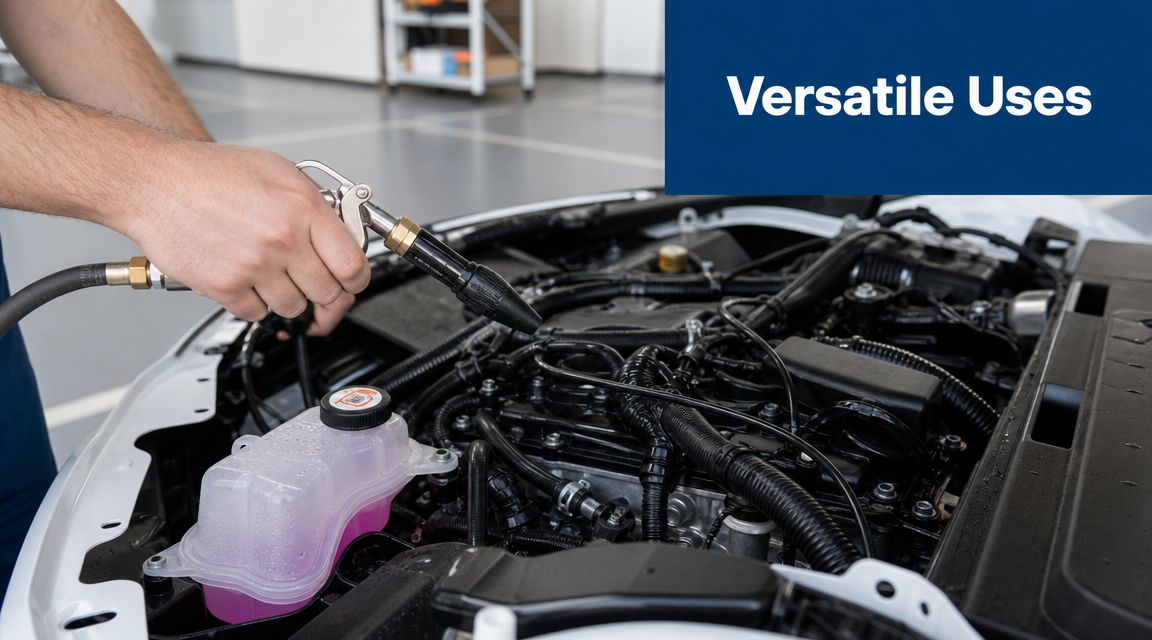
In detailing, the air blower gun earns its keep right after the rinse. That's when the easy water is gone and the stubborn water starts hiding. You can towel the hood and roof in seconds, but the water in mirror caps, grilles, badges, lug recesses, and window trim will wait until you think you're done.
Where it shines on vehicles
A few passes in the right spots can save a lot of frustration later.
-
Panel gaps and trim edges
Blow water out before it dribbles down clean paint. -
Grilles, badges, and emblems
These areas love to hold rinse water in tiny pockets. -
Wheels and brake areas
Air helps clear standing water from wheel details without rubbing grime across the finish. -
Engine bay touch-up cleaning
For dry dust and loose debris, a controlled air stream is useful around covers, brackets, and hard-to-reach corners. If you want a fuller walkthrough on that job, this guide on the best way to clean an engine bay is a helpful companion.
A detailer's habit that saves paint
When I dry a vehicle, I don't start with the towel anymore. I start with air on the problem zones, then use the towel only on the open panels. That changes the job from “wipe until every drip stops” to “remove trapped water first, then finish lightly.”
That matters because every extra towel pass is another chance to drag something across the paint.
Touchless help on coated cars
Air is especially satisfying on vehicles with strong water behavior. The water already wants to leave the surface. The blower gun just nudges it along and clears the leftovers from trim and seams.
A quick visual helps if you want to see airflow handling common detailing tasks in practice:
Useful around the house and workshop
This tool doesn't belong only in a detailing cart. It's handy anywhere you need non-contact cleaning or drying.
| Task | Why an air blower gun helps |
|---|---|
| Workbench cleanup | Moves loose dust and debris out of corners |
| Tool drying | Clears water from joints, grooves, and fastener heads |
| Filter and vent areas | Helps dislodge loose debris from awkward spots |
| Small parts after washing | Dries crevices a cloth can't reach |
One caution matters here. “Useful” doesn't mean “safe everywhere.” Sensitive electronics, loose contamination near bearings, and delicate painted defects all require judgment. If air can drive debris deeper, you should stop and rethink the method.
Mastering Safety and Basic Maintenance
An air blower gun looks harmless because it's compact and familiar. That's exactly why people misuse it. They treat it like a toy nozzle, point it at skin, or blast debris without eye protection. Compressed air deserves more respect than that.
OSHA guidance summarized here states that compressed air used for cleaning must be limited to 30 psi when dead-ended, and it warns that even short bursts can inject debris or air into the bloodstream if misused. That's why proper PPE and controlled handling matter.
The rules that matter most
Start with these habits every time:
- Wear eye protection because dust, grit, and liquid can bounce back unpredictably.
- Never point the nozzle at skin or at anyone nearby.
- Use controlled bursts instead of holding the trigger wide open without a reason.
- Watch where debris goes before you pull the trigger. You're not making dirt disappear. You're sending it somewhere.
- Be careful around bearings, connectors, and fragile finishes where air can force contamination deeper into the wrong place.
Misuse turns a cleaning tool into an injury risk fast.
Smart use on cars and home projects
Often, people confuse these situations. Clearing rinse water from exterior trim is one thing. Blasting directly into electrical connectors, paint chips, or body openings is another. The first can be useful. The second can create a bigger problem than the one you started with.
For vehicles, keep the airflow deliberate and avoid treating every crevice like it needs maximum force. For home work, don't use compressed air in a way that fills the room with debris you'll breathe in or spread onto other surfaces.
Basic maintenance keeps it predictable
Maintenance is simple, but skipping it is how leaks and failures sneak in.
- Inspect the hose for cracks, wear, or weak spots.
- Check the fitting so the connection stays secure.
- Look over the nozzle for blockage or damage that can distort airflow.
- Keep the trigger moving freely so you can feather the output when needed.
A well-kept air blower gun is easier to control, and control is what keeps both the work and the user safe.
How to Choose the Right Air Blower Gun
Buying the right air blower gun starts with one question. What are you trying to do with it most of the time? If you answer that accurately, the shortlist gets much smaller.
A detailing setup usually needs finesse more than brute force. A workshop setup may need more reach, tougher construction, or a nozzle shape that fits machinery and awkward corners. If you haven't already checked your compressor side of the equation, this guide to an air compressor for car wash use helps frame what kind of support tool the gun will be working with.
What to compare before you buy
EXAIR's air gun information gives buyers a useful benchmark. It notes that safety air blow guns can deliver up to 3.3 lb (1,497 g) of blowoff force while still meeting OSHA noise and pressure requirements. That's a helpful reminder that performance doesn't come only from throwing more air at the job.
Use this checklist when comparing products:
-
Primary job
Drying paint gaps and trim calls for control. Bench cleanup may call for broader coverage. Deep engine-bay work may need reach. -
Nozzle geometry
Short, long, or angled isn't a style choice. It decides how well you can place the air. -
Trigger control
A variable feel is useful when you want to feather airflow around delicate areas. -
Compressor compatibility
The tool has to match the air supply you already own. -
Blowoff force
This is often a better real-world clue than airflow alone because it points to how effectively the nozzle delivers useful force at the target.
A practical buyer mindset
Don't shop for the loudest listing language. Shop for a tool that matches your hands, your compressor, and your actual tasks. In real use, a well-designed air blower gun with sensible reach and good trigger feel is usually more satisfying than a supposedly high-output model that's awkward, noisy, or hard to aim.
Buyer shortcut: If the nozzle can't access the area and the trigger can't control the stream, the rest of the spec sheet won't save it.
Air Blower Gun vs Foam Gun Which Tool Do You Need
This is one of the most common points of confusion for beginners. Both tools show up around car care. Both can attach to a broader wash setup. But they do completely different jobs.
The simplest way to separate them
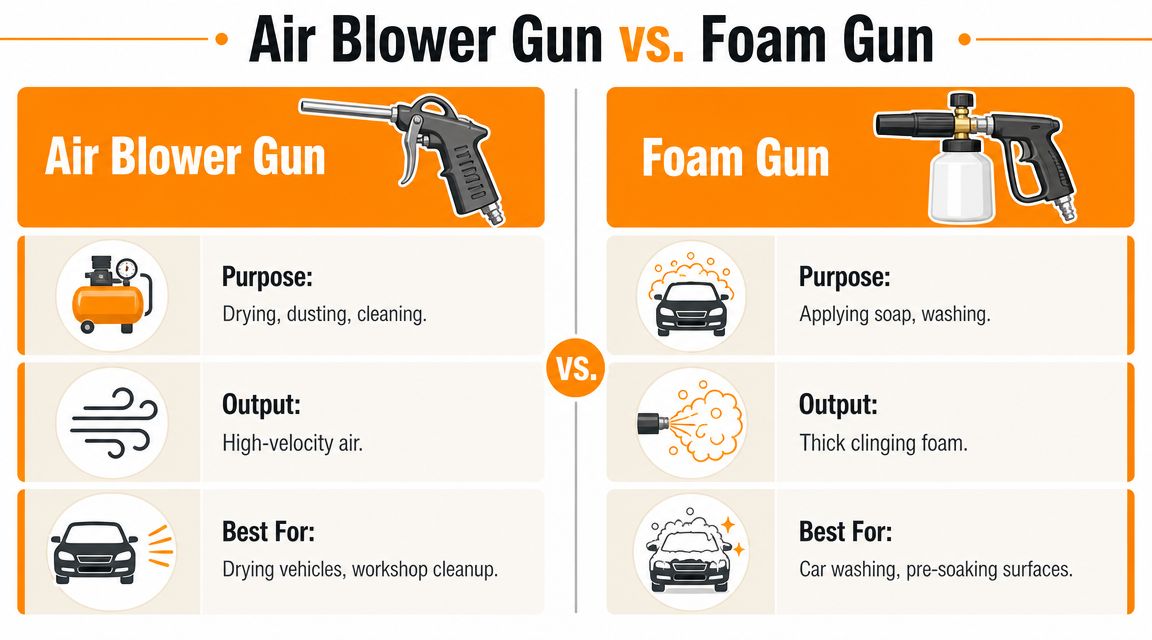
| Tool | Main role | Output | Best moment to use it |
|---|---|---|---|
| Air blower gun | Drying, dusting, targeted cleaning | High-velocity air | After rinsing, or during debris cleanup |
| Foam gun | Washing and pre-soaking | Thick soap foam | At the start of the wash |
A foam gun helps you lay soap onto the surface so you can loosen grime before contact washing. An air blower gun helps you remove water and loose debris after the cleaning stage. One is part of the wash step. The other is part of the drying and cleanup step.
Which one should you buy first
If your main problem is dirty vehicles and slow hand washing, start with a foam gun. If your main annoyance is water trapped in seams, drip marks after drying, or workshop dust in tight places, start with an air blower gun.
If you wash motorcycles or bikes and want an example of the washing side of the equation, a dedicated option like this Shop bike wash foam cannon shows what foam-focused tools are built to do. For more technique on that category, this guide on how to use a foam gun breaks down the washing workflow.
The key takeaway is simple. These tools aren't competitors. They're companions. Foam lifts dirt. Air clears water and debris.
If you want the washing side of your setup to be just as easy as the drying side, take a look at SwiftJet. Its foam gun is built for quick hose-connected washing at home, which makes it a practical partner to an air blower gun in a complete car-care kit.
