

You've just finished washing a dark-colored car. The foam looked great, the mitt lifted the grime, and the rinse seemed clean. Then the water dried, leaving white rings across the hood and glass. You reach for a microfiber towel, but the spots keep appearing because the problem wasn't necessarily your technique. It was the mineral content in the rinse water.

Introduction to Spot Free Water for Everyday Car Care
Spot free water is purified rinse water with very little dissolved mineral content. Instead of carrying a load of calcium, magnesium, silica, and other dissolved material onto the vehicle, it dries with little or no mineral residue. The basic explanation is covered by WaterCare's guide to hard-water spots, which connects visible spotting to minerals left behind as droplets evaporate.
That distinction matters most during the final rinse. Soap and loosened dirt can be rinsed away with ordinary water, but the last water touching the paint is also the water most likely to dry on the surface. If that final rinse contains dissolved solids, the water can disappear while the minerals remain. On paint, glass, and trim, repeated deposits can become difficult to remove and may eventually require correction instead of another simple rinse.
A spot-free rinse helps several types of car-care routines:
- DIY washing: You can spend less time chasing droplets with a towel.
- Mobile detailing: You can make drying more predictable when shade or indoor space isn't available.
- Dark vehicles: Black, blue, and other deep colors reveal pale mineral rings quickly.
- RVs and camping equipment: Large surfaces can be hard to dry before untreated water evaporates.
- Busy households: A dedicated purified final rinse can improve the finish without requiring purified water for every wash stage.
The practical idea is simple. Use regular water to do the cleaning, then reserve low-residue water for the last pass. That approach protects purification capacity and focuses it where it has the greatest effect.
Practical rule: The final rinse is the last opportunity to remove water that can leave minerals behind.
This guide starts with the chemistry, then compares home purification methods, shows how to add a spot-free final rinse to a SwiftJet foam-gun workflow, and finishes with nozzle-level testing. By the end, you should be able to choose a suitable system and judge its performance from the water reaching your vehicle.
What Spot Free Water Really Means
Think of tap water as a delivery vehicle. The water itself evaporates, but it may carry dissolved minerals onto the car. When the droplet disappears, the minerals remain as a faint ring or chalky film.
Spot-free water is water processed to remove most dissolved ions. Deionization, commonly called DI, uses ion-exchange resin to capture charged mineral particles. Reverse osmosis, or RO, pushes water through a membrane that removes much of the dissolved material and other impurities. Many practical systems combine RO and DI, using the membrane to reduce the load before resin polishes the water further. Pure Water Products explains why final-rinse TDS matters more than softness alone.
TDS is the residue signal
Total dissolved solids, or TDS, is a useful way to think about what water leaves behind. A lower TDS reading means fewer dissolved substances are available to remain on the panel after evaporation. Near-zero TDS gives the best chance of air-drying without mineral marks, while untreated tap water commonly has a much higher dissolved-solids load.
A water softener changes the picture, but it doesn't finish the job. Softening commonly exchanges calcium and magnesium for other ions. That can reduce some hard-water effects, yet the water may still contain dissolved material. For a final rinse, the question isn't only whether the water is soft. The question is whether it has low enough TDS to dry with minimal residue.
RO and DI serve different roles
RO acts like a fine gate. It allows water molecules through while rejecting much of the dissolved material. DI resin works more like a chemical cleanup stage, removing remaining ions through ion exchange. A DI cartridge can produce very pure water directly, while an RO and DI combination can make the resin last longer by reducing the amount it must capture.
Resistivity offers another quality signal. In professional water treatment, water with resistivity above 1 megohm is often described as adequate for preventing spots, as outlined by Cascadian Water's explanation of soft and spot-free water. You don't need to become a chemist to use that information. TDS tells you how much dissolved material remains, while resistivity reflects how poorly the water conducts electricity because so few ions are present.
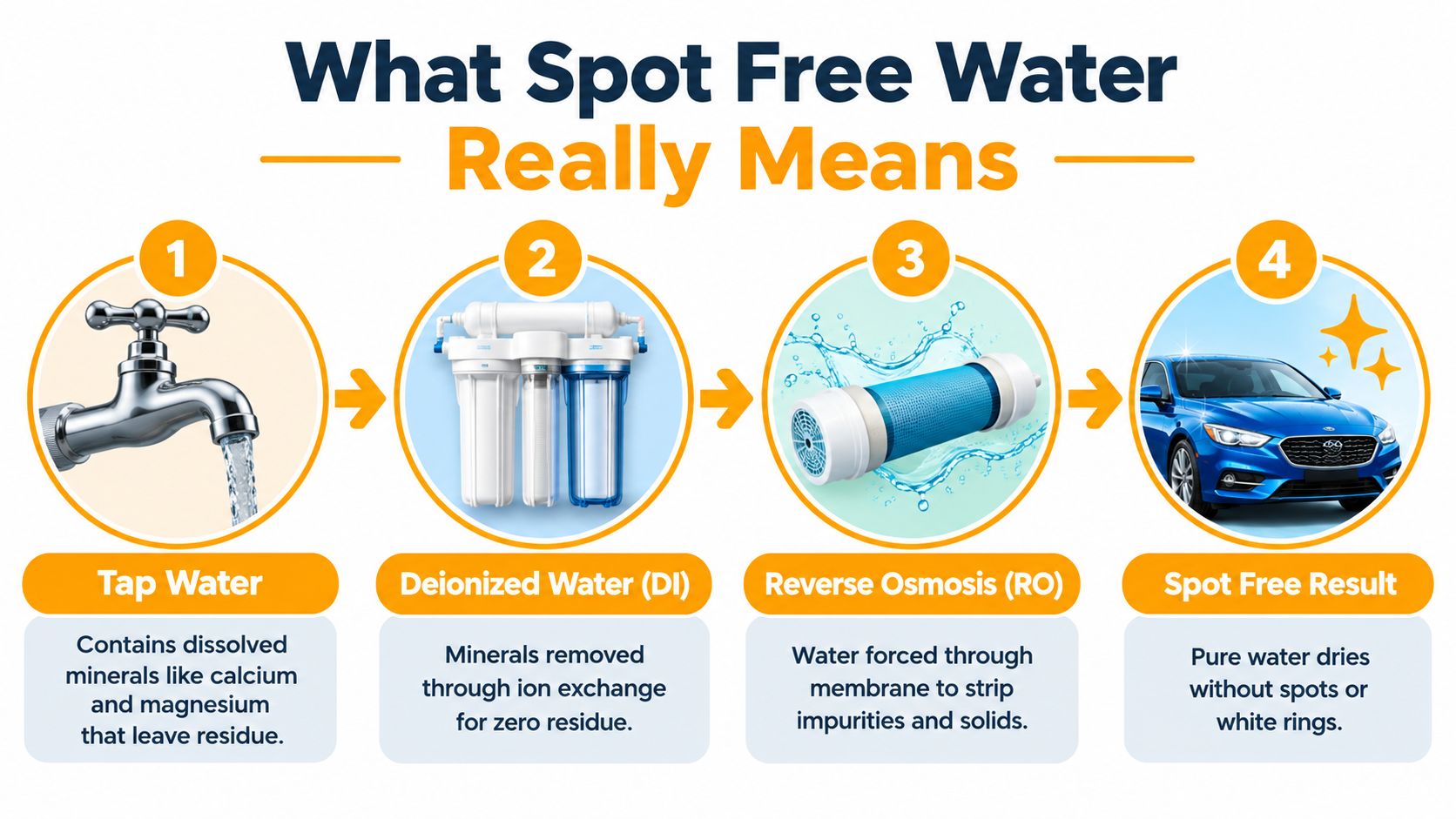
The useful distinction is this: filtered water can be cleaner, softened water can be less scale-forming, but spot-free water has had most of the residue-forming ions removed. That's why it can evaporate from a properly washed surface without leaving the same white rings.
Why Water Spots Happen and How Purity Prevents Them
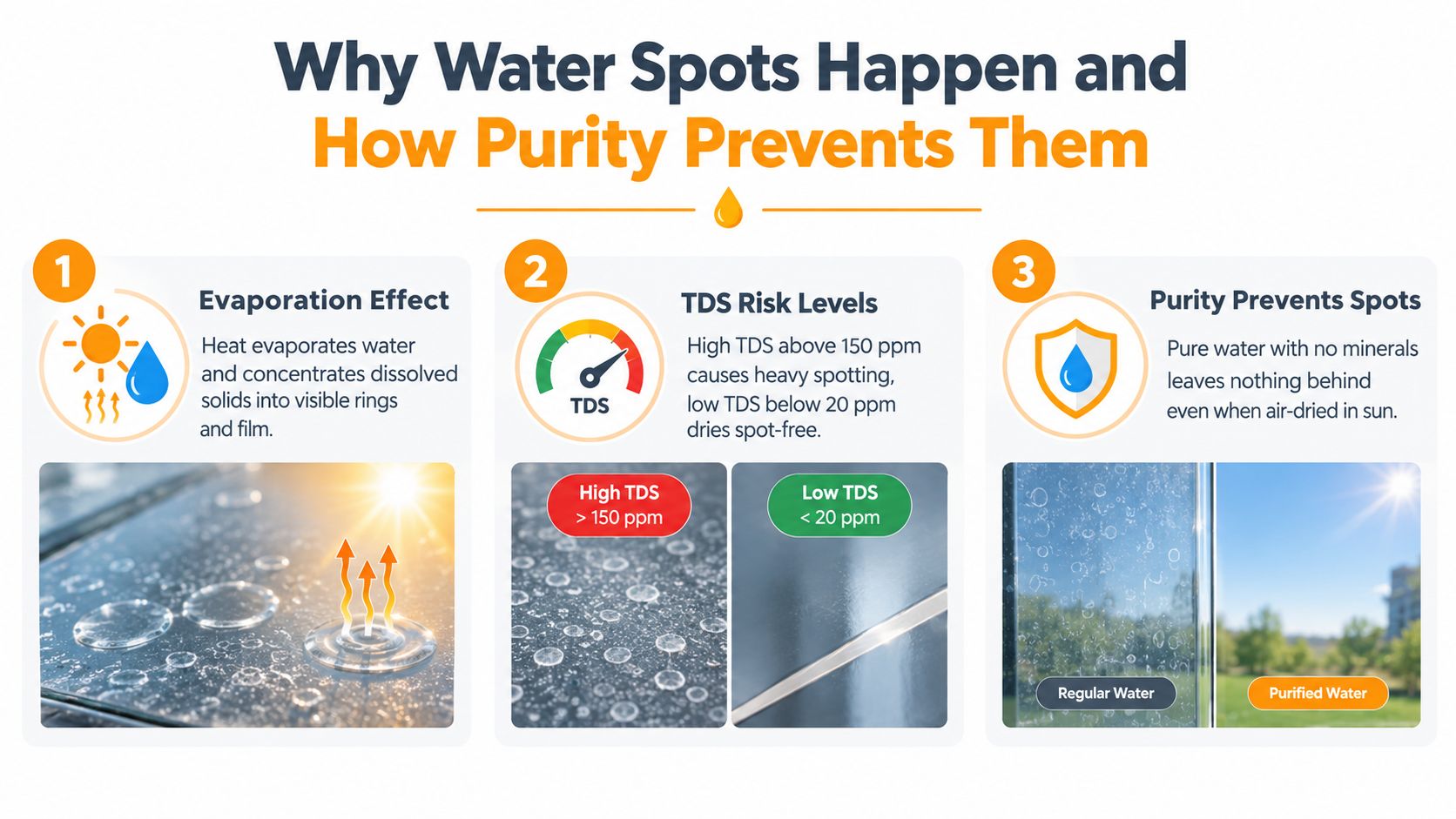
On a dark hood in direct sun, one tap-water droplet can leave a pale ring within minutes. The water evaporates, while dissolved material remains on the paint. Heat, airflow, panel temperature, and sunlight speed up that process. As the droplet shrinks, the minerals become concentrated and settle into a ring, film, or crust.
Hard water commonly carries calcium and magnesium. Tap water may also contain silica and other trace metals. These substances can remain invisible while diluted, then become easy to see after most of the water has disappeared. The result is similar to residue left behind after a wet footprint dries on glass, but the vehicle's finish can make the mark harder to remove if it sits in the sun.
TDS helps predict the risk
Total dissolved solids, or TDS, estimates how much dissolved material the water contains. More TDS means each drying droplet has more residue available to leave behind. As a general car-care rule, spotting risk begins to rise above about 50 ppm TDS, while water above 200 ppm is considered very hard and more likely to create visible spots.
Treat those figures as practical guidelines, not a guarantee. A dark panel in direct sun can reveal residue that remains difficult to see on a light vehicle in shade. Humidity, airflow, panel shape, surface temperature, and the condition of the paint also change the result. A handheld TDS meter helps you judge whether your rinse water is suitable for air-drying at the nozzle.
Purity matters most at the end of the wash. Ordinary wash water can remove dirt, but the final rinse decides what remains after evaporation. That makes spot-free water a finishing choice, not a requirement for every stage. Use regular water for washing and rinsing away loosened soil, then switch to low-residue water for the last pass.
The final rinse prevents correction work
Soap does not dissolve mineral deposits that have already dried on paint. A towel can remove remaining droplets, but it cannot erase dissolved solids left behind after evaporation. If deposits bond to or etch the surface, correction may require a dedicated remover or polishing. For a practical quick fix for water spots, follow a method suited to the paint and the age of the mark.
A reliable workflow is simple:
- Wash and rinse away dirt normally.
- Keep the vehicle wet while cleaning.
- Change to purified water for the final pass.
- Let the remaining droplets drain or air-dry when conditions allow.
For more prevention guidance, review SwiftJet's advice on hard water stain prevention. In a foam-gun workflow, this final rinse can be the step that makes air-drying practical. Test the water at the nozzle first, then use it only where its low residue provides the most benefit.
Comparing Ways to Get Spot Free Water at Home
Home users have several routes to a cleaner final rinse. The right choice depends on how often you wash, how much space you have, how much water you need at one time, and whether you want a portable setup or a permanently plumbed system.
A DI tank or cartridge is often the most direct option for a final rinse. Resin removes ions from the water, and a properly maintained DI setup can deliver near-zero TDS. The tradeoff is resin capacity. Water with a heavier mineral load consumes resin faster, so replacement planning matters.
An RO system reduces dissolved solids through a membrane. It can produce cleaner water for many uses, but it may produce water more slowly than a simple hose connection and may require storage or additional treatment. RO alone can be suitable for some workflows, while RO followed by DI gives the final rinse an additional polishing stage.
Distilled water arrives ready to use and can be practical for a small job, glass cleaning, or a limited rinse area. It becomes less convenient when you need a larger volume for a whole vehicle. Carrying and storing containers can also be less efficient than producing purified water at the wash location.
A softener can make wash water friendlier by reducing calcium and magnesium, but it doesn't remove all dissolved solids. It can be useful as pretreatment or for improving general wash water, yet it shouldn't be confused with a near-zero-TDS final rinse.
| Method | TDS Reduction | Best For | Limitation |
|---|---|---|---|
| DI tank or cartridge | Can reach near-zero TDS when resin is active | Final rinses, mobile detailing, DIY users who want direct purification | Resin exhausts and must be monitored or replaced |
| RO system | Removes much of the dissolved material through a membrane | Users needing a larger supply or a fixed purification setup | Flow, storage, membrane care, and reject water need planning |
| RO plus DI | RO reduces the load, DI polishes remaining ions | Frequent washing and users prioritizing very low-residue rinse water | More equipment and maintenance than one treatment stage |
| Distilled water | Very low residue in the purchased water | Small jobs, spot treatment, and occasional rinsing | Transport, storage, and volume can become inconvenient |
| Water softener | Exchanges hardness ions but doesn't eliminate all TDS | Pretreatment and general hard-water management | Soft water can still spot during evaporation |
For a more detailed look at equipment choices, SwiftJet's DI water system car wash guide is a useful reference. Choose based on the rinse, not the marketing label. A small user who washes occasionally may prefer purchased distilled water or a compact DI cartridge. A detailer who rinses regularly may value a testable DI or RO plus DI system with clear capacity tracking.
How to Use Spot Free Water With a SwiftJet Foam Gun
A foam-gun wash doesn't require purified water from the first spray. The most efficient workflow uses ordinary water for cleaning and reserves spot free water for the final rinse. That keeps the purification stage focused on the moment when mineral residue would matter most.
Follow the wash in this order
- Choose shade when possible. A cooler panel gives you more working time and reduces premature drying.
- Rinse loose grit first. Use your normal hose supply to remove sand and surface debris before applying soap.
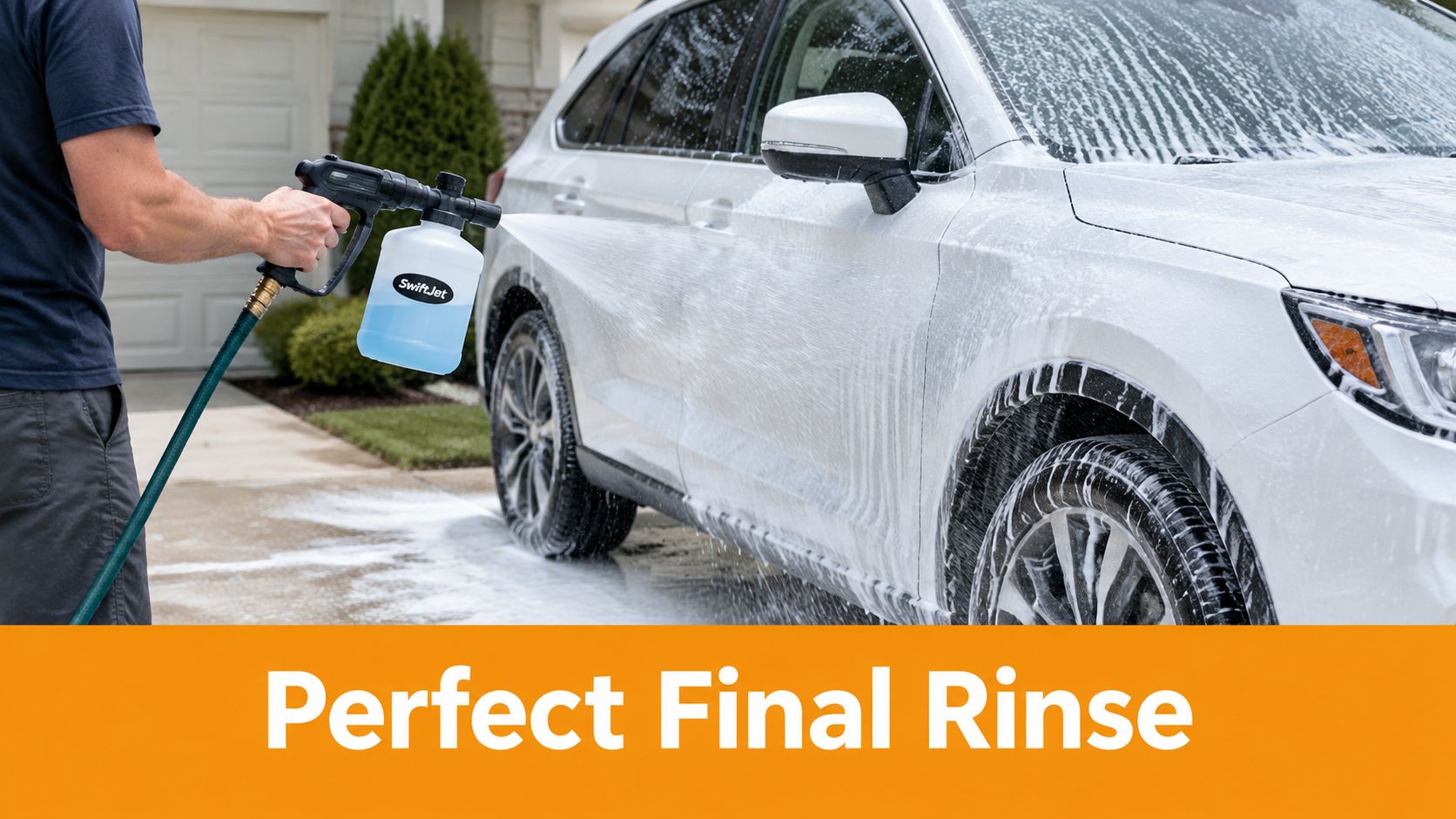
- Apply foam with the SwiftJet foam gun. Cover the vehicle evenly, giving the foam time to loosen traffic film without allowing it to dry.
- Rinse the foam away. Use regular water and work from the roof downward so loosened dirt leaves the vehicle.
- Complete the contact wash. Use a clean wash mitt and separate rinse water where appropriate. Rinse each area before soap or grime can dry.
- Switch to spot free water for the last pass. Start at the roof, then move across the glass, upper panels, sides, and lower sections.
- Let the vehicle drain. Use a gentle, even flow rather than blasting the surface with scattered droplets. A continuous sheet of water leaves fewer isolated beads to dry.
- Inspect before touching the paint. If the water quality is suitable and the surface is clean, you may be able to let it air-dry. Keep a microfiber towel ready for mirrors, trim gaps, handles, and other areas that hold water.
This sequence separates cleaning from drying protection. The foam gun handles product application through a garden hose, while the purified supply handles the residue risk at the end. For more general technique ideas, SwiftJet's guide to achieving a professional result can complement the rinse-focused process.
A good panel order also saves water. Finish one side of the vehicle before moving to the next, and keep the nozzle close enough to control the rinse without creating unnecessary overspray. On a large RV or truck, work in manageable zones so the purified rinse reaches each area before remaining droplets have time to bake in the sun.
The video below demonstrates a foam-gun washing approach. Use it as a visual companion to the final-rinse sequence rather than treating foam application as a replacement for water-quality control.
Verifying Results and Managing Drying Tradeoffs
A spot-free setup earns its place at the final nozzle, because that is where the rinse water meets the vehicle. Water can collect residue from hoses, fittings, connectors, or exhausted resin after leaving the tank. Test the actual outlet, not only the cartridge. AutoWashCo's FAQ guidance identifies nozzle-level TDS testing as a practical troubleshooting step.
Use a simple verification checklist
- Test the final nozzle: Take the TDS reading from the outlet used for rinsing.
- Compare readings over time: A rising reading can signal exhausted DI resin or an upstream issue.
- Inspect the delivery path: Check hoses, fittings, and connectors if the tank reading is low but the nozzle reading is higher.
- Watch the surface: Rinse a clean glass pane or dark panel, where mineral residue is easier to see.
- Record cartridge use: Note how much water passes through before the reading rises, then use that record to compare rinse costs.
Treat the reading like a quality check at the end of a pipeline. The water may be clean at the source, yet pick up contamination before it reaches the paint. A nozzle test confirms the quality of the water you are applying.
Drying speed creates a practical tradeoff. Spot-free water can dry more slowly than untreated water, so results depend on shade, wind, climate, panel temperature, and how quickly you need to finish. For one family car in a shaded driveway, slower air-drying may reduce towel work. A mobile detailer handling several vehicles may prefer purified rinsing followed by targeted towel drying on areas that retain water.
Capacity also varies with incoming mineral content and rinse volume. A 20-inch DI cartridge might last anywhere from a few hundred to more than a thousand gallons, depending on the TDS level of the supply water. Use your nozzle readings and cartridge log to judge real performance instead of treating a capacity estimate as a universal promise.
A Cleaner Rinse Every Time With Spot Free Water
The central lesson is easy to apply: spot free water belongs where drying begins, at the final rinse. You don't need to use purified water for every stage of a foam-gun wash. Use ordinary water to loosen and remove dirt, then use low-TDS water to prevent the last droplets from leaving mineral residue.
DI is a practical choice when you want a direct final-rinse solution and can monitor resin condition. RO can make sense when you need a larger or more permanent supply, while RO plus DI provides an added polishing step for users who wash often. Distilled water can handle occasional small jobs, but volume and storage may make it less convenient for full-vehicle rinsing.
For the next wash, test your final nozzle, clean the vehicle in shade if possible, and reserve the purified supply for the last pass. Watch the roof, windshield, hood, and dark trim as they dry. Those surfaces will quickly show whether your water-quality change is saving towel work and reducing the mineral marks that ordinary rinsing can leave behind.
SwiftJet offers a garden-hose foam gun that helps you apply thick foam and control the wash process, making it a practical companion to a low-TDS final-rinse routine. Visit SwiftJet to explore the foam gun and build a simpler car-washing setup for cleaner, easier drying.
