

When you're putting together your mobile detailing equipment list, a few key pieces form the backbone of your entire operation. You'll absolutely need a solid pressure washer, a water tank, a generator, a powerful wet/dry vacuum, and a hefty supply of quality microfiber towels and cleaning chemicals. I call these the foundational five—without them, you simply can't deliver professional-grade results out in the field.
Building Your Mobile Detailing Toolkit
Kitting out your mobile detailing rig is a lot like a professional chef setting up their kitchen; every single tool has a specific, crucial job to do. This guide isn't just a shopping list. It’s a blueprint to help you understand the why behind each piece of equipment, so you can build your toolkit intelligently. We’ll cover the absolute must-haves for delivering top-notch work from your very first job, steering you away from costly gear you won't need right away.
Think of this as your starting game plan. We'll get into why a reliable pressure washer is your most important workhorse and how something as simple as premium microfiber towels can be the difference between a good finish and a flawless, scratch-free one.
Core Components of a Mobile Setup
Your main goal is to create a mobile setup that’s efficient and versatile enough to tackle any vehicle a client throws your way. To pull that off, your gear has to be three things: reliable, portable, and effective.
Here’s where you need to focus your investment:
- Water and Power: Being self-sufficient is the name of the game. A dependable water supply is non-negotiable, and it's worth reading up on choosing the best water storage container to get it right. Couple that with a quiet, reliable generator, and you've built the self-powered core of your business.
- Cleaning and Decontamination: This category covers everything from your pressure washer, which blasts away heavy grime, to more delicate tools like clay bars that lift embedded contaminants from the paint.
- Interior Restoration: You can't skimp here. A high-suction vacuum, a steam cleaner for deep sanitation, and an arsenal of specialized brushes are essential for truly transforming a car's interior.
- Finishing and Protection: This is where the magic happens. Tools like orbital polishers and premium waxes or ceramic coatings deliver that jaw-dropping shine that gets you referrals and repeat customers.
A well-organized rig does more than just hold your tools—it screams professionalism. When you pull up to a job with everything clean, organized, and in its proper place, you build instant trust with the client before you've even washed a single panel.
The infographic below breaks down how your equipment can be categorized into tiers, starting with the bare essentials and scaling up to the advanced tools of a seasoned pro.
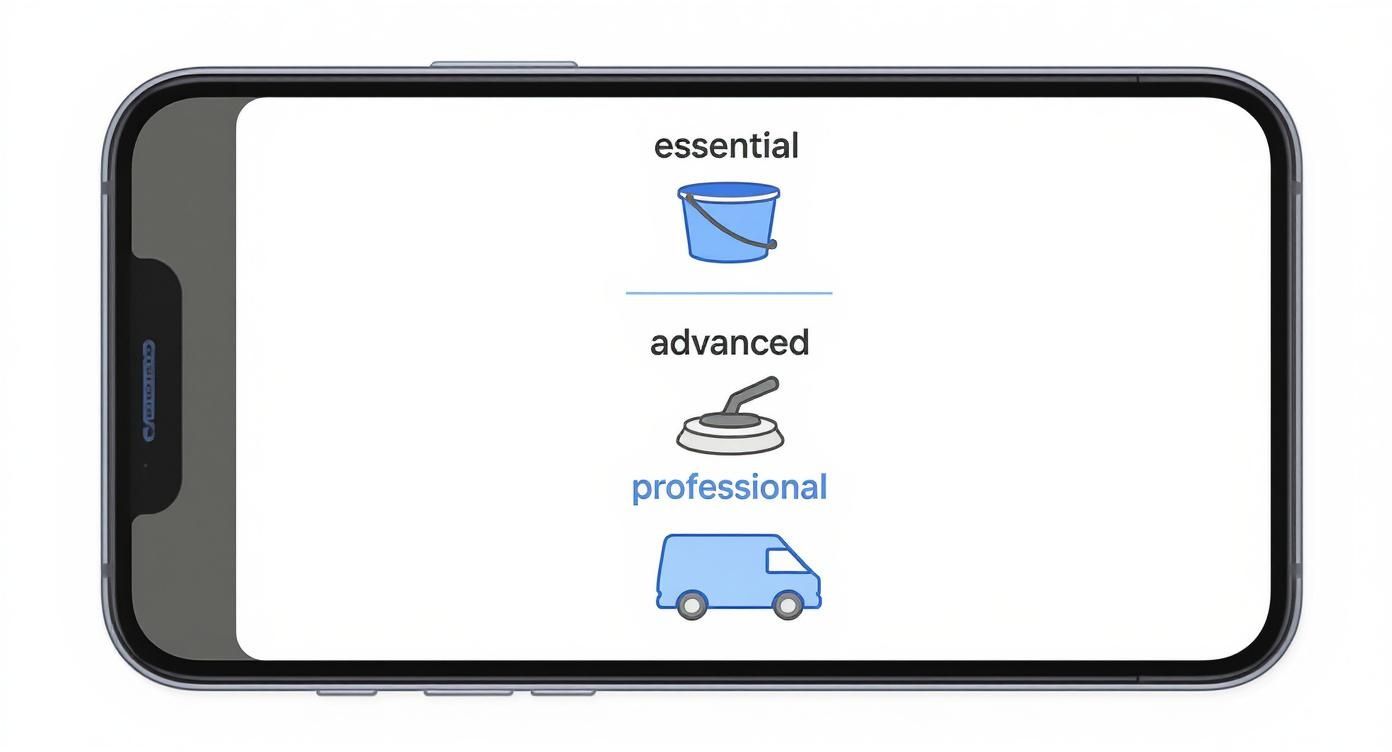
This tiered approach gives you a clear roadmap for growth. You can start with the basics and reinvest in more specialized equipment as your skills and client base expand.
For a deeper dive into getting started, this guide on the initial [https://www.swiftjetusa.com/blogs/news/mobile-car-wash-setup] is an excellent resource. It provides a solid, actionable plan for building a business that's ready to scale.
To make this even clearer, here's a simple table summarizing how you might approach buying your gear in stages.
Mobile Detailing Equipment Tiers at a Glance
| Equipment Tier | Key Items | Best For |
|---|---|---|
| Starter (The Essentials) | Pressure washer, 50-gallon water tank, basic generator, wet/dry vac, microfiber towels, buckets, core chemicals. | New detailers focusing on essential wash & wax services and basic interior cleanups. |
| Professional (The Upgrade) | Hot water extractor, steam cleaner, dual-action polisher, higher-end pressure washer, larger water tank (100+ gallons). | Established detailers offering paint correction, deep interior cleaning, and stain removal services. |
| Advanced (The Elite) | Ozone generator, specialized polishers (rotary, nano), paint thickness gauge, infrared curing lamps, professional-grade ceramic coatings. | High-end specialists focusing on concours-level detailing, advanced paint correction, and ceramic coating applications. |
Thinking in tiers helps you budget effectively and ensures you have the right tools for the services you're offering at each stage of your business journey.
Core Equipment for Washing and Drying
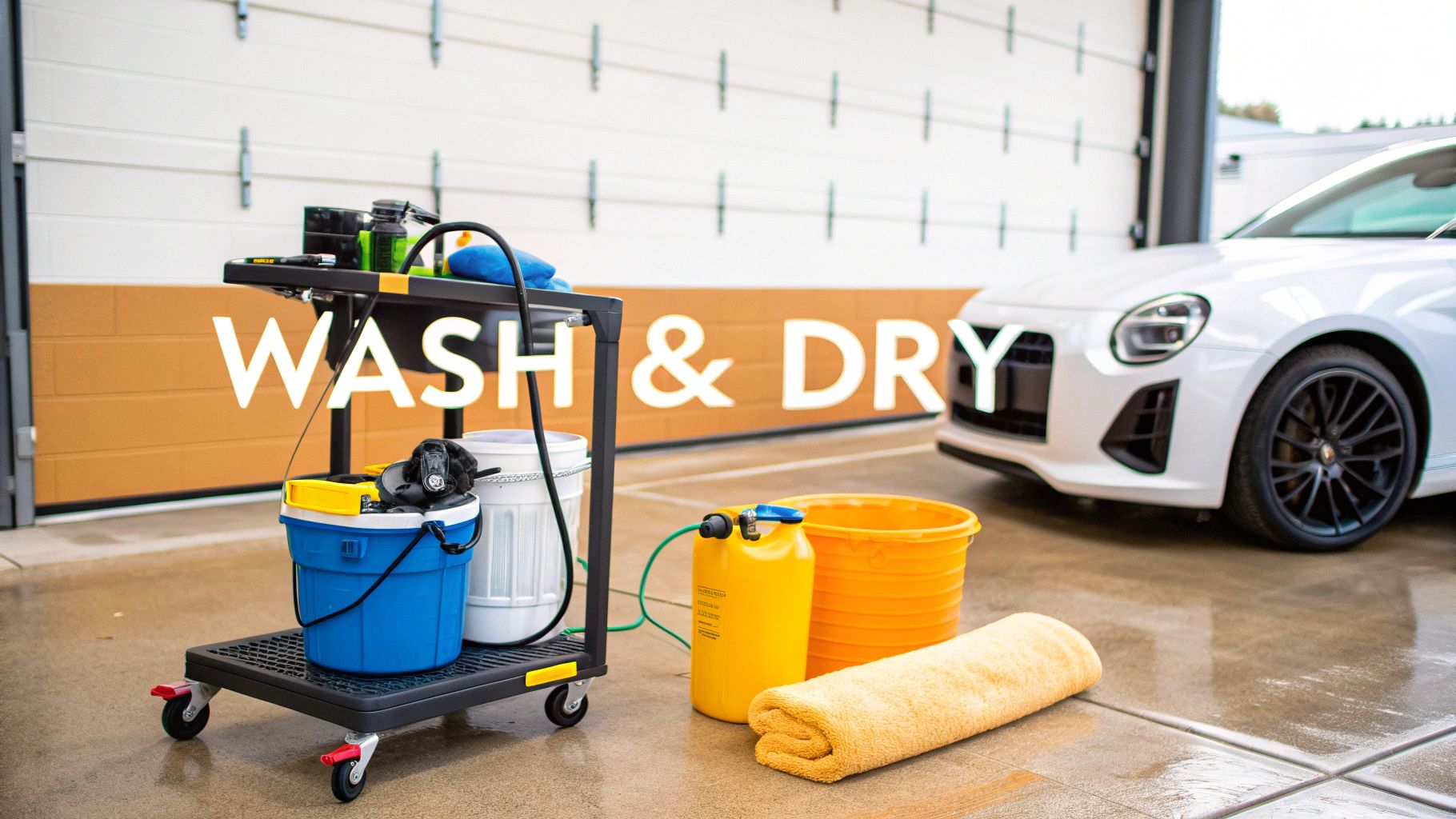
Every incredible detail job starts with a perfect, scratch-free wash. This is where you get rid of the layers of dirt, road grime, and other gunk that make a vehicle look dull. If you nail this part, you prevent scratches and set yourself up for a flawless finish later on. The right tools aren't just a nice-to-have; they're absolutely essential for getting professional results.
Think of your pressure washer as the heavy lifter of your operation. It’s got the muscle to blast away tough, caked-on grime, but when you use it right, it's gentle enough for delicate paint. It’s all about finding that perfect balance between power and control.
Choosing Your Ideal Pressure Washer
When you're shopping for a pressure washer for a mobile rig, two numbers matter most: PSI (pounds per square inch) and GPM (gallons per minute). PSI is the force, while GPM is the flow. A classic rookie mistake is chasing a super-high PSI, which can be way too aggressive and actually strip or damage the paint.
For detailing cars, you want to live in the 1500-2000 PSI range. That’s the sweet spot—plenty of power to clean effectively without being destructive. Just as important is the GPM, which dictates how fast you can rinse down a car. A GPM of around 1.5 to 2.2 will get you a quick, efficient rinse without wasting a ton of water.
As on-demand car care has exploded in popularity, having the right gear has become more important than ever. The car detailing equipment market was valued at about $1.52 billion and is on track to hit $1.68 billion, largely thanks to advanced tools like portable pressure washers. This isn't just a random spike; it shows a real shift in the industry toward professional, efficient solutions. For a closer look at market trends, you can check out these auto detailing industry statistics from Autoleap.
A foam cannon is the perfect sidekick to your pressure washer. It hooks right on and turns your car soap into a thick, shaving-cream-like foam that clings to the vehicle. This isn't just for cool Instagram videos; the foam lubricates the surface, lifting dirt particles away from the paint. This dramatically cuts down the risk of causing swirl marks when you start the hand wash. To learn more about the different tools available, check out our guide to essential portable car wash equipment.
The Art of the Scratch-Free Wash
If you're serious about detailing, the two-bucket wash method isn't optional—it's the law. It’s a dead-simple system that is unbelievably effective at keeping grit and dirt off the paint you're trying to clean.
Here’s how it works:
- The Soap Bucket: This one’s for your car wash soap and water solution.
- The Rinse Bucket: This bucket is just plain, clean water. It’s your mitt-cleaning station.
- The Grit Guards: You drop one of these plastic grids into the bottom of each bucket. They act as a washboard, trapping all the dirt at the bottom so your mitt can't pick it back up.
The process itself is easy. Dunk your mitt in the soap, wash one panel of the car, then rinse the now-dirty mitt in the clean water bucket before you go back for more soap. This simple step stops you from dragging dirt from the rocker panels all over the hood.
"The two-bucket method is the single most important technique a detailer can master to prevent wash-induced scratches. It's the difference between maintaining a flawless finish and creating one that needs correction."
Drying for a Flawless Finish
How you dry a car is just as critical as how you wash it. A bad drying technique is the number one cause of ugly water spots and fine scratches. You've got two main routes to go here, and both are great.
- Ultra-Plush Microfiber Towels: We're not talking about your basic shop rags. A high-quality, high-GSM (grams per square meter) drying towel can soak up a ridiculous amount of water. The safest way to use one is the "blotting" or "draping" method—just lay the towel across a panel and gently pat it dry. No wiping, no dragging, no scratches.
- Heated Air Blowers: A dedicated car dryer is a game-changer. It uses warm, filtered air to blast water out of all the tricky spots that towels miss, like behind mirrors, in panel gaps, and around emblems. This gives you a truly touchless dry, which means zero chance of scratching and no more annoying drips messing up your wax job later.
What’s the right choice? It usually comes down to your budget and how you like to work. A lot of pros use both: the blower for the nooks and crannies, and a premium microfiber towel to gently blot the big, flat surfaces like the hood and roof.
Mastering the Interior Detail
A car's shiny exterior is what first catches the eye, but the interior is where your clients live. It's where they spend their commute, run errands, and make memories. That's why a pristine, fresh-smelling interior often makes the most lasting impression. Getting this part right is absolutely critical for your mobile detailing business.
Transforming a grimy interior isn't about a quick wipe-down. It demands a specialized arsenal designed to deep clean, sanitize, and restore every surface, from the floor mats right up to the headliner. The right equipment doesn't just clean; it completely rejuvenates the space.
The Foundation of a Clean Interior
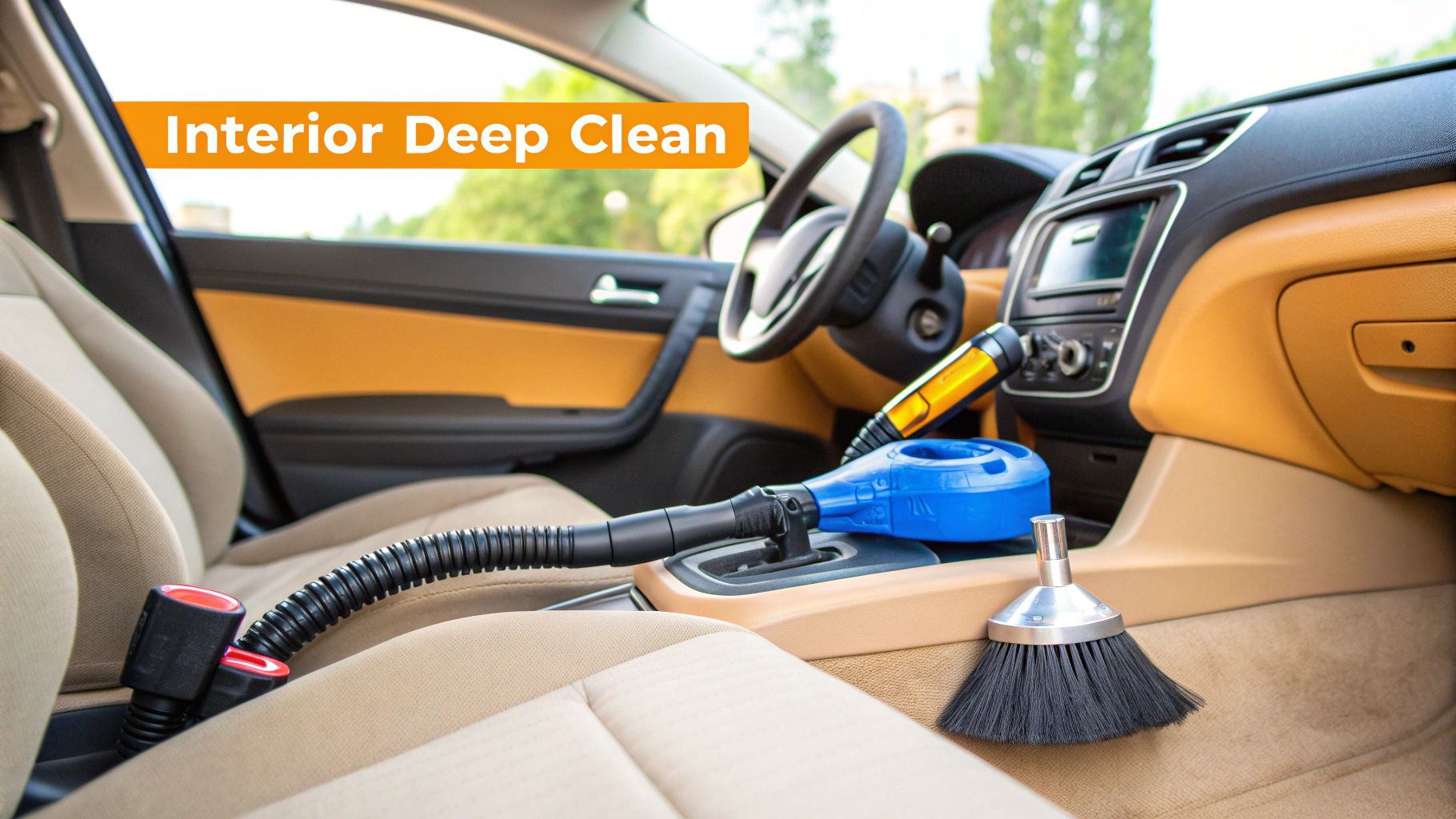
The absolute workhorse of any interior job is a professional-grade wet/dry vacuum. Forget your average household shop vac. For detailing, you need a beast with serious suction—look for a high horsepower rating of at least 4 HP or more—to pull stubborn dirt, pet hair, and crumbs from deep within carpet fibers.
But raw power is only half the story. The attachments are what turn a simple vacuum into a precision detailing tool. Your setup should include a versatile set of tools to hit every last nook and cranny.
- Crevice Tool: This long, skinny attachment is your best friend for getting between the seats, along the edges of the center console, and into all those tight seams where junk loves to hide.
- Upholstery Brush: A brush with soft-to-medium bristles is perfect for agitating and lifting stubborn grime from fabric seats and carpets without causing any damage.
- Flexible Hose: A long, pliable hose is non-negotiable. It lets you move freely inside the car without having to constantly drag the main vacuum unit around.
This combination of power and precision is your first line of attack, removing the majority of loose debris before you even think about deeper cleaning.
Deep Cleaning Carpets and Upholstery
For interiors that need more than a surface-level vacuuming, a hot water extractor is a total game-changer. Think of it as a professional carpet cleaner for a house, but perfectly scaled down for vehicles. It sprays a mixture of hot water and a cleaning solution deep into the fabric, then immediately sucks it back up, pulling out years of ground-in dirt, nasty spills, and set-in stains.
A hot water extractor is the difference between making a seat look clean and making it truly clean. It’s the tool that rips out the source of stains and odors instead of just covering them up.
In the same vein, a steam cleaner brings incredible versatility to the table. It uses high-temperature steam, often blasting at over 200°F, to melt away grease, kill bacteria, and sanitize surfaces with very little water and few, if any, chemicals. It's perfect for tackling delicate or awkward spots like air vents, sticky cup holders, and grimy center consoles where liquid cleaners would just make a bigger mess.
Restoring and Protecting Every Surface
Once the heavy-duty cleaning is done, the final touches are what truly bring an interior back to life. This stage requires a specific set of chemicals and applicators designed for all the different materials you'll encounter. A well-stocked interior cleaning kit is a must-have.
Here are the essentials you can't go without:
- All-Purpose Cleaner (APC): A quality, dilutable APC is your go-to for cleaning hard plastics, vinyl door panels, and dashboards. It's the Swiss Army knife of interior cleaners.
- Detailing Brushes: You'll need a whole collection of these, with varying bristle stiffness. Soft brushes are for delicate vents and electronics, while stiffer ones are for scrubbing gnarly floor mats and pedals.
- Interior Conditioner/Protectant: After cleaning plastics and vinyl, a non-greasy protectant is key. It restores a factory-fresh sheen and adds a crucial layer of UV protection to prevent cracking and fading over time.
- Leather Cleaner and Conditioner: If you're working on leather seats, a dedicated two-step process is non-negotiable. A pH-balanced cleaner safely lifts dirt, followed by a quality conditioner that replenishes the leather's natural oils to keep it soft and prevent it from drying out.
When you combine powerful extraction tools with meticulous brushwork and the right chemicals, you can take any vehicle's interior from lived-in to showroom-fresh. This is the level of detail that builds a rock-solid reputation and keeps your clients coming back for more.
Tools for Paint Correction and Protection
This is where the magic really happens. When you move into paint correction and protection, you're no longer just cleaning cars—you're restoring them. It's a shift that turns your service into a true art form, allowing you to deliver those jaw-dropping transformations that command top dollar. To do this, you need the right tools to erase years of wear and lock in a durable, show-stopping shine.
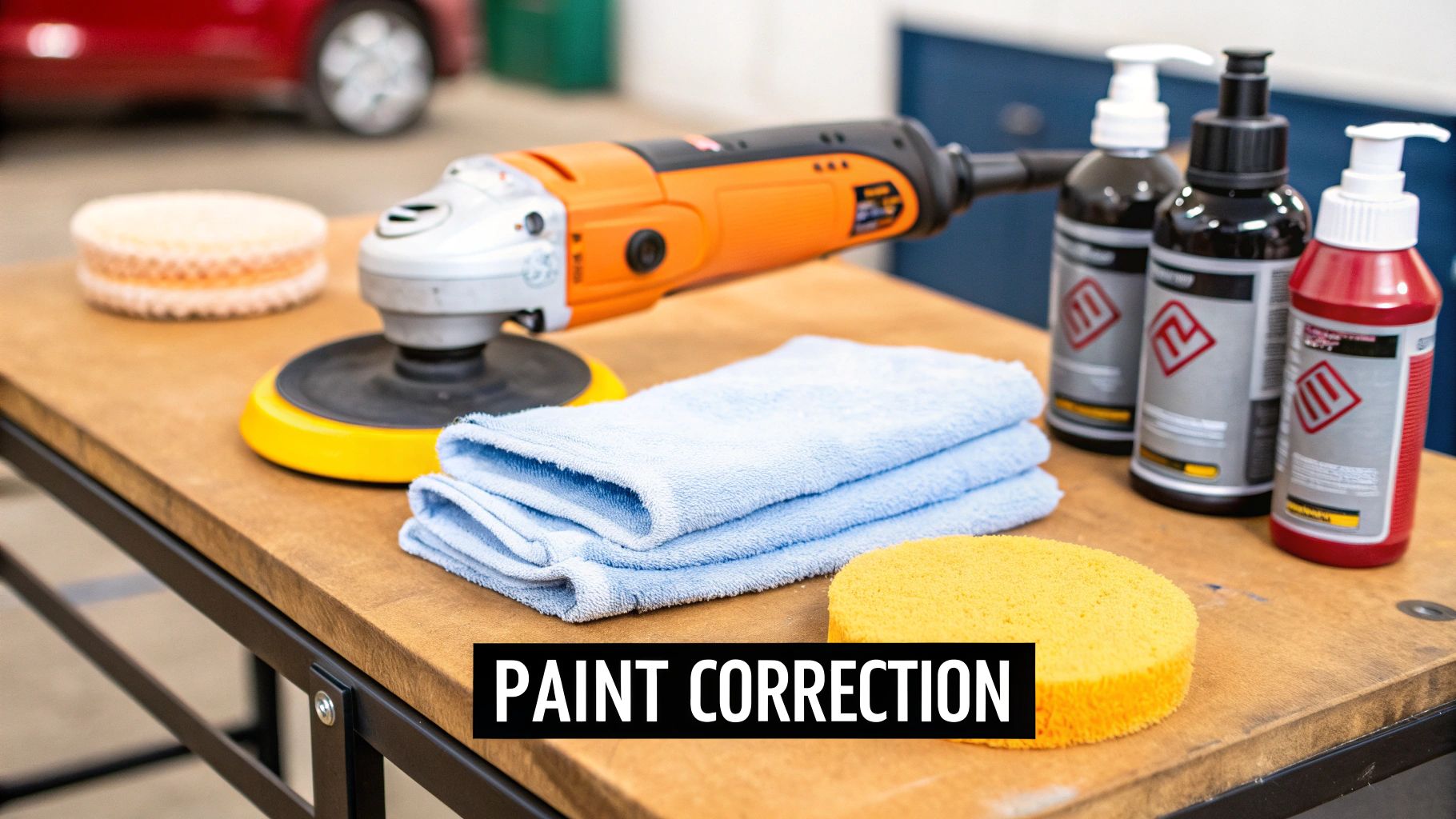
The machine polisher is the heart and soul of any paint correction service. This is the tool that’s going to do the heavy lifting, removing the fine scratches, swirl marks, and oxidation that make a car’s finish look dull and lifeless. Frankly, it’s a non-negotiable part of any serious mobile detailing equipment list.
Understanding Machine Polishers
When you start shopping for a polisher, you'll see two main types: dual-action (DA) and rotary. Think of it like this: a DA polisher is a safe, reliable sedan, while a rotary is a high-performance sports car. Both will get you down the road, but one is a lot easier for a new driver to handle.
The dual-action (DA) polisher is the go-to for beginners and most pros for a reason. It moves in a random oscillating pattern, which keeps heat buildup to a minimum and drastically lowers the risk of burning through the paint. It's the perfect machine for safely getting rid of moderate imperfections and dialing in a flawless finish.
A rotary polisher, on the other hand, spins on a single, fixed axis. This direct-drive action creates intense friction and heat, which lets it cut through heavy defects incredibly fast. But all that power comes with a serious risk—an inexperienced operator can cause irreversible damage in seconds. Most detailers learn the ropes with a DA and only add a rotary to their arsenal once they've truly mastered the craft.
A quality DA polisher is one of the smartest investments you can make early on. It lets you offer high-value paint correction services with a built-in safety net, so you can build your confidence and skills without putting your clients' cars at risk.
Keeping up with industry tools isn't just about polishers anymore. Smart detailers are using technology to get ahead. In fact, over 65% of detailers now use CRM software to manage their clients and deliver a better experience. We're also seeing an explosion in advanced protection products, with the market for things like graphene ceramic coatings growing by 20% annually. You can find more on these trends in car detailing equipment on Accio.com.
Pads and Compounds: The Correction Combo
A polisher on its own doesn't do much. You need the right pads and compounds to get the job done. These two things work as a team to gently abrade the paint on a microscopic level, smoothing out the surface to bring back clarity and shine. Getting the right pairing is everything.
You’ll want to build a small arsenal of pads for different tasks:
- Foam Pads: These are your everyday workhorses. They come in different densities, from aggressive cutting pads for deep scratches to ultra-soft finishing pads that create that perfect, mirror-like gloss.
- Microfiber Pads: When you need more cutting power, reach for microfiber. These pads are great for knocking down significant defects quickly, especially when you pair them with a heavy-duty compound.
- Wool Pads: Traditionally used with rotary polishers, wool pads offer the most aggressive cut possible. They take a skilled hand to use correctly, as they can easily leave behind their own swirl marks (holograms) if you're not careful.
Of course, pads need a liquid abrasive to work with. That's where compounds and polishes come in. A "compound" is more aggressive and designed to remove deeper flaws, while a "polish" is much finer and is used to refine the finish to a high gloss.
Sealing the Deal: Paint Protection
Once you’ve spent hours perfecting the paint, the last thing you want is for it to get damaged again. That's why the final step is to protect your work. This isn't just a nice little add-on; it’s an essential part of the service that keeps the car looking incredible for months or even years.
You have three main choices for paint protection:
- Carnauba Wax: This is the classic choice, famous for the deep, warm glow it gives to paint. It looks fantastic, but it doesn't last long—you'll typically get a few weeks to a couple of months of protection.
- Paint Sealant: A synthetic product that chemically bonds to the paint for much better durability. Sealants provide a sharp, reflective shine and can easily last for six months or more.
- Ceramic Coating: This is the top dog in modern paint protection. A ceramic coating is a liquid polymer that cures to form a hard, semi-permanent layer over the paint. It’s incredibly water-repellent, resistant to chemicals, and can last for several years with proper care, all while delivering unmatched gloss.
Essential Accessories and Safety Gear
True professionalism isn't just about the big-ticket items. It’s in the details—the supporting gear that makes your whole operation click. The right accessories are what turn a pile of tools into a smooth, efficient mobile detailing business. This part of your mobile detailing equipment list is all about the crucial support items that let you work anywhere, stay organized, and most importantly, stay safe.
Think of these items as the logistical backbone of your setup. They’re what give you the power and water to be truly independent, the organization to work faster, and the safety gear to build a long and healthy career.
Powering Your Mobile Operation
Being mobile means being self-sufficient. You simply can't roll up to a client's house and assume you can plug into their garage. An independent power source is non-negotiable, and today’s detailers have a couple of great options.
- Quiet Inverter Generator: This has become the industry standard for good reason. An inverter generator in the 4,000 to 6,500-watt range can easily run your pressure washer, vacuum, and polisher all at once. The key word here is inverter—unlike those roaring construction site generators, these are quiet enough to use in a peaceful suburban neighborhood without getting angry looks from the neighbors.
- Portable Power Station: These big, rechargeable battery packs are an amazing, completely silent alternative. They might not run a high-draw pressure washer all day, but they’re perfect for powering polishers, vacuums, and lights with zero noise and zero fumes.
A good water tank is just as critical. For most detailers, a 50 to 100-gallon tank hits the sweet spot. It's enough water to handle a few jobs before needing a refill, but not so heavy that it weighs down your vehicle unnecessarily.
Organization and Efficiency Tools
The way you manage your gear says a lot about your work. A clean, organized setup doesn't just look professional to your clients; it makes you a faster and better detailer.
A simple detailing cart is a game-changer. It keeps your go-to bottles, brushes, and towels right where you need them, saving you dozens of trips back and forth to your van. Likewise, getting some quality detailing bags to store polishers, pads, and extension cords protects your gear and keeps everything from becoming a tangled mess.
Investing in organization does more than just save you a few minutes here and there. It projects competence. When a client sees a tidy, well-thought-out setup, their confidence in your ability to care for their car skyrockets.
Prioritizing Personal Protective Equipment
Okay, let's get serious for a moment. This is easily the most important part of your accessory list. The chemicals we use every day can be pretty harsh, and long-term exposure can cause real health problems. Personal Protective Equipment (PPE) isn't an option—it's a must-have for a long-term career.
Your basic safety kit should always include:
- Nitrile Gloves: These are your first line of defense against degreasers, wheel acids, and all sorts of chemicals that can irritate your skin or worse.
- Safety Glasses: This is a no-brainer. One stray splash of a cleaner or a bit of kickback from a pressure washer is all it takes to cause a serious eye injury.
- Respirator or Mask: When you're spraying chemicals, especially in an enclosed space like a garage, you're breathing that stuff in. A good mask protects your lungs.
Building a business is a marathon, not a sprint. Taking these simple precautions ensures you can keep doing the work you love safely for years to come. That makes PPE one of the smartest investments you'll ever make.
Choosing Sustainable and Waterless Options
The world of detailing is changing fast, and one of the biggest shifts is toward sustainability. Adding eco-friendly gear to your mobile detailing equipment list isn't just about being trendy. It's a smart business decision that helps you stand out, attract a whole new wave of customers, and even get you into spots where a traditional wash is impossible—think corporate office parks or high-end apartment buildings with water restrictions.
This isn't just a niche movement. The market is seriously backing this green shift. Waterless and steam cleaning technologies now make up over 30% of all new equipment purchases globally. Here in North America, more than 60% of mobile detailers are already using waterless products. That’s a huge jump, driven by a mix of tighter regulations and customers who genuinely care about their environmental footprint. You can dig deeper into these market trends over at Future Market Insights.
The Power of Rinseless and Waterless Washes
At the heart of any eco-friendly setup are rinseless and waterless wash solutions. These aren't just glorified spray-on soaps. They’re high-tech chemical formulas engineered to work smarter, not harder.
Here’s the best way to think about it: a traditional car wash relies on a flood of water to blast dirt off the paint. A waterless wash is far more elegant. It uses special polymers that wrap around and encapsulate every single dirt particle. When you spray it on, these polymers lift the grit safely away from the finish. A quick, gentle wipe with a quality microfiber towel removes the encapsulated dirt, leaving a scratch-free shine. It’s the perfect solution for keeping already clean cars looking their best, and you can do it literally anywhere.
Rinseless and waterless solutions are a detailer's secret weapon for efficiency and flexibility. They let you deliver a perfect wash with just one bucket or a couple of spray bottles, turning any parking spot into a potential job site.
If you’re ready to dive into these amazing products, take a look at our guide to the top 7 waterless car wash kits for 2025.
High-Efficiency Steam Cleaners
The other game-changer in green detailing is the high-efficiency steam cleaner. These machines are incredible. They take a tiny amount of water, heat it to a high temperature, and produce a low-moisture steam that cleans and sanitizes like nothing else.
Steam is such a powerhouse tool for a few key reasons:
- Unbelievable Cleaning Power: The superheated steam just melts away grease, grime, and caked-on gunk from interiors and exteriors.
- Total Sanitization: It naturally kills 99.9% of bacteria and allergens on contact. No harsh chemicals needed, which is a huge selling point for cleaning vehicle interiors.
- Insanely Low Water Use: You can deep clean an entire car—inside and out—with as little as one or two gallons of water.
By bringing these water-saving tools into your workflow, you're doing more than just shrinking your environmental impact. You're making your business more flexible, more capable, and ready for the future of detailing.
Got Questions? We've Got Answers
Stepping into the world of mobile detailing can feel like a lot at once, especially when you're looking at all the gear you might need. Don't worry, that's completely normal. We've put together answers to the most common questions we hear from detailers who are just getting started.
What’s a Realistic Startup Budget for a Mobile Detailing Rig?
You can get a solid, professional setup off the ground for anywhere between $2,000 and $7,000. It really depends on how far you want to go right out of the gate.
At the $2,000 mark, you're building a workhorse kit. Think a dependable electric pressure washer, a 50-gallon water tank, a powerful wet/dry shop vac, and all your core chemicals and towels. This is more than enough to deliver fantastic results and build a client base.
Pushing closer to the $7,000 range lets you add some serious firepower. This is where you invest in things like a quiet inverter generator (your clients' neighbors will thank you), a hot water extractor for tackling deep stains, and a quality dual-action polisher so you can offer paint correction from day one.
If I Can Only Buy Three Things to Start, What Should They Be?
Great question. If you have to bootstrap it and start with the absolute essentials, focus on the tools that give you the biggest bang for your buck and let you complete a full, basic detail.
- A Reliable Pressure Washer: This is the heart of your exterior cleaning operation. It makes washing faster, more thorough, and more professional. Look for something in the 1500-2000 PSI range—it’s the sweet spot for power without being risky on paint.
- A Powerful Wet/Dry Vacuum: A spotless interior is just as important as a shiny exterior. A good vacuum with strong suction and a few key attachments is non-negotiable for getting into all the nooks and crannies.
- A Ton of Good Microfiber Towels: Seriously, you can never have enough. From washing and drying the exterior to wiping down interiors and buffing off wax, quality microfiber is your best friend for a scratch-free finish.
How Do I Upgrade My Gear as My Business Grows?
Think of it as leveling up. You don't need everything on day one. The smartest way to grow is to let your profits fund your new tools, and each new tool should unlock a new, higher-paying service.
Start with the basics. Get really, really good at washing, vacuuming, and basic interior details. Take the money you make from those first jobs and reinvest it into a dual-action polisher. Now you can offer paint correction. Use the profits from that to buy a steam cleaner, and suddenly you're offering advanced interior sanitizing.
This method ensures the business pays for its own expansion. Once you have a steady stream of clients, you can think about the big-ticket items like a commercial hot water extractor or an ozone generator for serious odor removal. Every purchase should directly tie back to a service that puts more money in your pocket.
Ready to take that first step? The SwiftJet Car Wash Foam Gun is an awesome place to start. It turns a simple garden hose into a foam-blasting machine, making your washes safer and way more effective. Grab one and see what a difference the right tool can make.
