

You've got a bare garden hose in your hand, one thumb pressed over the opening, trying to water delicate seedlings without flattening them or rinse a car without splashing mud everywhere. The hose itself isn't the problem. It's a water source waiting for the right tool.
Garden hose attachments turn one flexible line into a watering, cleaning, and control system. A spray nozzle can change a harsh stream into a soft mist. A sprinkler can cover a lawn while you work elsewhere. A foam gun can spread soapy suds over a vehicle, while a splitter and timer help manage several watering tasks with less daily effort.
This category has a longer history than many homeowners realize. Garden hose thread was already used for small hose couplings by 1894 or earlier, while Gardena introduced a common snap-on coupling format in 1968, helping modern attachments work across broader markets. The market remains substantial, with recent estimates placing the global garden hose nozzle market at about USD 1.45 billion in 2024 (global garden hose nozzle market estimate).
Before buying, it helps to understand your hose as a platform. A quick refresher on garden hose ratings can help you match the hose itself to the work, then you can choose the attachment based on the result you want.
Your Garden Hose Is More Powerful Than You Think
The most useful question isn't, “Which attachment should I buy?” It's, “What job am I trying to finish?”
For a flowerbed, the desired result is controlled water that reaches the soil without washing seeds away. For a car, you want broad coverage, dirt removal, and a way to apply soap without rubbing grit across the paint. For a patio, you may want a concentrated stream that moves surface debris, or a wide cleaning head that covers more ground with fewer passes.
That job-to-be-done approach prevents a common mistake: choosing an attachment because it has many settings rather than because one setting suits your task. A multi-pattern nozzle may be useful, but it won't replace an oscillating sprinkler for lawn coverage or a foam gun for vehicle washing.
Practical rule: Choose the water pattern and control method first. Material, color, and extra features come afterward.
Garden hose attachments also make ordinary work more repeatable. Instead of squeezing your hand around the end of the hose and hoping the flow feels right, you can select a known spray pattern. Instead of dragging a hose across every section of lawn, you can position a sprinkler. Instead of applying car shampoo with a bucket alone, you can distribute it through a hose-end sprayer.
The fittings matter just as much as the spray head. A nozzle that doesn't seal against the hose will waste water and make the connection frustrating, while a quick-connect system can make tool changes almost effortless. Think of the hose as the main electrical cable in a workshop. The attachments are the interchangeable tools, and the connectors are the plugs that let the system work together.
The Foundational Attachments for Everyday Tasks
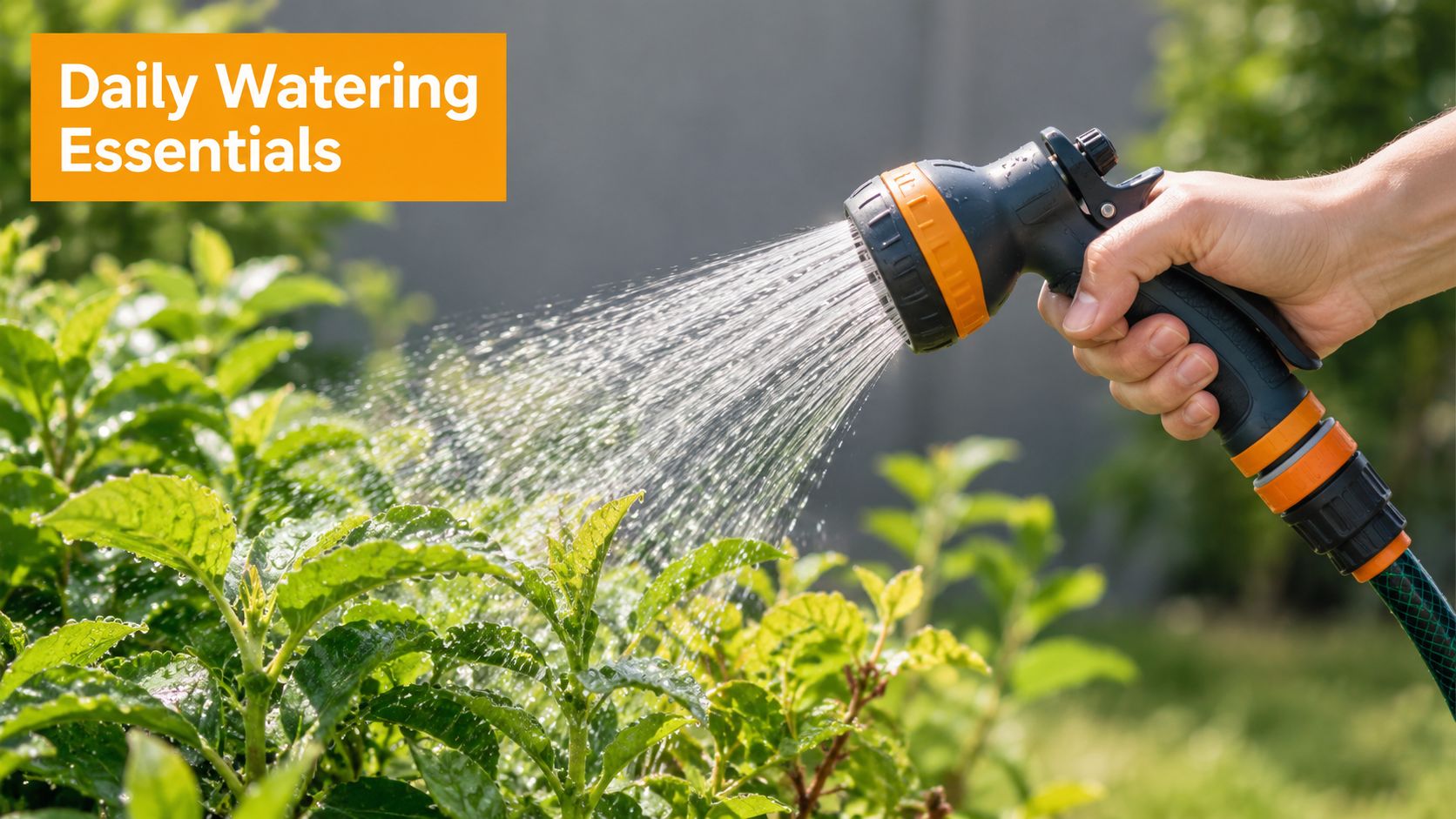
Start with the attachments that solve the most common household jobs. These are the dependable tools you'll reach for when watering containers, rinsing tools, washing outdoor furniture, or cleaning loose dirt from a walkway.
Nozzles for controlled hand watering
A simple twist nozzle works like a flashlight with an adjustable beam. Turn it toward a narrow stream when you need reach or concentrated rinsing. Open it toward a broader spray when you're watering established plants or washing a dusty surface.
This design is compact and easy to store, but it requires you to control the water manually. That makes it a good choice for short tasks, small gardens, and users who prefer a direct connection between hand movement and spray output.
Spray guns for changing jobs quickly
A pistol-grip spray gun adds a handle, trigger, and often several spray patterns. It's more comfortable than gripping a round nozzle during a longer session, and the trigger gives you a natural on and off control.
Use a gentle mist or shower pattern for seedlings and delicate leaves. Choose a flat or fan-shaped spray for rinsing planters and outdoor furniture. Reserve a stronger jet for hard surfaces and stuck-on debris, while keeping the stream away from fragile plants, soft wood, and painted finishes.
The advantage isn't just having more settings. It's being able to move from one task to another without changing tools. A brass water hose nozzle guide can help you compare construction and nozzle design before choosing a hand-held option.
Oscillating sprinklers for broad coverage
An oscillating sprinkler is the floodlight of the watering world. Instead of directing water at one plant, it sweeps a fan of water across a lawn or planting area while you handle another task.
Place it where the spray can reach the intended area without soaking walls, windows, or neighboring surfaces. Observe the coverage, then adjust its range if the model allows it. A sprinkler is convenient, but it isn't automatically efficient if it's positioned too close to a building or aimed beyond the garden.
The right basic kit depends on your property. A small patio garden may need only a spray nozzle. A larger lawn benefits from a sprinkler, while someone who washes vehicles and outdoor surfaces will appreciate a trigger spray gun with a durable connection.
Use the visual guide below to see how common nozzle patterns support different tasks.
Specialized Attachments for Cleaning and Projects
A Saturday car wash shows why specialized attachments earn their place. With a bare hose, you can rinse dust from the body, but the water alone won't spread cleaning solution evenly. You'll still need a separate bucket, sponge, and careful technique to loosen road film without dragging dirt across the paint.
A foam gun changes that sequence. It combines water, soap, and air to produce foam that clings to a surface instead of immediately running away. The foam helps loosen and surround dirt before you use a wash mitt, reducing the amount of dry rubbing required.
Foam guns for vehicle washing
Connect the foam gun to the hose, add the manufacturer's recommended cleaning solution, and start with a light application. Cover the vehicle from top to bottom, allowing the foam to sit briefly according to the product instructions. Rinse loose contamination away before making contact with the paint.
The tool doesn't eliminate the need for a proper wash. It gives you a better first stage, especially when the vehicle carries dust, pollen, or road grime. You can also use a hose-end foam sprayer on trucks, bicycles, outdoor furniture, and camping equipment when the cleaning product is suitable for the surface.
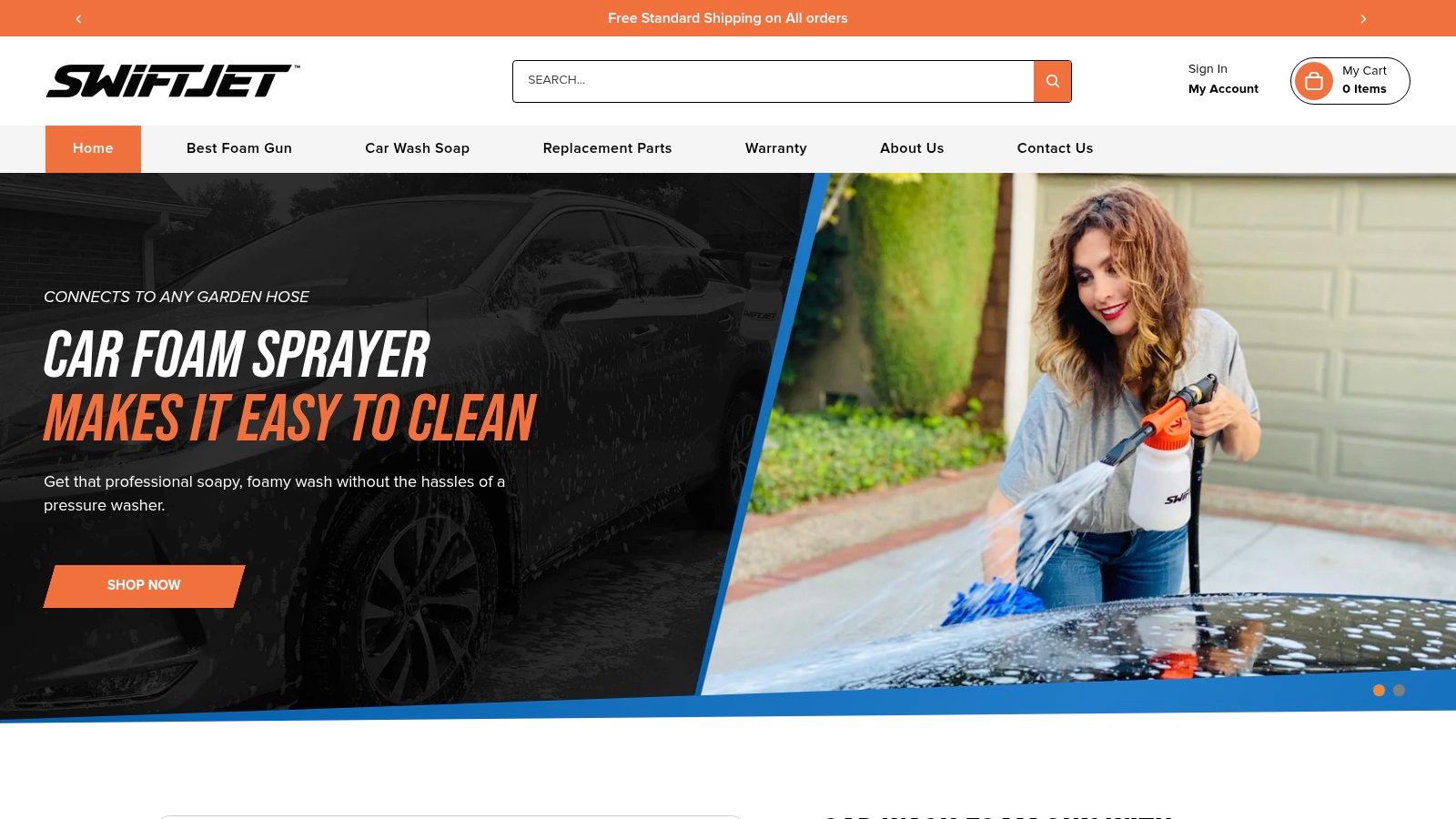
SwiftJet's Car Wash Foam Gun is one garden-hose option designed to connect directly to a standard hose and apply thick foam through a controlled trigger. Its product details describe standard 3/4-inch garden-hose threading, a 3/8-inch PVC quick connector, and an included microfiber wash mitt.
Adapters and water brooms for larger work
Pressure washer adapters can help connect a hose system to compatible cleaning equipment, but they don't turn an ordinary hose into a pressure washer. Check the pressure requirements and connection type before attaching anything. A mismatch can cause leaks, poor performance, or damage to the tool.
Water brooms use several spray outlets to clean broad hard surfaces. They're useful for patios, driveways, decks, and garage floors where a single narrow jet would require constant sweeping. Their value comes from coverage and consistency, not from replacing every other cleaning method.
A specialized attachment should shorten the difficult part of a job, not encourage you to use water carelessly.
Start cleaning at a low-risk setting and test a hidden or inconspicuous area. Painted surfaces, soft wood, loose masonry, and delicate trim can react badly to concentrated spray or unsuitable detergent, so match the attachment and cleaning product to the material.
How to Build a Smarter Watering System
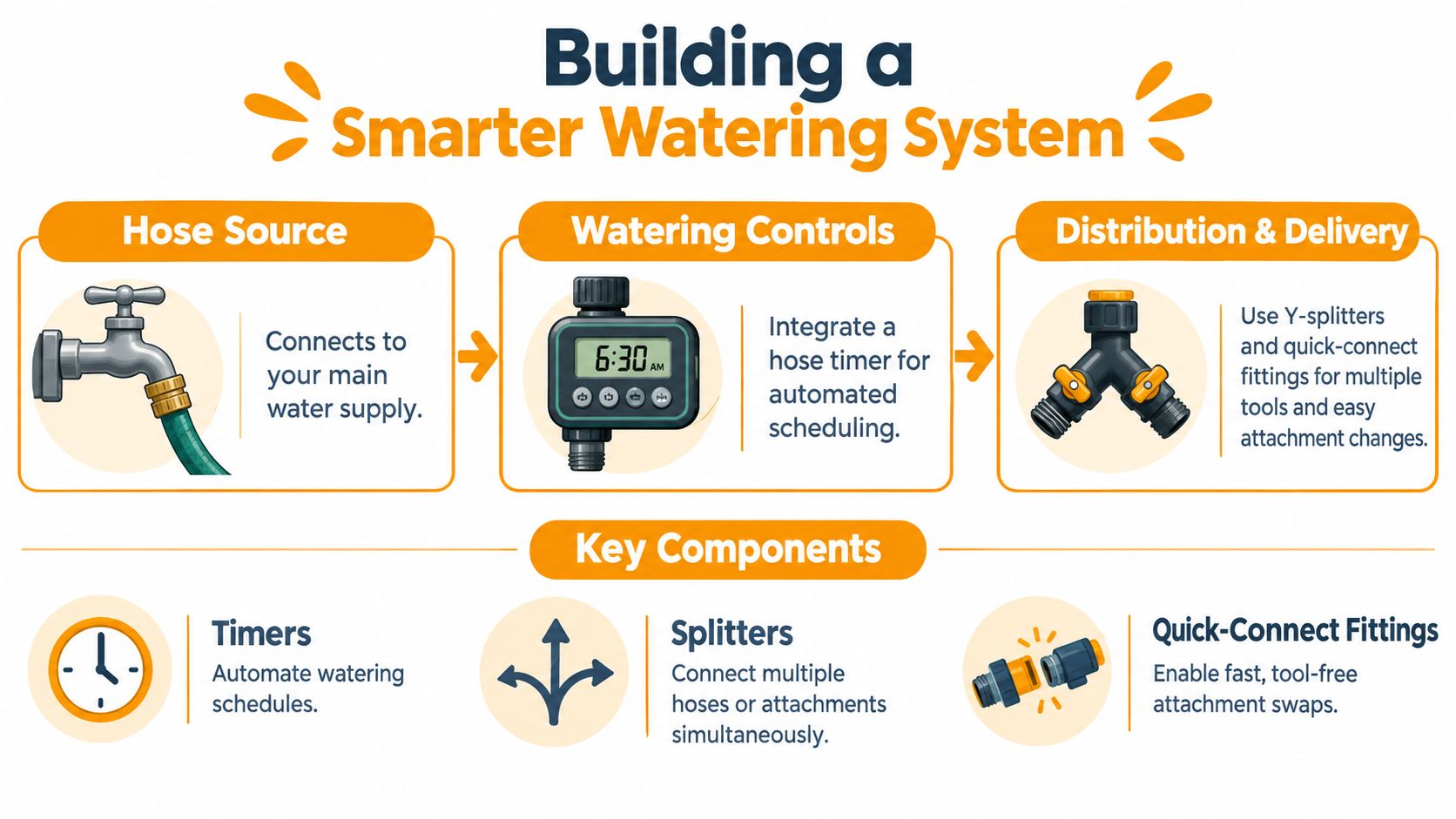
A hose becomes much more useful when you stop treating every attachment as a separate purchase and start building around a few connection points. The faucet is the source, the timer controls when water flows, the splitter divides the supply, and quick-connect fittings make the delivery tools interchangeable.
Build from the faucet outward
A practical arrangement might begin at the outdoor faucet with a timer, followed by a splitter. One outlet can feed a sprinkler or soaker-style tool, while the other remains available for a hand nozzle or cleaning attachment.
The timer acts like a schedule manager. It can run watering at a chosen time without requiring you to stand beside the faucet. Use a model that matches your water source and follow its instructions for programming, battery care, and seasonal storage.
A splitter provides the branching point. Look for shutoff controls on each outlet, because independent valves let you stop one line while leaving another connected. That's useful when a sprinkler is installed but you need the second outlet for rinsing a vehicle.
Make attachment changes simple
Quick-connect fittings work like interchangeable plugs. Install the compatible ends on the hose and attachments, then snap tools into place instead of repeatedly twisting threaded connections.
The main compatibility check comes before the snap. In North America, most garden hose attachments use the 3/4-11.5 NH/GHT thread standard, with a straight thread, approximately 1.0625 inches major diameter, and 11.5 threads per inch (garden hose thread reference). The rubber washer creates the seal, not the threads, so an attachment with a mismatched thread type such as NPT may screw on and still leak.
Use this guide to hose connector types when you're unsure whether you need a threaded adapter, quick-connect end, splitter, or shutoff valve. Once the connection family is correct, the system becomes easier to expand without replacing the hose itself.
Choosing Using and Maintaining Your Attachments
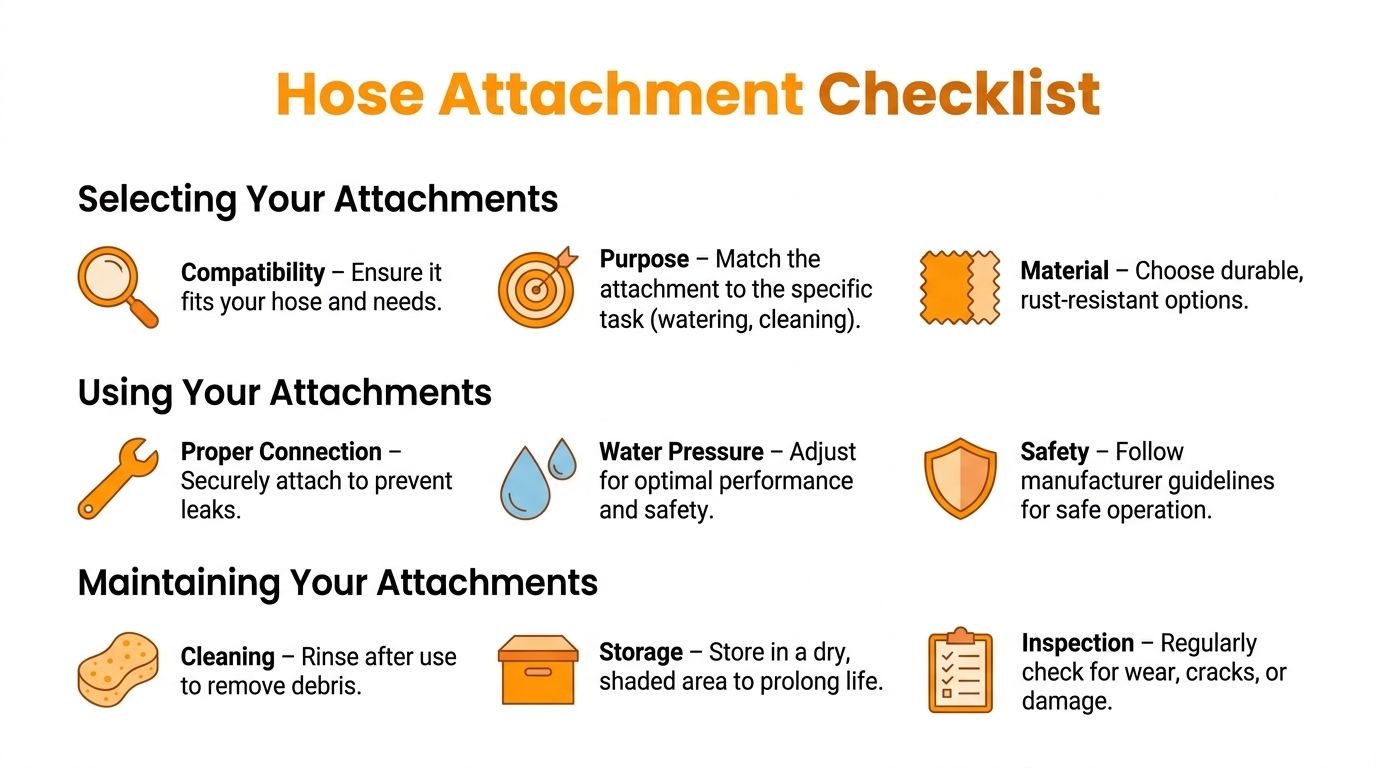
A good attachment should fit the hose, suit the job, feel comfortable in your hand, and survive the way you store and use it. Start with the connection, not the appearance. A polished finish won't compensate for the wrong thread or a missing washer.
Select for the actual job
Use this quick filter before buying:
- Purpose: Choose a soft spray for delicate plants, a controlled gun for mixed chores, a sprinkler for broad lawn coverage, or a foam gun for pre-washing vehicles.
- Compatibility: Confirm the attachment's hose thread, washer arrangement, and quick-connect style. Don't assume that a fitting is compatible because it appears to screw into place.
- Material: Plastic can be light and easy to handle, while brass is often selected for a more durable connection. Consider how often the fitting will be connected, disconnected, exposed to weather, and stored.
- Handling: A trigger that's easy to squeeze, a lockable handle, and a comfortable grip matter during extended watering or washing.
- Control: Shutoff valves, adjustable patterns, and independent splitter outlets let you manage water without returning to the faucet.
For a foam gun, follow the product's soap instructions rather than guessing at a concentrate ratio. Use a vehicle-safe detergent, apply foam from the top downward, allow it to dwell as directed, and rinse before touching the paint with a mitt. The foam is a preparation step, not permission to scrub a dirty surface aggressively.
Connect without creating leaks
Inspect the rubber washer before installation. It should sit flat inside the female fitting, with no visible damage or distortion. Hand-tighten the connection firmly, then open the faucet gradually and check the joint before increasing flow.
If water escapes around the threads, stop and identify the cause. The problem may be a missing washer, a damaged washer, a cross-threaded fitting, or an incompatible thread. Adding more force usually won't solve the underlying mismatch and can damage the connector.
Connection check: If two parts seem to fit but the seal fails, treat compatibility as the problem until you've checked the washer and thread type.
Protect drinking-water connections
A hose attached to an outdoor faucet can create a cross-connection risk if the hose end sits in a bucket, pool, chemical container, or other source of contaminated water. Plumbing requirements commonly call for approved backflow protection on hose bibbs and similar outlets because garden hoses are associated with contamination incidents (backflow and hose-connection requirements).
Use an approved backflow device appropriate for your plumbing setup and local requirements. Don't assume every device works in every condition. Standards guidance notes that some hose-connection backflow preventers aren't suitable for continuous pressure, while others have limits involving low-head backpressure and leakage rejection criteria as low as 3.0 psi (backflow prevention guidance). A qualified plumber or local water authority can help you choose the correct protection.
Clean, drain, and store
Rinse soap residue, soil, and grit from attachments after use. Open shutoff valves briefly so trapped water can drain, then disconnect the tool if freezing weather is possible.
Freezing water can expand inside housings, valves, and connectors, cracking components even when the exterior looks sound. Store attachments in a dry, shaded location, and inspect washers, O-rings, triggers, and plastic bodies before the next season.
Keep threads clean and avoid forcing stuck fittings. A small amount of lubricant approved for the fitting's seals can help maintain smooth operation, but don't apply an unsuitable petroleum product to rubber components. Replace worn washers instead of compensating for a poor seal by overtightening.
Match the Attachment to the Mission
A garden hose attachment earns its space when it produces a result that the bare hose can't deliver easily. The right nozzle gives you control. A spray gun handles changing chores. An oscillating sprinkler covers a lawn while you do something else. A foam gun prepares a vehicle for a safer wash, and a splitter, timer, and quick-connect system turn separate tools into a manageable setup.
Start with the outcome, then work backward. If you want healthier plant watering, choose gentler control. If you want a cleaner car, choose a tool that spreads cleaning solution before contact. If you want less daily effort, add scheduling and distribution components.
Take a look at your next three outdoor jobs and name the result you want from each one. Then check the connection standard, choose the attachment designed for that task, and build your setup one compatible piece at a time.
SwiftJet offers a garden-hose Car Wash Foam Gun for applying clinging foam to cars, trucks, camping equipment, and other suitable surfaces, with a microfiber wash mitt included. Visit SwiftJet to explore the foam gun and choose a hose attachment that fits your next cleaning job.
