

Drying your car with a chamois is one of those classic detailing secrets, a technique that’s been passed down for a reason. It's known for its incredible ability to soak up water and leave behind a finish that’s completely free of streaks and lint. When you get the hang of it, a good chamois feels different from any old towel; it just glides over the paint and glass, pulling water away for a look that’s pure showroom quality.
This guide is all about mastering that technique, from start to finish.
Why a Chamois Still Holds its Own for a Perfect Finish
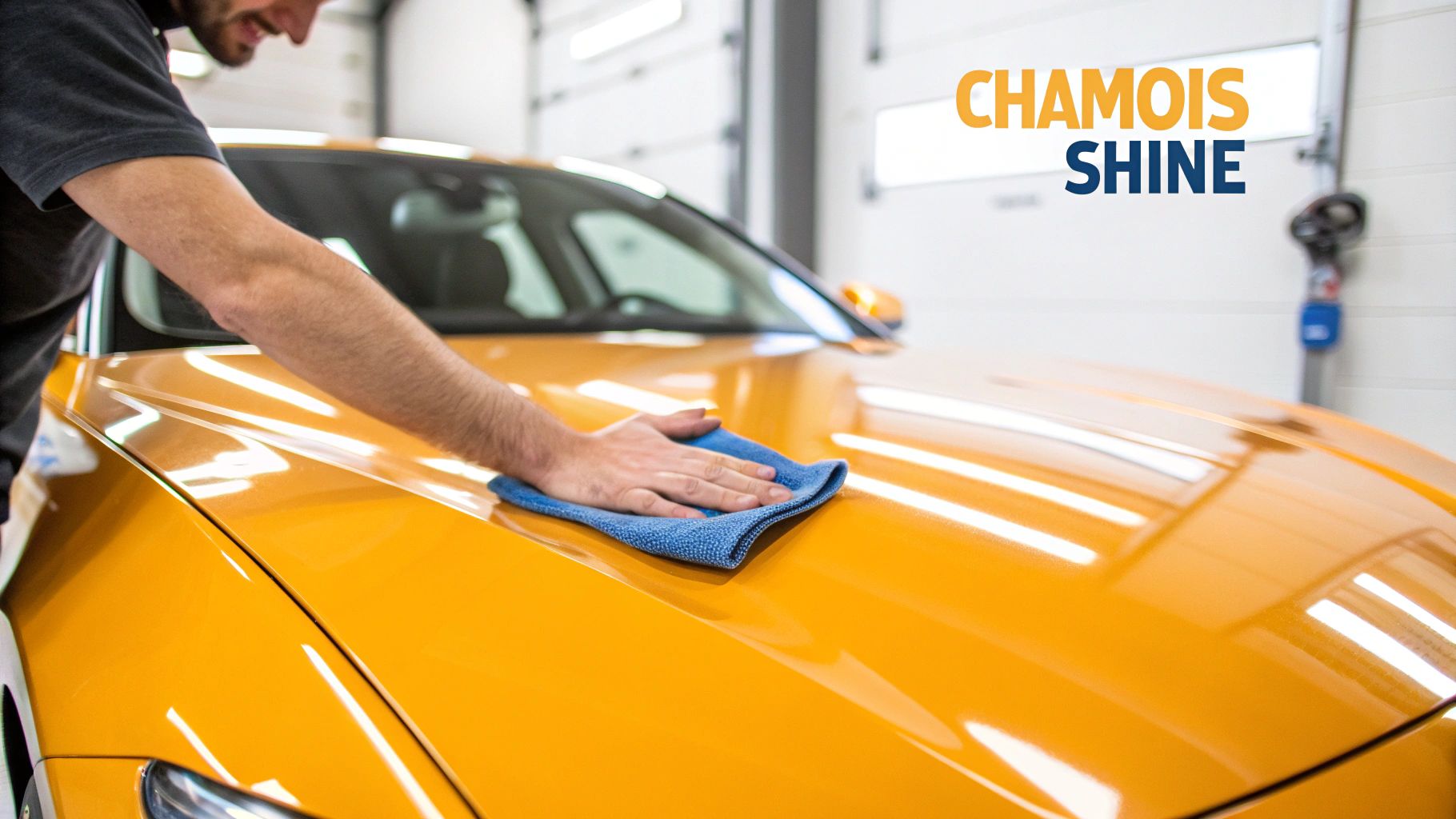
I know what you're thinking—microfiber towels are everywhere these days. But for a lot of experienced car lovers and pro detailers, the chamois is still a non-negotiable part of their kit. It’s not just about tradition; it’s about performance. There's a certain glide and water-sheeting action you get from a properly cared-for chamois that you just don't get from the heavy drag of a plush towel.
The real magic is in the material's unique structure. Whether you're using a traditional sheepskin or a modern synthetic PVA (Poly Vinyl Alcohol) version, the chamois is engineered to be incredibly gentle and super absorbent once it's damp. This is key. It allows the cloth to lift water clean off the surface instead of just pushing it around, which is your best defense against frustrating water spots.
The Real Secret to a Flawless Dry
Getting that perfect, mirror-like shine starts way before you even touch the chamois to the paint. The drying step is the grand finale of a good wash, and its success hinges completely on how clean you got the car in the first place.
A clean, debris-free surface is non-negotiable for a scratch-free dry. Think of it this way: any microscopic dirt or grit left on the paint will be picked up and dragged across the clear coat by your drying tool, creating fine scratches and swirl marks.
This is exactly why starting with the right tools makes all the difference. Using something like the SwiftJet Foam Gun before you dry is a game-changer. A thick layer of foam lifts dirt and grime off the surface, letting you rinse it away safely. This preps the paint perfectly, giving your chamois a smooth, clean canvas to glide over and work its magic.
It's no surprise that people are investing more in quality drying gear. The global market for car drying towels and cloths is expected to hit around USD 250 million by 2033, which just shows how much people care about getting these results. You can discover more insights about the car drying towel market and its growth online.
Getting Your Car and Chamois Ready for a Perfect Finish
A flawless, streak-free dry doesn't just happen. It all starts with what you do before you even pick up the chamois. Getting the prep right is the secret that separates a pro finish from a splotchy mess. Honestly, skipping these initial steps is the biggest reason people get frustrated with water spots and less-than-perfect results.
The Final Rinse is Everything
Your job begins the second you're done washing. Before that chamois even gets close to your paint, you need to do one last, thorough rinse. This isn't just about getting the last bit of foam off; it’s about making sure every bit of soap residue is gone. That leftover soap film is the number one culprit behind annoying streaks, and your chamois will just smear it all over the place.
Grab your hose, but take the high-pressure nozzle off. Let the water flow gently over the panels, starting from the roof and working down. This "sheeting" method uses the water's surface tension to pull the remaining suds and residue right off the car, leaving a perfectly clean slate for drying.
Waking Up Your Chamois
With the car rinsed and dripping, it's time to get your chamois ready for action. You can't just grab a dry, stiff chamois out of its tube and expect it to work miracles. Whether it's brand new or just been stored, it needs to be "activated" to unlock its incredible absorbency.
A dry chamois is useless—it’s stiff and won’t soak up a drop. The magic happens when it's perfectly damp.
- Give it a Good Soak: First, drop the chamois into a bucket of clean, cool water for a couple of minutes. Let it sit until it's completely saturated and feels soft and flexible. Whatever you do, don't try to unfold a natural chamois while it's dry and stiff; you'll risk cracking or tearing it.
- Wring It Out the Right Way: Once it's soft, pull it out and give it a gentle squeeze. Then, twist it firmly—but not aggressively—to get as much water out as you can. You're aiming for a chamois that feels damp, not sopping wet.
Pro Tip: A properly wrung-out chamois is the key. If it's too wet, it has no room to absorb more water and will just push puddles around. If it's too dry, it won't glide smoothly and can actually create friction on your clear coat.
Getting the chamois to that ideal "just damp" state is what turns it into a serious drying tool. It creates the perfect amount of surface tension, letting it glide across your paint and lift water off in one clean pass. Think of it like loading your tool for the job—a minute of prep here pays off big time with a stunning finish.
Getting That Perfect Streak-Free Finish
Alright, your car is freshly rinsed, the chamois is prepped—now for the part that separates a good wash from a great one. This is where a little technique goes a long way. The goal isn't just to get the car dry, but to do it without leaving a single streak or swirl mark behind.
The real secret is to let the tool do the work. A quality chamois is incredibly absorbent, designed to lift water straight off the surface, not just push it around. A lot of people make the mistake of rubbing too hard or using a circular "wax on, wax off" motion, which is a fast track to creating micro-scratches in your clear coat. Instead, think smooth, deliberate, and gentle.
This simple visual breaks down the prep work that makes a perfect dry possible.
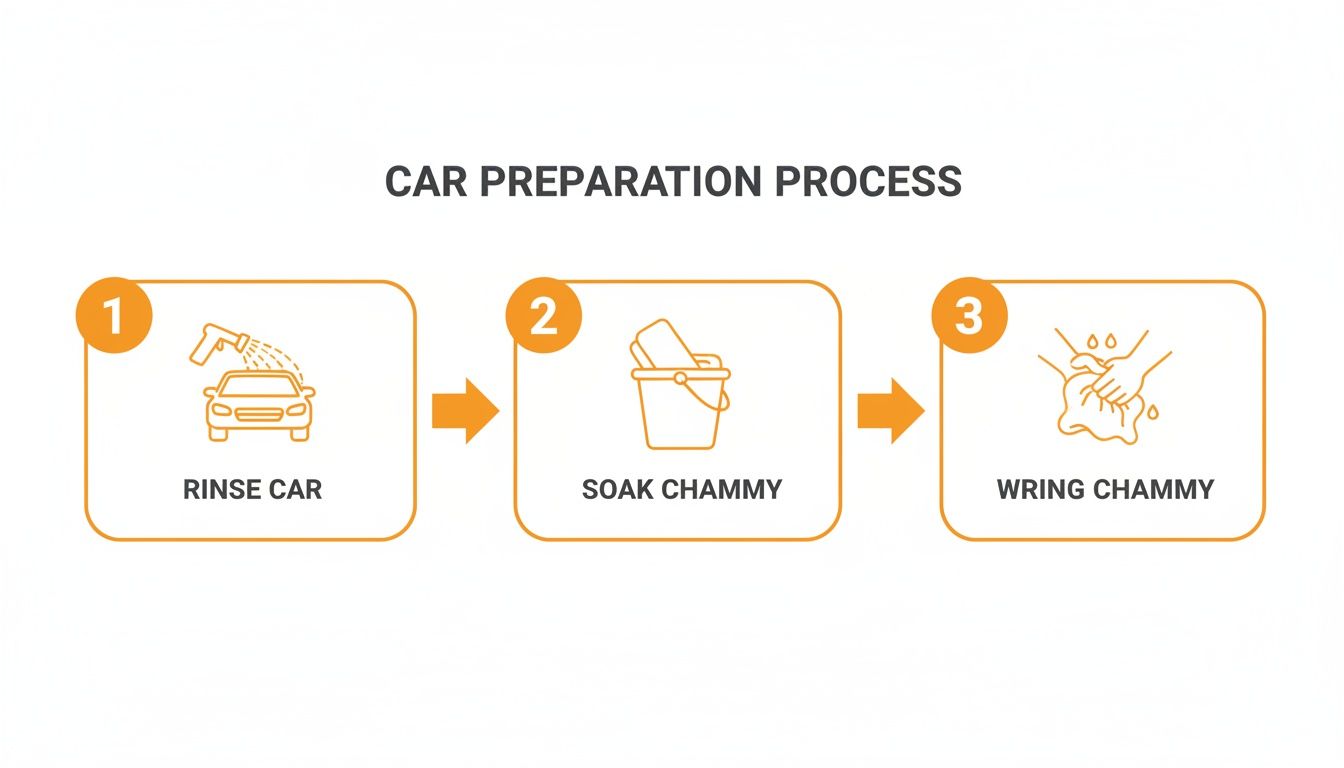
Nailing these three steps—rinse, soak, and wring—sets you up for success. It ensures your chamois is ready to absorb the maximum amount of water from the very first wipe.
For Big Surfaces: The Glide and Pull
When you’re tackling the big, flat expanses like the roof, hood, or door panels, the single-pass glide is your best friend.
Lay your damp, folded chamois flat against the paint. Apply just a bit of light, even pressure with your palm and pull it straight toward you in one smooth, continuous motion. You'll literally see a perfectly dry path appear in its wake.
Once you complete a pass, lift the chamois. If it feels heavy, give it a good wring. Then, lay it down again, slightly overlapping your last path to catch any drips. It might sound meticulous, but this method is surprisingly fast and is the surest way to get those large areas bone-dry and streak-free.
For Tricky Areas: The Blot and Lift
Of course, not every part of a car is a wide-open panel. For the more detailed or sensitive spots, you'll want to switch to the blot and lift technique to avoid dragging the chamois over complex shapes.
- Windows & Mirrors: This is a big one. Instead of wiping, which almost always smears, just press the flat chamois onto the glass and lift it straight off. It pulls the water up cleanly.
- Emblems & Trim: Use a corner of your chamois to gently dab at logos, badges, and intricate trim. This pulls water out of all the little nooks and crannies.
- Sharp Curves: On fenders or other highly contoured body lines where a straight pull won't work, just use a series of gentle blotting motions to lift the water away.
To help you decide which method to use where, here’s a quick-glance table.
Chamois Drying Techniques At a Glance
| Technique | Best For | Motion | Key Benefit |
|---|---|---|---|
| Glide and Pull | Hood, roof, doors, trunk lid | A long, continuous straight pull | Dries large, flat areas quickly and efficiently without streaks. |
| Blot and Lift | Windows, mirrors, emblems, grilles, curved panels | Gently press, hold for a second, and lift directly up | Prevents smears on glass and safely removes water from intricate or delicate spots. |
Using the right technique for the right area is what really elevates your results from amateur to pro-level.
If there's one habit to build, it's wringing out your chamois constantly. A chamois isn't a magic sponge; it has a limit. As soon as it's saturated, it stops absorbing and starts smearing water around. A quick, firm wring after every panel or two is the key to a fast, flawless dry.
Always Work from Top to Bottom
This is one of the oldest rules in the book for a reason: it just works. Always start drying at the highest point of the vehicle and work your way down.
Get the roof first, then the windows, then the hood and trunk. Save the doors, fenders, and lower body panels for last. It’s a simple, logical flow that makes gravity your ally. Any water that drips down will only land on a wet area, not a panel you just spent time perfecting.
This stops you from having to do frustrating touch-ups and is your best defense against water spots. While these core principles apply to any vehicle, you can dive deeper into specific methods in our complete guide on car wash drying techniques. Working top-down makes the whole process smoother and ensures you get that consistently clean finish every single time.
Chamois vs. Microfiber: Which Is Right for You?
In any car detailing forum or meetup, the debate between a classic chamois and a modern microfiber towel is a hot topic. Honestly, there’s no single right answer—it really comes down to what you're trying to achieve and what your personal preferences are. Picking the right tool for the job means knowing how each one actually works on your car's paint.
A high-quality chamois, whether it's natural or a synthetic PVA, is loved for its incredibly smooth, non-abrasive surface that just glides over paint. Its magic lies in its structure; it’s designed to pull water away in sheets, which is why it's a champion for a completely streak-free finish. This is especially true on tricky surfaces like glass and dark-colored cars, where every little imperfection seems to scream at you.
On the other side of the ring, premium microfiber towels have become the workhorse for many professional detailers, and for good reason. Their deep, plush fibers are not only wildly absorbent but also act as a safety net. They can trap any tiny dirt particles you might have missed during the wash, lifting them away from the paint to prevent those dreaded swirl marks.
Breaking Down the Key Differences
So, what really matters when you're standing next to your dripping car? Your decision usually boils down to a few key factors: absorbency, safety for your paint, and how easy it is to take care of.
Using a chamois is a bit of an art. It needs to stay damp to work properly, and you have to wring it out constantly as it picks up water. This process of wringing and wiping is what allows it to keep lifting water cleanly off the surface without just pushing it around. It's a method that definitely rewards a bit of patience and a steady hand.
Microfiber towels work differently, especially the thick, waffle-weave or twisted-loop types made specifically for drying. They act more like a high-tech sponge, soaking up massive amounts of water deep into their fibers. You can often dry your entire car with just one or two good towels, which means a lot less wringing. If you want to get into the nitty-gritty, check out our complete guide on microfiber towels for car detailing.
Performance Under Pressure
Let's talk numbers, because that’s where you see the real separation. A quality chamois can absorb 3–8 times its weight in water, which is impressive. But a high-GSM (grams per square meter) microfiber towel, typically in the 900–1,200 GSM range, is praised for its ability to dry a panel in a single pass. This can often cut your total drying time by 20–50% compared to older chamois technology.
While many professional detailers lean toward microfiber because of the lower risk of swirls, synthetic PVA chamois are still a favorite for RV and boat owners. Why? They're super compact, durable, and affordable.
The best choice really hangs on your priorities. If you're chasing a flawless, lint-free shine on a well-maintained car, a quality chamois is an amazing tool. But if you value speed, maximum safety on delicate paint, and easier maintenance, a premium microfiber towel is probably the way to go.
At the end of the day, both can give you a fantastic result if you use them correctly. Many serious car enthusiasts actually keep both in their garage. They might use microfiber for the big body panels and then pull out the chamois for a perfect, streak-free finish on windows and chrome. Understanding what each one does best is the key to getting that showroom finish every single time.
How to Clean and Store Your Chamois Correctly
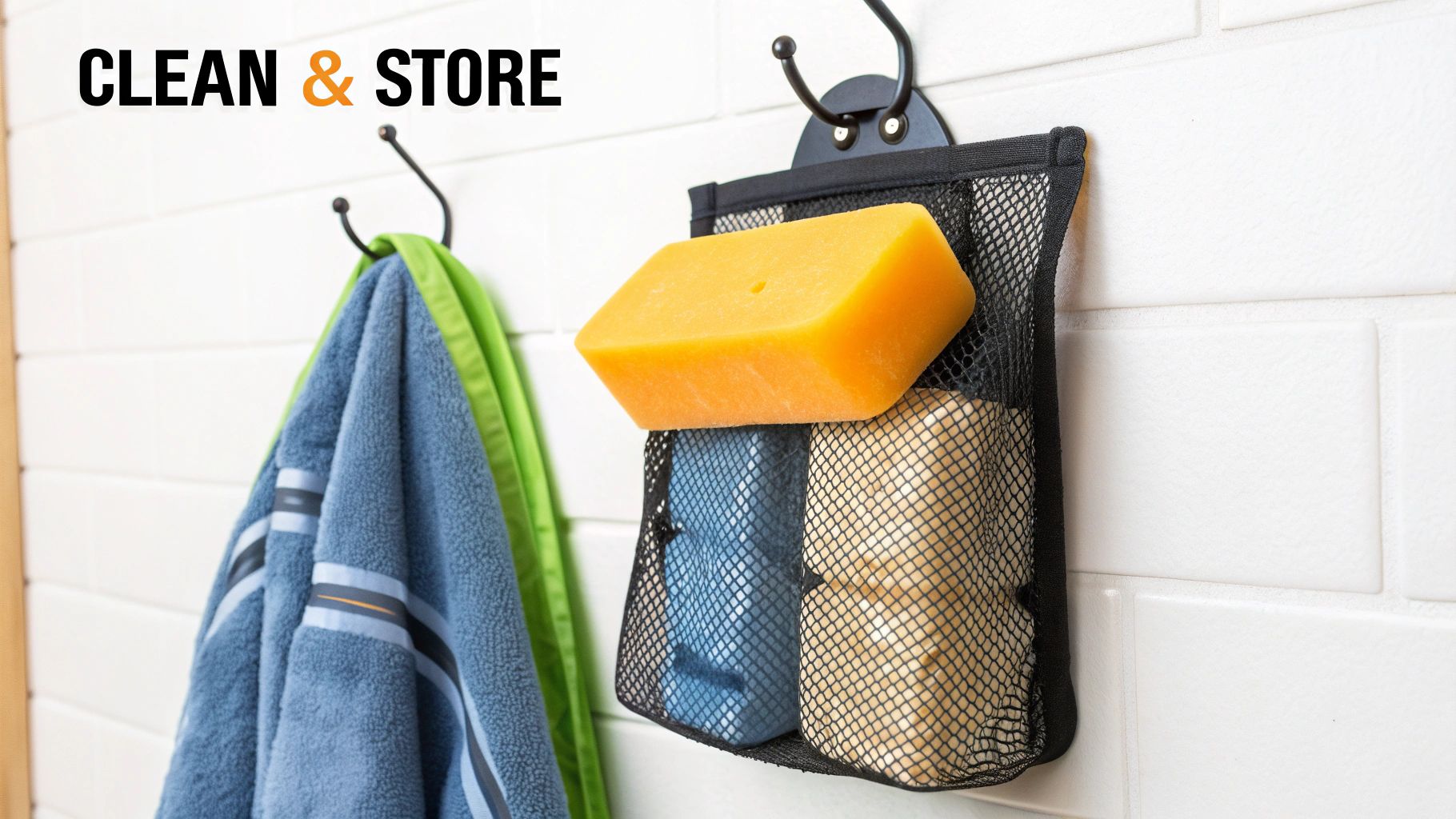
Think of your chamois as an investment in your car's finish. Like any good tool, its lifespan and performance hinge entirely on how you treat it after the job is done. Neglecting it is the fastest way to turn your super-absorbent cloth into a stiff, useless hide that could do more harm than good to your paint.
The golden rule? Clean it right after you finish drying your car. Every single time. Letting a dirty chamois sit allows any trapped grit to harden into the material, just waiting to get dragged across your clear coat on the next wash.
The Right Way to Wash Your Chamois
When it comes to cleaning, gentle is the name of the game. Keep your chamois far away from the washing machine and aggressive detergents. These will strip the natural oils from a genuine leather chamois or wreck the delicate structure of a synthetic one, killing its absorbency for good.
Here's the simple routine I follow:
- Initial Rinse: First, hold the chamois under a running tap of lukewarm water. Keep rinsing until the water runs completely clear, flushing out all the loose dirt and leftover soap from the car.
- A Deeper Clean: If it’s particularly grimy, fill a bucket with lukewarm water and a small squirt of a mild, pH-neutral soap. A quality car shampoo or even a gentle hand soap will do the trick. Just swish it around and gently work the soap through.
- Final Rinse & Wring: Give it one last thorough rinse to get all the suds out. Then, gently squeeze the water out. Avoid twisting it like you're wringing out a beach towel—that can stretch and permanently damage the material.
Whatever you do, keep harsh chemicals like bleach, degreasers, or fabric softeners away from your chamois. They are the enemy and will ruin it on contact, leaving you with a stiff, ineffective cloth. This simple cleaning step is a non-negotiable part of drying a car with a chamois properly.
Storing Your Chamois for Peak Performance
How you store your chamois between washes is just as crucial as how you clean it. Get this part wrong, and you might as well have not bothered cleaning it at all.
For a natural leather chamois, the goal is to store it slightly damp. Most come in a ventilated plastic tube for this very reason. Storing it this way keeps it soft, pliable, and ready to go for the next wash. If it ever does dry out completely and turn stiff as a board, don't panic! Just re-soak it in cool water for a few minutes until it softens up again.
Synthetic PVA chamois, on the other hand, are a bit more forgiving and can be stored dry. Even so, I’d still recommend keeping it in a protective case to keep it clean and free from contamination. This whole process is quite different from what you'd do with other detailing towels; you can learn more about washing microfiber car towels in our article to see the contrast.
Answering Your Top Chamois Questions
Even after you've got the basics down, you're bound to run into a few tricky situations when using a chamois. That's perfectly normal. Getting the hang of any detailing tool takes a bit of practice, so let's walk through some of the most common questions and how to solve them.
Can I Use a Chamois on My Ceramic Coating?
Yes, you can, but with a big dose of caution. A top-quality, spotless chamois is soft enough for a modern ceramic coating, but the technique has to change. You absolutely must avoid dragging it across the paint.
Instead, switch to a gentle "blot and lift" motion. Lay the chamois flat on a section, press lightly to absorb the water, and then lift it straight up before moving to the next spot. This minimizes the friction that could cause micro-marring on that beautiful, glossy coating.
Frankly, most pro detailers I know have switched to high-end, edgeless microfiber towels for coated vehicles. The plush fibers give you a bigger margin for error, pulling any lingering dust away from the paint. If you're set on using your chamois, just be religious about making sure it's perfectly clean before it touches the car.
My Chamois Dried Hard as a Rock—Is It Ruined?
Not at all! A natural leather chamois turning stiff when it air-dries is completely normal. It might feel like a piece of cardboard, but trust me, it's not damaged.
Here's the simple fix:
- First, don't try to unfold or bend it while it's rigid. That’s how you crack it.
- Just submerge the whole thing in a bucket of clean, lukewarm water.
- Let it soak for a minute or two. You’ll feel it start to loosen up as it absorbs the water, returning to that soft, pliable state you're used to.
Once it feels flexible again, give it a good wring until it's just damp, and it's good to go. The best way to avoid this altogether is to store your chamois slightly damp inside its ventilated case after each wash.
Why Do I Keep Getting Streaks?
Ah, the dreaded streaks. It's incredibly frustrating, but the cause is usually one of three simple things. Once you know what to look for, it's an easy fix.
The number one culprit is leftover soap residue. If you didn't rinse the car thoroughly enough, your chamois is just smearing a thin, invisible film of soap around. The solution? Spend an extra minute or two on your final rinse, letting the water sheet over every panel to wash away any remaining suds.
Next up, your chamois might just be too wet. A saturated chamois can't absorb any more water; it just pushes it around.
When your chamois starts leaving a wet path instead of a dry one, that's your cue. It's overloaded. Stop, give it a quick, tight wring-out, and you'll restore its thirst for water instantly.
Finally, you might be fighting your water source. If you have hard water, those streaks could be mineral deposits left behind as the water evaporates. When that's the case, speed is your best defense. Work panel by panel and consider using a quality detailing spray as a drying aid. It adds lubrication, helps the chamois glide, and leaves behind an even better shine.
Ready to achieve that perfect, streak-free dry every time? The SwiftJet Car Wash Foam Gun is the ultimate first step, lifting away grit to perfectly prep your car's surface for a safe, scratch-free drying experience. Upgrade your car wash routine today at swiftjetusa.com
