

You know that feeling. You've spent hours washing, claying, and waxing your car, only to step back and see it covered in stubborn, chalky water spots. It's frustrating, and it's a dead giveaway of an amateur wash.
The secret that professional detailers have been using for years isn't some exotic chemical or complicated technique. It’s deionized (DI) water—a highly purified form of water that dries perfectly clean, leaving absolutely no mineral residue behind. This one simple change is what separates a good wash from a great one.
The Secret to a Flawless, Spot-Free Shine
Think of the water coming out of your hose as carrying tiny, invisible passengers—minerals like calcium and magnesium. When the water evaporates off your car's surface, those mineral "hitchhikers" get left behind, creating those annoying white spots that etch into your paint over time.
Deionized water is the definitive solution to this problem. It’s water that has been put through a special filtration process that removes all those mineral ions. It's essentially stripped clean of any dissolved solids.
When you use it for the final rinse, there's nothing left to stick to the surface. The water evaporates, and poof—it's gone, leaving nothing but a flawless, streak-free shine.
Why It Matters for Your Car Wash
Using deionized water for a car wash is all about working smarter, not harder. Instead of frantically rushing to towel-dry your vehicle before spots can form, a DI rinse allows you to simply let the car air-dry to perfection.
This doesn't just save you the chore of hand-drying; it also dramatically reduces the risk of introducing swirls and micro-scratches from your drying towels.
The push for DI water in detailing really took off in the early 2000s as pros got fed up with hard tap water undoing all their hard work. It's a proven method. In fact, industry benchmarks show that a final DI rinse can cut down on water spotting by as much as 95%. This means when you’re using great tools like a SwiftJet foam gun, that thick blanket of soap will rinse away without a trace.
If you’re chasing that perfect finish, we’ve got a whole guide on water spot-free car wash tips for a spotless finish that dives even deeper.
To see just how big of an upgrade this is, take a look at this quick comparison.
Why Deionized Water Is the Ultimate Car Wash Upgrade
| Feature | Regular Tap Water | Deionized (DI) Water |
|---|---|---|
| Mineral Content | High (Calcium, Magnesium, etc.) | Virtually Zero (0 PPM) |
| Drying Result | Leaves mineral deposits (water spots) | Evaporates cleanly, no spots |
| Post-Wash Effort | Requires immediate, careful towel drying | Can be left to air-dry safely |
| Finish Quality | Prone to streaks and chalky residue | Delivers a flawless, streak-free shine |
| Paint Safety | Spots can etch into clear coat over time | Eliminates risk of mineral etching |
The difference is night and day. Once you switch to a DI rinse, you'll wonder how you ever managed without it.
Deionized, Distilled, and Softened Water: What's the Real Difference?
If you're chasing that flawless, mirror-like finish, you've probably heard people throw around terms like "deionized," "distilled," and "softened" water. It’s tempting to lump them all into a "pure water" category, but in the world of car detailing, they are worlds apart. Each one is created differently and will give you a completely different result on your paint.
Let's cut through the confusion. While all three methods treat regular tap water, the way they do it matters—a lot. Getting this right is the secret to unlocking a truly spot-free rinse.
Deionized Water: The Mineral Magnet
Think of deionized (DI) water as the gold standard for that final rinse. The magic happens through a process called deionization, which uses special resin beads that are like super-magnets for minerals. As your tap water flows through these beads, they literally snatch all the troublemaking mineral ions out—we're talking calcium, magnesium, chlorides, you name it.
The end result? Water that is almost unbelievably pure, with a Total Dissolved Solids (TDS) reading of nearly zero. When water this clean evaporates off your car, there's simply nothing left behind to cause a spot. It just vanishes. This is precisely why a deionized water car wash is the go-to method for professional detailers and weekend warriors who refuse to compromise on the final look.
If you're a bit of a science nerd and want to go down the rabbit hole of how this all works, you can explore how water purification systems operate and see the technology in action.
Distilled Water: Pure, But Impractical
Distilled water is also exceptionally pure, but it gets there in a totally different way. The process involves boiling water into steam, which leaves all the minerals and gunk behind. That clean steam is then cooled and condensed back into liquid water. Voila, pure H₂O.
The problem? Distillation is incredibly slow and energy-intensive. While it’s perfect for topping off a car battery, making enough of it to rinse an entire vehicle is just not practical or cost-effective.
Key Takeaway: Both DI and distilled water will give you a spot-free finish. But for car washing, deionization is the only method that makes sense for producing the amount of pure water you actually need without breaking the bank.
Softened Water: The Ion Swap
Water softeners are a common sight in homes with hard water, but they are not the solution for a spot-free rinse. A softener doesn't actually remove minerals; it just swaps them. It takes the "hard" ions like calcium and magnesium and exchanges them for "soft" sodium ions.
So, what does this mean for your car? While softened water feels slick and helps your soap lather up nicely, it’s still loaded with dissolved solids—just sodium this time. When it dries, you’ll trade hard water spots for salt spots. To really win the battle, you have to eliminate the minerals entirely. We dive deeper into this in our guide on tried-and-true expert solutions for hard water car washing.
Here’s a simple breakdown to help you see how these stack up for detailing:
| Water Type | Purification Method | Spot-Free Rinse? | Primary Advantage for Detailing |
|---|---|---|---|
| Deionized | Ion-exchange resin removes all mineral ions. | Yes | Delivers a perfect, spot-free finish practically and cost-effectively. |
| Distilled | Boiling and condensation removes all impurities. | Yes | Extremely high purity, but impractical and expensive for washing. |
| Softened | Swaps calcium/magnesium for sodium ions. | No | Improves soap performance but still leaves sodium spots. |
At the end of the day, while distilled water is pure and softened water helps with the suds, only deionized water hits the sweet spot. It gives you the absolute purity you need for a flawless shine, with the practicality and performance required for real-world car washing.
How to Weave a DI Rinse Into Your Car Wash Routine
Here's the secret most people miss: using deionized water for a car wash doesn't mean you have to flood your driveway with it. The real magic happens when you use it strategically—for the final rinse only. This single step is the key to getting that coveted spot-free finish without draining your wallet on purified water for the entire wash.
The idea is simple but incredibly effective. You'll wash your car just like you always do with regular tap water, getting all the grime and suds off. Then, for the grand finale, you switch over to your DI water source for one last, gentle pass. This final rinse pushes off any lingering tap water and soap residue, blanketing your car in pure H₂O that evaporates without leaving a single spot behind.
The Two-Stage Rinse: A Step-by-Step Guide
The whole point here is to be smart with your deionized water. Think of it as the clear coat, not the primer. You still need your pressure washer or garden hose hooked up to tap water for the heavy lifting—blasting away mud, pre-rinsing dirt, and washing away thick foam.
This process is a breeze and works with any setup you have.
-
Wash as Usual with Tap Water: Go through your entire wash process. Pre-rinse the loose gunk, lather it up with your foam cannon, and do the main rinse to get all the soap off. Use your standard tap water for all of it.
-
Switch to Your DI Water Source: Once the car is completely clean and soap-free, it's time for the switch. Disconnect your tap water line and connect your DI water system. This is where the transformation begins.
-
Perform the Final "Sheeting" Rinse: Now, with your DI water flowing, gently rinse the entire vehicle from top to bottom. You aren't trying to pressure wash it again; you want the pure water to flow or "sheet" over every surface. This action effectively displaces any remaining tap water droplets, replacing them with ultra-pure DI water.
What is "Sheeting" and Why Does It Matter?
"Sheeting" is the detailer's term for the perfect final rinse. Instead of a high-pressure spray that mists and atomizes the water, you want a gentle, steady flow. This encourages the water molecules to cling together and run off the panels in a unified sheet, pulling everything along with it and leaving very little moisture behind to dry.
To get this effect, adjust your nozzle to a fan or shower setting. If you really want precise control, this is where a quality spray gun and wand system makes a world of difference. For more pro tips on dodging water spots, check out our guide on the best way to dry a car after washing.
This chart breaks down the differences between common water types and shows exactly why deionized water is the champion for this final step.
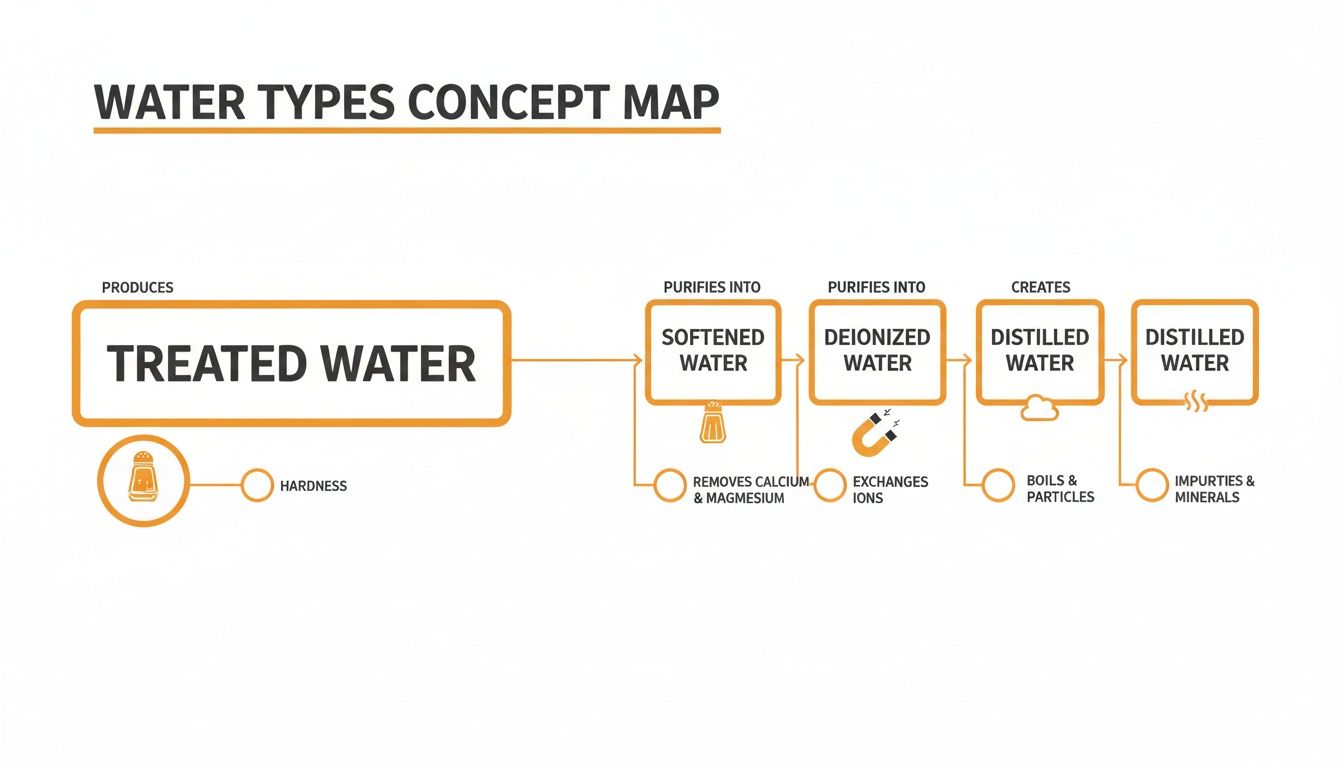
As you can see, softened water just swaps one mineral for another. Distilled and deionized water actually remove them, but deionization is the far more practical and scalable process for the volumes needed for car washing.
Pro Tip: Always work from the top down during your final DI rinse. Start with the roof, then the glass, hood, and trunk, finishing with the side panels. Gravity is your best friend here—let it do the work of pulling all the tap water off the car for you.
Nailing the Spotless Finish Every Time
Adding a DI rinse is straightforward, but a few small details can take your results from great to absolutely perfect.
-
Stay Out of the Sun: Never wash or rinse your car in direct sunlight if you can help it. The heat makes water evaporate way too fast, and if any tap water is left behind, it can still cause spots.
-
Check Your TDS: Before you start rinsing, grab a TDS (Total Dissolved Solids) meter and test your DI water. You want a reading as close to 0 PPM as possible. If the number starts climbing, it’s a heads-up that your resin is getting exhausted.
-
Don't Go Overboard: A common mistake is using too much pressure or rinsing for too long. A quick, gentle pass over each panel is all you need to push the tap water off. Be efficient.
This method isn't just a DIY trick; it's an industry standard. A 2023 study highlighted that 75% of touchless car washes rely on DI water for their guaranteed spot-free results. For us at home, that professional technique translates to big savings. A final DI rinse might only use 20 gallons of water, a huge drop from the 80+ gallons used in some traditional washes. That's a potential water cost savings of 75% for frequent washers.
By bringing this professional approach to your driveway, you can finally stop chasing water spots with a drying towel and let your car air-dry to a flawless, effortless shine.
How To Source Your Deionized Water
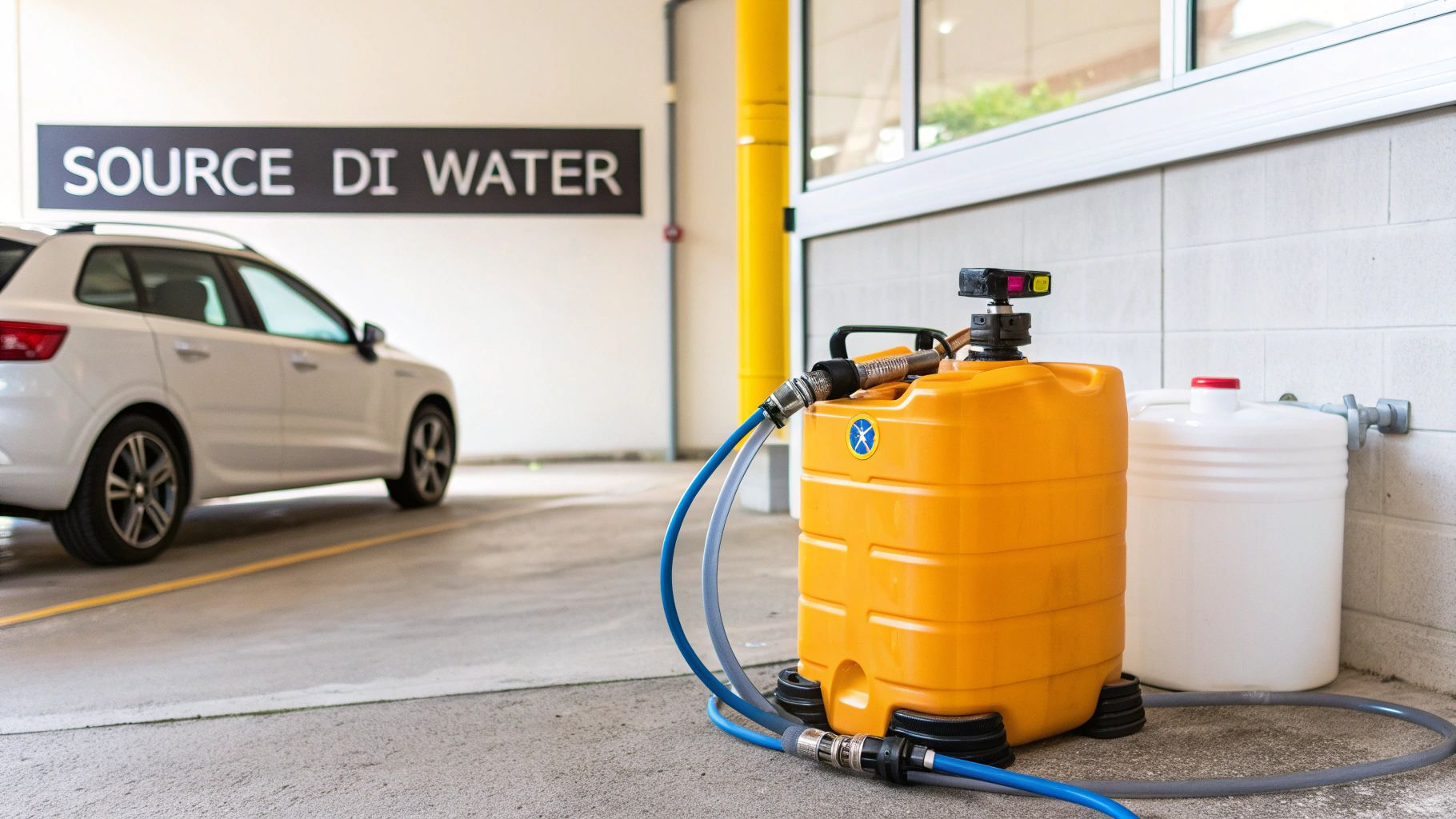
Alright, you're convinced that a spot-free rinse is the missing piece in your detailing puzzle. So, the big question is: where do you get this magical water?
Thankfully, you've got two main routes. You can either buy it ready to go or set up a system to make it yourself right at home. The best choice for you really boils down to how often you wash your car, your budget, and whether you prefer upfront convenience or long-term savings. Let's dig into both.
The Convenience Of Buying Bottled DI Water
For the weekend warrior who only gives their car a deep clean a few times a year, buying bottled deionized water is a no-brainer. It's the simplest way to get started. You can find it on the shelves at most auto parts stores, big-box hardware stores, and even some supermarkets.
With this approach, there’s zero upfront investment in any special gear. Just pick up a few gallons, use it for that final, perfect rinse, and you're all set. It's perfect if you need a small amount for a specific event, like getting a car prepped for a show.
But here's the catch: that convenience adds up fast. Buying DI water by the gallon gets pricey, and a full rinse on an SUV can easily drink up several gallons. For anyone washing their car regularly, this method becomes a serious drain on the wallet.
Investing In A DIY Deionization System
If you're a serious enthusiast or a professional detailer, a personal deionization system isn't just a luxury—it's practically a necessity. These systems hook right up to your garden hose or pressure washer, creating pure, mineral-free water on demand as you work.
The core of any DI system is a tank (or sometimes two) packed with ion-exchange resin beads. These are the tiny "mineral magnets" we talked about earlier. As your tap water flows through the tank, the resin grabs onto all those dissolved solids, leaving you with perfectly pure 0 TDS water at the other end.
The rise in at-home detailing isn't happening in a vacuum. The global car wash market, valued at $34.31 billion in 2024, is expected to climb to $49.06 billion by 2030. This growth is fueled by people wanting better, more efficient, and eco-friendly options. In fact, detailers who offer DI water rinses report a 25% increase in repeat customers, proving just how much people value that flawless finish. If you're interested in market deep-dives, check out the 2025 State of the Carwash Market report.
Choosing The Right DI System For You
Not all DI systems are created equal. They range from small, portable units ideal for mobile detailers to larger, high-capacity setups for a permanent garage install. Finding the right fit depends on a few things:
- How Often You Wash: If you're a weekly washer, a larger system with more resin will save you money and hassle in the long run because you won't have to replace the resin as often.
- Your Local Water Quality: The "harder" your water is (meaning it has a higher Total Dissolved Solids or TDS reading), the quicker the resin gets used up. If you live in an area with very hard water, you'll need a bigger system to keep up.
- Your Budget: The initial price tag for a DI system is definitely higher than a few jugs of water. But over time, it easily pays for itself. The only real ongoing cost is buying new resin once the old stuff is saturated.
Deciding between a DIY system and buying bottled water can be tough, so here’s a quick breakdown to help you weigh the options.
Choosing Your Deionized Water Source DIY System vs Buying Bottled
| Factor | DIY Deionization System | Buying Bottled DI Water |
|---|---|---|
| Upfront Cost | Moderate to High ($150 - $500+) | Extremely Low ($0) |
| Cost Per Gallon | Very Low (pennies per gallon) | High ($3 - $6 per gallon) |
| Convenience | Always available on demand | Requires trips to the store |
| Best For | Regular washers, enthusiasts, professionals | Infrequent use, one-off projects |
| Long-Term Value | Excellent ROI over time | Becomes very expensive quickly |
For anyone truly committed to maintaining a flawless finish, a DI system is a game-changer. It takes the final rinse from a frantic race against the clock to a calm, foolproof step that delivers professional results, every single time.
Keeping Your DI System Running Smoothly
So you've invested in a deionization system to get that perfect, spot-free finish. That's a huge step up for your detailing game. But like any specialized tool in your garage, it needs a little attention to keep it working flawlessly.
The great news? It's not complicated. Maintenance really boils down to keeping an eye on your water quality and knowing when it's time to swap out the resin. Get that right, and you'll protect your investment and ensure every rinse is a perfect one.
The TDS Meter: Your System's Best Friend
If you own a DI system, a Total Dissolved Solids (TDS) meter is non-negotiable. This little handheld gadget is your window into what's happening inside the tank. It measures the electrical conductivity of the water, which tells you exactly how many mineral ions are left. The more ions, the higher the Parts Per Million (PPM) reading.
Think of your DI resin like a sponge with a limited capacity for soaking up minerals. A TDS meter tells you exactly when that sponge is full.
Pro Tip: For a truly spot-free finish, you need that TDS meter to read 0 PPM. Once you see the number consistently creeping up into the 10-20 PPM range, you're on borrowed time. That's your clear signal that the resin is spent and it's time for a replacement before spots start appearing.
Making Your DI Resin Last Longer
Let's be honest, the main running cost of any DI system is the replacement resin. While you can't avoid it forever, you can absolutely be smart about it and make each batch last as long as possible. The trick is to lessen the burden on your DI system.
- Final Rinse Only: This is the golden rule. Use your regular tap water for the pre-rinse, the foam cannon, and washing the soap off. Switch over to the DI water only for that final, sheeting rinse.
- Add a Pre-Filter: A basic sediment pre-filter is a cheap and easy upgrade. It will catch any rust, sand, or other gunk from your water lines before it has a chance to clog up your expensive resin bed.
- Watch Your Flow Rate: Most DI systems are designed for a flow rate of around 3 gallons per minute (GPM) or less. If you blast water through it any faster, you're not giving the water enough contact time with the resin. Minerals will slip through, and you'll burn through resin much faster than you need to.
Quick Troubleshooting Fixes
Even the best setups can have an off day. If you run into trouble with your deionized water for car wash system, here are the most common culprits and how to fix them.
-
Uh Oh, I'm Seeing Water Spots!
- Check TDS First: This is always step one. Grab your meter. If it's reading over 10-20 PPM, the resin is done. Time for a change.
- Slow Down: Were you in a hurry? Rinsing too fast is a common mistake. Make sure you're keeping the flow rate at or below the recommended 3 GPM.
-
The Water Pressure Seems Low.
- Check for Kinks: It sounds simple, but walk your hoses and check for any kinks or blockages that are choking the flow.
- Inspect the Pre-Filter: If you have a sediment filter installed, it might be clogged with debris. Give it a look and clean or replace it if needed.
-
My Resin Is Getting Used Up Way Too Fast!
- Test Your Source Water: If you live in an area with notoriously hard water (meaning a very high starting TDS), your resin is simply working harder and will get exhausted quicker. That's normal.
- Confirm Your Flow Rate: This is the #1 cause of premature resin burnout. Using a high-pressure nozzle for your final rinse will absolutely shred through resin. Switch to a gentle shower or low-pressure setting.
By keeping these simple maintenance and troubleshooting tips in mind, your DI system will be a reliable workhorse, giving you that flawless, professional-grade finish for years to come.
Your Top Questions About DI Water Car Washes Answered
Alright, so you see the potential of a DI water rinse, but you probably still have a few questions rolling around in your head. That's completely normal. Let's tackle the most common ones I hear from detailers and enthusiasts so you can feel confident adding this to your setup.
Getting these details right is the key to unlocking that flawless, spot-free finish you're after.
Is Deionized Water Safe for My Car's Paint and Coatings?
Absolutely. Not only is it safe, it's actually safer than the regular tap water you've been using all along. Think about it: deionized water is just pure H₂O. It's been stripped clean of all the abrasive minerals—like calcium and magnesium—that are responsible for those stubborn water spots that can etch into your clear coat over time.
Because there are no dissolved solids left, a final rinse with deionized water for car wash is the cleanest, gentlest way to finish washing your vehicle. It leaves nothing behind, which helps your waxes, sealants, and ceramic coatings perform their best and last longer.
Can I Use Deionized Water for the Entire Wash?
You could, but honestly, it would be a massive waste of money and resources. The magic of DI water is its ability to evaporate without leaving a trace. That superpower only matters for the final rinse. Using it to blast off initial dirt or wash away thick soap doesn't give you any extra cleaning power—it just burns through your expensive resin.
Best Practice: Stick with your regular tap water for all the heavy lifting—the pre-rinse and the main wash. Save your precious DI water for that last, gentle rinse that sheets over the panels, pushing all the mineral-filled tap water off the car. This approach gives you all the benefits without draining your wallet.
How Often Will I Need to Replace the Resin in My DI System?
This is the classic "it depends" question. The lifespan of your resin comes down to one thing: the hardness of your local water. The higher your water's Total Dissolved Solids (TDS) reading, the harder the resin has to work and the faster it gets used up.
Someone in an area with a low starting TDS of 50 PPM will get way more spot-free rinses out of a single cartridge than someone battling hard water at 300 PPM. Your best friend here is a simple TDS meter. Once you see the water coming out of your system creep up from a perfect 0 PPM to over 10-20 PPM, you know it's time to swap in fresh resin.
What Is the Difference Between a DI Rinse and a Spot-Free Rinse at a Commercial Car Wash?
In many cases, they're the exact same thing. Most decent commercial car washes, especially the touchless automatic ones, use either deionization or a similar process like reverse osmosis for their "spot-free" rinse option.
By setting up your own DI system at home, you’re basically bringing that professional-grade finishing touch to your own driveway. The big difference? You have complete control over the quality and can ensure every last drop of water on your car is truly pure.
Ready to stop chasing water spots and achieve a flawless, air-dried shine every time? The SwiftJet Car Wash Foam Gun makes the washing process a breeze, setting you up perfectly for that final, game-changing DI rinse. Upgrade your wash routine with SwiftJet today!
