

You finish washing the car, set the foam gun beside the hose, and head inside. A day later, the trigger still feels damp. A week later, orange freckles appear around the spring, fitting, or hinge. The tool didn't fail because rust is random. It failed because water, oxygen, salts, surface condition, and material choice worked together.
That's why corrosion resistant tools shouldn't be treated as a yes-or-no category. A lightly plated carbon-steel wrench, a stainless detailing brush, and a marine-grade fastener may all carry similar marketing language while offering very different protection. The useful question is not whether a tool is “rust-proof.” It's how the tool resists corrosion, where that protection works, and what causes it to fail.
Why Tools Rust and What Corrosion Resistant Really Means
A garden-hose nozzle left on a damp garage floor gives you a simple demonstration. Moisture forms an electrolyte, oxygen participates in the reaction, and exposed metal begins to lose material. Road salt, detergent residue, and trapped water make the process more aggressive. A foam cannon trigger can look fine on the outside while moisture sits around its spring or inside a threaded fitting.
Rust is the visible result of corrosion in iron-containing metals. The process is electrochemical, so it depends on the metal, the environment, and the condition of the surface. A tool stored dry after use may last for years, while the same tool left wet in a coastal shed can develop staining, pitting, or seized moving parts much sooner.
Resistance comes in levels
Corrosion resistant describes performance, not permanent immunity. The range includes ordinary carbon steel with a thin zinc finish, coated steel hardware, stainless alloys, and specially treated materials intended for wet, chemical, or marine conditions.
The protective strategy also changes by material:
- Stainless steel relies on chromium and a passive oxide film.
- Zinc plating protects steel through a coating and, in some conditions, sacrificial action.
- Zinc-nickel plating uses a more durable alloy coating for demanding exposure.
- Paint, powder coat, and polymer finishes act as barriers between the substrate and the environment.
- Anodized aluminum develops a controlled oxide surface that protects the underlying metal.
A scratch, sharp edge, unsealed joint, or trapped moisture pocket can defeat an otherwise respectable finish. That's why a tool's grade, coating process, geometry, and storage habits all belong in the buying decision.
Practical rule: Treat “corrosion resistant” as an engineering claim that needs a material, finish, environment, or test behind it.
The cost of ignoring that distinction shows up in practical ways. A rusty brush can shed debris onto paint. A seized hose fitting can damage threads. A corroded ratchet spring can stop the mechanism from releasing. Choosing the right resistance level is often cheaper than replacing a tool that looked acceptable on the shelf.
The Science Behind Corrosion Resistance
A stainless tool left wet on a boat dock illustrates the key idea: corrosion resistance comes from surface chemistry, not a permanent shield. When an alloy contains roughly 10.5% chromium, oxygen can help form a thin, chromium-rich oxide film. The film is typically less than 130 Angstroms thick, yet it adheres tightly and can reform after minor surface damage, provided the environment supports that reaction. The history and chemistry of stainless steel describes this passive-film mechanism.
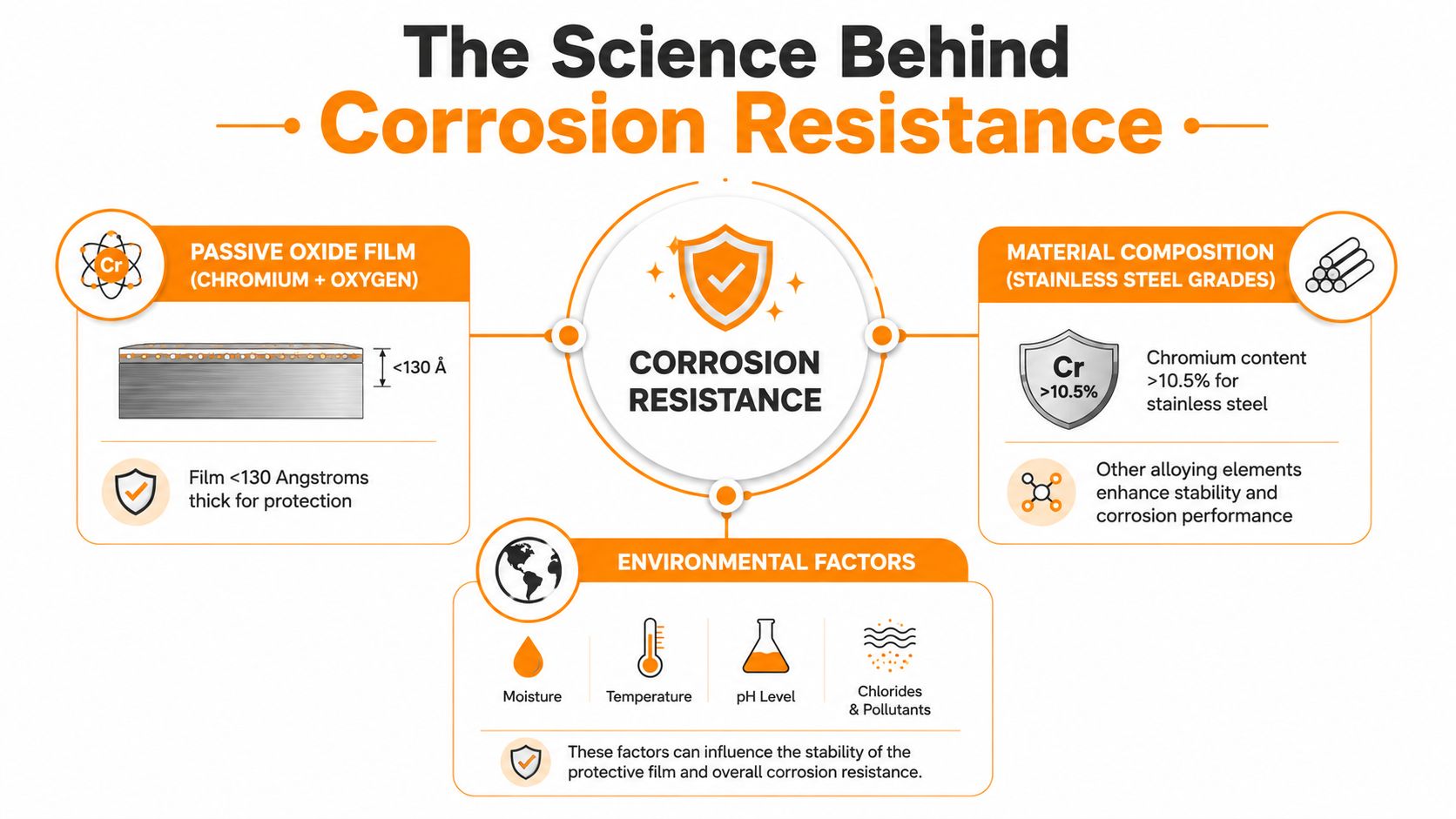
A passive film works like an invisible suit of armor that can repair itself. Paint behaves more like a fixed barrier. Scratch paint, and the exposed steel remains vulnerable until the coating is repaired. Stainless steel can rebuild its chromium-rich protection when oxygen reaches the surface, although salt, dirt, metal particles, and trapped moisture can create concentrated attack sites.
Three ways tools can corrode
Uniform corrosion affects a broad area at a similar rate. Dulling, discoloration, and general surface loss are easy to spot, but they can still weaken thin parts or erase tool markings.
Pitting corrosion forms small openings that grow into deep cavities. Chloride ions from seawater, road salt, and some cleaning environments can breach weak areas in the passive film. A tool may look clean while corrosion advances below the surface.
Galvanic corrosion starts when dissimilar metals touch while an electrolyte, such as salty water, completes the electrical path. A stainless fitting joined to a less noble metal can corrode at the joint if moisture remains. Crevices, rough welds, embedded metal particles, and grime increase the risk.
Chromium content provides a useful starting point, not a complete rating. Common stainless grades contain roughly 12% to 20% chromium, while molybdenum and nitrogen also affect chloride resistance. Buyers seeking an industrial corrosion resistant coating should compare substrate preparation, coating chemistry, and exposure conditions rather than trusting the word “stainless” alone. That distinction connects material chemistry to real choices for car-care bays, RV storage, and outdoor work.
Comparing Common Materials and Coatings
No single material wins every tool application. A stainless tool may tolerate repeated washing well, while a coated carbon-steel tool may offer better strength or lower purchase cost. A marine fastener needs a different strategy from a hand brush used in a dry garage.
304 stainless steel is a common general-purpose choice. It resists ordinary humidity and cleaning exposure, but it isn't a universal marine alloy. One engineering reference notes that 304 stainless can develop pitting corrosion within weeks in seawater, which is why chloride-heavy applications often use higher-alloy options such as 316. The same reference explains the role of chromium, molybdenum, nitrogen, and PREN in evaluating chloride resistance through its stainless-steel corrosion guidance.
316 stainless steel adds molybdenum and is generally selected when chloride exposure is the dominant concern. It still needs clean surfaces, sound welds, and sensible maintenance. “316” doesn't mean the tool can remain wet indefinitely.
Coatings can be the economical route
Zinc plating protects carbon steel with a sacrificial coating, but scratches and thin areas remain vulnerabilities. Zinc-nickel plating is more capable in harsh conditions. At 12 to 15 µm, zinc-nickel coatings are commonly reported at about 1,000 to 1,500 hours of neutral salt spray resistance, while 20 to 25 µm electroless nickel is often cited at roughly 800 to 1,200 hours. Standard zinc plating is commonly reported around 240 to 480 hours. These ranges come from comparative salt-spray guidance for marine hardware.
Chrome can provide a hard, attractive surface, but chrome-plated steel isn't the same thing as solid stainless steel. Powder coat forms a useful barrier, yet chips and damaged edges expose the substrate. Anodized aluminum is light and useful outdoors, although its resistance depends on the environment and the integrity of the anodized surface.
| Material or Coating | Typical Salt Spray Range | Relative Cost | Best Fit Environments |
|---|---|---|---|
| 304 stainless steel | Not stated as a universal range | Moderate | Garages, detailing bays, general wet use |
| 316 stainless steel | Not stated as a universal range | Higher | Coastal, chloride-heavy, and marine use |
| Zinc-nickel plating | 1,000 to 1,500 hours at 12 to 15 µm | Moderate | Road salt, marine air, exposed fasteners |
| Electroless nickel | 800 to 1,200 hours at 20 to 25 µm | Moderate to higher | Hardware needing an even engineered finish |
| Standard zinc plating | 240 to 480 hours | Lower | Indoor, light outdoor, and controlled exposure |
| Powder coat | No universal range | Low to moderate | Outdoor tools with protected surfaces |
| Anodized aluminum | No universal range | Moderate | Lightweight outdoor equipment |
For a broader discussion of steel choices in cutting tools, buying kitchen knives at Blade Master offers useful material context. For a simple brass alternative in hose work, see this guide to a brass water hose nozzle.
How to Read Salt Spray Ratings and Other Corrosion Metrics
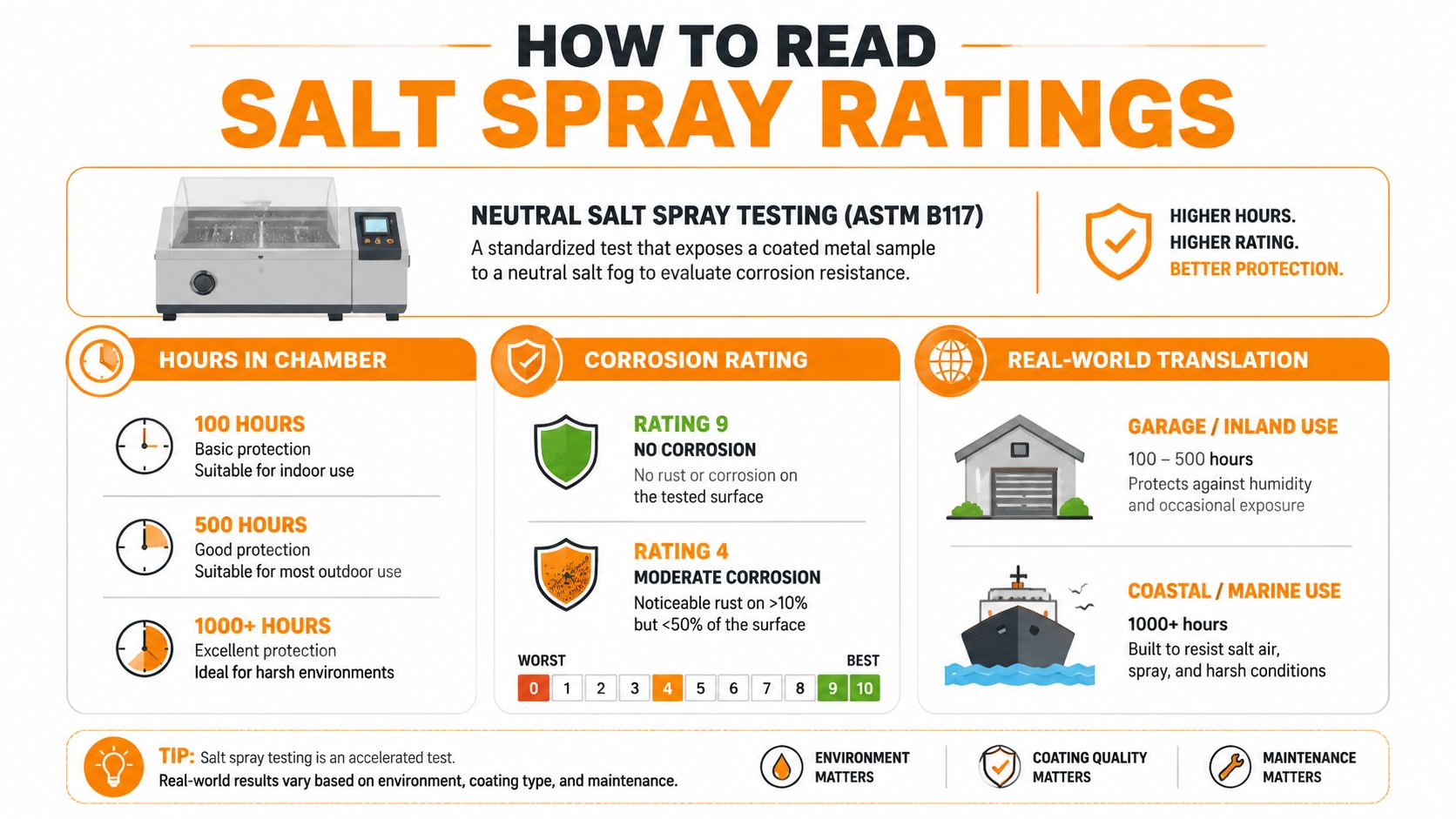
A tool can survive years in a dry garage yet rust quickly after repeated work beside a boat dock. Salt spray ratings help explain that difference, but they are controlled comparisons, not outdoor warranties. Neutral salt spray places coated samples in a saline mist, commonly under ASTM B117. The result is reported in chamber hours, showing how finishes perform under the same test setup.
Those hours do not convert directly into months or years of service. A chamber stays consistent. A driveway, dock, or RV campsite adds drying cycles, abrasion, temperature changes, detergent, dirt, ultraviolet exposure, and trapped moisture. A finish that performs well on a flat panel may fail sooner on a threaded fitting, sharp edge, or chipped area.
Use the numbers as comparisons
The verified coating ranges from the previous section apply here as well. Their value is comparative: a higher result generally indicates greater resistance under that particular test method, coating thickness, preparation, and failure criterion. It does not automatically make one tool better for every garage, detailing bay, or outdoor application.
The same salt-spray comparison source places zinc, electroless nickel, and zinc-nickel finishes on a useful scale. Compare like with like, because changing the substrate, thickness, surface preparation, or test endpoint can change the result.
PREN provides another way to compare stainless alloys. The formula is %Cr + 3.3 × %Mo + 16 × %N. Engineers use it to estimate resistance to chloride-induced pitting. A higher PREN can support a better choice for salty conditions, while chromium still matters because it helps form the passive film that protects stainless steel. Alloy chemistry is only part of the decision. Geometry, finish quality, weld condition, contamination, and maintenance also affect service life.
Treat “marine grade” and “rust-proof” as questions, not proof. Ask for the alloy, coating type, relevant thickness, test method, failure criterion, and intended environment. Without those details, a product listing offers marketing language rather than a measurable corrosion comparison.
Choosing Corrosion Resistant Tools by Application
A detailing bay usually combines water, detergent, road grime, and repeated handling. That's a moderate but persistent challenge. Choose stainless components or a credible plated finish for foam guns, brushes, hose fittings, and small hardware, then prioritize designs that drain easily and don't trap liquid around springs or threads.
For car care, road salt is often more important than rain. A tool used in a snowy region should have a finish that tolerates chloride residue, not just occasional fresh water. Zinc-nickel or stainless fasteners make sense where salt spray reaches the hardware, while a good powder-coated handle may be sufficient when the working metal stays protected.
Match the tool to the exposure
Home detailing: Look for stainless or well-protected plated fittings, smooth surfaces, and replaceable seals. A SwiftJet Car Wash Foam Gun connects to a standard garden hose and uses an on/off trigger for applying vehicle-wash foam. It belongs in the same buying conversation as the fitting material and the storage routine, because the tool still needs rinsing and drying after use.
RV and camping: Humidity, condensation, dirt, and outdoor storage create a mixed environment. Lightweight anodized aluminum can be practical for some accessories, while stainless hardware helps at connection points. Keep tools out of wet storage compartments when possible, and inspect fasteners after travel on salted roads.
Marine and coastal use: Chloride exposure changes the decision. Favor 316 stainless where the design and budget justify it, and look for sealed bearings, drain paths, protected joints, and compatible fasteners. A tool made from a good alloy can still suffer if seawater sits in a crevice or if dissimilar metals touch while wet.
General garage storage: You may not need a marine alloy. A sound zinc-nickel finish, stainless working surface, or powder-coated body can be adequate if you rinse contaminants and store the tool off the floor.
The comparison table above gives you the material starting point. Then inspect the actual construction. A polished, easy-to-clean tool with no hidden water pocket can outperform a nominally superior material used in a poor design.
Here's a practical visual guide to tool use and corrosion-aware equipment selection:
Maintenance and Storage Habits That Multiply Tool Life
Material selection matters, but care often decides whether a tool stays useful. After washing a car or rinsing outdoor gear, flush detergent and road grime from fittings. Wipe the tool dry, operate the trigger or hinge to move trapped water, and let the parts air out before putting them away.
A foam cannon can hold moisture around its trigger, bottle connection, and internal passages. A coiled hose can keep a damp film against a fitting for a long time. Hang hoses where air can reach them, place hand tools on a pegboard instead of a damp floor, and use a dry box for small marine accessories.
A simple post-use routine
- Rinse contaminants away. Fresh water removes detergent, salt, and abrasive dirt before they dry onto the surface.
- Drain and dry moving parts. Shake out fittings, open triggers, and wipe threads.
- Lubricate suitable mechanisms. Apply a light compatible lubricant to hinges, springs, and threads when the manufacturer allows it.
- Store with airflow. Use breathable covers, raised storage, or dry containers rather than sealed damp bags.
- Inspect early. Surface staining is easier to remove than deep pitting or a seized joint.
If a tool develops repeated cracking, discoloration, or premature failure, don't just replace it with the same model. A structured metals steel failure analysis can help distinguish poor material selection, surface damage, contamination, and environmental overload.
For vehicle exhaust cleanup, pair corrosion-conscious storage with a sensible guide to cleaning an exhaust pipe. The same principle applies throughout the garage: remove residues before storage, then give moisture a clear path out.
Storage habit that pays back: Never put a wet tool into a closed case and assume the case will protect it. The case may preserve the moisture as effectively as it preserves the tool.
Common Misconceptions About Corrosion Resistant Tools
Stainless steel never rusts. It resists corrosion through a passive chromium-rich film, but chloride exposure, poor finishing, contaminated surfaces, welds, and crevices can create localized attack. Recent research on stainless and aluminum alloy weld finishing found that finishing quality can improve surface uniformity, reduce residual stress, and increase corrosion resistance. That supports a practical buying lesson: inspect the surface and joints, not just the alloy label. See the research on finishing and corrosion behavior.
A thicker coating is always better. Thickness helps in some systems, but coating chemistry, adhesion, substrate preparation, edge coverage, and passivation also matter. A thick finish with poor preparation can fail sooner than a thinner, better-engineered system.
Marine grade means anything suitable for the ocean. The phrase sounds specific, but it doesn't identify an alloy, coating, test method, or failure limit. Ask whether the product uses 304, 316, zinc-nickel, another treatment, or merely a decorative finish.
Chrome-plated means stainless. Chrome is a surface layer. Stainless is an alloy family with chromium built into the material. A damaged chrome finish can expose the underlying steel, while stainless depends on its alloy chemistry and surface condition.
A sensible checklist is short: identify the environment, verify the material or coating, look for a test standard, inspect joints and edges, and plan how you'll rinse and store the tool.
Buying Checklist and Frequently Asked Questions
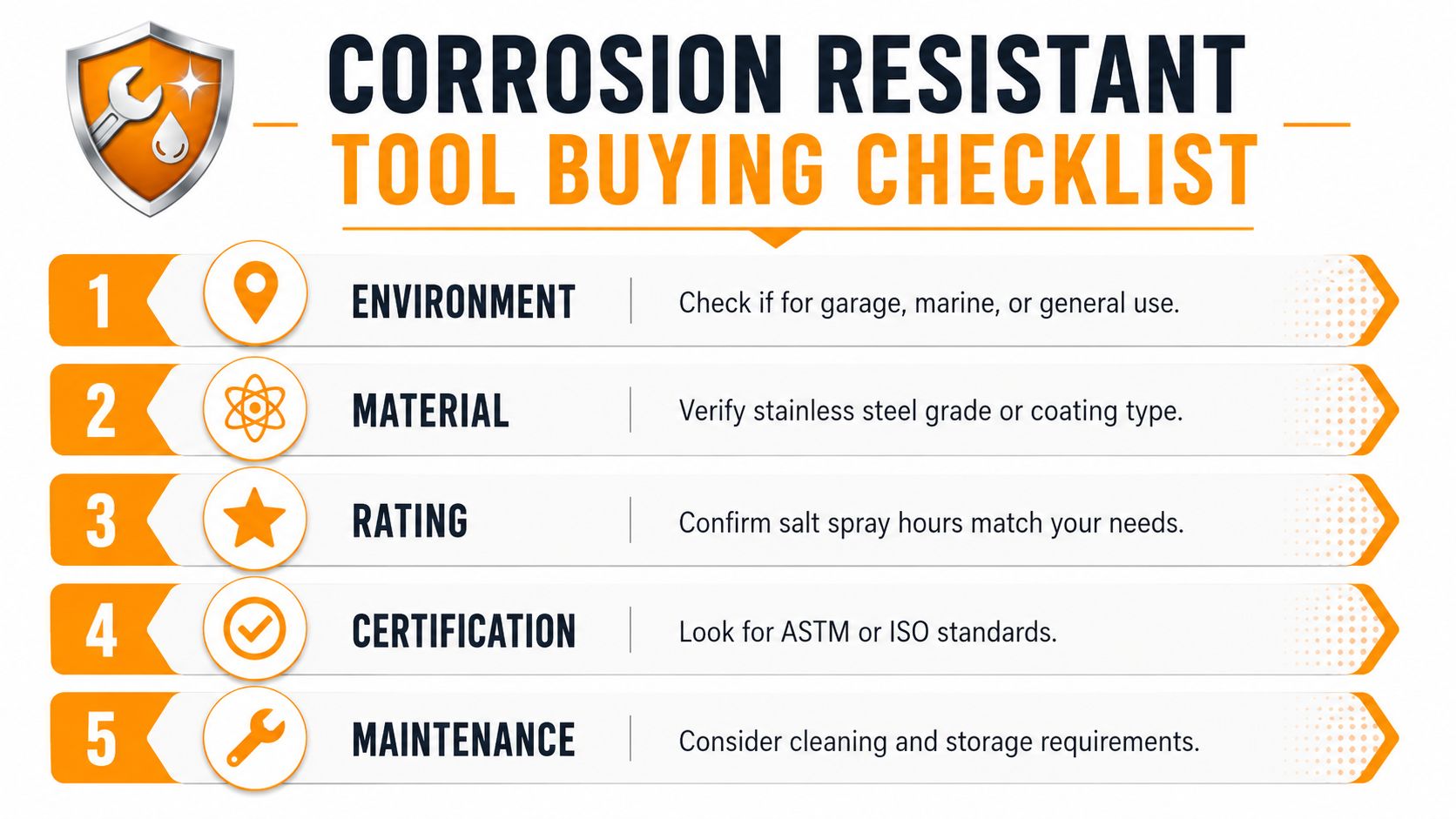
Before checkout, confirm:
- Environment: Garage, detailing bay, RV, outdoor storage, or marine exposure?
- Material: Which stainless grade or coating system is specified?
- Rating: Are salt spray hours reported with a test method and failure criterion?
- Construction: Can water drain, and are joints, springs, bearings, and threads protected?
- Maintenance: Can you rinse, dry, lubricate, and store the tool properly?
How long will corrosion-resistant tools last? There's no universal service life. Exposure, abrasion, finish damage, and storage determine the result.
Are stainless tools worth paying more for? They can be, especially when replacement is difficult or chloride exposure is routine. For a dry garage, a sound coated-steel option may be more economical.
What should you do about surface rust? Remove loose corrosion, clean the area, dry it completely, and inspect for pitting or weakened parts. Replace components that no longer operate safely.
What if the listing has no test data? Treat “rust-proof” and “marine grade” as unverified marketing until the seller identifies the material, finish, and test basis. For vehicle upkeep, you can also review chrome polish for cars, while remembering that polishing doesn't replace sound material selection or storage.
Choose tools by the environment they'll face, not by the boldest label on the package. SwiftJet offers hose-connected car-washing equipment for rinsing and foaming vehicles, and you can review the available options at SwiftJet before your next detailing session. Use the same visit to plan the rinse, dry, and storage routine that protects every corrosion resistant tool in your garage.
